


State of the product job market in 2026
There’s reason to be optimistic, but the recovery isn’t benefiting everyone equally.
If you’ve been following conversations about the product job market lately, you’ve probably noticed how confusing things have become. One person announces a new role at a major tech company, another shares that they’ve been unemployed for six months, and somewhere in between, someone is convinced AI is about to replace product managers entirely.
So, what’s actually happening?
We looked at recent hiring data from TrueUp, LinkedIn, and independent product job market analyses. The picture is more encouraging than some headlines suggest, but there are a few important catches.
Here’s what we’re seeing in 2026:
Product management opportunities are increasing. TrueUp tracked 7,351 open PM roles in October, approximately 80% above its recorded market low.
Experienced professionals have an advantage. Around 64% of TrueUp’s classified PM vacancies are senior level or above, including leadership positions.
AI skills are becoming increasingly valuable. LinkedIn reports that US job postings requiring AI literacy grew 70% year over year.
Remote opportunities remain competitive. Only about 21% of the PM jobs tracked by TrueUp offer a remote option.
The recovery is uneven. Some regions are seeing significant hiring growth, while others are experiencing declines.
Let’s look at what these numbers mean for anyone building a career in product.
1. Product management hiring is recovering
Here’s some encouraging news: companies are still hiring product managers, and the number of available positions has increased significantly from the lows of 2023.
According to TrueUp’s October 2026 Product Manager Job Report, there are 7,351 open PM positions, representing a 79.7% increase from its recorded low of 4,090.
Source: TrueUp Product Manager Job Report, October 2026
That doesn’t mean finding a job has suddenly become easy. But it does challenge the idea that product management opportunities are disappearing.
Another independent analysis by James Gunaca, using LinkedIn job listings, counted 26,003 open product management roles worldwide in October 2026, up 8% compared with October 2025.
Interestingly, that same report shows a 0.9% decline from September. So while the market has improved compared with last year, hiring isn’t increasing every single month.
Source: James Gunaca, Product Management Jobs Report, October 2026
These reports track different sets of vacancies, so their totals aren’t directly comparable. However, both point toward improvement in product hiring.
There’s a catch, though. More vacancies don’t automatically translate into better opportunities for every candidate.
The kinds of product professionals companies want are changing.
2. Companies are hiring, but experience matters more than ever
One of the most interesting findings in TrueUp’s October report is the distribution of open roles by seniority.
Here’s how the vacancies break down:
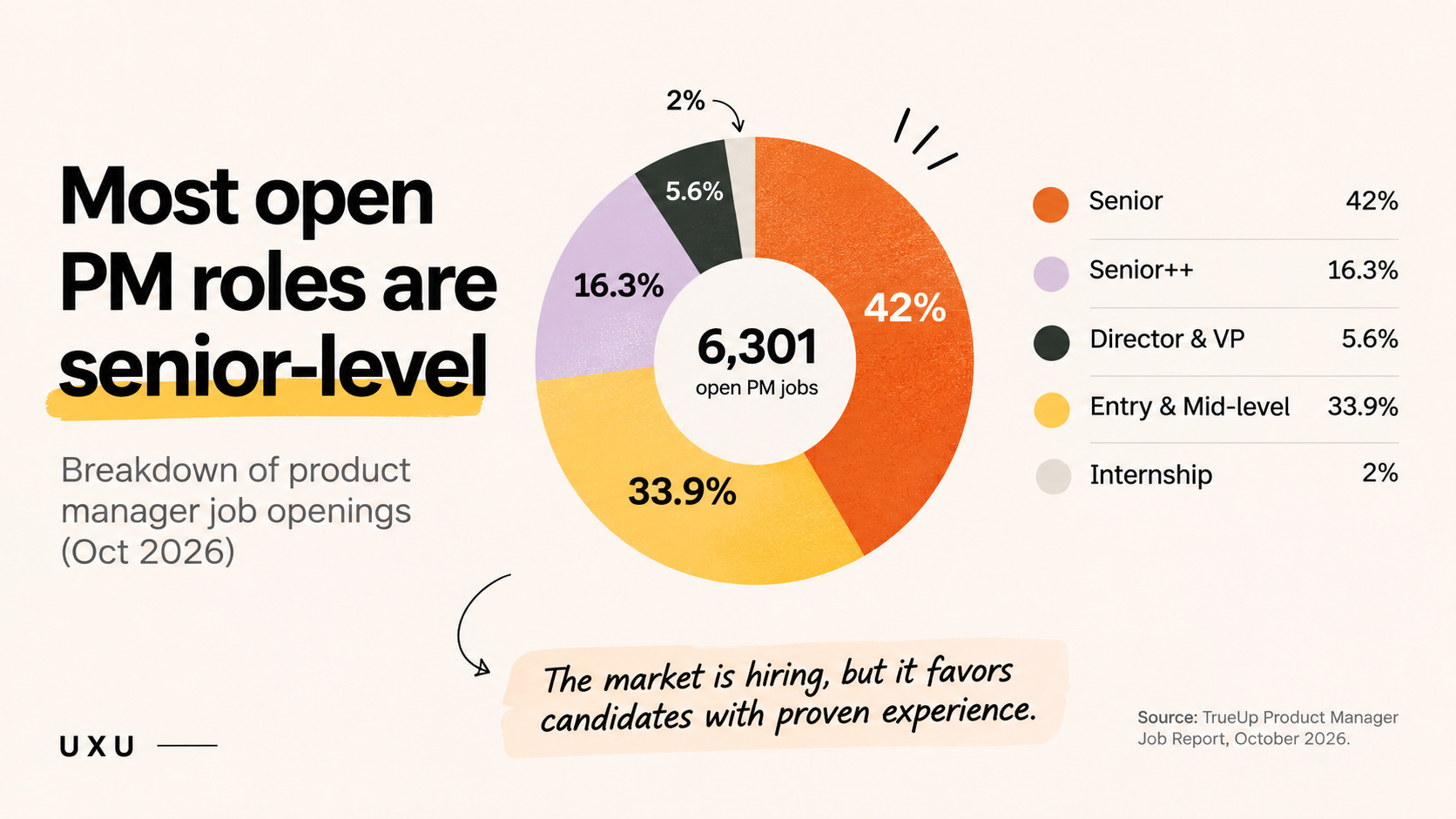
42% are senior-level positions.
16.3% are classified as Senior++.
5.6% are director and VP-level positions combined.
33.9% are entry- and mid-level positions.
2% are internships.
Source: TrueUp Product Manager Job Report, October 2026. Figures are rounded.
Senior roles alone account for the largest share of vacancies. Add more experienced leadership positions, and the market clearly favors candidates who can demonstrate ownership, sound judgment, and the ability to deliver results.
For someone trying to break into product management, this creates an uncomfortable situation. You need experience to qualify for many roles, but you need opportunities to gain that experience.
For experienced professionals, the challenge is different. Simply having five or seven years of experience may not be enough. Employers still need evidence of what you’ve accomplished during those years.
Consider two candidates describing the same project.
Candidate A: “Managed the product roadmap, collaborated with stakeholders, and led feature development.”
Candidate B: “Prioritized a checkout improvement after identifying a major drop-off point, aligned engineering and design on the solution, and measured its impact on completed purchases.”
The second example tells a much more useful story about product judgment and accountability, even without adding an invented performance figure.
The lesson? Your experience matters, but how you demonstrate its value matters just as much.
And this becomes even more important when we look at where product hiring is headed next.
The UXU Team
Helping you learn, grow, and navigate the future of UX and product.


