


You’ve spent weeks working on your UX portfolio. The typography is clean, the mockups look incredible, and your case studies have all the right sections. Problem statement, research, personas, wireframes, and final designs. You’ve even added those beautiful device mockups that make everything look like a real product launch.
You hit publish. You start applying. And then... nothing.
A few automated rejection emails. A few applications that never receive a response. Maybe one recruiter who views your LinkedIn profile and disappears. So you go back to your portfolio, change the layout, rewrite the introduction, and find a better mockup.
But what if the problem was never how your portfolio looked?
What if you’ve spent all this time showing people what you designed without giving them enough evidence of how you think? Because those are two different things, and when someone is evaluating whether to trust you with real product problems, that difference matters.
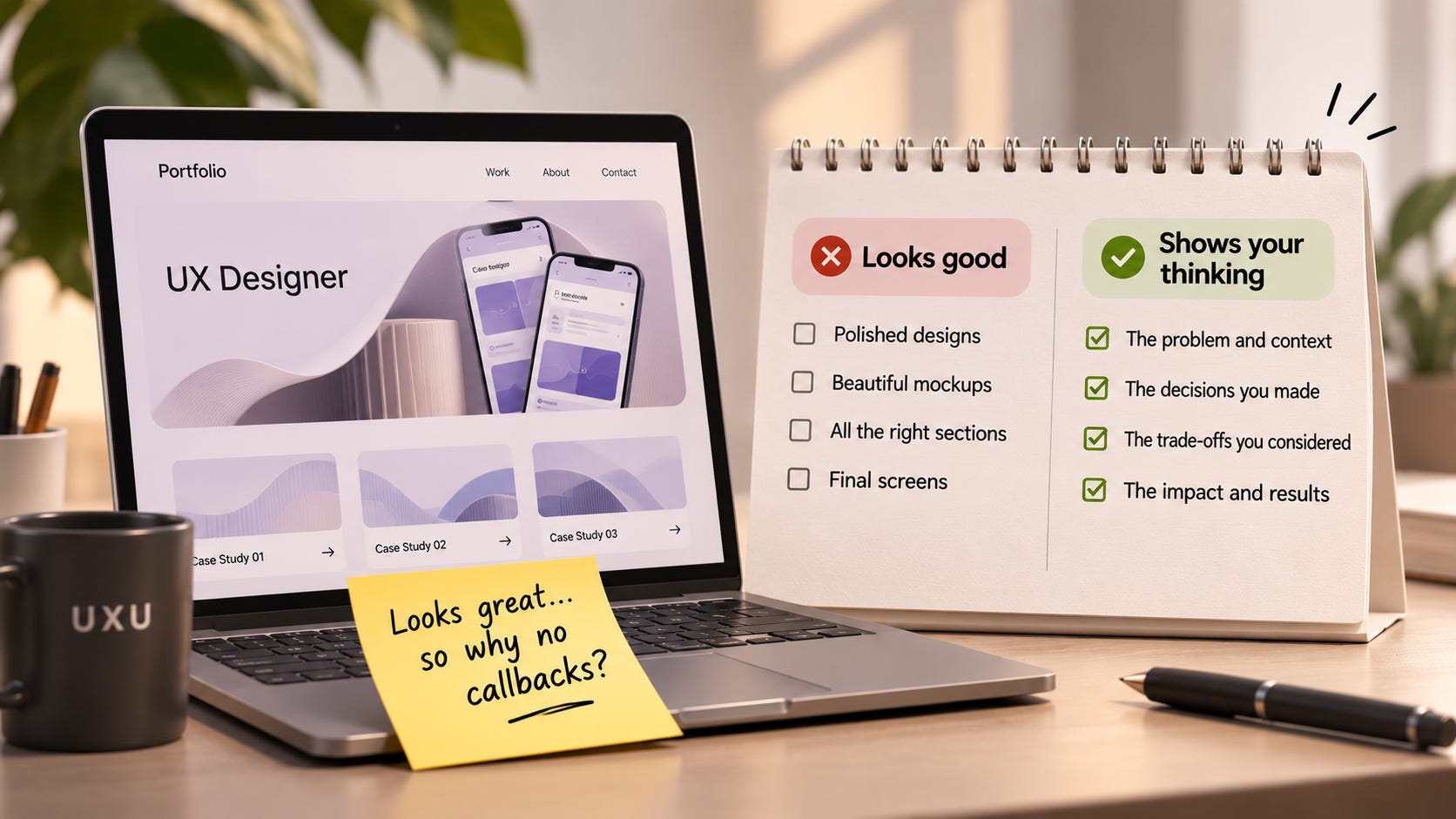
This issue is about the portfolio mistake that’s easy to overlook: presenting the finished work while hiding the decisions that made the work valuable.
In this issue:
The beautiful portfolio problem
Why following the perfect UX process can make your case study forgettable
What your portfolio actually needs to prove
The difference between showing activities and demonstrating judgment
How to rewrite a case study that isn’t working
The UXU Portfolio Evaluation Checklist
Resource Corner
The beautiful portfolio problem
Somewhere along the way, UX portfolios became design projects of their own. And not necessarily in a good way.
We spend hours choosing the right layout, arranging mockups, and making sure every section looks impressive. There’s nothing wrong with presentation. A portfolio should be readable, organized, and visually considered. But presentation can become a distraction when it receives more attention than the actual story.
Think about the last portfolio you saw. You probably remember a few attractive screens. But can you remember the problem the designer solved? What made the problem difficult? What they discovered that wasn’t obvious at the beginning? What decision they made because of that discovery?
If you can’t remember any of those things, the portfolio may have shown you a product without showing you much about the designer.
And that’s the risk. A beautiful portfolio can attract attention, but it cannot, by itself, establish that someone can navigate uncertainty, evaluate tradeoffs, or make good product decisions. Those abilities need evidence.
Why the perfect UX process can make your case study forgettable
You’ve seen this case study before. Probably hundreds of times.
First, the designer introduces the problem. Then comes user research, followed by personas, a journey map, wireframes, high-fidelity designs, and finally, a prototype. The conclusion usually says something about creating a seamless user experience.
Everything looks organized. Everything follows the process. But something important is missing.
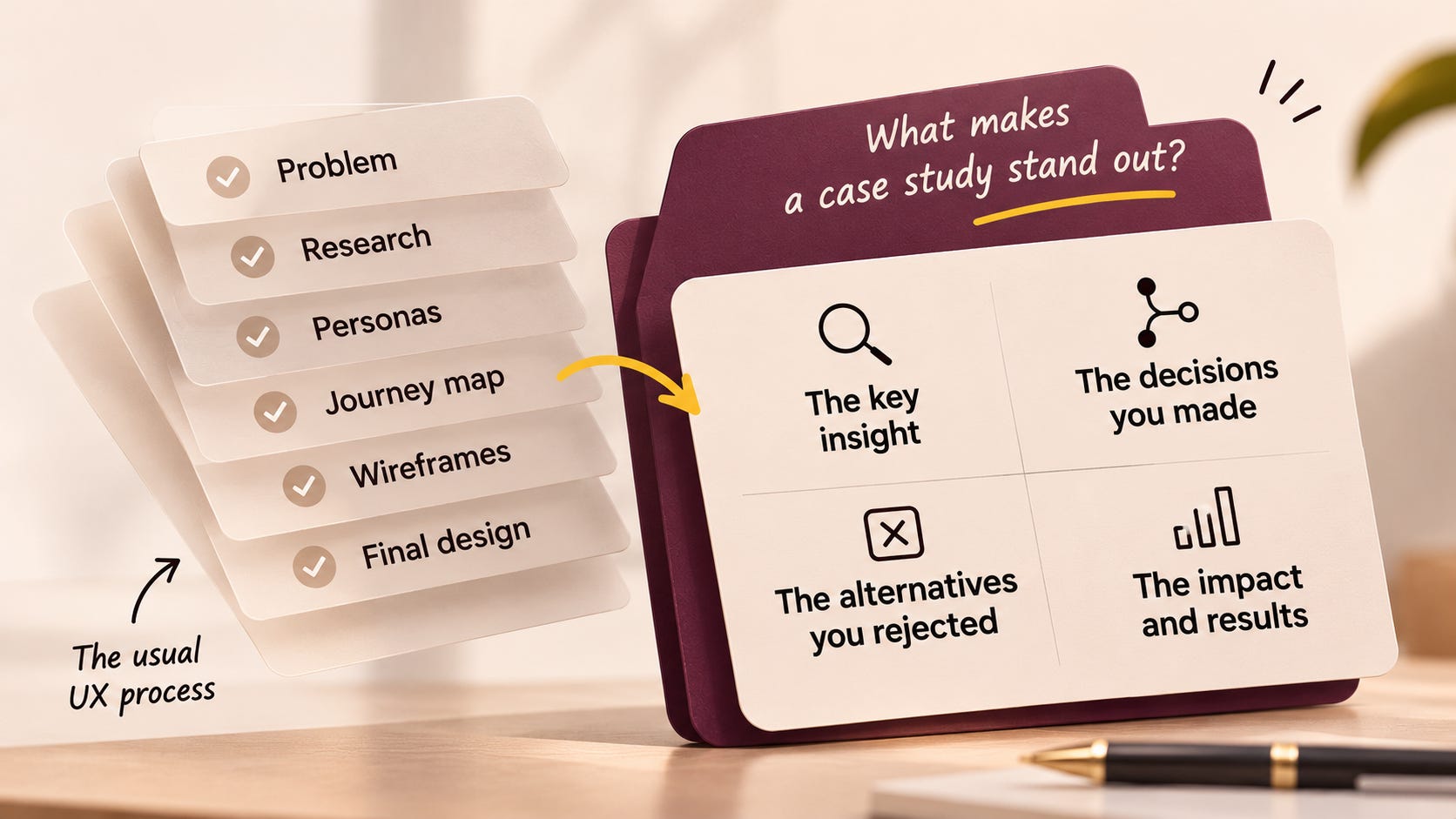
The decisions.
Why was that research method appropriate? What did the research reveal that changed the original direction? Which ideas were rejected? What constraints shaped the solution? What happened when users encountered the design?
Without those answers, the case study becomes a record of activities, and activities are not the same as evidence of ability.
Conducting five interviews doesn’t automatically mean you conducted useful research. Creating three personas doesn’t automatically mean you understand your users. Producing a beautiful prototype doesn’t automatically mean you’ve solved the problem.
The value is in what those activities helped you understand and decide.
Consider two ways of describing the same project.
Designer A: “I conducted user interviews, developed personas, created wireframes, and designed a seamless onboarding experience.”
Designer B: “During early interviews, we discovered that users weren’t abandoning onboarding because the form was too long. They were leaving because they didn’t understand why certain information was required. We tested a revised explanation before removing any fields.”
Which designer gives you more confidence in their thinking?
The second. Not because they used more sophisticated terminology, but because you can see the relationship between evidence, interpretation, and action.
That’s the story your portfolio needs to tell.
What your portfolio actually needs to prove
A UX portfolio isn’t just a gallery. It’s a collection of evidence about your ability to contribute to real work. And while hiring criteria differ across organizations, a strong case study should help a reviewer answer several important questions.
1. Can this person understand a problem?
Not just repeat the brief they were given. Can they identify what’s unclear, investigate assumptions, and define a problem worth solving?
2. Can this person make thoughtful decisions?
When multiple approaches are possible, can they explain why they chose one? Can they distinguish user evidence from stakeholder opinion? Can they recognize the limitations of their research?
3. Can this person work within constraints?
Real projects have deadlines, technical limitations, competing priorities, and imperfect information. A case study that pretends everything went smoothly may hide some of the most valuable parts of the work.
4. Can this person evaluate outcomes?
What happened after the design was tested, shipped, or handed over? What evidence supports the claim that the solution helped? And if the project never launched, can they clearly explain what was validated and what remains unknown?
5. Can this person communicate their contribution?
Especially on team projects, it’s important to distinguish what you personally did from what the team accomplished. A hiring manager shouldn’t have to guess.
Here’s the important part. You don’t need a perfect answer to every question. You need an honest, coherent account of the work.
A thoughtful explanation of an unsuccessful experiment can reveal more about your judgment than a flawless-looking process diagram.
The difference between showing activities and demonstrating judgment
Let’s say you’re redesigning the checkout experience for an e-commerce product.
Your case study says: “Users were experiencing difficulties during checkout, so I redesigned the interface to make it more intuitive.”
It sounds reasonable, but it leaves almost everything unanswered. What difficulties? How did you identify them? What did you initially think was causing the problem? What did you learn? Why was redesigning the interface the right response? What alternatives did you consider?
Now imagine the case study explains:
“We initially assumed that the number of checkout steps was causing abandonment. However, during usability sessions, participants repeatedly hesitated at the delivery-cost summary. We kept the existing checkout structure and tested a clearer cost breakdown before pursuing a larger redesign.”
That’s a much more interesting story. It shows that the designer didn’t simply jump to the most obvious solution. They investigated, challenged an assumption, and made a decision based on what they observed.
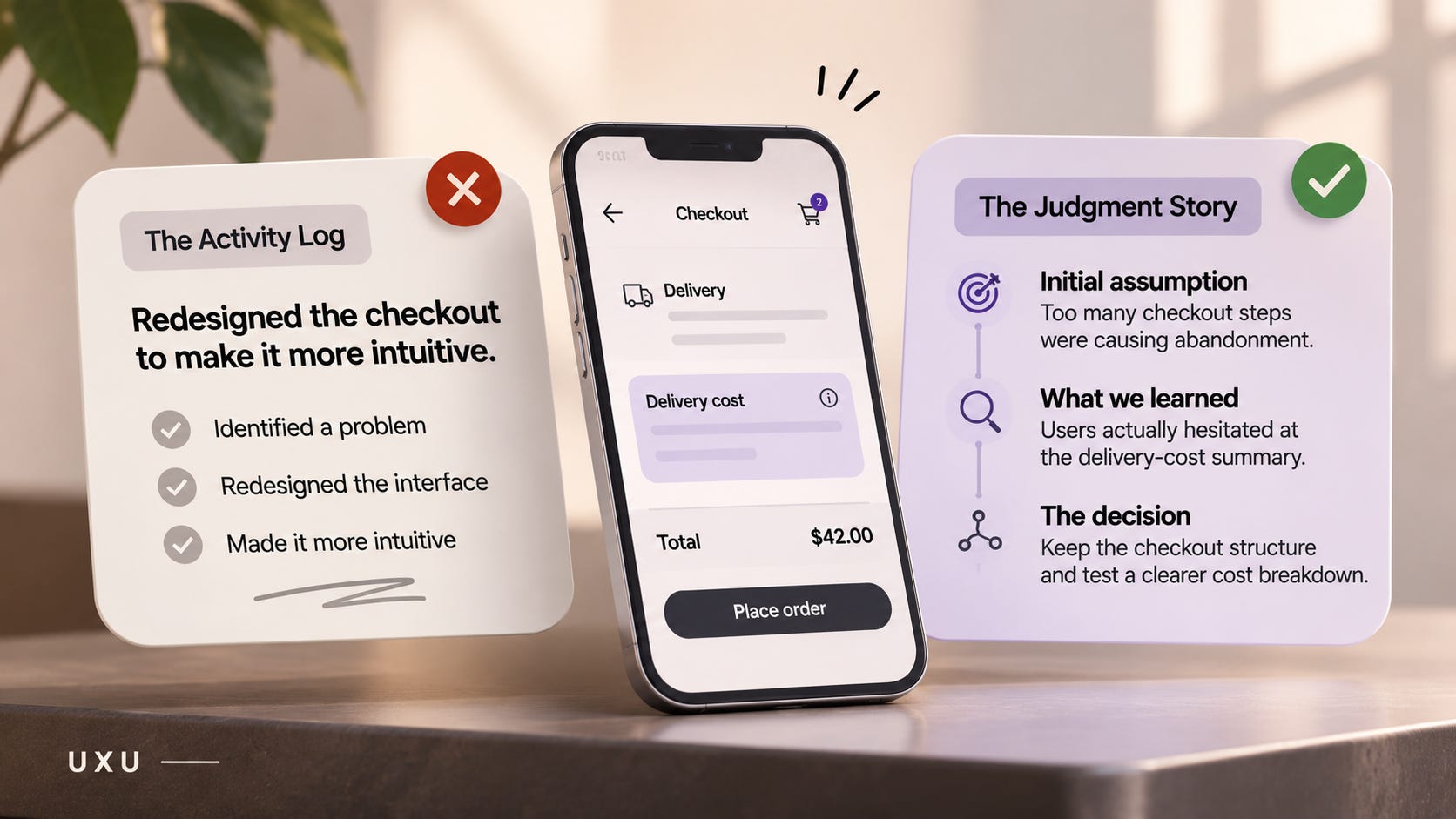
And that is the kind of thinking a portfolio should make visible.
The examples above are illustrative, not findings from an actual hiring study or product experiment.
Before you redesign your portfolio, ask yourself this
Open your strongest case study. Not your most visually impressive one, but the project you believe best represents your ability.
Now remove the final mockups from the page.
Is there still a compelling story?
Can someone understand the problem, your reasoning, the decisions you made, and what you learned? Or does the entire case study depend on the final screens to feel impressive?
If the story falls apart without the visuals, you may have identified something worth fixing. And it probably doesn’t require another portfolio redesign. It requires a better explanation of your work.
🔒 UXU PLUS | The Portfolio Rewrite
Now let’s turn that insight into something you can use.
For UXU Plus members, we’re going beyond the advice and breaking down how to transform a generic UX case study into one that demonstrates real design judgment.
Inside this edition:
The Before-and-After Rewrite: How to transform a process-heavy case study into a compelling decision-driven story.
The Five-Part Case Study Framework: A structure you can adapt to your next portfolio project.
The Portfolio Evaluation Checklist: 15 questions to identify what’s missing before you apply for another role.
The 30-Minute Portfolio Audit: A practical exercise for improving an existing case study without rebuilding your entire website.
Because the goal isn’t to make your portfolio look more impressive. It’s to make your ability harder to overlook.
Continue reading with UXU Plus.


