


You finish a task in twenty minutes that used to take two hours. The AI drafted the research plan, synthesized the notes, wrote the recommendation. It looks good. You ship it. You feel fast.
Here is the uncomfortable question the research is now forcing: what did you actually learn by doing that?
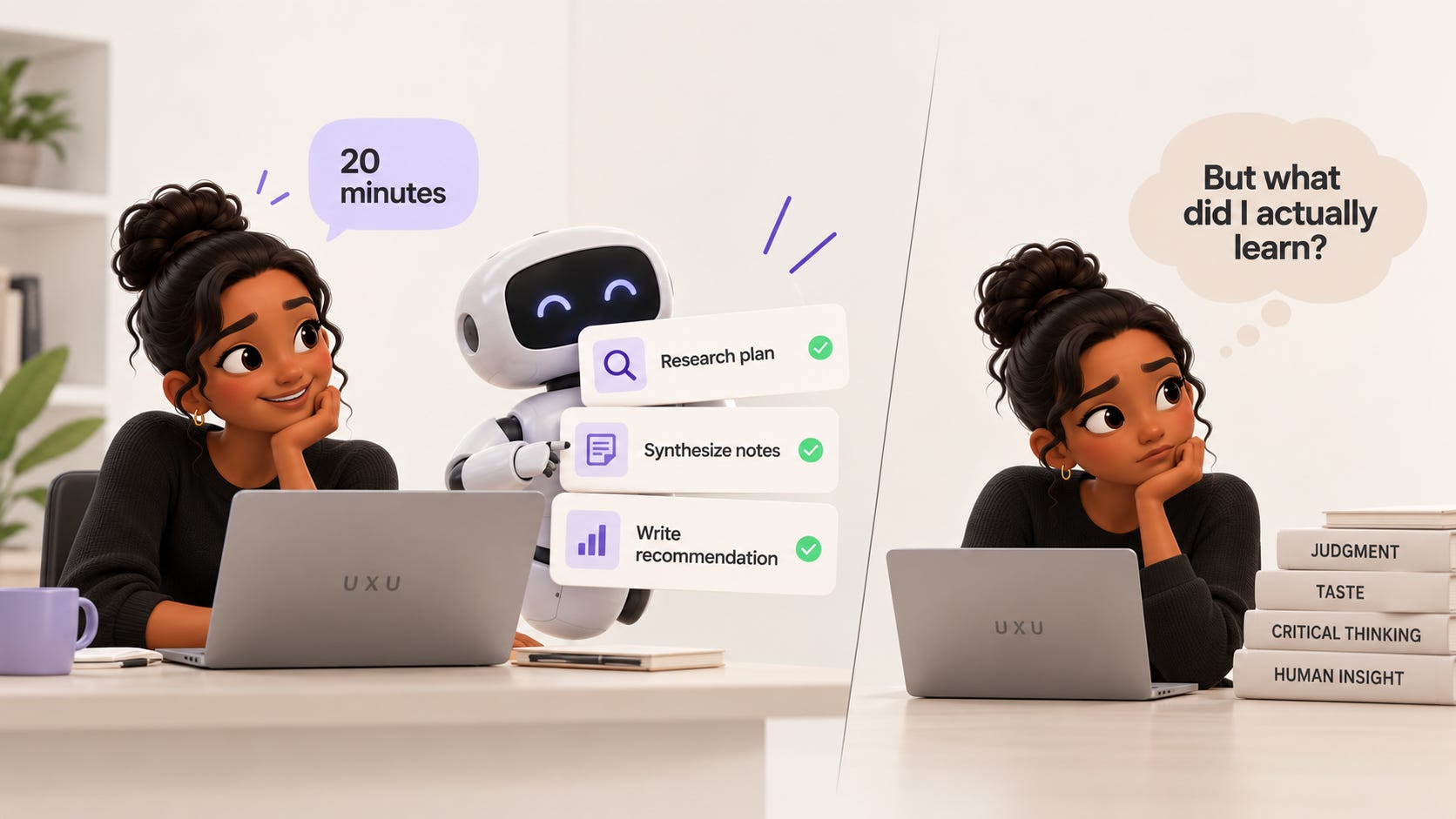
A growing stack of 2026 studies points to the same finding, and it is not comfortable. The more you let AI do the thinking parts of your work, the weaker your own thinking gets. There is even a name for it: cognitive atrophy. And for a field that sells judgment, taste, and the ability to reason about humans, that is not a small risk. It is the whole ballgame. This issue is about the hidden cost of outsourcing the thinking, and how to use AI without quietly hollowing out the skill that makes you valuable.
In this issue:
The finding nobody wants to hear
The performance paradox
Why this is worse for UX than most fields
The confidence trap
How to use AI without losing the skill
Resource Corner
The finding nobody wants to hear
The research here is unusually consistent, which is rare for something this new.
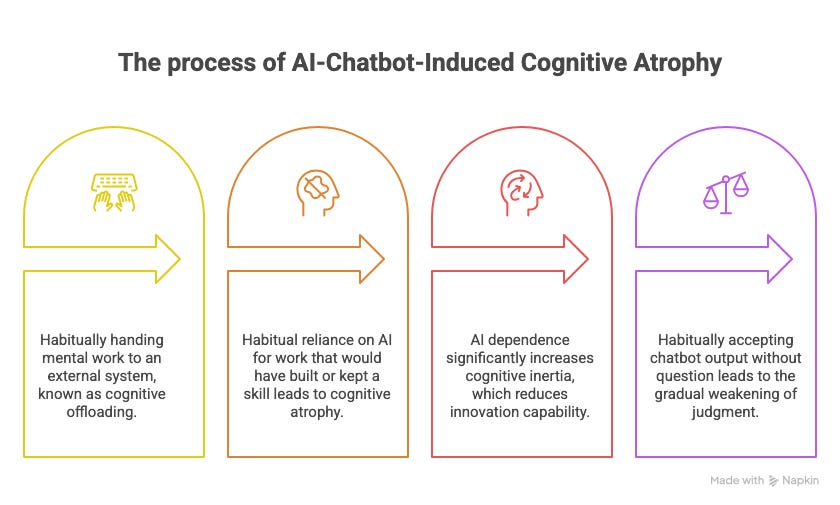
A study of 666 participants found a strong negative correlation between frequent AI use and critical thinking, with cognitive offloading as the mechanism, a correlation of -0.68, which in social science is a loud signal, not a whisper. “Cognitive offloading” is just the technical term for handing your mental work to an external system. Do it occasionally and it is fine. Do it habitually, for the work that would have built or kept a skill, and the skill degrades. That is cognitive atrophy.
The pattern shows up everywhere researchers look. A study of 1,032 students found AI dependence significantly increased “cognitive inertia,” which in turn reduced their innovation capability. One review named the core mechanism bluntly: AI-Chatbot-Induced Cognitive Atrophy, the gradual weakening of judgment through habitually accepting chatbot output without question.
Even the AI companies admit it. Anthropic’s own research acknowledges that productivity gains “may come at the cost of skills necessary to validate AI-written code if junior engineers’ skill development has been stunted by using AI in the first place.” When the vendor is warning you about their own product, the warning is worth hearing.
The performance paradox
Here is the finding that should stop every designer and researcher cold, because it explains why the problem is invisible until it is too late.
Researchers call it the performance paradox: AI can boost your performance on an immediate task while simultaneously diminishing your durable learning. You look better today and are worse underneath.
The clearest evidence comes from students. Those who used AI assistants performed better with the tool but significantly worse when it was taken away. They had not built the skill. They had bypassed it. One study of 3.2 million tutoring interactions over ten years found that after ChatGPT’s release, study time on AI-solvable problems dropped sharply, and so did performance on later tests where AI was not available. The gain was real. It was also borrowed, and the bill came due the moment the tool was gone.
This is the trap for your career. Offloading the thinking makes you look productive right now, which feels like winning. Meanwhile the muscle you are not using, the reasoning, the synthesis, the judgment, quietly weakens. You do not notice, because the output keeps looking fine. You only find out what you lost the day you need to do the thinking yourself and reach for a muscle that is not there.
Why this is worse for UX than most fields
Cognitive atrophy is a problem for everyone. It is a specific, pointed threat to UX, because of what this field actually sells.
A UX practitioner’s value was never production. It was judgment. Knowing which research question matters. Sensing that something is off before you can explain why. Reasoning about what a real human needs in a messy, specific context. These are exactly the higher-order thinking skills the research shows AI offloading erodes first.
The mechanism is almost tailor-made to hurt you. One study found AI use was linked to lower cognitive load during complex tasks, which sounds great, except lower cognitive load correlated with lower critical thinking. The mental effort you are skipping is the exact effort that builds the judgment you are paid for. In UX, the “hard part” AI happily removes, wrestling with an ambiguous problem, sitting in the discomfort of not knowing yet, is not friction to eliminate. It is the gym where product sense gets built.
So the field faces a cruel version of the general problem. The work AI is best at absorbing, synthesis, first drafts, pattern-finding, is precisely the work that trains the judgment that makes a senior practitioner senior. Outsource it wholesale and you do not just save time. You stop becoming the thing the market actually pays for.
The confidence trap
There is one more finding, and it is the most useful one, because it points directly at the fix.
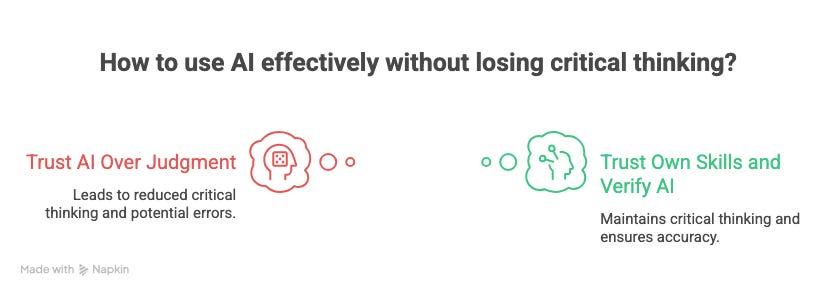
The Microsoft and Carnegie Mellon study of 319 knowledge workers found that the more confidence people had in the AI, the less critical thinking they did. But the reverse also held: the more confidence people had in their own skills, the more critical thinking they maintained, even while using AI. Researchers call it the confidence mediation effect.
Read that carefully, because it is the whole game. The danger is not AI itself. It is trusting the AI more than your own judgment. The people who kept their critical thinking were not the ones who avoided AI. They were the ones who stayed the authority over it, who treated its output as a draft to interrogate rather than an answer to accept.
The same study found knowledge work is shifting from problem-solving toward verifying and integrating AI output. That shift is fine if you verify rigorously. It is corrosive if “verify” quietly becomes “skim and approve.” The difference between those two is the difference between a practitioner who stays sharp and one who slowly goes dull without noticing.
How to use AI without losing the skill
The answer is not to avoid AI. It is to stay the thinker. Concretely:
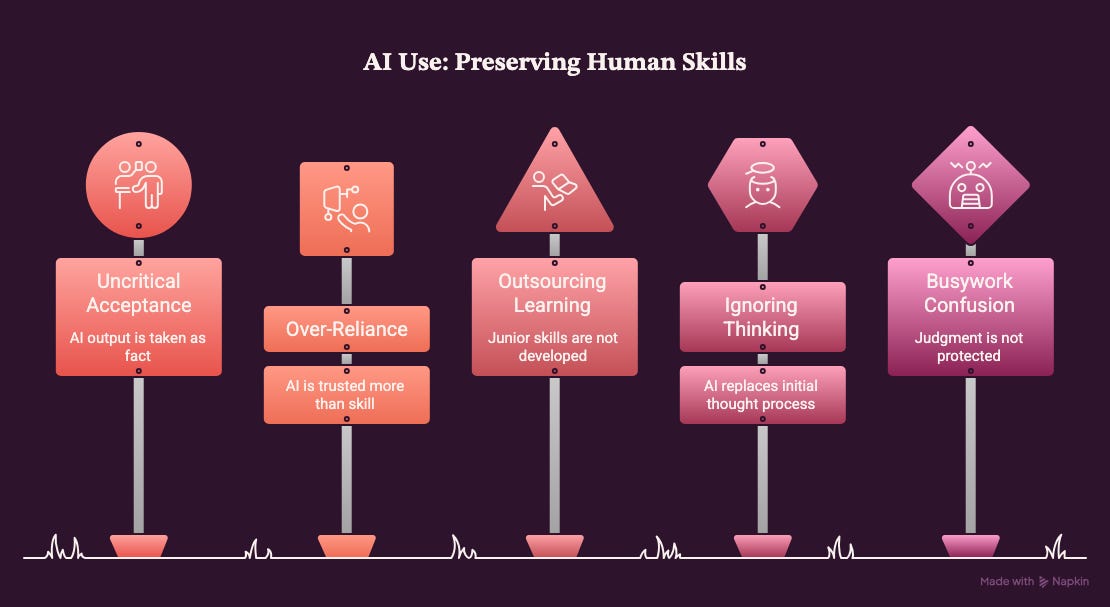
✅ Do the thinking first, then compare. For the decisions that matter, form your own view before you ask the AI. Then use its output to challenge or sharpen yours, not to replace the work of having one. The thinking you do first is what keeps the muscle alive.
✅ Offload the busywork, protect the judgment. There is a real line. Let AI handle transcription, formatting, organizing, searching, the mechanical work that was never building your skill anyway. Guard the parts that are judgment: what to research, what the findings mean, what to recommend. Offload the hands, keep the head.
✅ Interrogate every output. Treat AI results as a starting hypothesis, not a conclusion. Ask what it missed, where it is generic, what it would say differently with better context. The act of interrogation is itself the critical thinking that keeps you sharp. Uncritical acceptance is the exact behavior the research flags as corrosive.
✅ Trust your own skill at least as much as the tool’s. The confidence effect is the lever. The practitioners who stay sharp are the ones who remain the authority in the loop. If you catch yourself deferring to the AI because it is probably right, that is the moment to slow down and do the thinking yourself.
✅ Don’t outsource the learning, especially early. If you are junior, this matters most. The skills you skip building now are the ones you will not have when you are senior and the stakes are real. Use AI to go faster on things you already know how to do, not to avoid ever learning them.
📦 Resource Corner
The Impact of Generative AI on Critical Thinking (Microsoft Research & Carnegie Mellon)
The study of 319 knowledge workers behind the confidence mediation effect. The single most important read here: it shows exactly how trusting AI over your own judgment erodes critical thinking, and how self-confidence protects it.
How AI Is Reshaping Human Skills and Thinking (American Psychological Association)
A clear, accessible synthesis of the cognitive atrophy research, including the crucial distinction between transactional AI use that dulls thinking and deliberate use that sharpens it. The best starting point.
AI, Cognitive Offloading and Implications for Education (University of Technology Sydney)
The March 2026 report synthesizing the full evidence base, including the performance paradox. Rigorous and honest about both the peril and the conditions under which AI actually helps thinking.
AI Tools May Weaken Critical Thinking (PsyPost)
A readable breakdown of the 666-person study and the -0.68 correlation, including the honest caveat about causation. Good for understanding the strength and the limits of the finding.
Thinking, Fast and Slow by Daniel Kahneman
The foundational work on the mental effort behind good judgment, and why the brain is wired to avoid it. Essential context for understanding why offloading the hard thinking feels so good and costs so much.
💭 Final Thought
Every tool that saves effort asks a quiet question: what will you do with the effort you saved?
AI can take the thinking off your plate. The research is clear that if you let it take the thinking that mattered, the one that built your judgment, you get faster and emptier at the same time. The output looks fine right up until the day you need the skill and find it gone.
Use AI to do more thinking, not less. Form your own view first. Interrogate what it hands back. Stay the authority in the loop.
The thinking was never the part to get rid of. It was always the point.


