


For years, the UX researcher had a clear and comfortable role: the expert everyone came to. Teams submitted requests, researchers ran the studies, insights got delivered, and the cycle repeated. The researcher was the person through whom all user understanding flowed. It was a position of real authority, and for a long time, it worked.
That model is breaking, and not because research stopped mattering. It broke because the math stopped working.
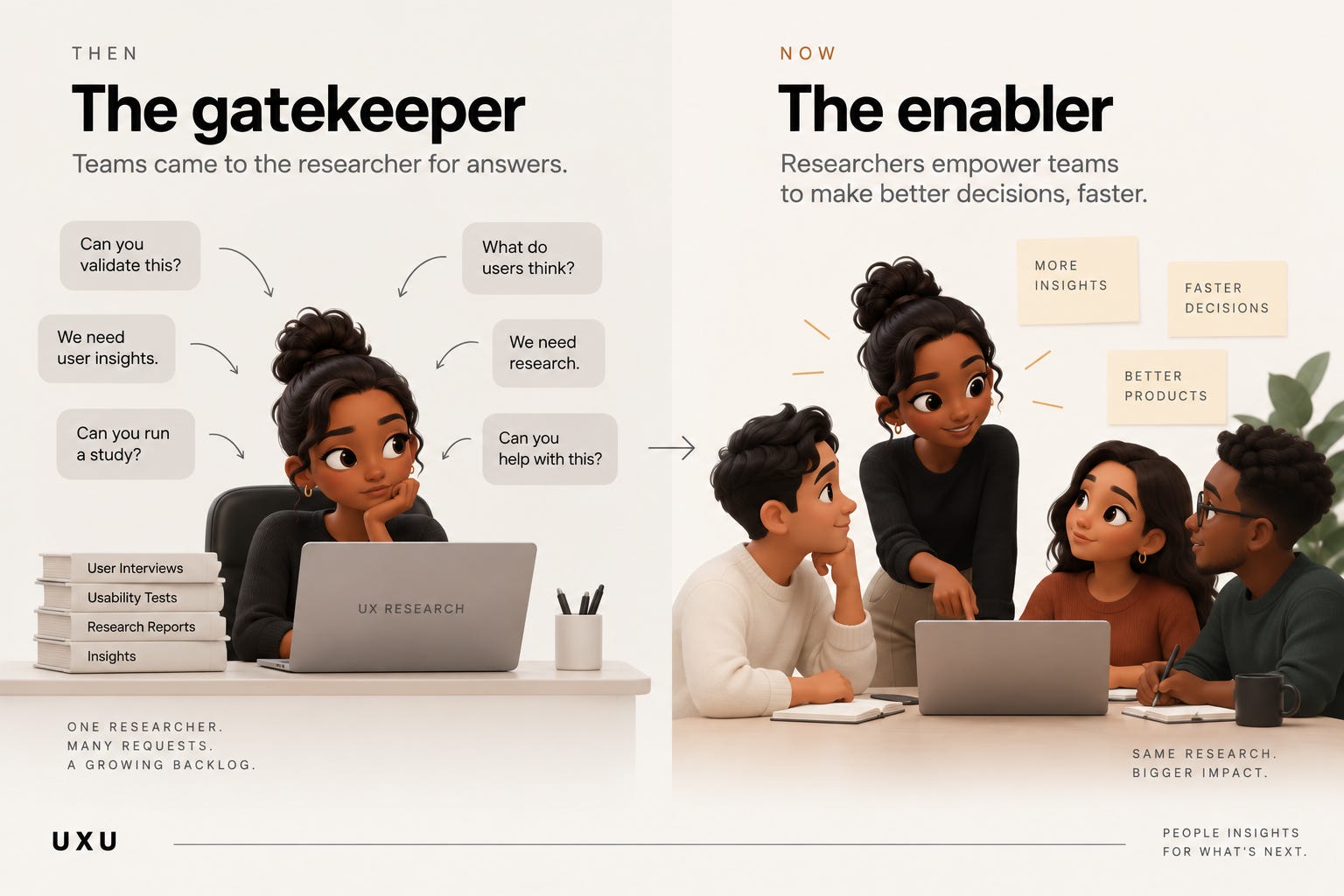
One researcher cannot support twenty product team members making hundreds of decisions per quarter. When product development moved slowly and research questions were occasional, the bottleneck model held. In a world where features ship continuously and decisions happen daily, a single gatekeeper for all user understanding is not a source of rigor. It is a source of delay. And so the role is transforming, from gatekeeper to enabler, and it is one of the most important career shifts happening in UX right now.
In this issue:
Why the bottleneck model stopped working
From gatekeeper to enabler: what actually changes
The fear, and why it is mostly misplaced
The insight that disappears without a system
How to make this shift in your own role
Resource Corner
Why the bottleneck model stopped working
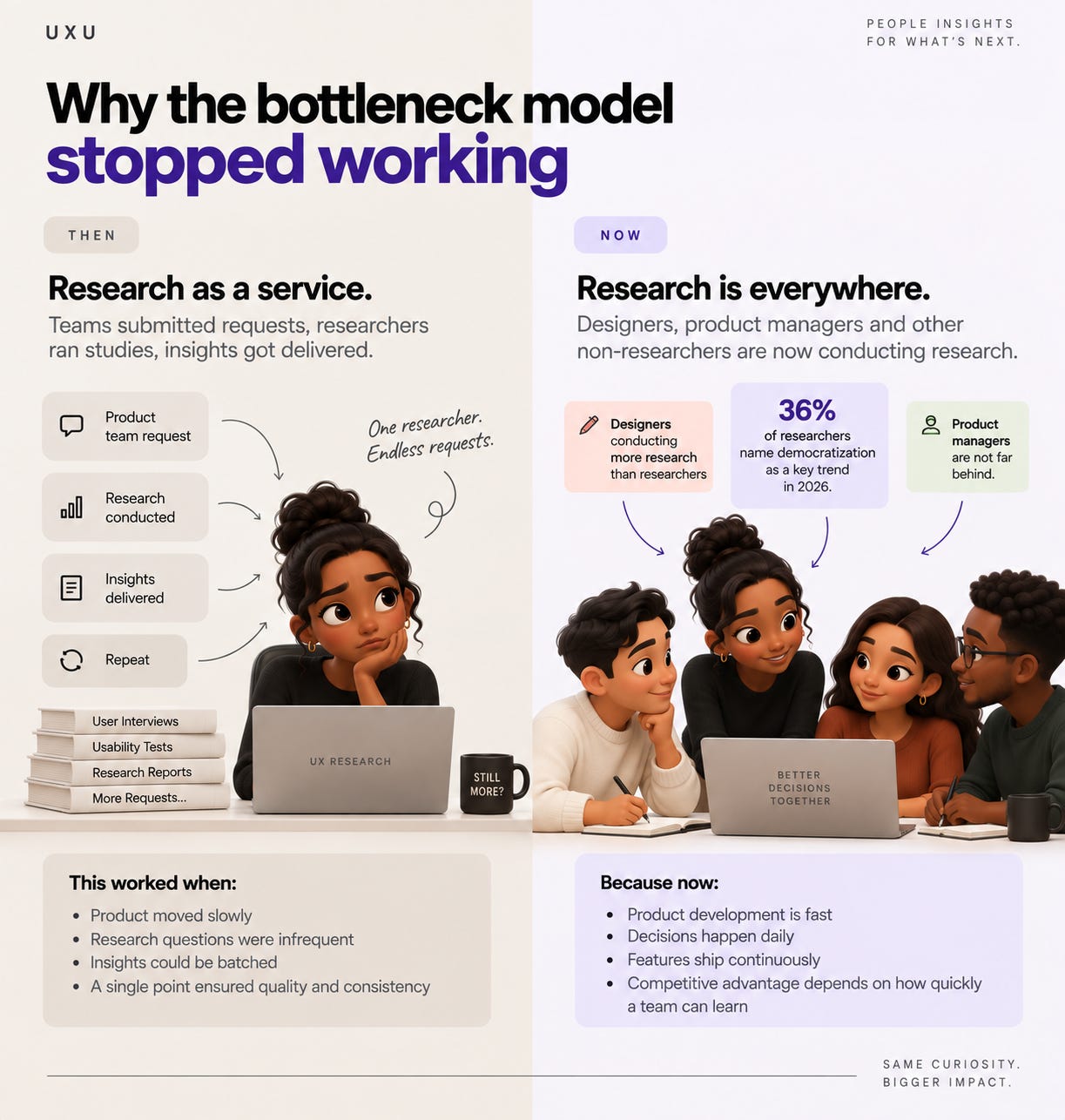
The traditional research model operated as a service. Teams submitted requests, researchers conducted studies, insights got delivered, and the cycle repeated. Every piece of user understanding in the organization flowed through the research team.
This worked under specific conditions: when product development moved slowly, when research questions were infrequent, and when insights could be batched into quarterly releases. In that world, being the single point through which all research passed was a feature. It ensured quality and consistency.
Those conditions no longer exist for most teams. Modern product development is fast. Decisions happen daily, features ship continuously, and competitive advantage depends on how quickly a team can learn. In that environment, the service model does not just slow down. It fails outright. The math simply does not work: one researcher cannot personally support twenty-plus people making hundreds of decisions a quarter. Something has to give.
What gave, in a lot of organizations, was the gatekeeping itself. Non-researchers started doing research. As of 2026, designers are now conducting more research than dedicated UX researchers, and product managers are not far behind. Around 36% of researchers name democratization, non-researchers conducting research, as a defining trend of the year. The question is no longer whether this happens. It is what the trained researcher does now that it does.
From gatekeeper to enabler: what actually changes
The shift is captured well in a phrase gaining traction in the field: researchers are moving from gatekeepers to enablers. It sounds like a demotion. It is the opposite.
In the gatekeeper model, the researcher’s value came from doing all the research personally. Their influence was bounded by their own capacity, which meant they could only touch as many decisions as they had hours in the week. Every study was theirs, and every study was also a ceiling.
In the enabler model, the researcher’s value comes from raising the quality of all the research happening across the organization. They define the methods, build the templates, set the guardrails, train the non-researchers, review the work for quality, and personally take on the complex, high-stakes, generative studies that genuinely require deep expertise. Their influence is no longer bounded by their own hours. It is multiplied across every team doing research with the systems they built.
This is a more powerful position, not a lesser one. A gatekeeper controls a narrow gate. An enabler shapes how an entire organization understands its users. The researcher who makes this shift stops being a service provider and becomes something closer to infrastructure, and infrastructure is far harder to cut than a service.
The framing from the field is that this is not the disappearance of the research role many feared at the start of 2025. It is the evolution of that role into something more essential than before. The researchers who understand that are positioning themselves at the center of how their organizations learn, rather than at a bottleneck everyone is trying to route around.
The fear, and why it is mostly misplaced
It would be dishonest to skip the anxiety here, because it is real. At the start of 2025, there was widespread fear that democratization meant research roles were disappearing. Some researchers predicted that a dedicated research specialization might not even be needed, since everyone would do it with AI.
That fear is understandable, and it is mostly misplaced, for one clear reason: democratization done without expertise produces bad research, confidently held.
The researchers surveyed about 2026 named this directly. Their biggest worry is not being replaced. It is AI and research tools being used by non-researchers with results that are not checked or confirmed. When people without research training use powerful tools without understanding their limitations, they produce findings that look rigorous and are not. Biased samples. Leading questions. Surface themes mistaken for insight. Conclusions drawn from data that does not support them.
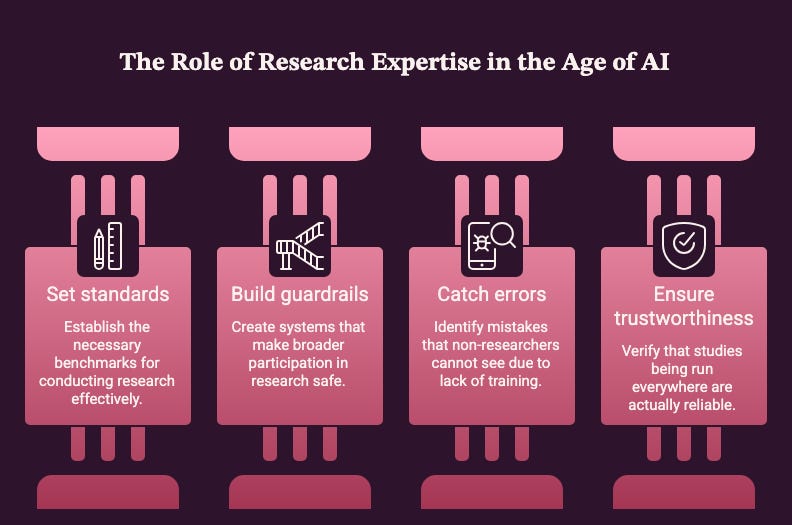
This is precisely where the trained researcher becomes more necessary, not less. Someone has to set the standards, build the guardrails, and catch the errors that non-researchers cannot see because they do not know what they do not know. The value of research expertise does not vanish when everyone can run a study. It relocates, from executing the study to ensuring the studies being run everywhere are actually trustworthy.
The researchers who thrive are the ones who stopped defending their territory and started building the system that makes broader participation safe. That is a role that requires more expertise, not less.
The insight that disappears without a system
There is a quiet crisis underneath all of this that most teams have not solved, and it is where enablers earn their keep: research democratization produces more findings and does not automatically produce more organizational knowledge.
Here is the problem in practice. When many people across an organization run research, the insights scatter. They live in a designer’s Notion doc, a PM’s slide deck, a Slack thread, someone’s memory. Six months later, a different team researches the exact same question from scratch, because nobody could find what was already learned. The organization did the work twice and got dumber in between.
This is why 29% of researchers name research repositories and insight management as a defining trend of 2026. As research scales and democratizes, having systems to organize and share findings becomes crucial. A good repository does several things at once: it avoids redundant and duplicate work, helps new hires get up to speed faster, and prevents knowledge from walking out the door when someone leaves.
But there is an honest catch that the field is grappling with. Repositories are hard to maintain, because the people doing democratized research are doing it for insights they personally need, and once they have those insights, motivating them to contribute to a shared system is difficult. In practice, it almost always requires a dedicated researcher to pull the knowledge management over the finish line, even when others contribute.
That is the enabler’s opportunity in a sentence. Owning the system that makes all of the organization’s research findable, trustworthy, and cumulative is unglamorous, high-leverage work that almost no one else is positioned to do. It turns the researcher into the connective tissue of product knowledge across the company, which is one of the most durable and influential positions available.
How to make this shift in your own role
Whether you are a researcher navigating this or a designer trying to understand where research is heading, concrete moves.
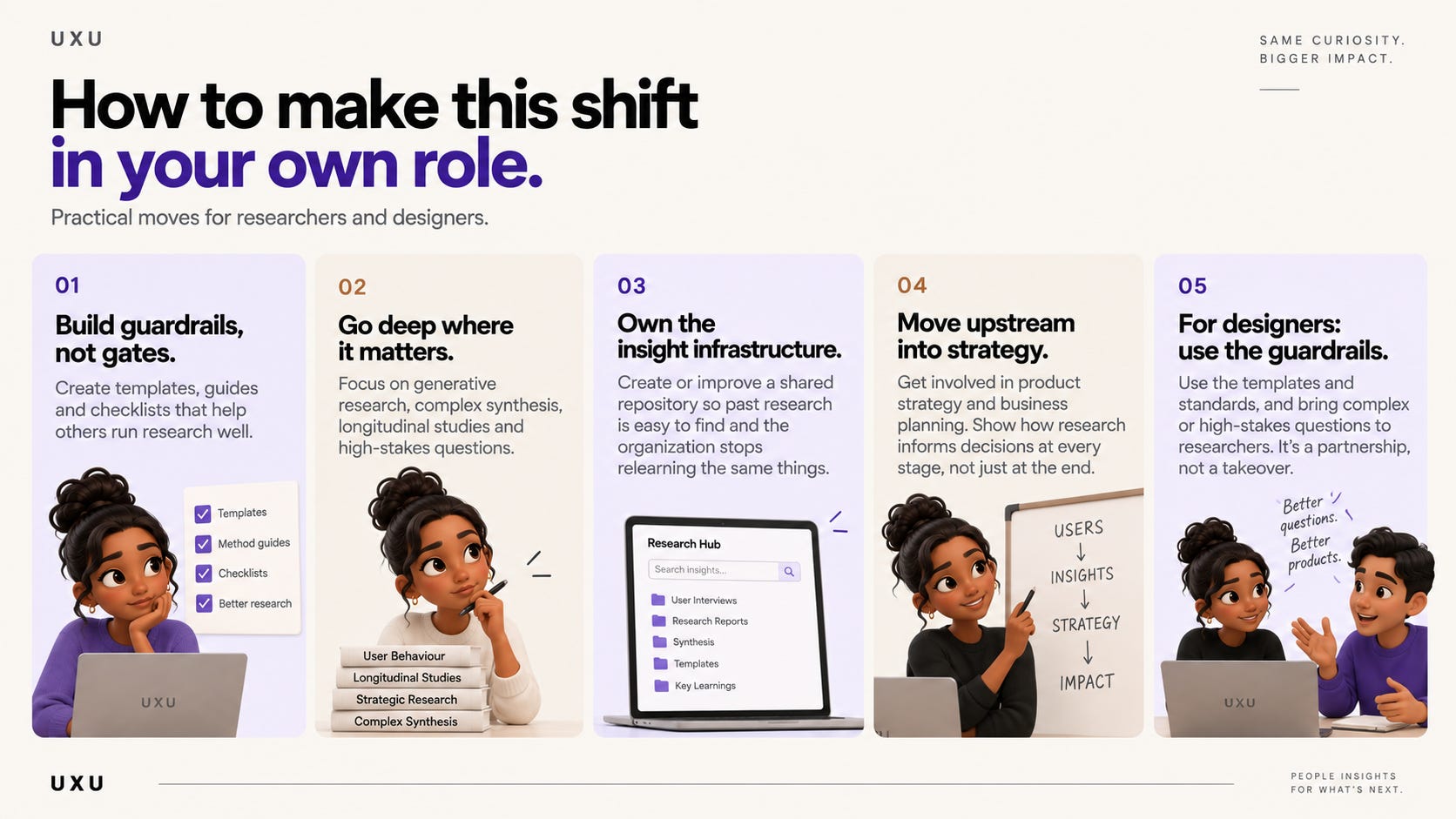
✅ Build guardrails, not gates
Instead of trying to be the only person who runs research, create the templates, method guides, and quality checklists that let others run it well. Mature organizations are investing in research guidelines that enable democratization without losing rigor, with central researchers acting as coaches. Be the coach, not the bottleneck.
✅ Go deep where expertise is irreplaceable
Generative research. Complex synthesis across multiple sources. Longitudinal studies. High-stakes strategic questions. These do not democratize easily and are where trained expertise creates the most value. Spend more of your time here and less defending studies others can reasonably run.
✅ Own the insight infrastructure
If your organization is doing democratized research without a shared, well-maintained repository, that is your highest-leverage project. Advocate for one, or take ownership of the one you have. Make past research findable so the organization stops relearning what it already knew.
✅ Move upstream into strategy
The clear advice to researchers for 2026 is to move beyond tactical execution and get involved in product strategy discussions and business planning. Demonstrate how research can inform decisions at every stage, not just validate designs at the end. The enabler role is inherently more strategic, so lean into it.
✅ For designers: use the guardrails, respect the expertise
If you are doing your own research now, use the templates and standards researchers provide, and bring the complex or high-stakes questions to them. The goal is a partnership, not a takeover. The best outcomes come from a mix of democratized execution and expert oversight.
Quick pause. This belongs in the room.
🎯 UXCON26 · One Day · The Whole Community
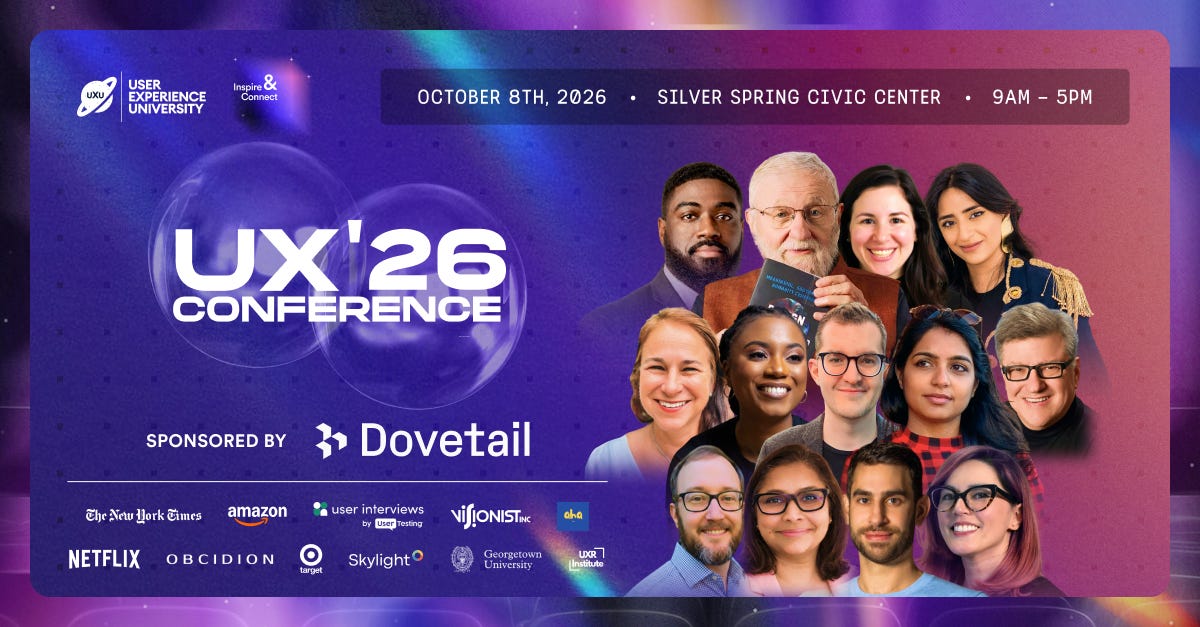
The evolution of the research role, and how designers and researchers work together as the lines blur, is exactly the kind of conversation the field needs to have in person, together.
On October 8, 2026, the UX community comes together for a full day built around where this work is really heading, for researchers and designers alike. Headlining is Don Norman, who coined the term user experience and at 88 is still pushing this field forward. Alongside him are practitioners from Netflix, The New York Times, Target, UserTesting, and Skylight, hosted by Jeremy Miller of the Beyond UX Design podcast.
Three keynotes. Two panels. One room.
📦 Resource Corner
From Gatekeepers to Enablers: The UX Researcher’s New Role in 2026 (Optimal)
The clearest articulation of the role shift this issue is built around. Essential reading for any researcher trying to understand where the profession is heading and how to position for it.
UX Research Democratization: 2025 Survey Report (Great Question)
A survey of 301 research and research-ops professionals on how democratization is actually playing out, including the honest struggles with repository maintenance and follow-through. Grounded in real practice, not ideals.
UX Research Trends 2026 (Lyssna)
100 researchers on what will shape the field, including the data on democratization and insight management. The best single snapshot of where researchers themselves think things are going.
UX Research Repository: Templates and Best Practices (Maze)
A practical guide to actually building the insight infrastructure that makes democratized research cumulative rather than scattered. Start here if owning the repository is your move.
Dovetail
The closest thing to a standard research repository right now. If your team is doing democratized research without a shared place to store and search findings, this is the tool to evaluate first.
💭 Final Thought
There is a version of this story that reads as loss. The researcher who once held exclusive authority over user understanding now shares the work with designers, PMs, and AI tools. If your identity was built on being the gate, that feels like the ground shifting.
But the researchers who are thriving in 2026 tell a different story. They realized that controlling a narrow gate was never the point. The point was always helping the organization understand its users and make better decisions because of it. And you can do that far more powerfully by enabling good research everywhere than by personally running every study yourself.
The gate was a ceiling. The enabler role is not. It scales your expertise across every team, embeds your standards into every study, and positions you as the person who makes the whole organization smarter about its users over time. That is more influence, more security, and frankly more interesting work than being the bottleneck everyone was quietly trying to get around.
The role that says “no, only I can do that” is fading. The one that says “here is how you do it well, and here is the system that makes it last” is where the future is.
Stop guarding the gate. Start building what everyone walks through.


