



Here is the trap, and almost everyone in UX is in it.
The whole field is screaming at you to expand.
Learn to code.
Own strategy.
Do research, design, and front-end.
Be the “design engineer.”
Take on more, or get left behind.
So you say yes. Yes to the extra scope. Yes to the surprise request. Yes to the responsibility that was never yours.
Each yes feels like ambition. Like you’re future-proofing your career.

The data says most of those yeses are doing the opposite.
The strongest recurring reason designers gave for wanting to leave the field in 2026 was burnout and workload. A lot of it is self-inflicted, one reasonable-sounding “sure, I can take that on” at a time.
This issue makes the unpopular case: the most valuable career skill in UX right now isn’t doing more. It’s knowing what to refuse.
In this issue:
Why the field is pushing you to overextend
The scope creep tax, in numbers
Busy without being useful
Why “no” is a senior skill, not a junior risk
How to say it without burning bridges
Resource Corner
Why the field is pushing you to overextend
The pressure to say yes is not in your head. It is structural, and it keeps getting worse.
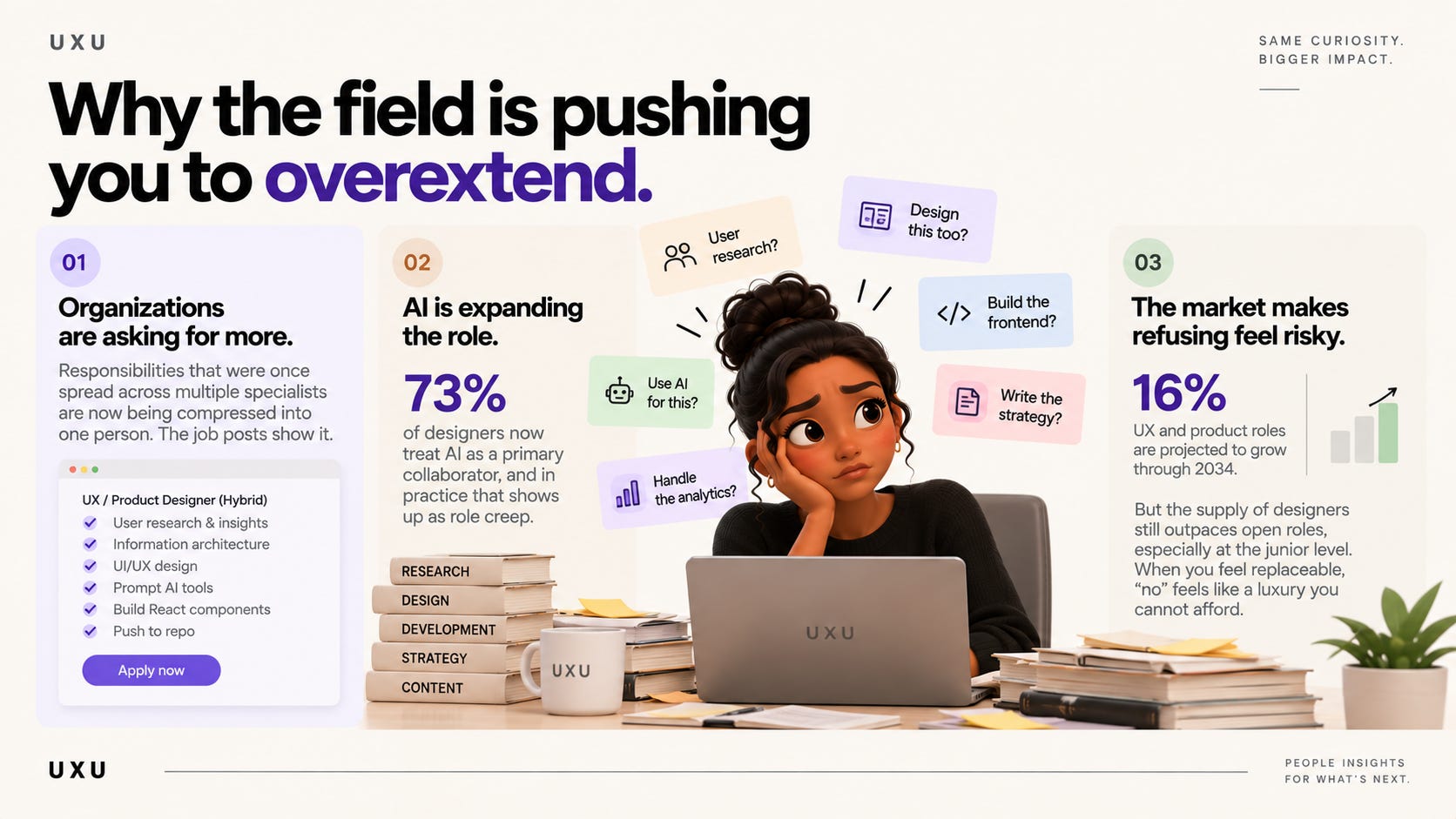
1. Roles are being compressed.
Organizations are asking more of each role, folding work once spread across several specialists into one person. Job posts show it.
73% of designers now treat AI as a primary collaborator. In practice, that “collaboration” often shows up as role creep. Recruiters want one person who can do:
Empathy
Information architecture
Prompt a React component into existence and push it to a repo
The role keeps absorbing new territory.
2. The market makes “no” feel dangerous.
UX and product roles are projected to grow 16% through 2034. But designers still outnumber open roles, especially at the junior level.
When you feel replaceable, “no” feels like a luxury you can’t afford. So you:
Take the extra work
Learn the extra tool
Stretch into the extra role
All in the hope that breadth will keep you safe.
3. The catch nobody mentions.
Expanding into everything is also how you become mediocre at everything, and exhausted doing it.
The advice to broaden isn’t wrong. The advice to broaden without limit is what breaks people.
The scope creep tax, in numbers
Scope creep is the clearest, most measurable version of the yes problem, and the numbers are brutal.
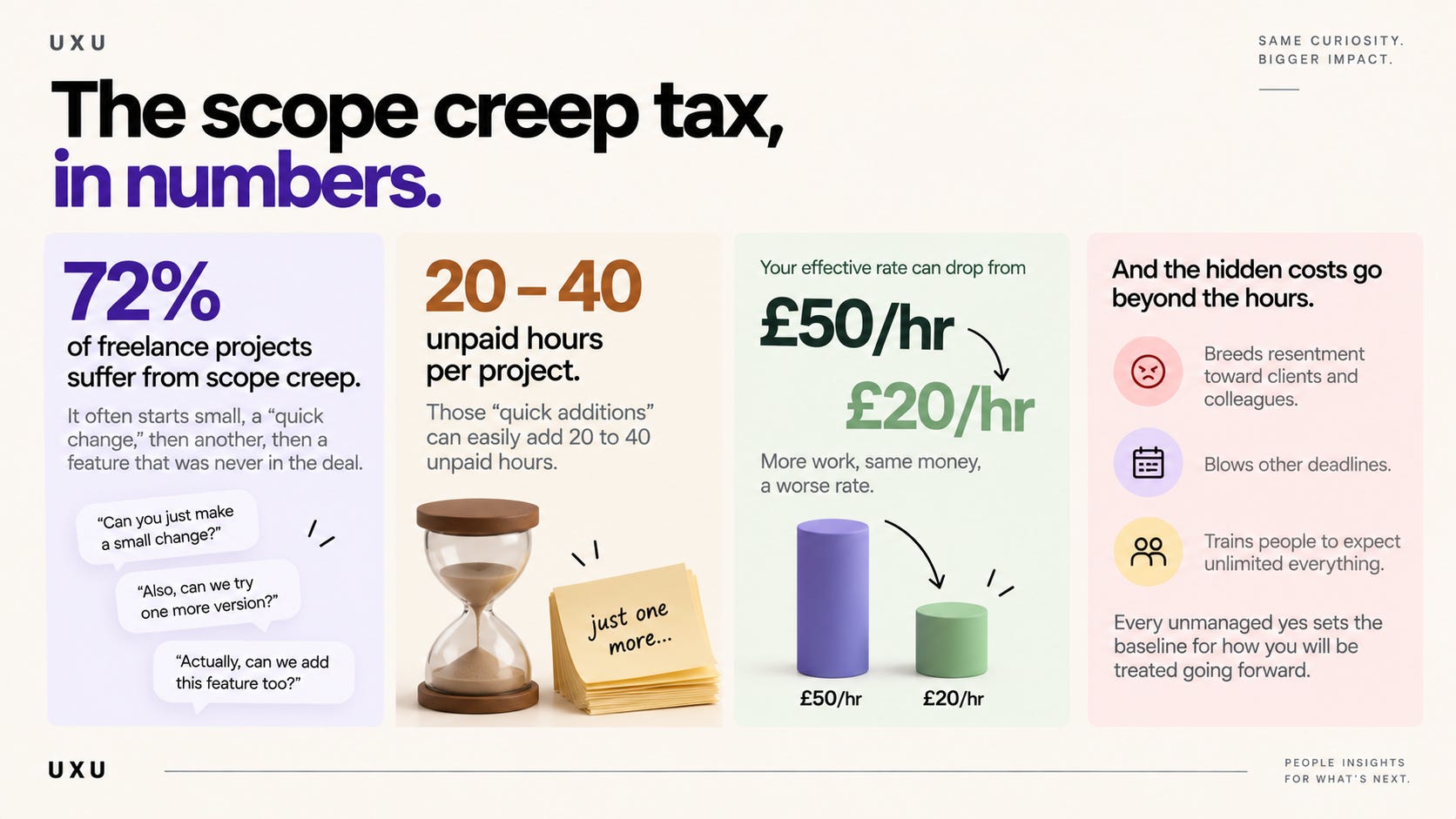
72% of freelance projects suffer from scope creep.
It starts small: “just one quick change.” Then another. Then a feature that was never in the deal.
The cost adds up fast:
20 to 40 unpaid hours per project, often
£50 an hour → £20 an hour, the effective rate it can quietly drop to
More work, for the same money, at a worse rate. And you call it dedication.
It’s not only a freelance problem.
In research, scope creep looks like the urge to leave no stone unturned. A few more sessions. A more robust study. The result is the same: task pile-up, stretched deadlines, and burnout.
The pursuit feels responsible. The outcome is diminishing returns and an exhausted researcher.
And the hidden costs are worse than the hours.
Scope creep:
Breeds resentment toward clients and colleagues
Blows other deadlines
Trains the people around you to expect unlimited everything
Every unmanaged yes teaches the next person to ask for more.
You’re not just overworking. You’re setting the baseline for how you’ll be treated from here on.
Busy without being useful
This is the deeper, more corrosive version of the problem. It is the one that actually makes people quit.
The most honest line in the 2026 research on why designers are leaving:
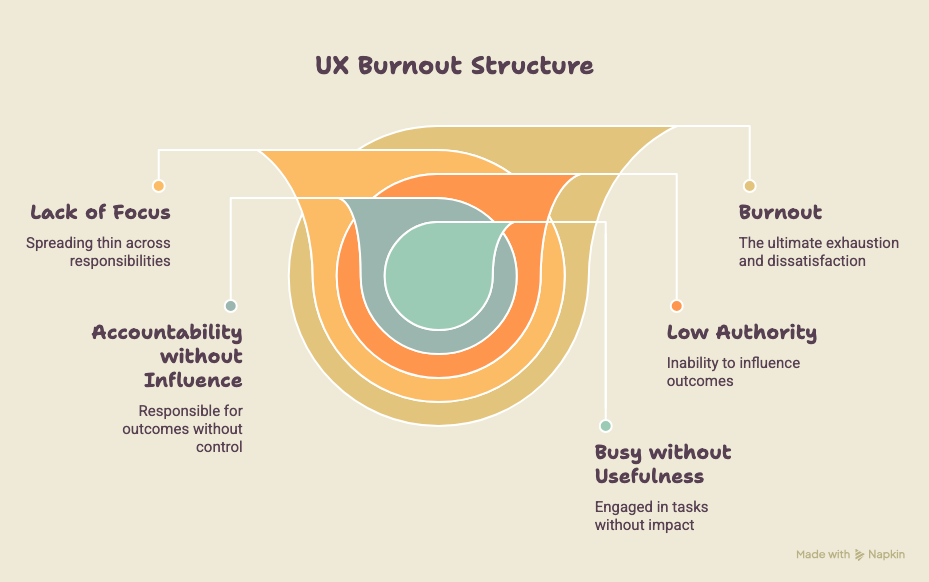
In UX, burnout is usually described as a workload issue, but the more corrosive version is structural. Designers can be busy without feeling useful, responsible without having authority, and accountable for user outcomes without having enough influence to affect them.
Read that again, because it reframes everything.
The problem isn’t only that you have too much to do. It’s that saying yes to everything spreads you so thin, across so many half-owned responsibilities, that you have real authority over none of them.
You end up:
Accountable for outcomes you can’t control
Drowning in work that doesn’t add up to impact
High workload plus low authority is one of the strongest predictors of burnout there is.
That’s why “just work harder” doesn’t fix it. Neither does “learn one more tool.”
The exhaustion isn’t coming from a lack of effort. It’s coming from a lack of focus.
Every yes that adds a shallow responsibility subtracts from the few things you could actually own deeply and be known for.
You end up busy, scattered, and strangely invisible. The worst possible position when the layoffs come.
Why “no” is a senior skill, not a junior risk
Let’s flip the whole frame, because this is the part that changes careers.
The 2026 guidance is that available roles increasingly demand breadth and judgment, not just artifacts.
People hear “breadth” and start saying yes to everything. They miss the more important word: judgment.
Judgment isn’t doing more things. It’s knowing which things matter, and having the spine to decline the rest.
Junior vs. senior
A junior says yes to every request, afraid that no will make them look uncommitted.
A senior says no to the wrong work so they can say an excellent yes to the right work.
The senior protects their focus because they know reputation is built on a few things done exceptionally, not many things done adequately.
Saying no isn’t a sign you’re not a team player. It’s a sign you know what your contribution actually is.
There’s career safety in this too. The opposite of what the fear tells you.
The durable role is built around:
Deep judgment
Systems thinking
Proximity to real outcomes
You can’t build that depth while saying yes to everything. The scattered generalist is far more replaceable than the person who owns something specific and important.
In a competitive market, focus isn’t the risky move.
It’s the moat.
Now….How do you say it without burning bridges?
Saying no is a skill, and a plain “no” does read as rude. Here is how to do it so it builds trust instead of friction.
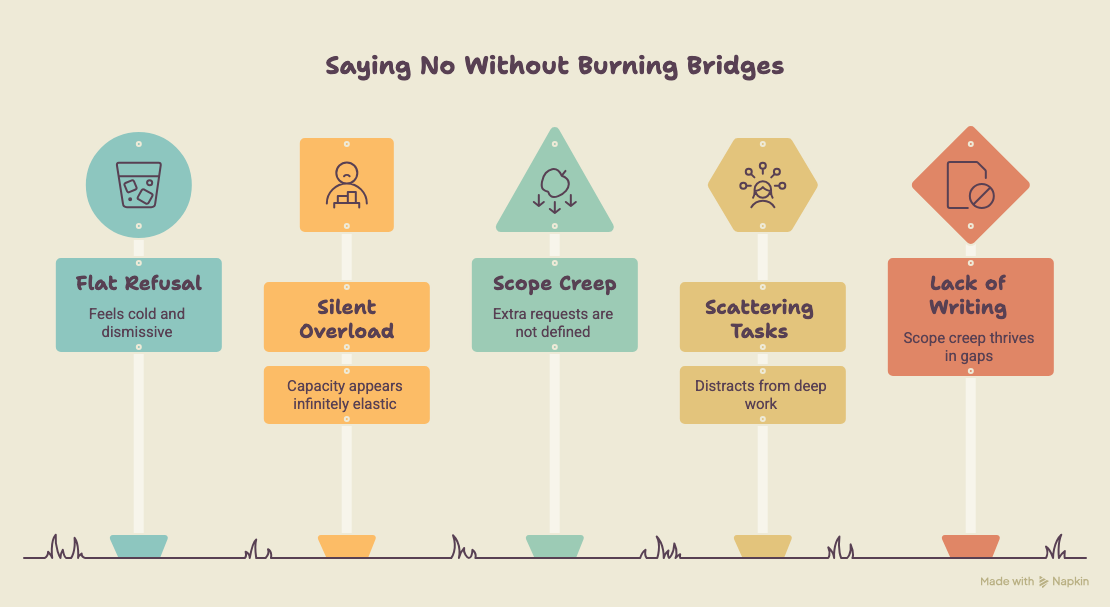
✅ Give the honest reason, not just the refusal. A flat no feels cold. Try:
“I can’t take this on well right now because I’m focused on X, and I’d rather protect the quality of both.”
That builds more trust than a yes you deliver badly. Explaining the why lands far better than a curt no or a resentful yes.
✅ Name the tradeoff out loud. When new work lands, don’t just absorb it. Say:
“I can do this, but it means Y slips. Which matters more?”
This turns silent overload into a shared decision, and it makes your capacity visible instead of infinitely elastic.
✅ Turn scope creep into a defined ask. The freelance move that works:
“That’s outside what we agreed, but I can add it as a separate package.”
It reframes the extra request as a real decision with a real cost, which is what it always was.
✅ Protect the deep work, trade away the shallow. Say no to what scatters you. Say yes to what builds the depth you want to be known for.
The filter is simple: does this add to the thing I’m becoming excellent at, or just to my task list?
✅ Put it in writing early. Most scope creep thrives in the gap where nothing was agreed. A clear, written scope up front, for clients and internal projects alike, is the cheapest boundary you’ll ever set.
📦 Resource Corner
Five reads if you want to go deeper.
1. Leaving UX Design in 2026: Why Designers Want Out (DesignWhine)
The research behind “busy without being useful,” drawn from 23 UX community discussions. The clearest case that structural overload, not laziness, is burning designers out. Start here.
2. How to Negotiate Scope and Set Boundaries as a Designer (UX Playbook)
Practical guidance on protecting your time and declining work without torching relationships. The counterweight to a field that only tells you to do more.
3. Scope Creep Is Killing Your Freelance Profits (ClearTimeline)
The numbers behind the scope creep section: 72% of projects, 20 to 40 unpaid hours, and a system for stopping it. Best if you freelance or run your own projects.
4. Avoiding Burnout as a Product Designer (GitLab)
A firsthand account of how saying yes to every request spirals into burnout, with a practical checklist for prioritizing and setting boundaries.
5. Essentialism by Greg McKeown
The classic on the disciplined pursuit of less. Not a UX book, but the most useful read on why focus beats breadth and how to say no without guilt.
💭 Final Thought
The field will keep telling you to do more. More skills, more scope, more yes. Some of it is real opportunity. Taken to its logical end, it produces the scattered, exhausted, low-authority designer the burnout data keeps describing.
Your career is built on depth, not volume. On the few things you own well, not the many things you touched.
So guard your focus. Decline the wrong work on purpose. Save your best yes for what matters.
That isn’t doing less. It’s finally doing the right things well.


