


The promise was simple: AI would let designers ship faster without bothering engineering. Prompt a feature, get working output, move on.
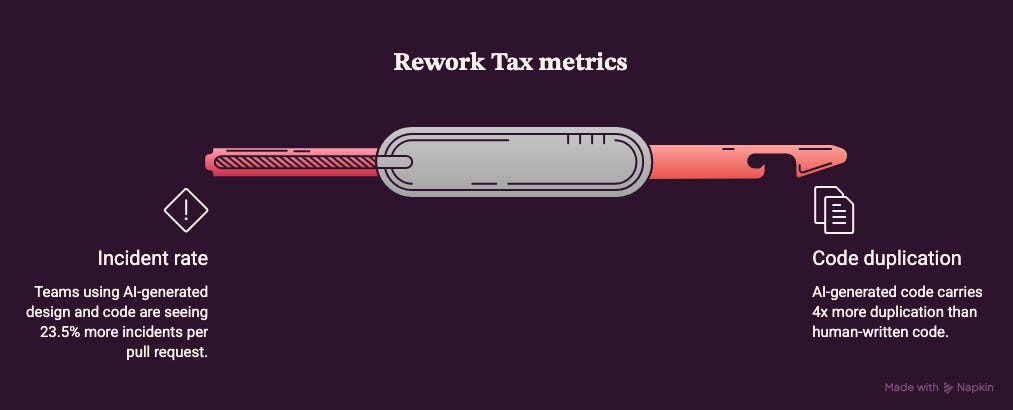
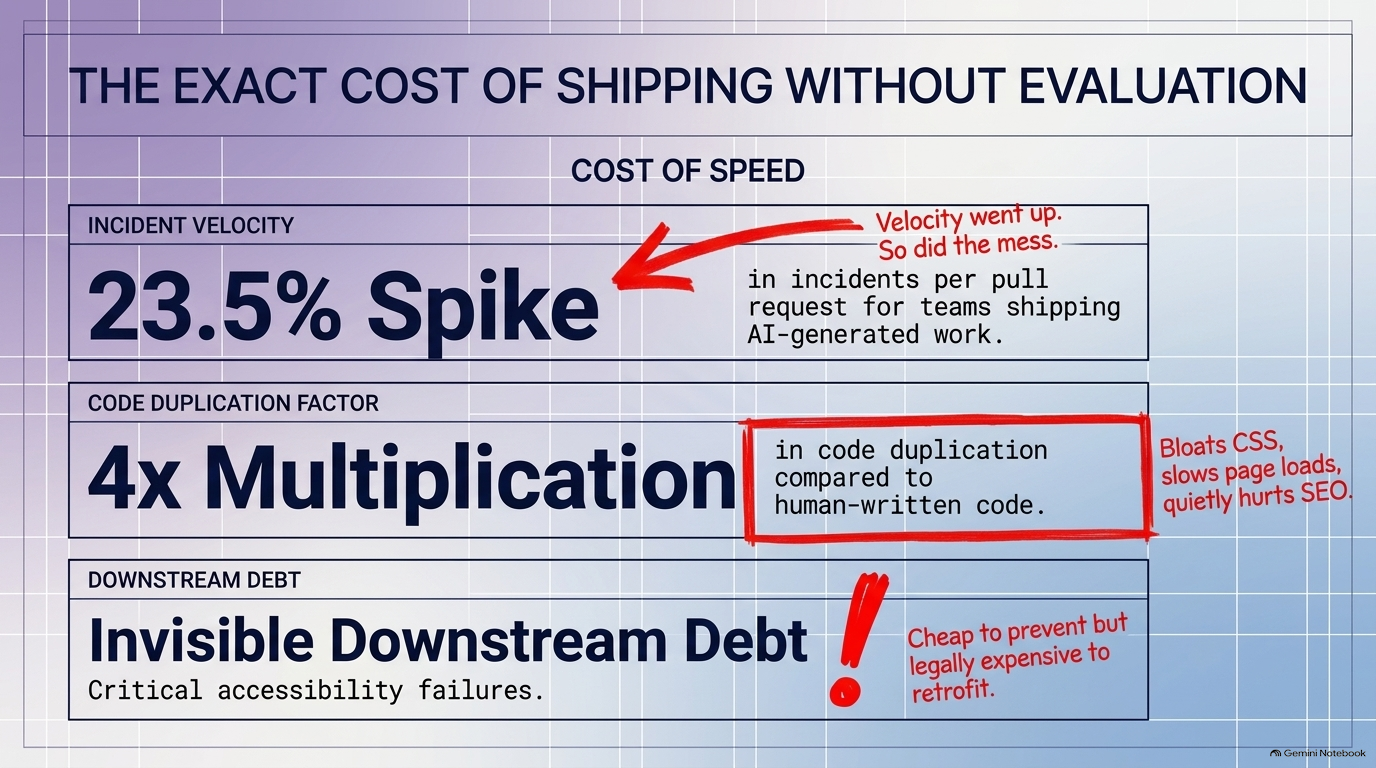
The reality has a name now. Engineers are calling it the Rework Tax, and the numbers behind it are ugly. Teams using AI-generated design and code are seeing 23.5% more incidents per pull request. AI-generated code carries 4x more duplication than human-written code. Velocity went up. So did the mess. And someone has to clean it.
That someone, increasingly, is you. A new phase is quietly setting in, one where a large part of the UX job is not creating but reviewing, catching, and fixing what AI produced too fast to be trusted. This issue is about that shift, and why it might be the most valuable thing you do in 2026.
In this issue:
The Rework Tax, in real numbers
Why AI builds faster than anyone can evaluate
What “AI slop” actually looks like
The custodial job nobody put on the roadmap
How to be the person who catches it
Resource Corner
The Rework Tax, in real numbers
Let’s put numbers to the thing everyone senses but few measure.
AI genuinely speeds up production. It also degrades quality in ways that show up downstream. Teams shipping AI-generated work see incidents per pull request rise 23.5%. The code is verbose: AI is linked to 4x more code duplication than human-written code, which bloats CSS files, slows page loads, and quietly hurts SEO.
Then there is the debt you cannot see until it is expensive. A designer prompts a “beautiful, functional toggle,” and the AI hands back something that looks right but lacks keyboard focus and screen-reader support. That is accessibility debt, cheap to prevent, costly to retrofit, and now a legal exposure on top of it.
The result is a strange inversion. AI was supposed to save engineering time. Instead, some engineering teams now spend a significant chunk of their week cleaning up “AI slop” delivered by design teams who skipped a rigorous review. The work did not disappear. It moved downstream, multiplied, and got more expensive. That is the Rework Tax, and almost nobody budgeted for it.
Why AI builds faster than anyone can evaluate
Here is the core problem in one sentence: AI lets teams build faster than UX can evaluate.
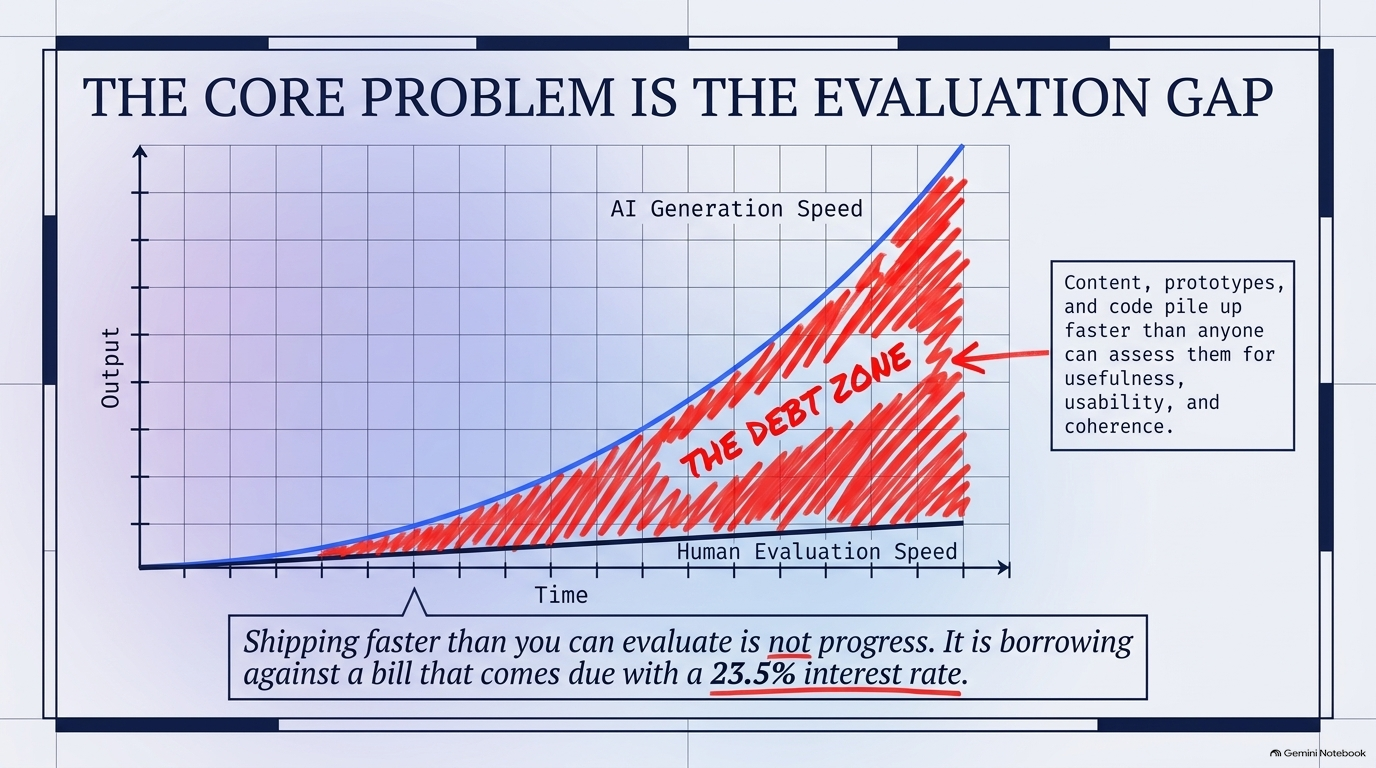
That imbalance is the whole story. A prompt produces a prototype in seconds. Evaluating whether that prototype actually works, whether it matches how users think, whether the hierarchy reflects what matters, whether it survives edge cases, whether the same action behaves consistently everywhere, takes real human judgment and real time. Generation got instant. Evaluation did not.
So a gap opens, and it fills with debt. Content, prototypes, code, and features pile up faster than anyone can assess them for usefulness, usability, accessibility, and coherence. Each unreviewed piece looks finished. Underneath, decisions were skipped. And skipped decisions do not announce themselves. They surface later as confused users, accessibility complaints, inconsistent flows, and the slow erosion of trust in a product that “works” but does not feel right.
This is why speed alone is a trap. Shipping faster than you can evaluate is not progress. It is borrowing against a bill that comes due with interest, and the interest rate is that 23.5%.
What “AI slop” actually looks like
“AI slop” sounds vague until you learn to see it. Then it is everywhere, and it is oddly specific.
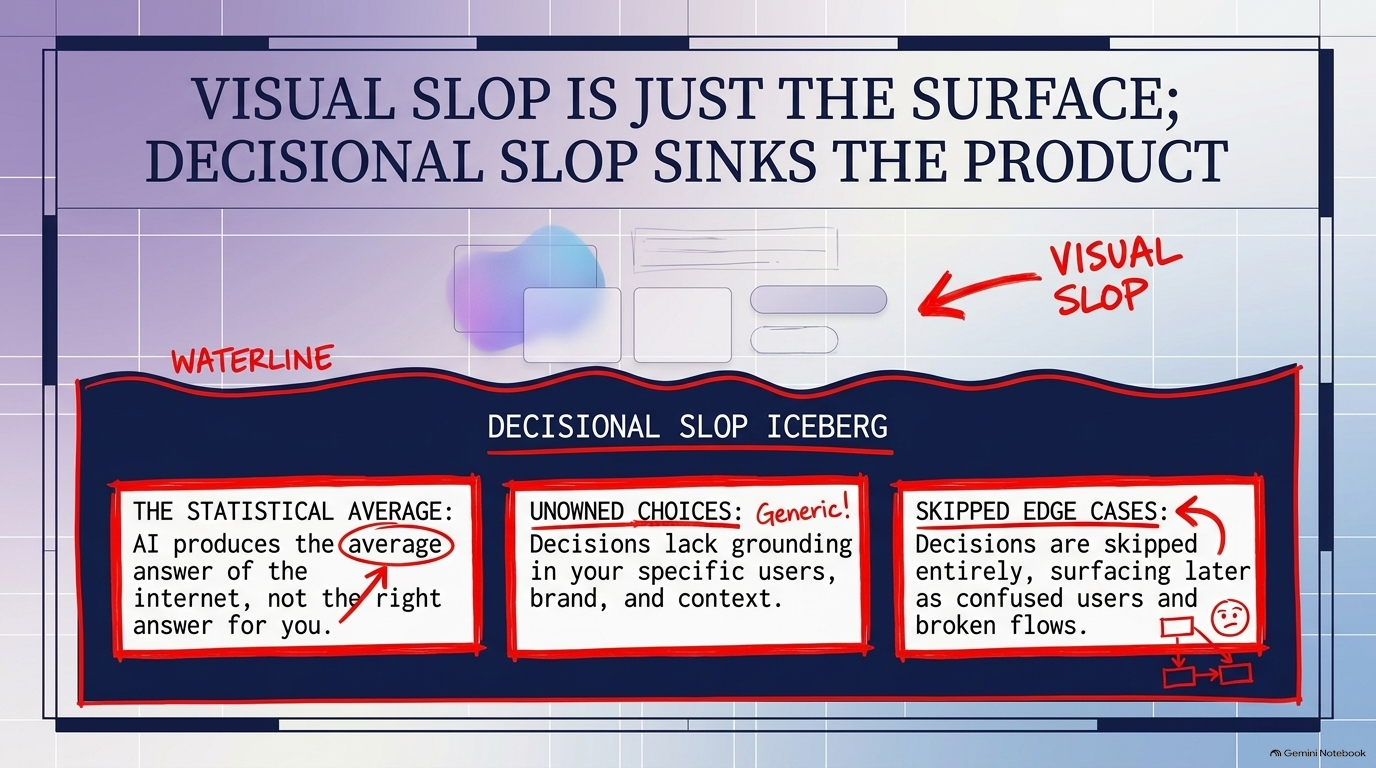
The visual tells are now a recognized pattern. The purple-to-blue mesh gradient. Floating 3D shapes. The default Inter font doing every job. Three identical cards in a perfect grid. Emoji standing in where an icon belongs. The stripped focus outline. Two unrelated apps prompted with “clean modern dashboard” come out nearly identical, because the model reaches for the same statistical average every time. Left unchecked, entire product ecosystems start to blur into the same beige sameness.
The deeper slop is not visual, it is decisional. AI produces the average answer, not the right one. It defaults to generic, unowned choices instead of decisions rooted in your users, your brand, and your context. Telling the model to “make it feel premium” yields the average of everything labeled premium on the internet, which is to say, nothing specific to you.
The fix reveals the skill. You do not de-slop by adding more adjectives. You do it by giving constraints: exact hex values, named fonts, real spacing rules, and an explicit list of what not to do. Constraints, not adjectives. Knowing which constraints to give, and why, is exactly the judgment AI does not have and you do.
The custodial job nobody put on the roadmap
Here is the reframe that makes all of this an opportunity instead of a complaint.
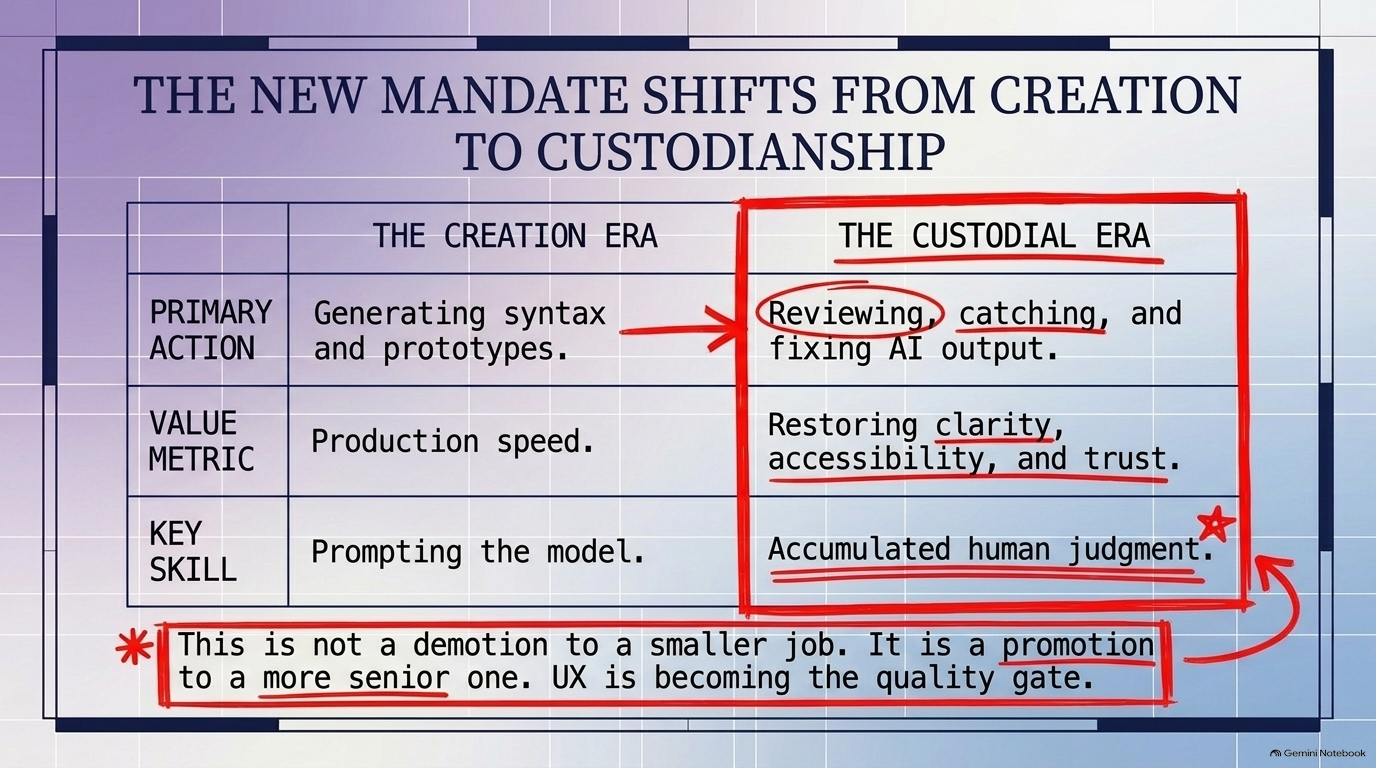
As AI floods teams with fast, unreviewed output, UX’s most valuable role is shifting from creation to custodianship: reviewing what AI generated, judging whether it is actually good, and restoring the clarity, accessibility, trust, and coherence that got skipped in the rush. It is unglamorous. It is also becoming indispensable.
This is not a smaller job than designing. It is arguably a more senior one. Anyone can prompt a model. Almost no one can look at what it produced and reliably answer the questions that matter: Does this match how our users think? Does the hierarchy reflect what the business cares about? Will this survive edge cases? Is this action consistent across the product? Those questions require accumulated judgment, and the industry is discovering, expensively, that it cannot skip them.
The pendulum is already turning. The field is in a phase of “AI infatuation” right now, but the quality reckoning is coming, and when it does, the people who can catch what AI misses become the most valuable people in the room. The custodial era is not a demotion. It is UX becoming the quality gate an entire AI-accelerated pipeline depends on.
How to be the person who catches it
Concrete ways to own this role instead of drowning in the Rework Tax.
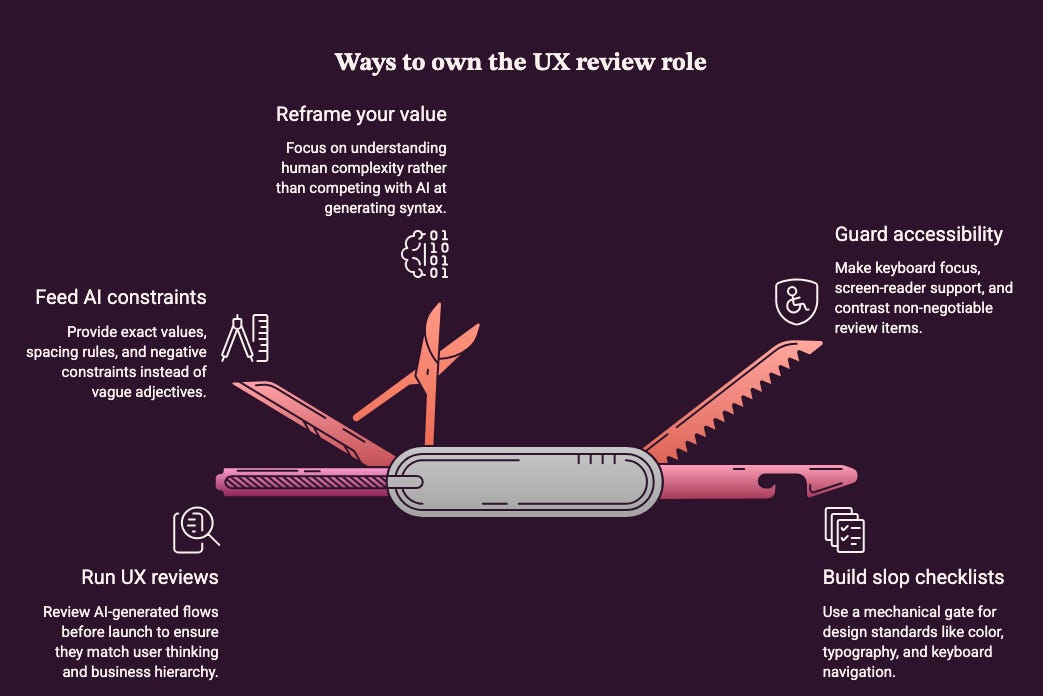
✅ Run a real UX review before it ships, not after. The single highest-leverage move. Have someone with genuine judgment review any AI-generated flow before launch, checking what the model can’t: does this match how users think, does the hierarchy reflect the business, will it survive edge cases. Most AI output can be fixed with a targeted review, not a full redesign.
✅ Build a pre-ship slop checklist. Make the mechanical tells a gate. One accent color, saturation under 80%. Real type hierarchy, not one font at every size. Proper focus states, keyboard nav, alt text. Consistent behavior for the same action. Catch the obvious floor mechanically, then spend your human judgment on composition, voice, and fit.
✅ Feed AI constraints, not adjectives. When you use AI to generate, give it exact values, named fonts, spacing rules, and a “do not do this” list. You get far less to clean up when you direct the model precisely instead of asking it to “make it nice.”
✅ Guard accessibility specifically. AI routinely skips keyboard focus, screen-reader support, and contrast. This is where the cheapest-to-prevent, most-expensive-to-fix debt lives, and it is now a legal risk. Make it a non-negotiable review item.
✅ Reframe your value in evaluation, not production. Stop competing with AI at generating syntax, the thing it does best. Position yourself around understanding human complexity, the thing it cannot do. That is where your career is safe and your judgment is worth paying for.
Quick pause. This belongs in the room.
🎯 UXCON26 · One Day · The Whole Community
The question of what UX becomes when AI generates everything, and where human judgment stays essential, is exactly the conversation the field needs to have out loud, together.
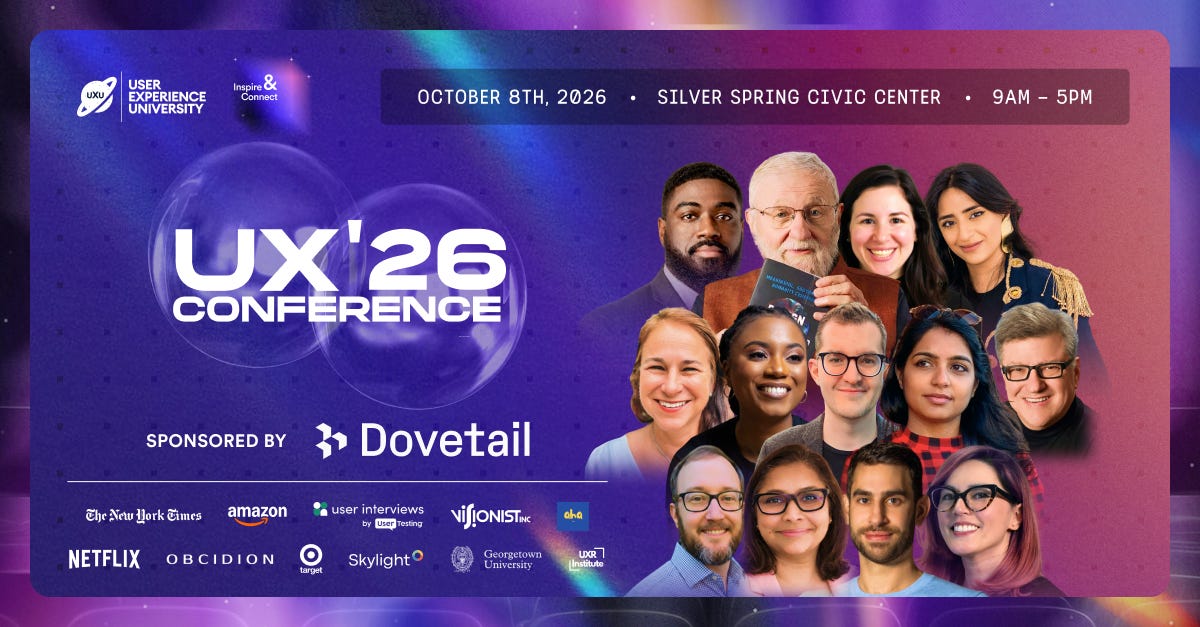
On October 8, 2026, the UX community gathers for a full day on where this work is really heading. Headlining is Don Norman, who coined the term user experience and has spent decades arguing that design is about human understanding, not output. Alongside him: practitioners from Netflix, The New York Times, Target, UserTesting, and Skylight, hosted by Jeremy Miller of the Beyond UX Design podcast.
Three keynotes. Two panels. One room.
📦 Resource Corner
The UX Designer’s Nightmare: When “Production-Ready” Becomes a Deliverable (Smashing Magazine)
The source of the Rework Tax and the hard numbers behind it. A clear-eyed look at what happens when design ships AI output without rigorous review. Essential reading.
The Custodial Era of UX: Cleaning Up After AI (DevFeed)
The piece that named this shift. Sharp on why AI builds faster than UX can evaluate, and how the field adapts by building shared judgment and faster evaluation.
AI Slop in UX: Why AI-Generated Interfaces Miss the Mark (Foundey)
The best practical guide to fixing AI slop without scrapping everything, including the “constraints, not adjectives” principle and a five-lens review framework. Directly actionable.
A Pre-Ship Design Review Checklist for AI-Generated UI
A concrete, layer-by-layer checklist for catching the mechanical tells of AI slop, palette, type, spacing, states, accessibility, motion, with the fix for each. Print it and use it as a gate.
The Design of Everyday Things by Don Norman
The foundational case that design is about human understanding, not production. More relevant than ever now that the production half is automated and the judgment half is what remains.
💭 Final Thought
Everyone is celebrating how fast AI lets us build. Almost no one is counting what it costs to fix.
That gap is the whole opportunity. When generation is free and evaluation is scarce, the scarce thing is where the value goes. Being the person who catches what AI missed is not the boring job. It is the one the whole pipeline depends on.
Review before you ship. Give constraints, not adjectives. Guard the judgment no machine has.
That is the job now.


