


Every UX person knows the rule. Test with 5 users. Jakob Nielsen said so. It is the most quoted number in the field, deployed in every sample-size debate to shut down the stakeholder who wants to interview 150 people.
Here is the problem. The rule is real, but almost everyone citing it is misusing it, and the misuse is producing shallow, misleading research dressed up as rigor.
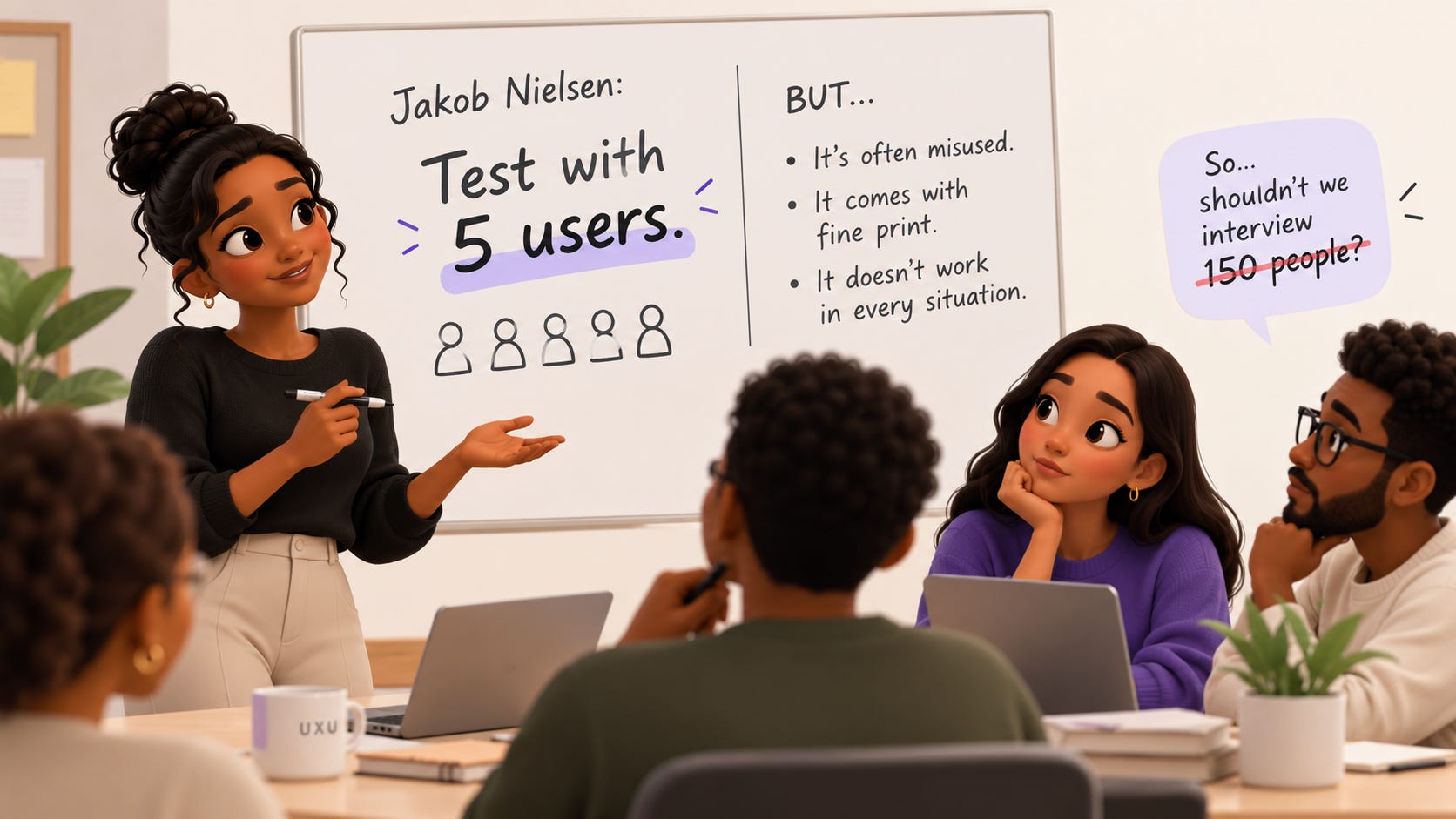
The “5 users” finding came with fine print that got stripped away somewhere around the thousandth retelling. Strip the fine print and a genuinely useful guideline becomes, in the words of one veteran researcher, “lazy UX” that is hurting more teams than it helps. This issue is what the number actually means, when it holds, when it falls apart, and how to size research to the question instead of to a myth.
In this issue:
Where the number actually came from
The fine print nobody repeats
When 5 users is genuinely wrong
The qual/quant confusion that wrecks studies
How to size research by the question
Resource Corner
Where the number actually came from
Start with the real thing, because the finding is sound. It is the application that broke.
In 1993, Jakob Nielsen and Tom Landauer published a model showing that about 5 users uncover roughly 85% of the usability problems in an interface. The logic is diminishing returns: the first few users surface the obvious issues, and each additional user increasingly finds problems you have already seen. Past five, you are mostly paying to rediscover the same things.
The practical wisdom attached to it was genuinely smart, and it is the part most people forget. Nielsen’s actual advice was not “test 5 users and stop.” It was test 5 users, then iterate, run at least three rounds. The point was to spread your budget across multiple small, cheap rounds of testing as the design evolved, rather than blowing it all on one big study at a single moment. Small sample, many iterations. That was the insight.
What survived in the culture was “test 5 users.” What got dropped was every condition that made it true, and all the nuance about iteration. That gap is where the damage lives.
The fine print nobody repeats
Here is what the 5-user rule actually requires, none of which makes it into the average sample-size argument.
First, the 85% figure holds only when each problem has roughly a 31% discovery rate, meaning each issue is likely to be caught by about one in three users. For subtle problems that only some users hit, the discovery rate is far lower, and 5 users will miss a lot of them. The clean “85%” assumes an average that does not hold for every kind of issue.
Second, and this is the big one: it is 5 users per segment. The rule applies to a single, homogeneous group of users. If your product serves distinct audiences, say, new users and power users, or clinicians and patients, each group needs its own ~5. A product with three real user types does not need 5 participants. It needs closer to 15, and testing 5 across all three tells you very little about any of them.
Third, it applies to qualitative problem discovery only. It answers “what is broken here,” not “how many of our users does this affect” or “did task success actually improve.” The moment your question becomes a measurement, 5 users is not a small sample. It is statistical noise.
Three conditions. Strip any one and the number stops meaning what people think it means. Most citations strip all three.
When 5 users is genuinely wrong
Put the fine print into practice and you can see exactly where “just test 5” quietly fails teams.
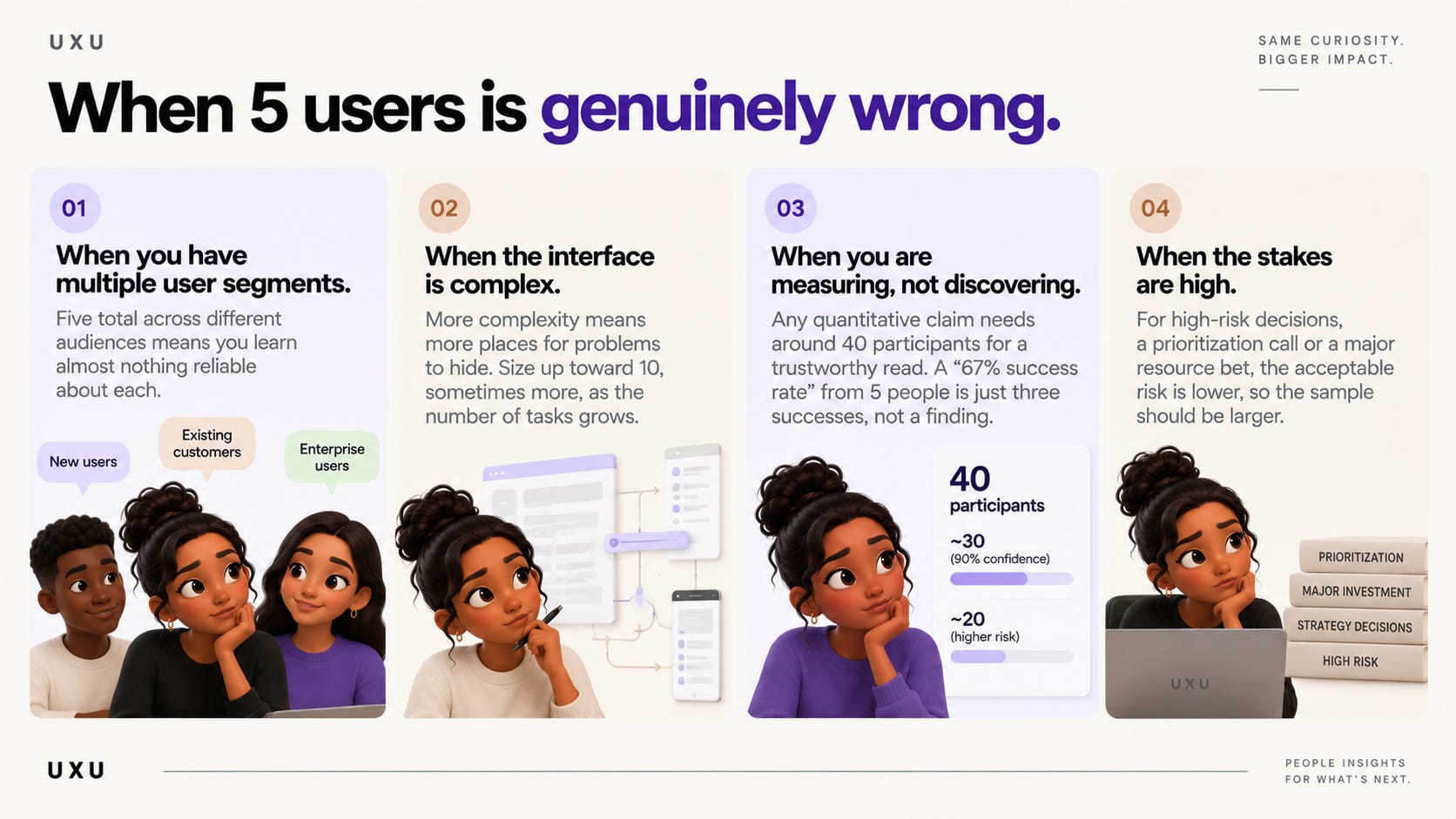
🔴 When you have multiple user segments. The most common failure. Five total across three distinct audiences means you learned almost nothing reliable about each. Size up to cover each group.
🔴 When the interface is complex. More complexity means more places for problems to hide, many with low discovery rates. Sources suggest sizing up toward 10, sometimes more, as complexity and the number of distinct tasks grow. Five users cannot cover a dense, multi-path product.
🔴 When you are measuring, not discovering. Any quantitative claim, task success rate, time on task, a SUS score, needs around 40 participants for a trustworthy read on a population over 500. You can drop to ~30 at 90% confidence, or ~20 if you accept real risk, but 5 is not in the conversation. A “67% of users succeeded” statistic from 5 people is three successes. That is not a finding. That is anecdote with a percent sign.
🔴 When the stakes are high. The whole 5-user logic rests on the cost of being somewhat wrong being low enough to accept. For a high-risk decision, a prioritization call, a major resource bet, the acceptable risk is lower, so the sample should be larger.
The through-line: 5 users is a floor for cheap, early, single-segment problem discovery. It was never a universal answer.
The qual/quant confusion that wrecks studies
Underneath most sample-size mistakes is one deeper confusion, and naming it fixes a lot.
Qualitative and quantitative research answer different questions and therefore need different sample sizes. Qualitative asks why is this happening and needs just enough people for themes to repeat, roughly 5 to 12, because most qualitative themes emerge within that range. Quantitative asks how many users does this affect, or how much did this improve, and needs enough people for the numbers to be stable, around 40.
When a stakeholder says “let’s interview 150 users” for a qualitative study, they are applying quantitative logic to a qualitative question, and wasting money on repetition. When a team reports a confident percentage from a 5-person test, they are applying qualitative logic to a quantitative question, and producing a number that cannot bear weight. Both errors come from the same root: not knowing which kind of question they are actually asking.
Get that straight first, and the sample size mostly answers itself. The question determines the method. The method determines the number. “5 users” is the answer to exactly one narrow version of one of those questions.
How to size research by the question
Stop starting with a number. Start with the question, then let it set the size. A practical framework:
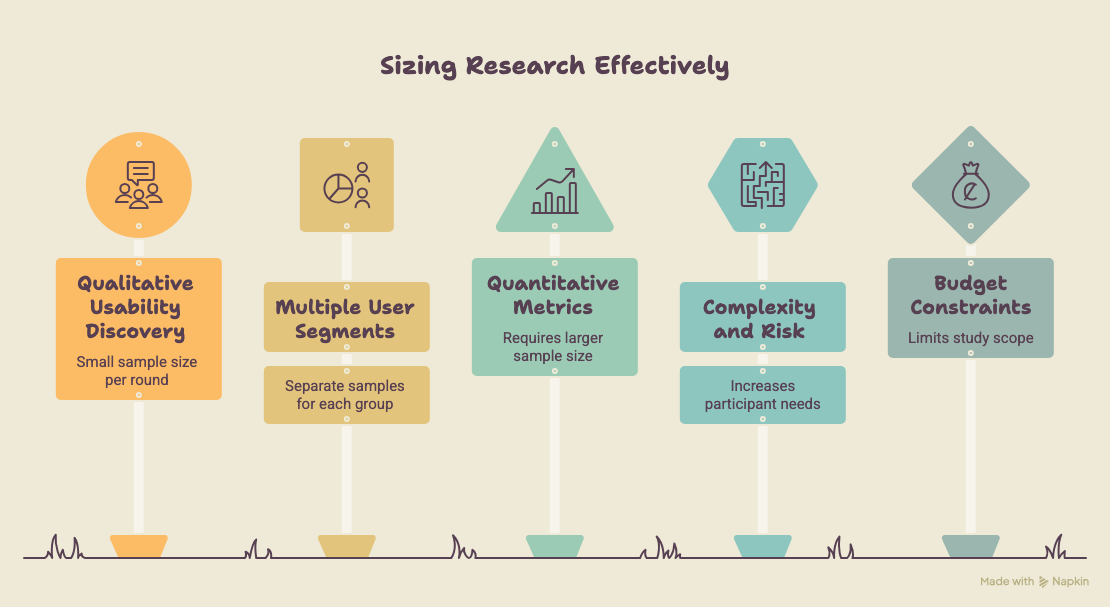
✅ Qualitative usability discovery, one segment: 5 to 8 per round. Finds most major issues fast. Then iterate across multiple rounds rather than piling users into one study. This is the real 5-user rule, used correctly.
✅ Multiple segments: ~5 to 8 per segment. Do not average across audiences. Each distinct user group gets its own small sample, so three segments means roughly 15 to 24 total.
✅ Quantitative metrics: ~40 participants. Any time you want a percentage, a benchmark, or a before/after comparison you can trust, size for statistics. Drop to ~30 or ~20 only when you consciously accept more risk.
✅ Scale up for complexity, risk, and specificity. The harder the interface, the higher the stakes, or the more specific your recruiting criteria, the more participants you need. Low-stakes and simple, lean small. High-stakes and complex, invest more.
✅ Spend the budget on more studies, not more users per study. Nielsen’s actual wisdom. The highest return usually comes from running several focused rounds as the design evolves, not one oversized study at a single point in time. One modern upside: AI-moderated interviews now make larger, better-segmented studies far cheaper, so the old “we can only afford 5” constraint is loosening.
📦 Resource Corner
How Many Users Do You Need for Usability Testing? The “5 Users” Rule, Revisited (2026) (Koji)
The clearest current breakdown of the fine print, especially the 31% discovery rate and the per-segment condition. The single best read for understanding what the rule actually claims. Start here.
UX Research Sample Size: How Small Is Small Enough? (LogRocket)
Excellent on the qualitative versus quantitative distinction and why mixing them wrecks studies. Includes a practical framework for sizing by goal. Highly actionable.
How Many Participants for Quantitative Usability Studies (Nielsen Norman Group)
The authoritative explanation of the 40-participant guideline, including the assumptions behind it and when you can responsibly go lower. Essential for anyone reporting metrics.
The 5 User Sample Size Myth by Frank Spillers
A pointed critique from two decades of practice on how the rule became “lazy UX.” A useful counterweight that will make you question any number you cite reflexively.
How Many Research Participants Do You Need? (Maze)
A clean, practical reference table of starting sample sizes across methods, first-click, moderated, unmoderated, surveys. Good to keep on hand when planning any study.
💭 Final Thought
“Test 5 users” survived because it is short, confident, and ends arguments. That is exactly why it is dangerous. A rule simple enough to repeat forever is simple enough to misapply forever.
The real skill was never knowing the number. It is knowing the question. What are you actually trying to learn, why is it happening or how many does it affect, one audience or several, discovery or measurement. Answer that honestly and the right sample size falls out of it.
Stop reaching for the magic number. Start with the question. The number is the last step, not the first.


