


You have heard it in feedback. “Great execution, but they need to work on their product sense.” You have seen it in job posts. You have watched someone get promoted because they “just have good product sense,” said the way people describe someone who is naturally tall.
And you have probably quietly wondered if you have it, or if it is one of those things you either possess or you don’t.
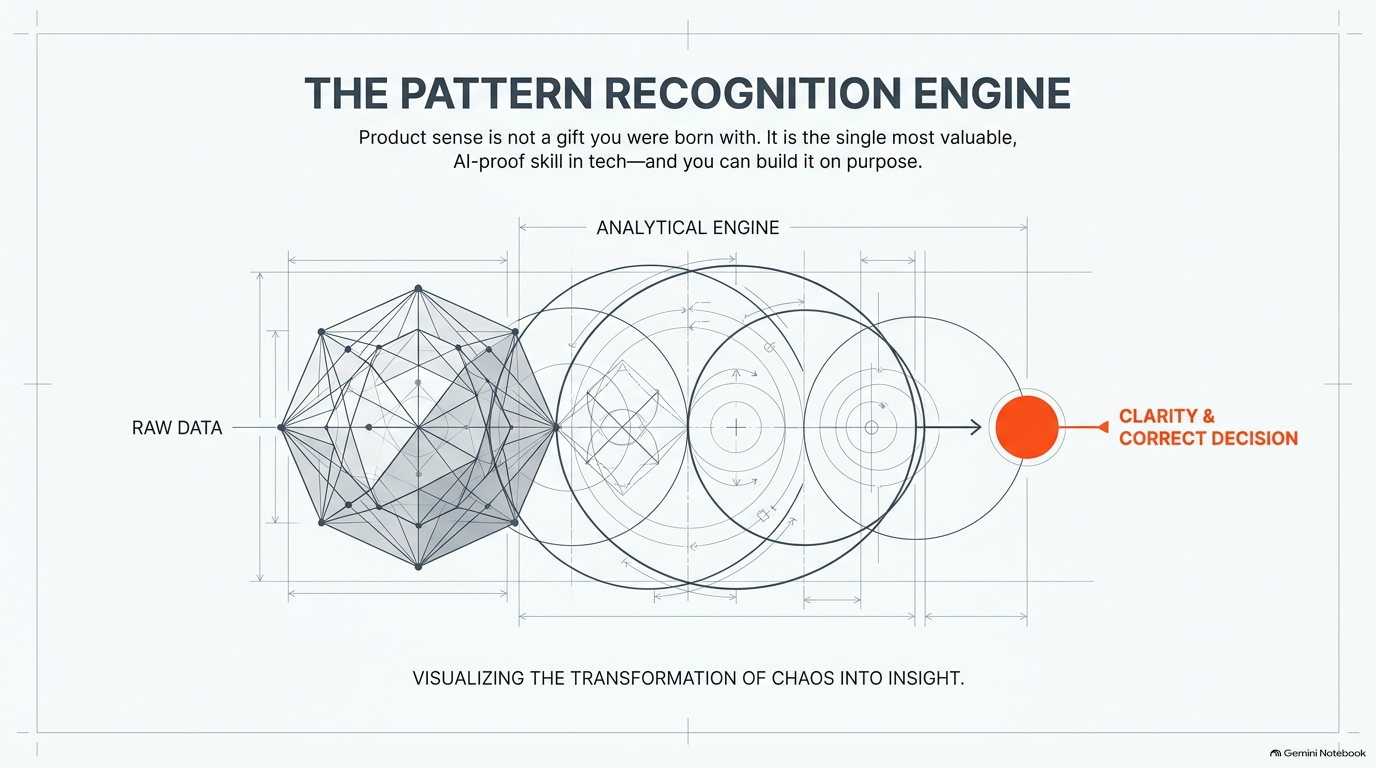
Here is the reframe that changes everything: product sense is not intuition, not taste, not a gift. It is pattern recognition built through experience, and that means it can be built on purpose. It is also, right now, becoming the single most valuable thing a designer or researcher can have, for a reason that has everything to do with AI. This issue is what product sense actually is, and how to build it deliberately instead of waiting to be born with it.
In this issue:
Why the word “sense” is misleading everyone
The real definition nobody gives you
Why AI just made this the skill that matters most
What product sense is not
How to build it deliberately
Resource Corner
Why the word “sense” is misleading everyone
The problem starts with the name. “Sense” implies a sixth sense, intuition, something you feel rather than something you learned. That framing does real damage, because it tells people it is innate, and if it is innate, there is no point trying to build it.
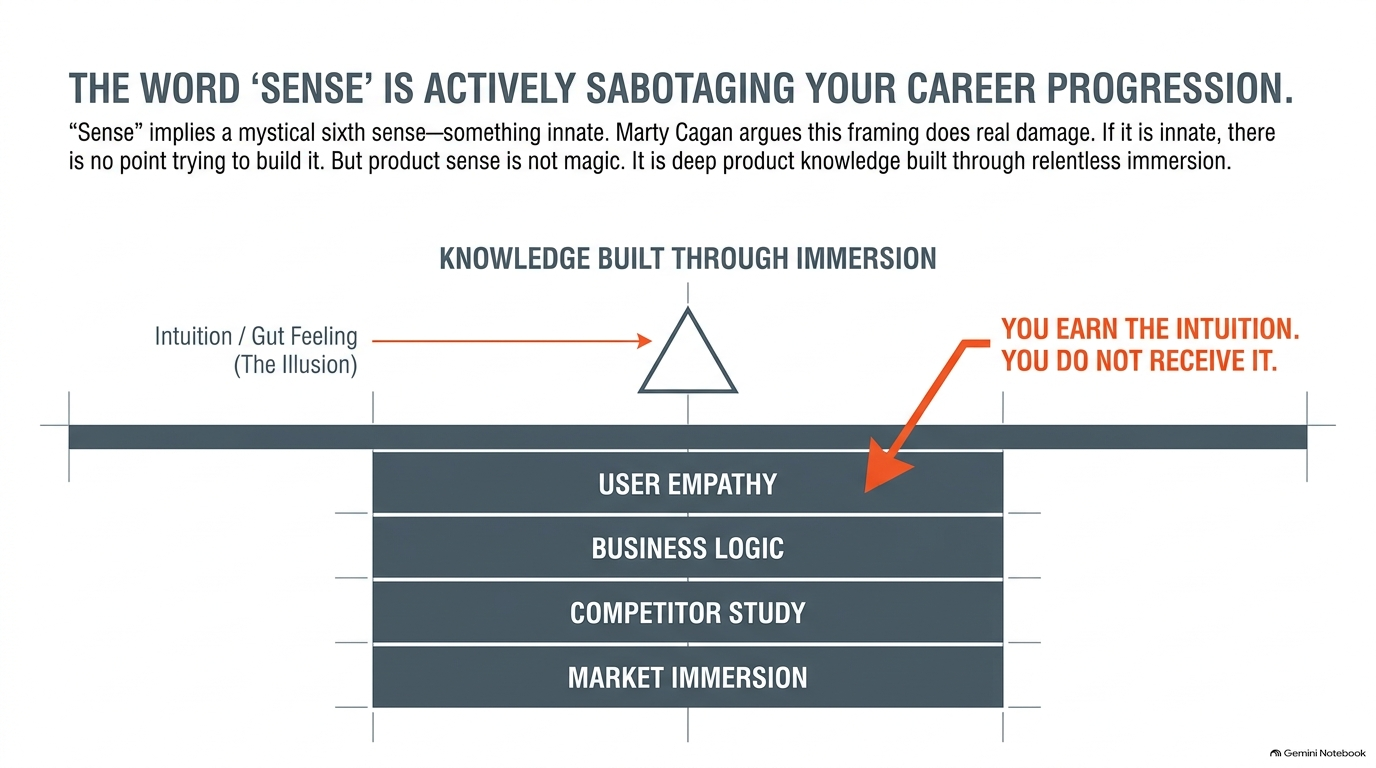
Marty Cagan of the Silicon Valley Product Group argues the term is actively misleading. It suggests a gift when, in reality, strong product sense is better described as deep product knowledge built through immersion. Not a sixth sense. A foundation. Built by spending real time with customers, studying competitors, and absorbing how the market actually behaves.
In other words, the “sense” is not magical. It is pattern recognition that emerges from repeated exposure. The person who “just knows” which idea will work is not psychic. They have seen enough attempts succeed and fail that they can predict the pattern. They earned the intuition. They did not receive it.
This matters because it flips the whole thing from a fixed trait into a trainable skill. Nobody is born with product sense any more than they are born knowing which chess moves are strong. Both come from volume, feedback, and attention over time.
Quick pause.
🎯 UXCON26 · One Day · The Whole Community
Product sense is built by exposure, to real decisions, real outcomes, and people who have made the hard calls. A room full of them is one of the fastest ways to accelerate it.
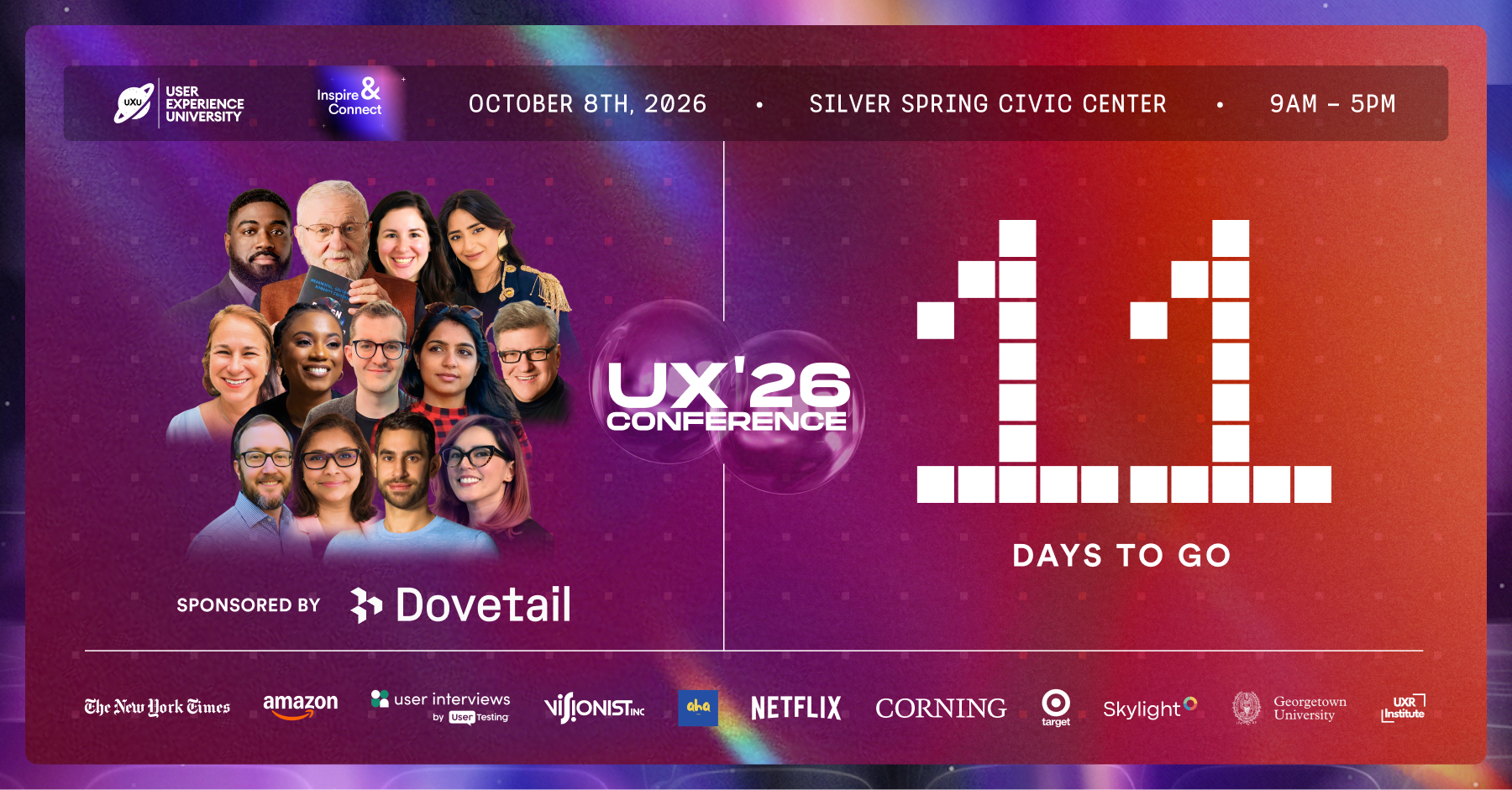
On October 8, 2026, the UX community gathers for a full day with people who decide what gets built, not just how. Headlining is Don Norman, who coined the term user experience and has spent his career on the judgment behind great products. Alongside him: practitioners from Netflix, The New York Times, Target, UserTesting, and Skylight, hosted by Jeremy Miller of the Beyond UX Design podcast.
Three keynotes. Two panels. One room.
The real definition nobody gives you
Strip away the vague versions and a concrete definition emerges. The sharpest one comes from framing product sense as predicting which product decisions will succeed based on patterns learned through experimentation, and knowing when those patterns apply.
Sit with that, because the second half is the part everyone misses. Product sense is not just having patterns. It is knowing when a pattern applies and when it doesn’t. A junior might learn “simpler onboarding converts better” and apply it everywhere. Someone with real product sense knows the specific contexts where that holds and the ones where it breaks. The judgment is in the boundaries of the pattern, not just the pattern itself.
Shreyas Doshi, who led product at Stripe, Google, and Twitter, puts it as the ability to make correct product decisions even under considerable ambiguity. That is the heart of it. Product sense is what you use when the data is incomplete, the answer is unclear, and you still have to decide what to build. It operates at every level, from “what should we build at all” down to the smallest interaction detail.
And notice the through-line across every serious definition: it rests on two things. Empathy to discover what users actually need, and enough accumulated pattern knowledge to know what will address that need. Real user understanding plus earned pattern recognition. That combination is product sense. Neither half alone is enough.
Why AI just made this the skill that matters most
Here is why this suddenly matters more than it did two years ago, and it is the sharpest point in this whole issue.
AI can now handle many of the tasks that once made product builders valuable. It generates layouts, writes code, drafts flows, produces variations. The “how to build it” work is getting automated fast. What is left, the part AI cannot do, is deciding what to build and whether it will actually succeed. That decision is product sense.
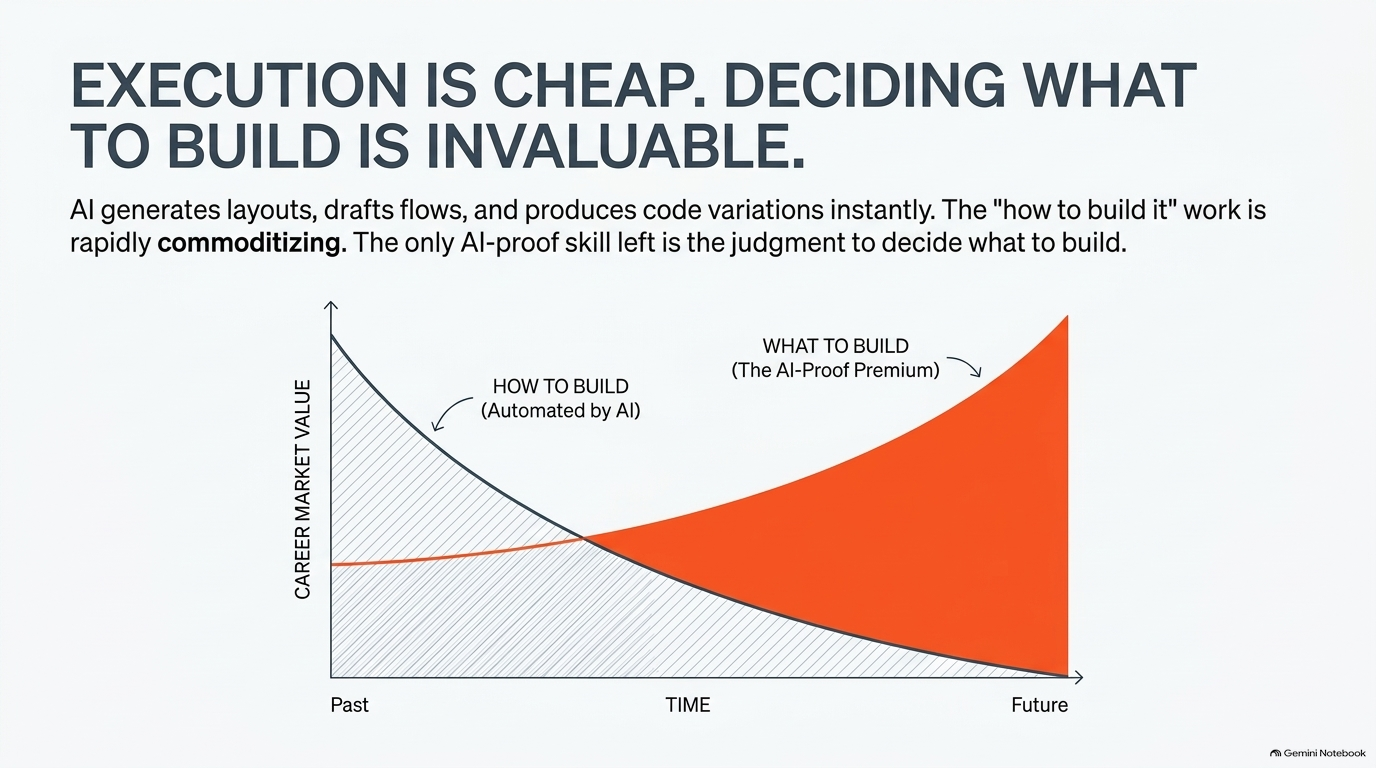
The pressure this creates is already showing up in hiring. Designers and engineers are under growing pressure to decide what to build, not just how to build it, and that shift is exactly what fueled the rise of “product sense” as a term. Companies do not need more people who can execute. Execution is cheap now. They need people who can make the right call under ambiguity, and that is the scarce, expensive, AI-proof skill.
There is a clear career signal in this too. When designers try to move into product design, the biggest barrier is never tools or technical skill. It is product sense and business thinking. It is the hardest skill to master, and it is precisely what separates good designers from the ones who get paid extraordinary amounts. In an AI world, the gap between “can execute” and “can decide” is the gap between commoditized and invaluable.
What product sense is not
Clearing up the confusion is half the battle, because people chase the wrong thing.
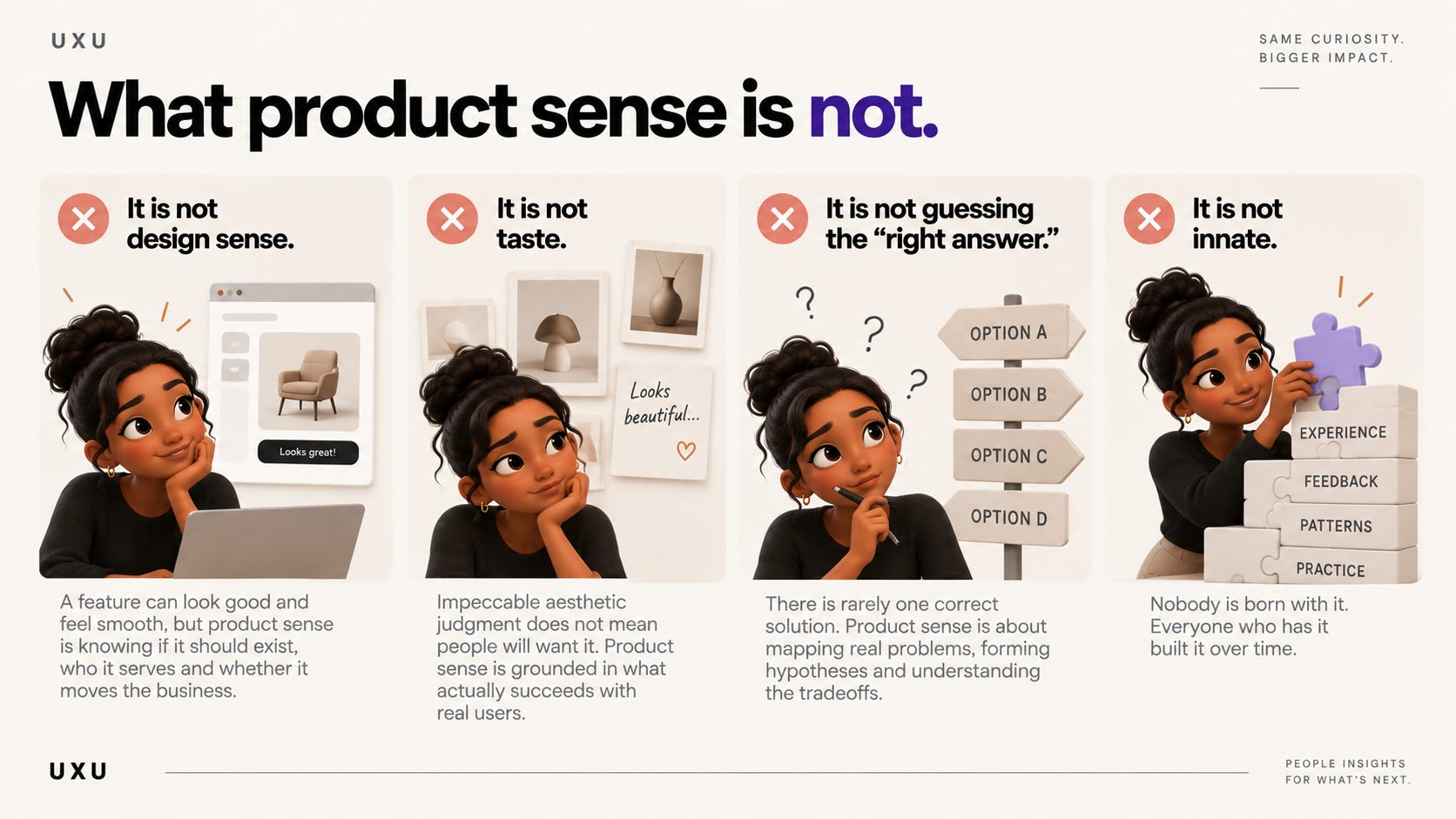
🔴 It is not design sense. The most common mistake, especially for designers, is shrinking product sense down to the interface. Making a feature look good and feel smooth is design sense. Product sense is knowing whether that feature should exist at all, who it serves, and whether it moves the business. The UI is a small slice of a much bigger judgment.
🔴 It is not taste. Taste without market truth is just opinion. You can have impeccable aesthetic judgment and consistently build things nobody wants. Product sense is grounded in what actually succeeds with real users, not in what you personally find elegant.
🔴 It is not guessing the “right answer.” There usually isn’t one. Product sense is not the ability to divine the single correct solution. It is the ability to map the real problems, form reasonable hypotheses, understand the tradeoffs of each path, and know what to ask next. It is a way of reasoning through ambiguity, not a crystal ball.
🔴 It is not innate. The whole premise. Nobody arrives with it. Everyone who has it built it, whether they realize it or not.
How to build it deliberately
Since it is pattern recognition, you build it by deliberately accumulating patterns and feedback. Concretely:
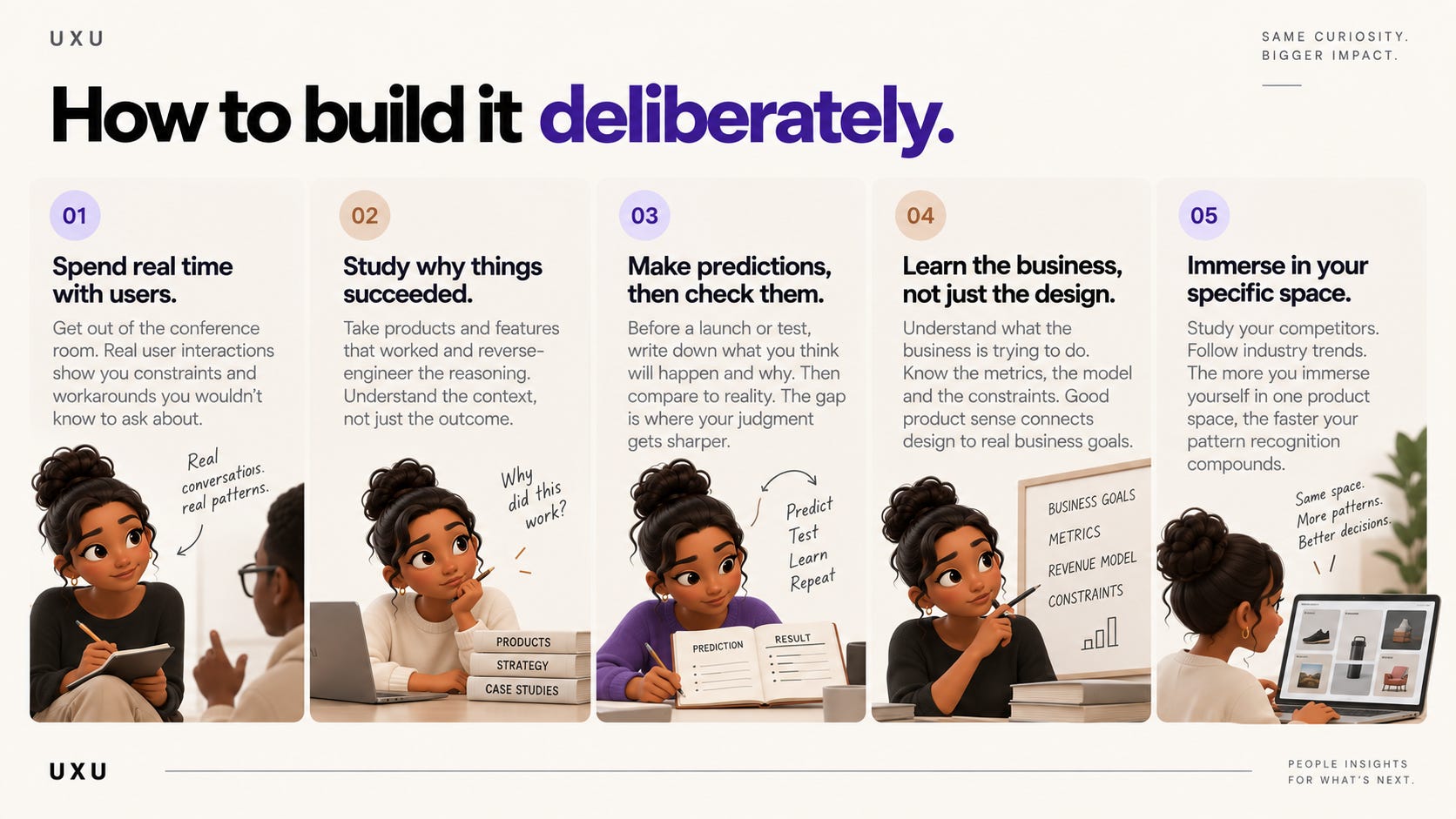
✅ Spend real time with users, not summaries of users. You cannot build product sense in a conference room. Field studies and contextual inquiry expose the constraints and workarounds people never articulate, the things you would not know to ask about. Every real user interaction adds a pattern. Secondhand summaries do not stick the same way.
✅ Study why things succeeded, not just that they did. Take products and features that worked and reverse-engineer the reasoning. Why did this decision land? What context made it right? Doing this repeatedly builds the causal models that let you predict, rather than just memorize surface rules.
✅ Make predictions, then check them. This is the engine. Before a launch or a test, write down what you think will happen and why. Then compare to reality. The gap between your prediction and the outcome is exactly where product sense grows. Patterns without feedback loops never sharpen into judgment.
✅ Learn the business, not just the design. Product sense requires understanding what the business is trying to do and caring about it. Know the metrics, the model, the constraints. A design decision disconnected from business context cannot have good product sense behind it.
✅ Immerse in your specific space. Cagan’s core point: deep product knowledge comes from immersion. Study your competitors relentlessly. Absorb your industry’s trends. The more saturated you are in one product space, the faster your pattern recognition compounds within it.
📦 Resource Corner
A Concrete Definition of “Product Sense” (and How to Build It) (Nielsen Norman Group)
The sharpest definition available: product sense as predicting which decisions succeed based on patterns from experimentation. Directly addresses why AI makes this the skill that matters. Start here.
What Is Product Sense? 2026 Guide to Building the Skill (Parallel)
A thorough synthesis of how experts from Cagan to Doshi define product sense, and why it is knowledge built through immersion rather than a gift. Excellent for the full picture.
Product Sense Interview Prep 2026 (Exponent)
Practical framing of how product sense is actually tested and evaluated, useful whether you are interviewing or just want a structured way to practice the reasoning. Covers segmenting users and connecting decisions to impact.
Inspired by Marty Cagan
The foundational book on building products people want, from the person who reframed product sense as deep product knowledge. The best long-form investment for building the underlying judgment.
The Mom Test by Rob Fitzpatrick
A short, practical book on talking to users so you actually learn the truth, the raw material product sense is built from. Essential for making your user immersion actually count.
💭 Final Thought
The most freeing thing about product sense is that it was never a gift.
Every person you have watched “just know” the right call built that knowing the slow way: real users, real outcomes, real predictions checked against reality. You can build it the same way, starting now.
Spend time with users. Predict what will work. Check if you were right. Repeat until the pattern lives in you.
That is the skill AI can’t touch. Go build it on purpose.


