


Ask a room of UX practitioners what they should be learning to get ahead, and most will name a tool. A new Figma feature. An AI plugin. A prototyping technique. The instinct is that career growth comes from sharpening the craft.
The data says something uncomfortable. When the Interaction Design Foundation asked hiring managers worldwide to name the top three skills they look for in a UX candidate, roughly 73% chose communication and problem-solving. Proficiency in design tools, the thing so many practitioners spend their energy on, was chosen by only 13%.
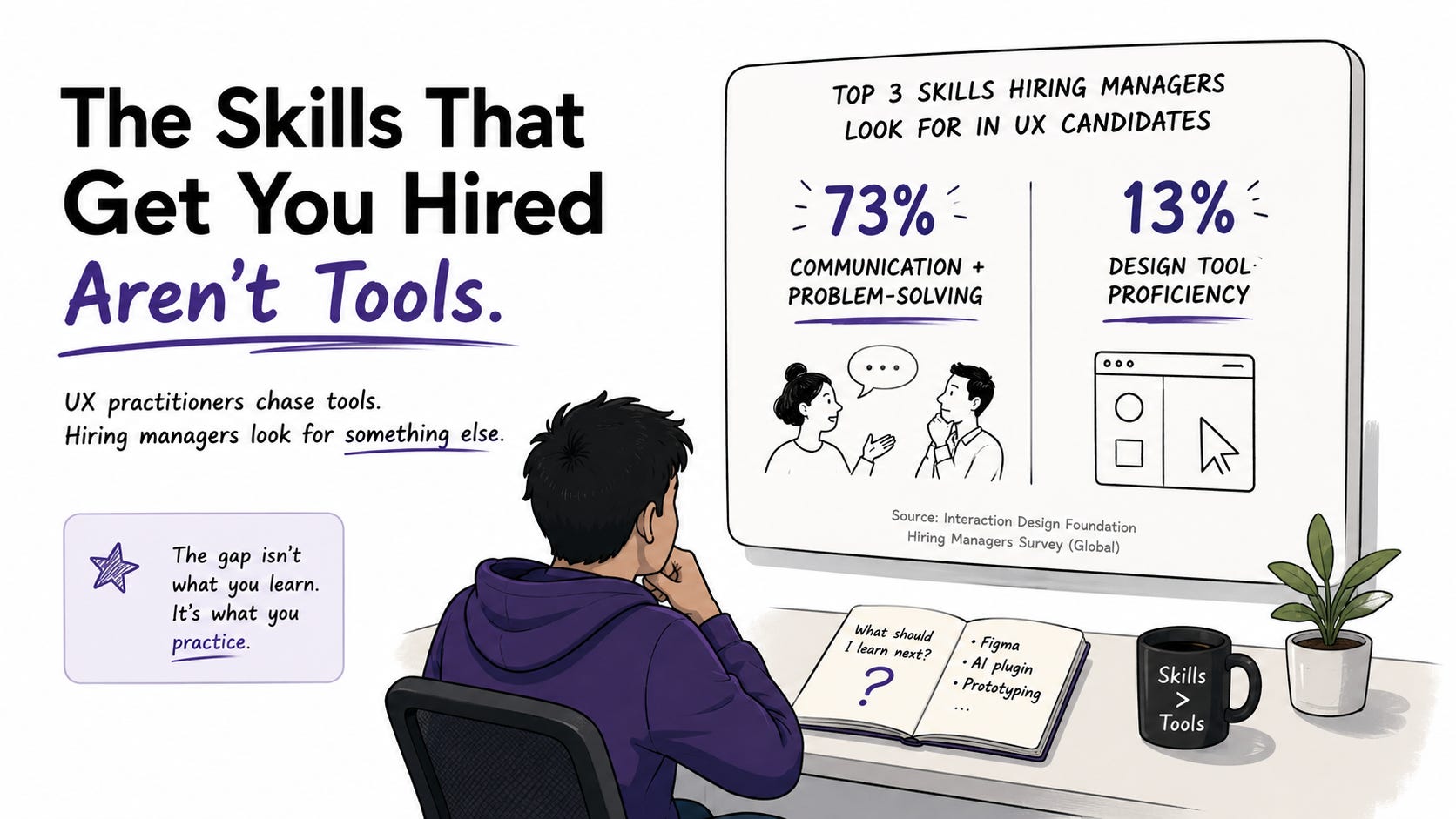
Read that gap again. The skills you were told to master are the ones hiring managers care about least. The skills that actually determine who gets hired, who advances, and who stalls are the ones almost nobody deliberately trains for. This issue is about those skills, why they matter more every year, and how to actually get better at them.
In this issue:
Why tools stopped being the differentiator
Communication is the whole job in disguise
The skill that separates juniors from seniors
Listening: the underrated half of research
How to actually build these
Resource Corner
Why tools stopped being the differentiator
There was a time when tool proficiency genuinely set people apart. Knowing Figma well, or Sketch before it, was a real advantage because not everyone had it.
That time is over. Tool fluency has become table stakes, the baseline everyone is assumed to have, not the thing that distinguishes you. And AI has accelerated this dramatically. When AI can generate a wireframe, draft copy, and produce a prototype, the value of being fast in a tool drops. The value of knowing what to build, why, and how to bring people along rises.
This is why the framing among people who hire is shifting. It is not enough to just make things intuitive anymore. With AI, strategy, and stakeholder battles entering the picture, what matters is being able to say, in effect, “yes, I can handle Figma, and I can also handle the room.” The room is the harder part. The room is where careers are actually decided.
The practitioners who struggle most are often the most technically skilled ones who assumed the craft would speak for itself. It does not speak. Someone has to speak for it, and that someone is you, using skills that no tool tutorial ever taught.
Quick pause. This belongs in the room.
🎯 UXCON26 · One Day · The Whole Community
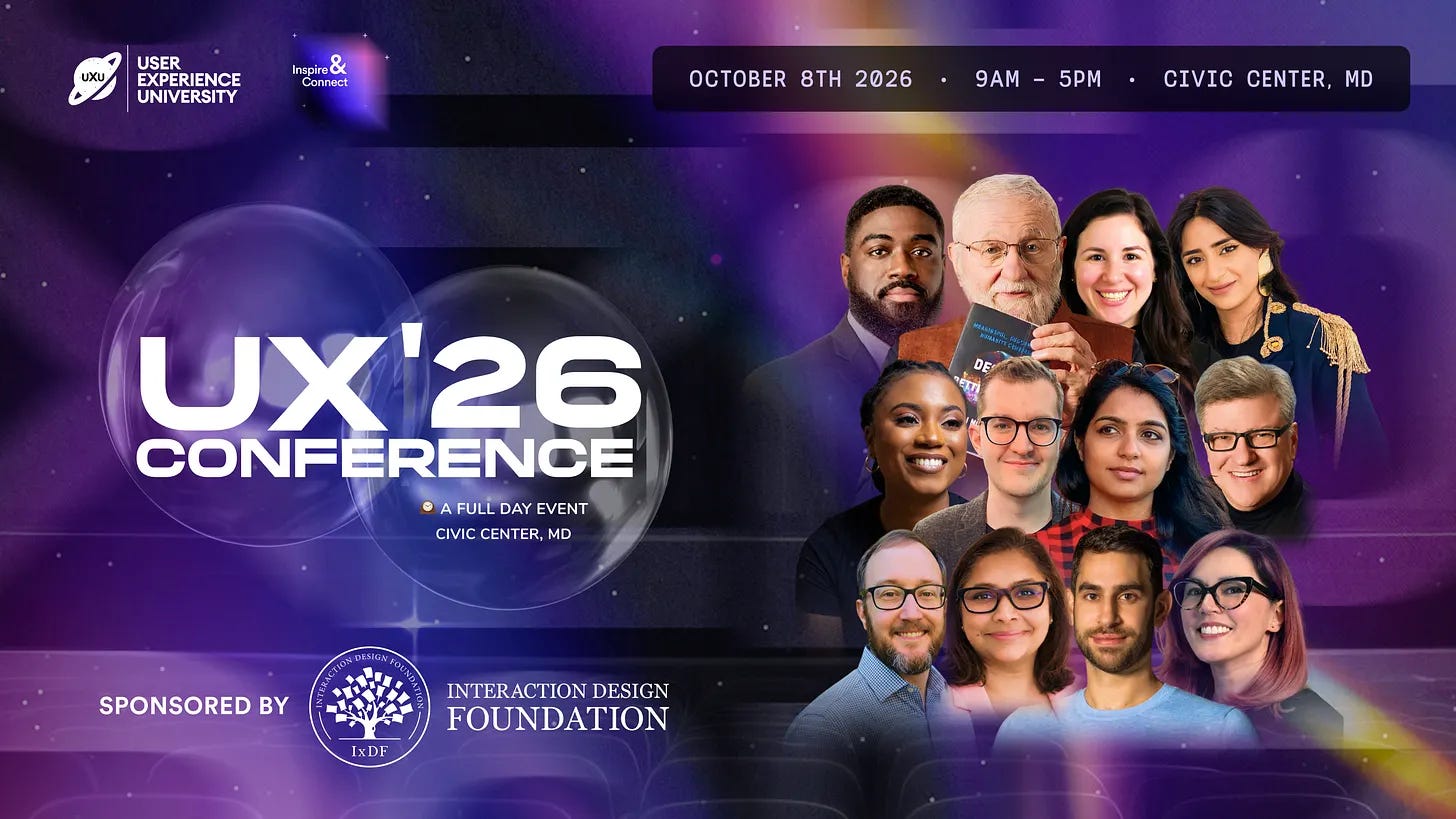
Questions like this one, what it actually takes to make AI trustworthy through design, are exactly the conversations the field needs to have out loud, together.
On October 8, 2026, the UX community comes together for a full day built around where this work is really heading. Headlining is Don Norman, the person who coined the term user experience, at 88 still publishing and still pushing this field to be braver than it is comfortable being. Alongside him are practitioners from Netflix, The New York Times, Target, UserTesting, and Skylight, hosted by Jeremy Miller of the Beyond UX Design podcast.
The conversations that stay with you long after the day ends. You wouldn’t want to miss this.
Communication is the whole job in disguise
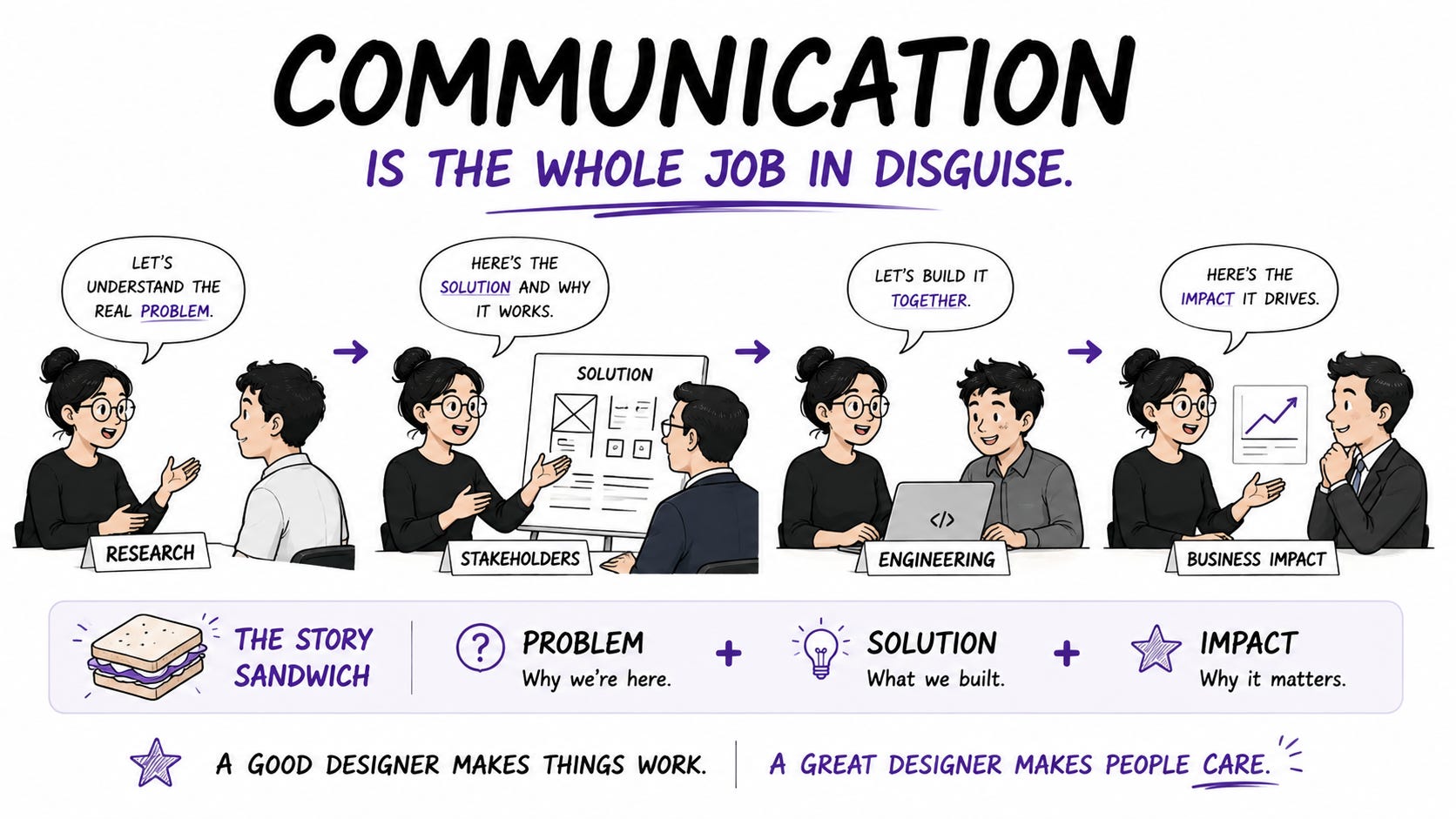
When people hear “communication skills,” they think of presenting well. That is a small slice of it. In UX, communication is woven into nearly everything you do, which is exactly why it matters so much.
Consider where communication actually shows up in the work: building rapport with participants so they give you honest, useful insights in research. Pitching ideas to business stakeholders who do not speak design. Collaborating with engineers to bring designs to life without losing intent in translation. Selling the value of UX itself to management. Facilitating brainstorms that actually go somewhere. Nearly every high-value UX activity depends on communication as the delivery mechanism.
Here is the failure mode, described bluntly by one industry writer: most designers communicate like they are translating ancient hieroglyphics, using jargon that would make a consultant blush and presenting work like they are defending a PhD thesis. The user need was real. The solution was good. But it died in the gap between the work and the ability to explain it in language a non-designer could hold onto.
A useful fix is the “story sandwich.” Structure any explanation of your work as Problem (why we are here), Solution (what we built), Impact (why it matters). Three parts, in plain language. And a test worth using: practice explaining your designs to non-designer friends first. If they get it, stakeholders will too. If they do not, you are not ready to present.
The reframe that matters: a technically average designer who can tell the story behind their choices and defend them will always have more impact than a brilliant one who cannot. That is not cynical. That is how influence works in every organization.
The skill that separates juniors from seniors
If you want to know what actually distinguishes a senior UX practitioner from a junior one, it is rarely craft. Both can often produce similar quality work. The difference is the ability to navigate the business environment around the work.
These soft skills are what separate junior designers from seniors in the role. A junior does the work and hands it over. A senior does the work and manages the room around it: aligns stakeholders, defends decisions with evidence rather than opinion, handles objections without getting defensive, and keeps a project moving through the organizational friction that would otherwise stall it.
Part of this is emotional intelligence, the ability to step outside your own bias, put yourself in the user’s shoes, and genuinely feel their frustration. That empathy is the intellectual core of user-centered design, and it extends to the people you work with, not just the people you design for. Reading a room, sensing when a stakeholder is unconvinced, knowing when to push and when to listen, these are senior-level skills, and they are entirely human.
The other part is the ability to sell a vision. You are constantly pitching to people who do not speak design, which means you need to tell a compelling story about the user’s journey that connects to what those people actually care about. A senior practitioner does not present features. They tell the story of a user, a problem, and an outcome the business recognizes as valuable.
None of this shows up in a tool. All of it shows up in a promotion conversation.
Listening: the underrated half of research
Communication gets talked about as an output skill, how well you speak and present. But the most valuable communication skill in UX is an input skill, and it is badly underrated: active listening.
You will spend enormous amounts of time gathering information, from users, from stakeholders, from teammates. How well you actually hear them determines the quality of everything downstream. In research especially, your attentiveness determines how well you understand user needs, feedback, and insights, all of which drive whether the product you build is any good.
Here is the trap: people assume listening is passive and automatic, that there is nothing difficult about it. That is false. Real active listening requires deliberate, conscious effort and sustained focus. It means fully concentrating on what someone is saying instead of waiting for your turn to talk, resisting the urge to fill silences, and staying curious about answers that do not match what you expected.
The payoff is direct. In research, the difference between a participant who gives you surface answers and one who tells you what they actually think is usually the researcher’s ability to build rapport and listen without leading. In stakeholder work, addressing someone’s real concern requires first genuinely hearing what it is, rather than the objection you assumed they had.
The best practitioners talk less than you would expect. They ask a good question, then get out of the way and actually hear the answer.
How to actually build these
Soft skills feel vague, which makes them feel unlearnable. They are not. They are learned through deliberate practice, just differently than tools.
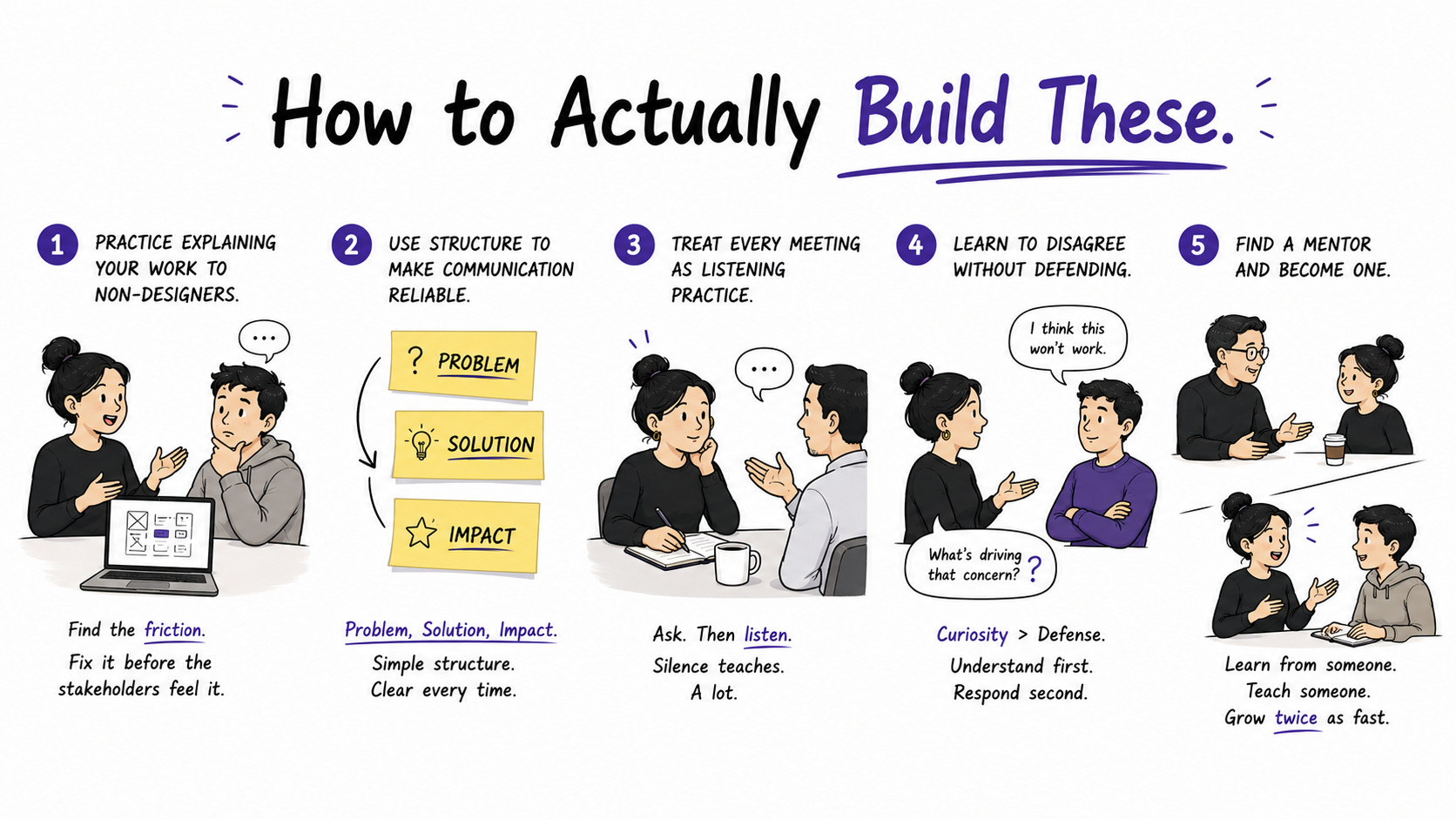
✅ Practice explaining your work to non-designers
The single highest-leverage habit. Take any project and explain it to someone outside the field until they understand it. The friction you hit is exactly the friction stakeholders feel. Fix it there, in low stakes, before it costs you in a real meeting.
✅ Use structure to make communication reliable
You do not have to be naturally charismatic. Use frameworks. The story sandwich (Problem, Solution, Impact) turns a rambling explanation into a clear one every time. Structure is what makes good communication repeatable rather than dependent on mood.
✅ Treat every meeting as listening practice
In your next stakeholder or research conversation, deliberately talk less. Ask a question, then let the silence sit. Notice how much more you learn. Active listening improves fastest when you consciously practice restraint.
✅ Learn to disagree without defending
When someone pushes back on your work, practice responding with a question (”what’s driving that concern?”) instead of a defense. This one shift, from defending to understanding, is what separates practitioners who build trust from those who create friction.
✅ Find a mentor and become one
These skills transfer through people, not manuals. Seek someone who navigates organizations well and watch how they do it. Then mentor someone junior, because teaching a skill is how you actually understand it. Both accelerate your growth in ways no course can.
📦 Resource Corner
Key Soft Skills to Succeed as a UX Designer (Interaction Design Foundation)
The source of the 73% versus 13% data, with a strong breakdown of why communication underpins nearly every UX activity. Includes a great video from a Head of Product Design on why your ideas need you to speak for them.
Articulating Design Decisions by Tom Greever
The definitive book on communicating design work to stakeholders who do not speak design. Directly addresses the gap between doing good work and getting it approved. If you read one thing on this, read this.
How to Improve Communication Skills as a UX Designer (UX Playbook)
Ten practical, specific steps for handling feedback, presenting ideas, and holding your ground in sprint planning. Actionable rather than abstract.
Just Listen by Mark Goulston
The best book on active listening, written by a psychiatrist. Not a UX book, but the single most useful thing you can read to improve the input side of your communication, which research depends on entirely.
Storytelling for Designers (Nielsen Norman Group)
Practical guidance on using narrative to make your work land with stakeholders. Storytelling is the format that turns a good design decision into one people remember and support.
💭 Final Thought
There is a quiet unfairness in how this field is taught. Newcomers are handed tool tutorials and technique guides, given the clear impression that mastering the craft is the path forward. Then they get into the work and discover that the craft was the easy part, and the actual determinant of their career is a set of skills nobody put on the syllabus.
But there is freedom in knowing this early. The skills that matter most, communicating clearly, listening deeply, telling the story of your work, navigating the people around it, are all learnable. They are not innate gifts reserved for naturally charismatic people. They are practiced, refined through real interactions, and improved deliberately over time, exactly like any craft skill.
The practitioners who pull ahead are not the ones with the deepest tool knowledge. Tools change every year anyway. They are the ones who can take good work and make a room believe in it, who can hear what a user actually means, who can turn a design decision into a story a stakeholder remembers.
You already have the hard skills, or you can get them. Now build the ones that actually decide how far they take you.
Start with the next conversation you have.


