


A stakeholder sends a message.
“We need to add a dashboard.”
Someone else agrees. The product manager adds it to the roadmap. The designer starts exploring layouts. Engineering estimates the work.
A few weeks later, the dashboard ships.
Everyone celebrates.
Then the next request arrives.
“We should also add custom reports.”
And just like that, the team is back where it started.
Nobody has stopped to ask whether the dashboard solved the original problem. Nobody has checked whether people use it. Nobody has questioned whether a simpler improvement could have achieved the same result.
The team is busy. The roadmap is moving. Features are shipping.
But is the product actually getting better?
This is the problem with what product people often call a feature factory: an environment where success is measured by how much the team ships rather than what changes for the people using the product.
It can look like productivity. It can even look like progress.
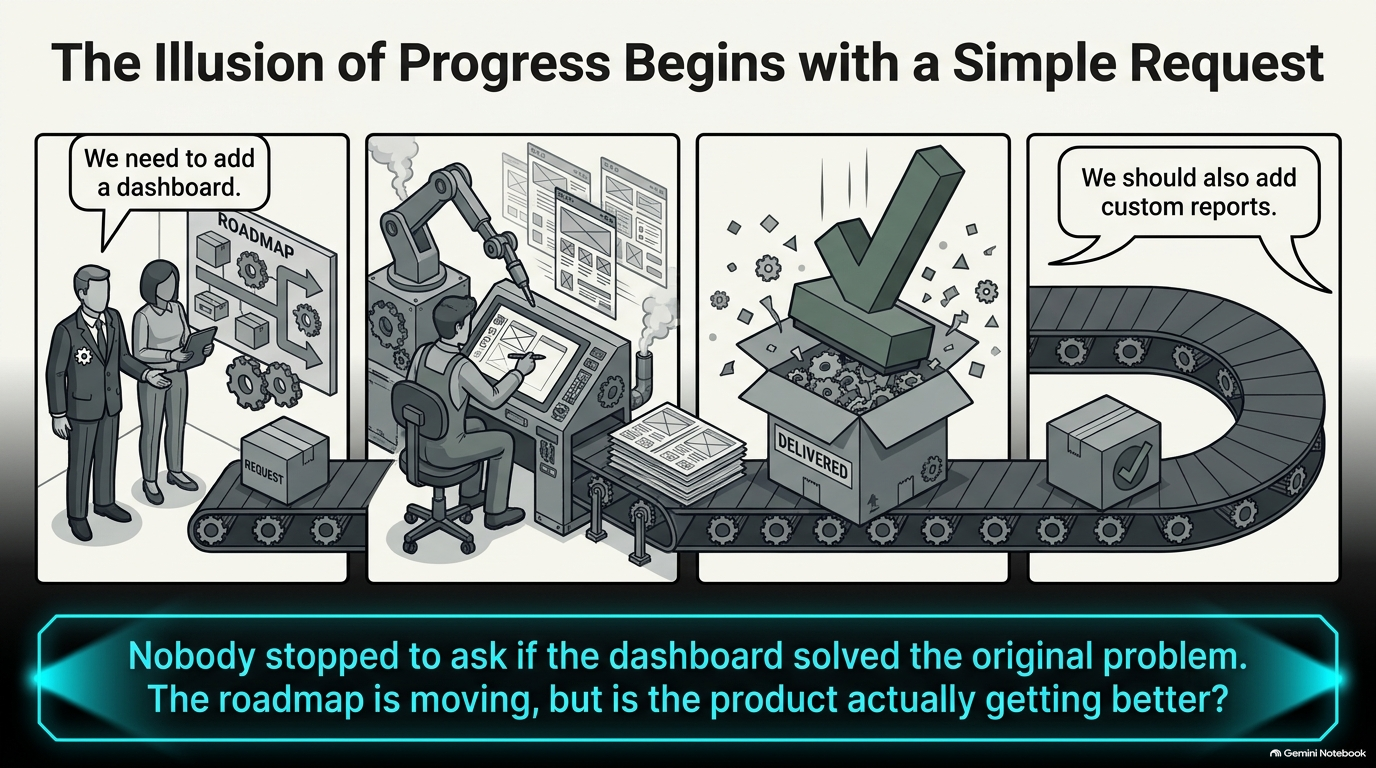
But shipping more does not automatically mean creating more value.
And designers need to understand this because we’re often involved in turning these requests into real experiences. We shouldn’t just be asking how a feature should work. We should be asking whether it should exist in the first place.
The roadmap is not the product strategy
A roadmap can become a very convincing illusion of progress.
It has dates, feature names, priorities, colour-coded statuses and delivery milestones. It gives everyone the feeling that the business knows exactly where it’s going.
But look closely at what some roadmaps contain.
“Add AI recommendations.”
“Build a reporting dashboard.”
“Introduce team permissions.”
“Redesign the profile page.”
These are solutions. They don’t tell us what problem the business is trying to solve.
Why does the product need AI recommendations? Are users struggling to make decisions? Are they unable to find relevant information? Is the business trying to increase repeat usage?
A dashboard might be the right answer. But perhaps users simply need a better summary on the page they already visit.
The difference matters.
When a team starts with a solution, it limits the range of possibilities before it has properly understood the problem.
The UK Government’s Service Standard makes a similar point: teams should understand user needs and design around the problem, rather than begin with a preselected solution. It also warns against building services that become unnecessarily complicated because they try to do too much.
Read the GOV.UK guidance on understanding user needs.
A good product strategy should tell the team which problems deserve attention. The roadmap should show how the team intends to address them.
Those are not the same thing.
The cost of building something nobody uses
Every feature has a cost that goes beyond the hours required to design and develop it.
There’s the cost of research, design, engineering, testing and maintenance. There’s the cost of explaining it to users. There’s the additional complexity it introduces into the interface.
And there’s an opportunity cost.
While a team is building one feature, it isn’t working on something else.
That something else might be fixing a frustrating checkout process, improving search, making an existing feature easier to use, or resolving an accessibility issue.
Jan Bosch, a researcher and professor who has studied software development and R&D efficiency, reported that research across different companies and software systems found that around half of the features studied were hardly ever or never used.
This is not a universal statistic for every modern product. It comes from Bosch’s research and should be understood in that context. But it raises an uncomfortable question: how much development effort is being invested in functionality that delivers little practical value?
Jan Bosch: Half the Features You Build Are Waste.
The problem isn’t that every rarely used feature is automatically useless. Some features serve small but important groups. Security settings, accessibility options and occasional administrative tools may have low usage but high importance.
The problem is building functionality without understanding who needs it, why they need it, and what success should look like.
And that’s a much bigger issue than an overcrowded interface.
The rest of this edition is about making better product decisions, not simply recognising bad ones. We’ll work through a practical method for evaluating feature requests, prioritising competing opportunities, estimating the cost of a decision, and defending your recommendations in a product meeting.
— The UXU Team


