



Product managers are running usability tests. Designers are conducting interviews between sprints. Engineers are interpreting analytics and calling it user insight. Research tools have made all of this faster and cheaper than ever. On paper, it sounds like a win. More research, more decisions informed by users, faster cycles. In practice, a lot of it is producing confident conclusions from bad data.
This issue looks at what democratization actually means, where it helps, where it breaks down, and what both researchers and designers need to do about it.
In this issue:
What research democratization actually is and why it happened
Where it genuinely helps
Where it quietly goes wrong
What researchers need to do to stay relevant and protect quality
What designers need to know when they become the researcher
The right model for 2026
Resource Corner
What research democratization actually is and why it happened
Research democratization means non-researchers doing research. Designers running their own usability tests. PMs sending out surveys. Customer success pulling themes from support tickets and calling it qualitative insight. It has been building for years but in 2026, designers are now conducting more research than dedicated UX researchers, and product managers are not far behind. LogRocket
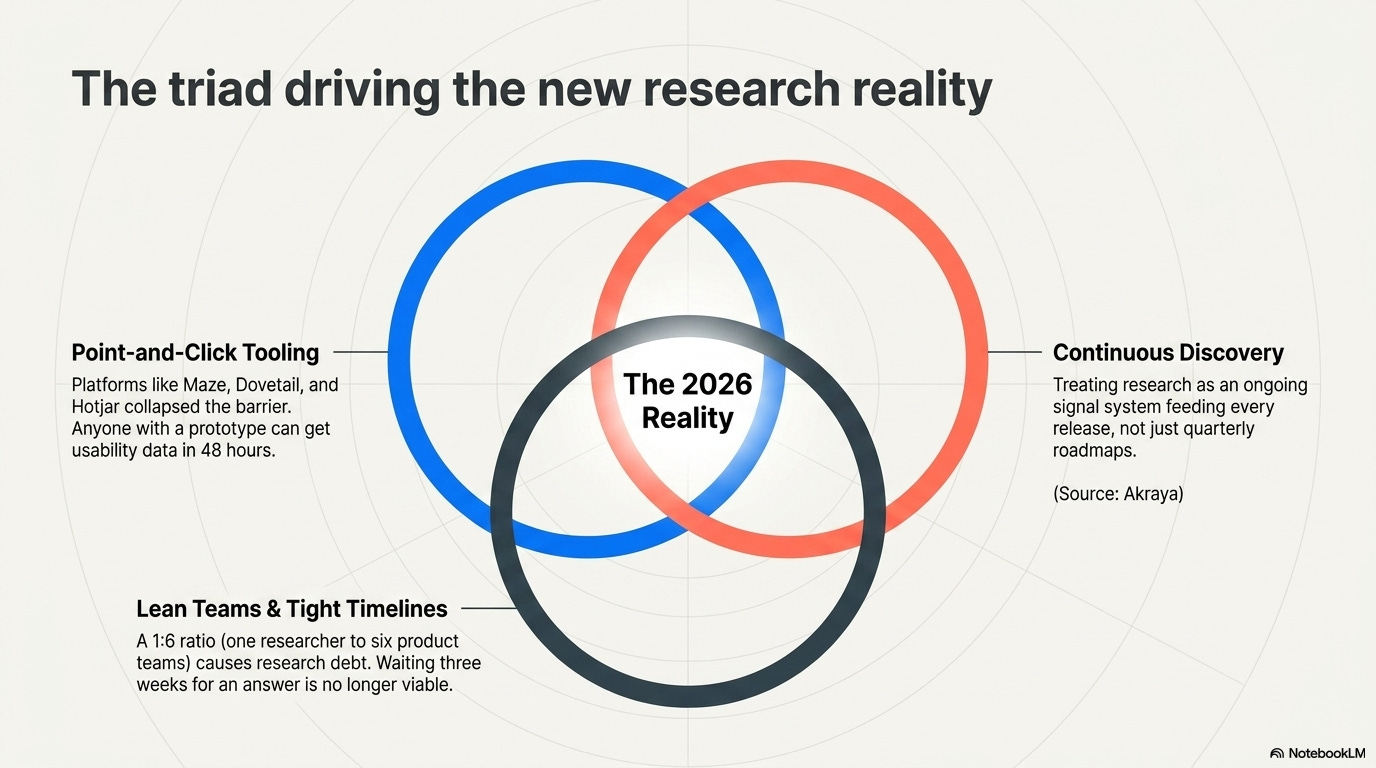
Three things drove this.
1. The tools got too easy to ignore Platforms like Maze, Dovetail, UserZoom, and Hotjar turned research tasks that once required specialist knowledge into point-and-click workflows. Anyone with a prototype and a Maze account can have usability data in 48 hours. The barrier to running research collapsed.
2. Teams got leaner and timelines got shorter Teams are under pressure to validate problems and ship faster, often leading to research debt. LogRocket When there is one researcher supporting six product teams, waiting for dedicated research support on every question is not realistic. Teams started doing it themselves out of necessity, not ambition.
3. Continuous discovery became the expectation The old model of big research studies feeding into quarterly roadmaps does not match how product teams actually work in 2026. Leading teams are treating UX research as an ongoing signal system that informs every release, not just major launches. Akraya That requires more people feeding into the system, not fewer.
Where it genuinely helps
Not all democratization is bad. Some of it is actually good for the field, and saying otherwise is defensive rather than honest.
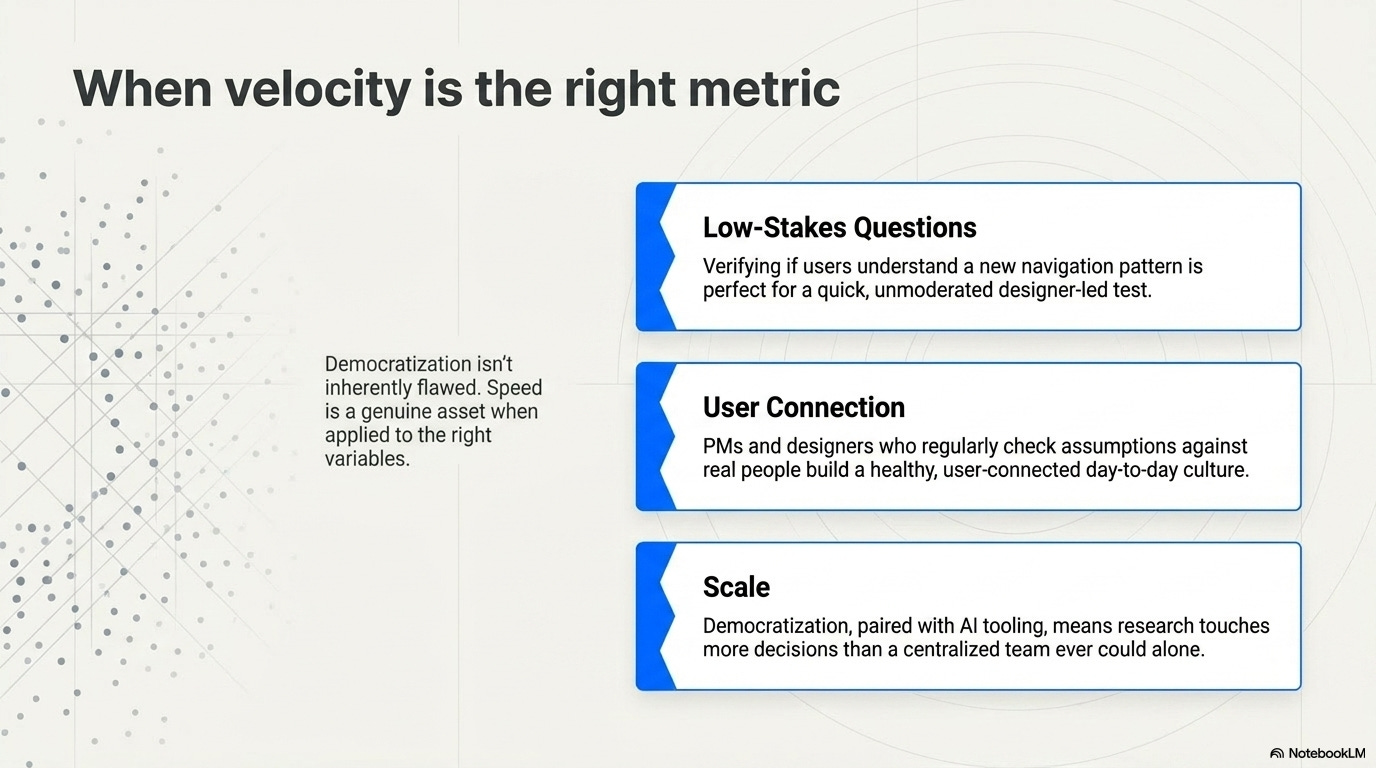
✓ Speed on low-stakes questions When a designer needs to know whether users understand a new navigation pattern, running a quick unmoderated test themselves is faster and often good enough. Waiting three weeks for researcher availability on that question is not a good use of anyone’s time.
✓ Keeping teams user-connected Designers and PMs who regularly talk to users, even informally, make better decisions day to day. The instinct to check assumptions against real people before building is healthy and worth encouraging across the whole team.
✓ Freeing researchers for harder work AI can complete 80% of the work, allowing researchers to add the crucial 20% with nuanced interpretation based on experience and expertise. UX Studio The same logic applies to democratization. If basic usability testing moves to designers, researchers can spend their time on generative research, complex synthesis, organizational influence, and strategic framing. That is a better use of a researcher’s depth.
✓ Scaling research operations AI is accelerating time-intensive workflows like transcription, synthesis, and study planning, helping teams scale research operations more efficiently. LogRocket Democratization plus AI tooling means research can touch more decisions than a small centralized team could ever cover alone.
Quick interruption. This one is for you personally.
Worth four hours of your time.
🎯 AI & The New Economy: Hands-On Workshop
The job market is not waiting for anyone to catch up. If you are feeling behind, unclear on your positioning, or just not getting responses, this workshop skips the theory and gets straight to work.
You bring your real stuff. Your resume, your pitch, your positioning. You leave with something finished and one clear next step.
back to where we stopped….
Where it quietly goes wrong
This is the part the tools companies underplay in their marketing.
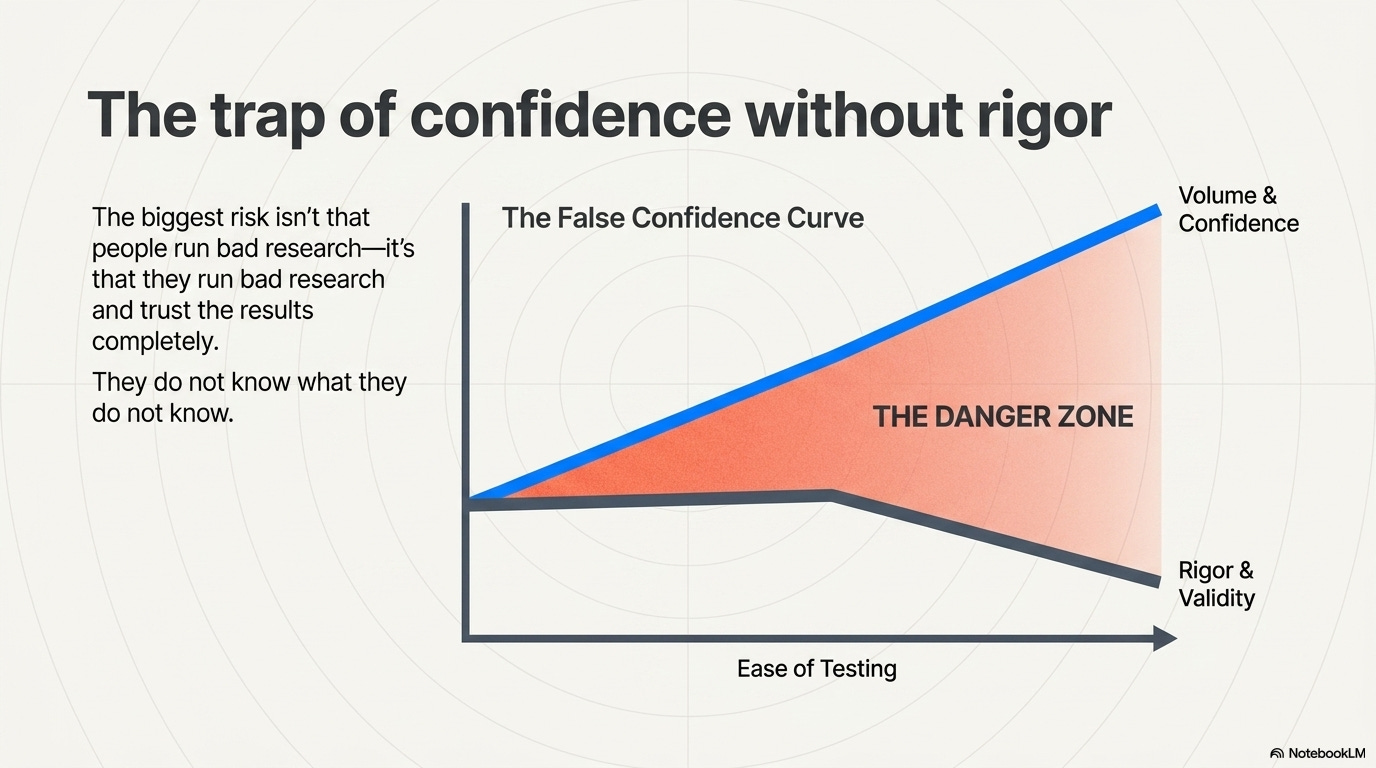
🔴 Confidence without rigor The biggest risk of democratization is not that people run bad research. It is that they run bad research and trust the results completely. A PM who sends a five-question survey to 30 existing customers and concludes “users want feature X” has done something. But the sample is biased toward power users, the question framing likely led the response, and the finding says nothing about non-users or churned users. The problem is they do not know what they do not know.
🔴 Usability testing replacing discovery Most democratized research is evaluative. Does this design work? Can people find this button? Those are useful questions. But they are not the same as asking why users behave the way they do, what problems are worth solving in the first place, or what the product is missing entirely. Researchers will increasingly need to test trust, explainability, failure modes, and escalation paths, not just task flows and layouts. Akraya That kind of generative, strategic research does not democratize easily, and when teams substitute usability tests for it, they optimize existing ideas rather than finding better ones.
🔴 Insight repositories nobody uses Research democratization produces more data. It does not automatically produce more decisions informed by that data. Most teams doing democratized research are not feeding findings into a shared repository. They are keeping them in a Notion doc, a Slack thread, or their own memory. Six months later, the same questions get researched again from scratch.
🔴 Researchers losing influence without losing workload Several researchers have expressed concerns about overreliance on AI, quality control, and the risk that AI will be overused and the gaps will be found and documented. Lyssna The same concern applies to democratization. When everyone is doing research, researchers can end up in a worse position: still responsible for quality and rigor, but no longer the clear owners of the function. They get consulted rather than leading.
What researchers need to do to stay relevant and protect quality
The answer is not to gatekeep research. That ship has sailed and fighting it wastes credibility. The answer is to reposition.
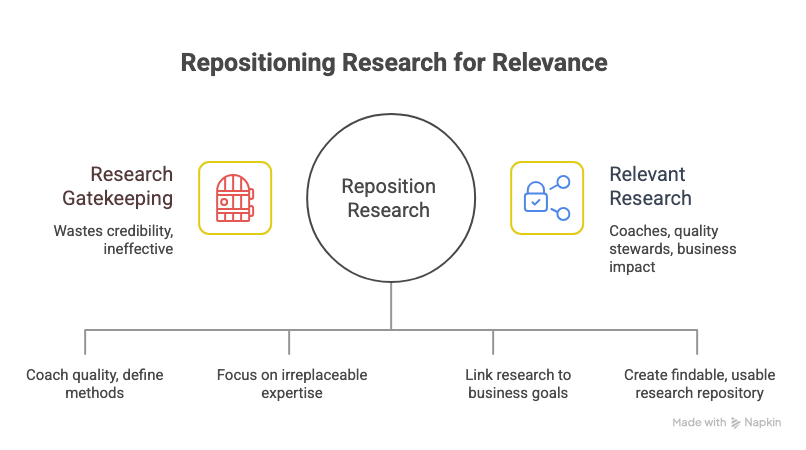
→ Become the standard-setter, not the executor The most effective researchers in 2026 are acting as coaches and quality stewards. They define the methods, build the templates, maintain the insight repository, review democratized research for quality issues, and step in personally for high-stakes or complex questions. Mature organizations are investing in research guidelines and templates that enable democratization without losing rigor, with central research teams acting as coaches. LogRocket
→ Go deeper on what cannot be democratized Generative research. Longitudinal studies. Synthesis across multiple data sources. Organizational storytelling that actually changes roadmap decisions. Measuring trust, not just task completion. These are the areas where researcher expertise creates irreplaceable value. Spend more time there and less time defending territory on studies that designers can reasonably run themselves.
→ Connect research to business outcomes explicitly UX research is now judged not only on insight quality but on how clearly it connects to outcomes like conversion, retention, and trust. Akraya Researchers who can speak that language directly get taken more seriously. Researchers who present findings without connecting them to decisions get their work admired and ignored.
→ Build the insight infrastructure If every team is doing research, someone needs to own the system that makes all of it findable and usable. Building and maintaining a research repository is unglamorous work that pays enormous dividends. It also positions researchers as the connective tissue of product knowledge across the organization, which is a much stronger position than running studies in isolation.
What designers need to know when they become the researcher
Designers doing their own research is not going away. Here is how to do it without fooling yourself.
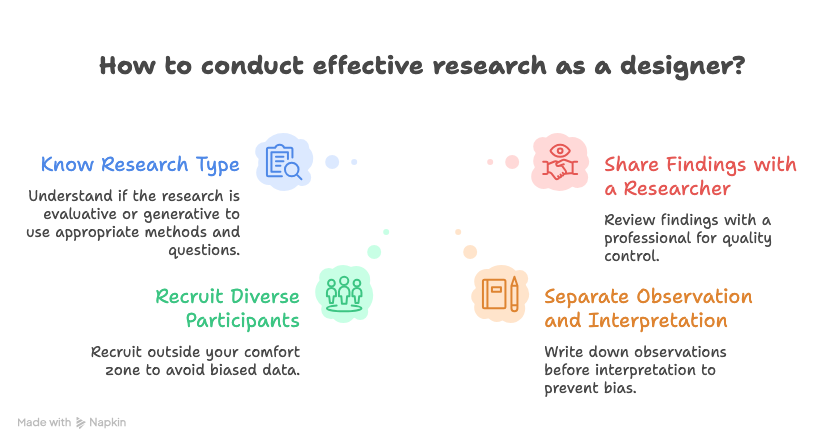
✓ Know what kind of research you are running Evaluative research (does this work?) and generative research (what should we build?) require different methods, different questions, and different sample sizes. Most designer-led research is evaluative. That is fine, but be honest about what it can and cannot tell you.
✓ Recruit outside your comfort zone The most common mistake in democratized research is recruiting participants who are too similar to existing users or too easy to access. Colleagues, friends, and current customers all produce biased data in specific directions. Reach for people who are unfamiliar with your product, represent edge cases, or have recently churned.
✓ Separate observation from interpretation Write down what you saw before you write down what you think it means. The gap between “three users clicked the wrong button” and “users don’t understand the navigation” is where bias lives. Stay in observation longer than feels comfortable.
✓ Share your findings with a researcher before making decisions Even a 15-minute review with someone who does this professionally will catch problems you missed. It is not about asking permission. It is about quality control on a decision that might affect a lot of people.
The right model for 2026
The teams getting this right are not choosing between centralized research and full democratization. They are running both deliberately.
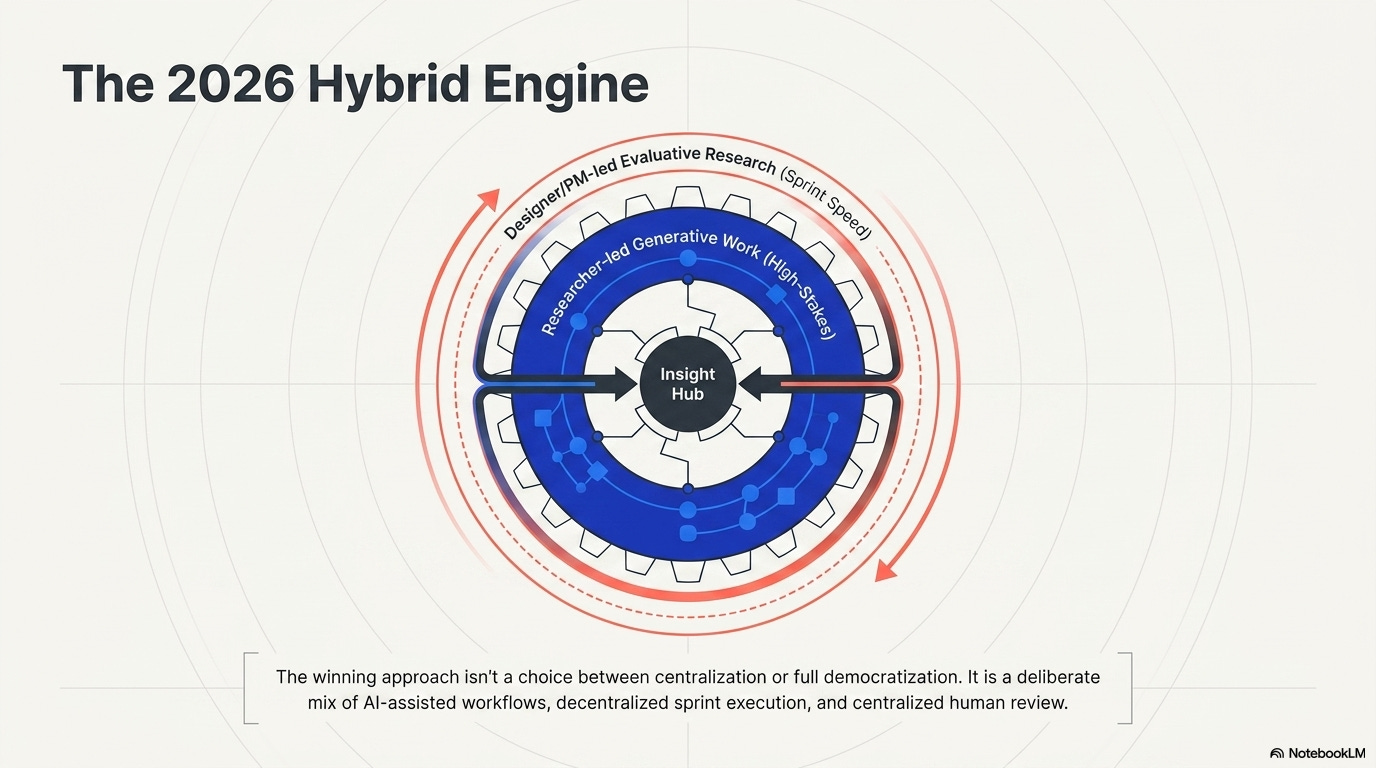
Designers and PMs handle evaluative, sprint-level research on their own using shared templates and tools. Researchers own generative work, complex synthesis, high-stakes studies, and the infrastructure that makes everything findable. Researchers also coach non-researchers regularly, not as a one-time training but as an ongoing relationship.
The winning approach is a mix of research democratization, AI-assisted workflows, and human review. LogRocket The key word is mix. Any team that tips too far in either direction, either locking all research behind a single team or letting everyone run studies without oversight, ends up worse off.
📦 Resource Corner
Lyssna UX Research Trends Report 2026 Survey of 100 UX researchers on what they expect to shape the field. The synthetic users data alone is worth reading carefully.
Dovetail The closest thing to a standard research repository right now. If your team is doing democratized research without a shared place to store findings, start here.
Maze The tool most designers reach for when running their own unmoderated tests. Worth understanding its strengths and limits before using it as a primary source of truth.
Research Skills for Designers (Nielsen Norman Group) The most credible structured training available for designers who are taking on research responsibilities without formal research training.
Just Enough Research by Erika Hall The best single book on research for non-researchers. Practical, opinionated, and short enough to actually read. Required for any designer who is running their own studies.
Continuous Discovery Habits by Teresa Torres The framework most product teams are moving toward for embedding research into weekly product work rather than treating it as a separate phase.
💭 Final Thought
Research democratization is not a threat to the UX research field. Bad democratization is.
The distinction matters. When everyone on a product team is curious about users, asks questions before building, and checks assumptions against real people, that is a healthy culture. When everyone runs five-question surveys, calls it research, and ships confidently based on a 30-person biased sample, that is a quality problem wearing the costume of a good habit.
Researchers who understand this are not trying to put the genie back in the bottle. They are building the infrastructure, standards, and coaching relationships that make broader participation in research actually trustworthy. That is a more interesting and more influential job than running studies alone.
And for designers doing their own research: do it. It will make you better. Just stay honest about what it can tell you and humble about what it cannot.
The goal was never research for its own sake. It was always better decisions for real users. Keep that as the measure and the rest follows.


