



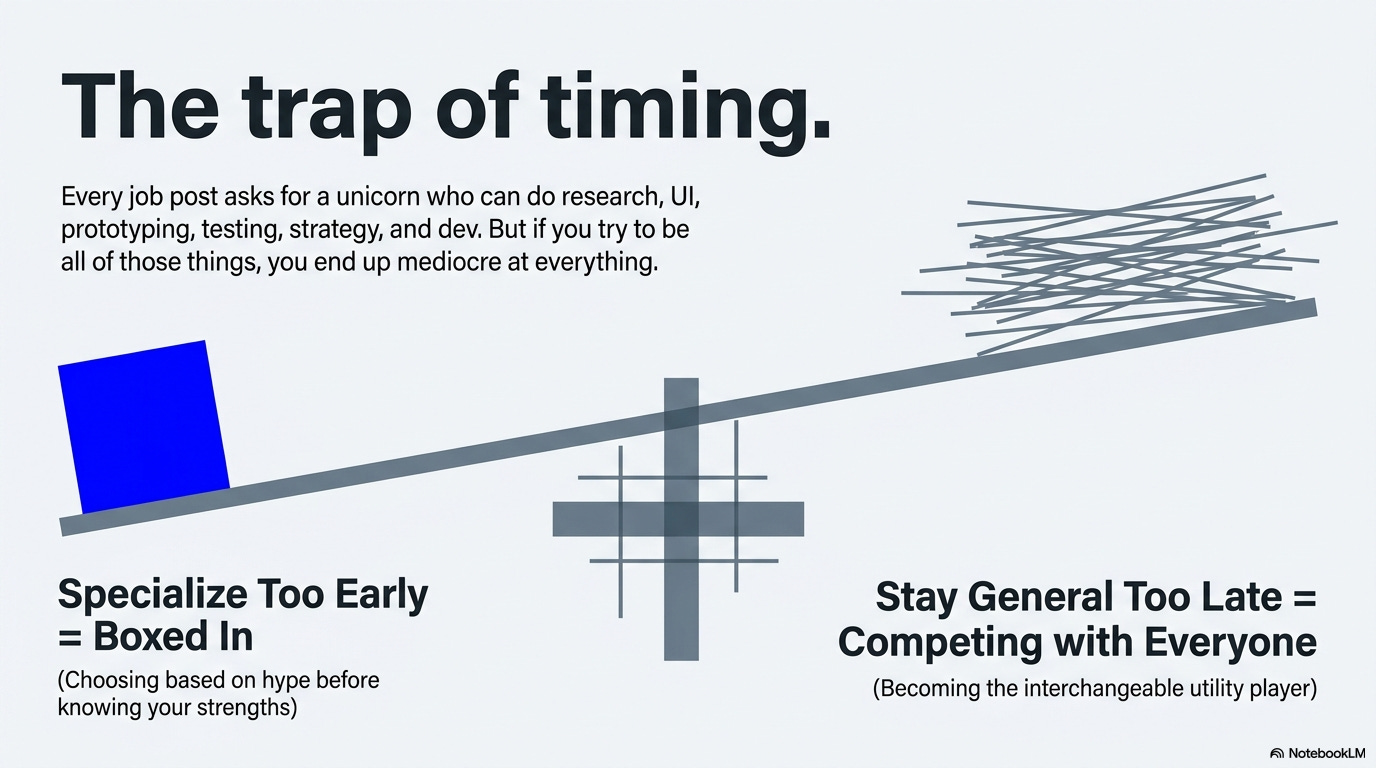
Every job post wants a generalist who can do research, UI design, prototyping, testing, strategy, and front-end development. You try to be all of those things, and you end up mediocre at everything. Meanwhile, designers with clear specializations are getting hired faster, paid more, and building stronger careers.
But here’s the trap: specialize too early and you box yourself in. Stay too general and you’re competing with everyone.
This issue breaks down the specialization paradox, when to niche down, and how to pick a focus that actually helps instead of limits you.
In this issue:
Why “jack of all trades” stops working after year two
The specializations that actually pay more right now
How to pick a niche when you don’t know enough yet
T-shaped vs. I-shaped vs. broken comb (and which you should be)
When generalist skills still matter
📦 Resource Corner
Why “jack of all trades” stops working after year two
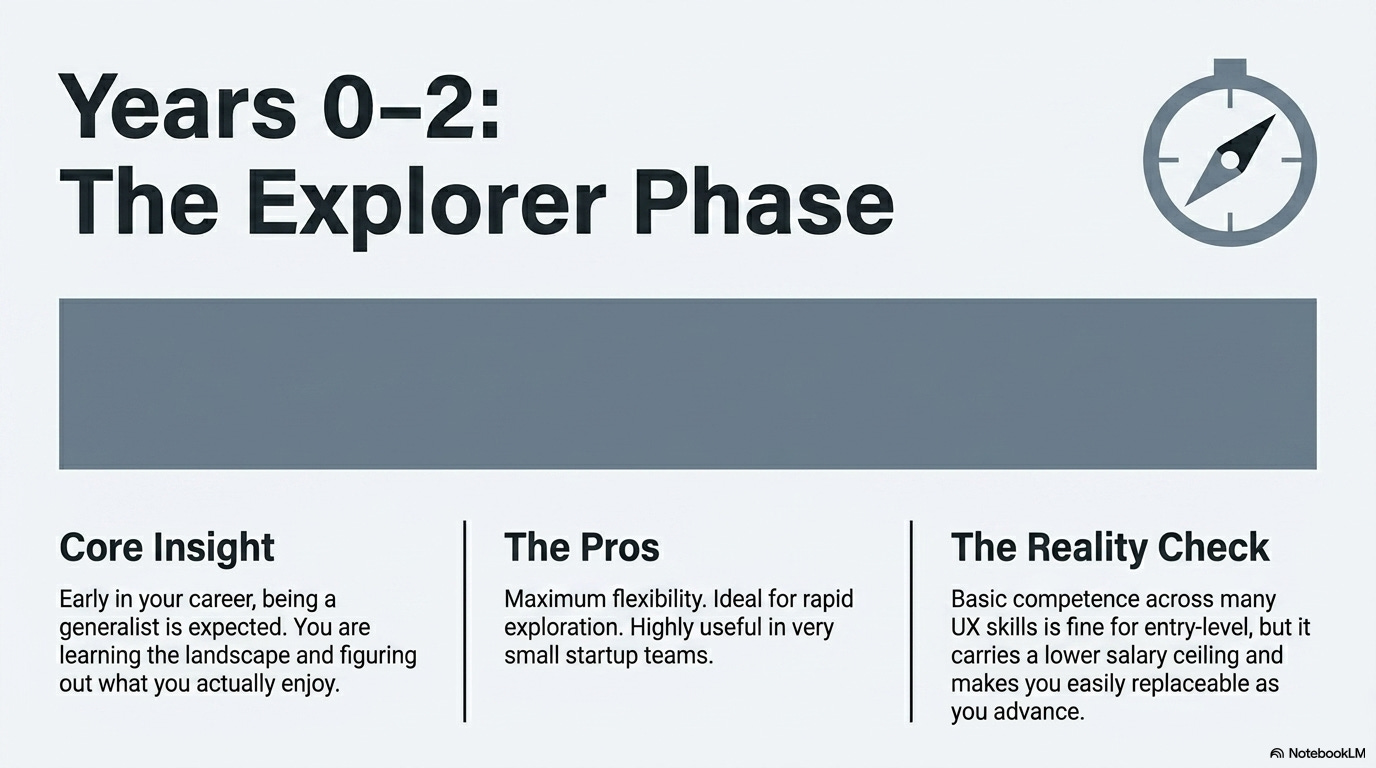
Early in your career, being a generalist is fine. Actually, it’s expected. You’re learning the landscape. You’re figuring out what you’re good at and what you actually enjoy.
But somewhere around year 2-3, the market shifts on you.
Here’s what happens:
🔴 Entry-level roles want generalists, but there are fewer entry-level roles
Junior positions ask for someone who can do “a little bit of everything” because they can’t afford specialists. But companies are hiring fewer juniors overall. They want experienced people who can hit the ground running in a specific area.
🔴 Mid-level roles assume specialization
Once you hit 3-5 years of experience, job descriptions get specific:
“Senior UX Researcher with expertise in generative research”
“Product Designer specializing in complex B2B workflows”
“Interaction Designer with strong motion design skills”
If your resume says “I do everything UX,” you’re competing against people who are demonstrably excellent at the specific thing this role needs.
🔴 Generalists get passed over for raises and promotions
When it’s time for promotions, the conversation is: “What is this person the best at on our team?” If the answer is “they’re okay at everything,” that’s not promotion material. Specialists who’ve become go-to experts in something get recognized and rewarded faster.
🔴 You can’t build a strong portfolio without focus
When you’re trying to show research AND UI design AND strategy AND prototyping, your portfolio is diluted. You have one okay research project, one okay visual design project, one okay strategy project. Someone specialized in research has three excellent research case studies that go deep. They look more hirable.
🔴 Salaries plateau faster for generalists
Market data shows specialists earn 15-25% more than generalists at the same experience level. (Source: Design salary surveys, Glassdoor) Companies pay premium rates for deep expertise in areas they need.
The shift:
→ Years 0-2: Generalist skills help you learn and stay flexible
→ Years 3-5: Specialization becomes necessary to advance
→ Years 5+: Deep expertise in 1-2 areas is expected, with general competence in others
If you stay purely generalist past year 3, your career trajectory flattens. You become the “utility player” who never quite makes it to senior roles.
💡 Reality check: “UX Designer” is not a specialization. It’s a category. What kind of UX designer are you?
The specializations that actually pay more right now
Not all specializations are created equal. Some open doors. Some close them. Here’s what’s actually valuable in the market right now:
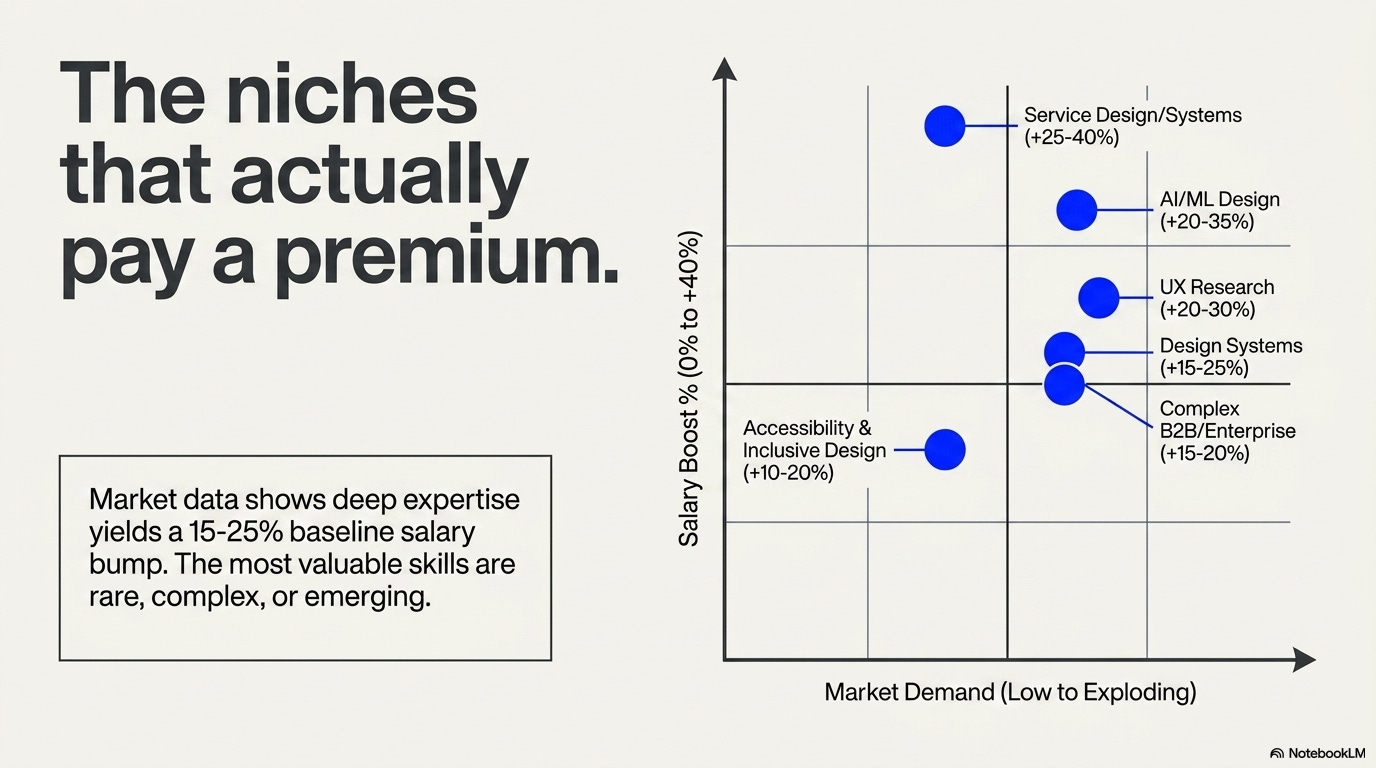
💰 High-demand specializations (2025):
→ UX Research (especially generative research)
What it is: Leading discovery, understanding user needs, synthesis, insight generation
Why it pays: Few designers are truly good at research. Most can run a usability test, but deep qualitative research is rare.
Salary boost: 20-30% over general UX roles
Demand: High, especially in product companies
→ Design Systems & Component Design
What it is: Building scalable, flexible design systems that actually work
Why it pays: Every company wants one, few know how to build them well
Salary boost: 15-25% over general product design
Demand: Very high, particularly at companies with multiple products
→ Complex B2B/Enterprise UX
What it is: Designing for workflows with multiple user types, permissions, data-heavy interfaces
Why it pays: B2B is harder than consumer. Fewer designers have the skills. Companies pay for that expertise.
Salary boost: 15-20% over consumer product design
Demand: High and growing
→ AI/ML Product Design
What it is: Designing interfaces for AI features, chatbots, recommendation systems, predictive tools
Why it pays: Emerging space with high demand and low supply of experienced designers
Salary boost: 20-35% over traditional product design
Demand: Exploding, will stay high for years
→ Accessibility & Inclusive Design
What it is: WCAG compliance, designing for disabilities, inclusive research and testing
Why it pays: Legal requirements + ethical imperative + very few true experts
Salary boost: 10-20%, plus job security
Demand: Growing steadily
→ Service Design & Systems Thinking
What it is: Designing end-to-end experiences across channels, understanding ecosystems
Why it pays: Strategic level work, often consulting rates
Salary boost: 25-40% at senior levels
Demand: High in consulting and large enterprises
⚠️ Lower-demand or saturated specializations:
→ UI/Visual Design only
Market is saturated. AI tools are automating parts of this. Still valuable as a secondary skill, risky as only skill.
→ UX Writing (standalone)
Unless you’re at content-heavy products, this is often rolled into other roles. Hard to build a career on this alone.
→ Generic “product design”
Not specific enough. Everyone calls themselves this. Doesn’t differentiate you.
The pattern:
Specializations that pay well are either:
✓ Rare skills with high demand
✓ Complex domains that take years to master
✓ Emerging areas where expertise is scarce
Pick something that fits at least one of these.
How to pick a niche when you don’t know enough yet
Okay, so you need to specialize. But you’re early in your career and you don’t know what you’re best at yet. How do you choose?
❌ Bad way to pick: What sounds coolest
“AI design sounds exciting, I’ll specialize in that.”
Why it fails: You haven’t actually done it. You might hate it. You might not be good at it. You’re choosing based on hype, not fit.
✅ Better way: Notice what you’re naturally drawn to
Look at your existing work and ask:
What parts of projects energize you?
What tasks do you volunteer for?
What do teammates come to you for help with?
What do you read about in your free time?
Why it works: Your interests reveal your aptitudes. You’ll get good at things you’re intrinsically motivated to do.
✅ Better way: Follow the money/demand
Look at job boards and notice:
What specific skills are companies desperately hiring for?
What roles have the fewest qualified candidates?
What specializations appear in high-paying job posts?
Why it works: Market demand is real data. Specializing in something rare and needed guarantees work and leverage.
✅ Better way: Build on adjacent experience
If you came to UX from:
Development → Specialize in design systems or complex technical products
Psychology/research → Specialize in UX research or behavioral design
Marketing → Specialize in growth design or conversion optimization
Writing → Specialize in UX writing or content design
Why it works: You have a head start. Your prior skills compound with UX skills to create unique combinations.
✅ Better way: Try multiple things, then commit
Years 1-2: Do generalist work. Try research, UI, strategy, testing. Notice what clicks.
Year 2-3: Start focusing 60-70% of your effort on one area while keeping other skills active.
Year 3+: Commit to a primary specialization with clear secondary skills.
Why it works: You make an informed decision based on real experience, not guesses.
The questions to ask yourself:
→ What UX work do I do where time disappears?
→ What do people compliment me on or ask me to help with?
→ What’s hard for me but satisfying when I get it right?
→ What domain knowledge or skills do I already have that transfer?
→ What specializations have strong job markets?
If 2-3 of these point in the same direction, that’s probably your answer.
🎯 Take-home: Don’t pick randomly. Don’t pick based on hype. Pick based on aptitude + interest + market demand.
Quick interruption. This matters for your trajectory.
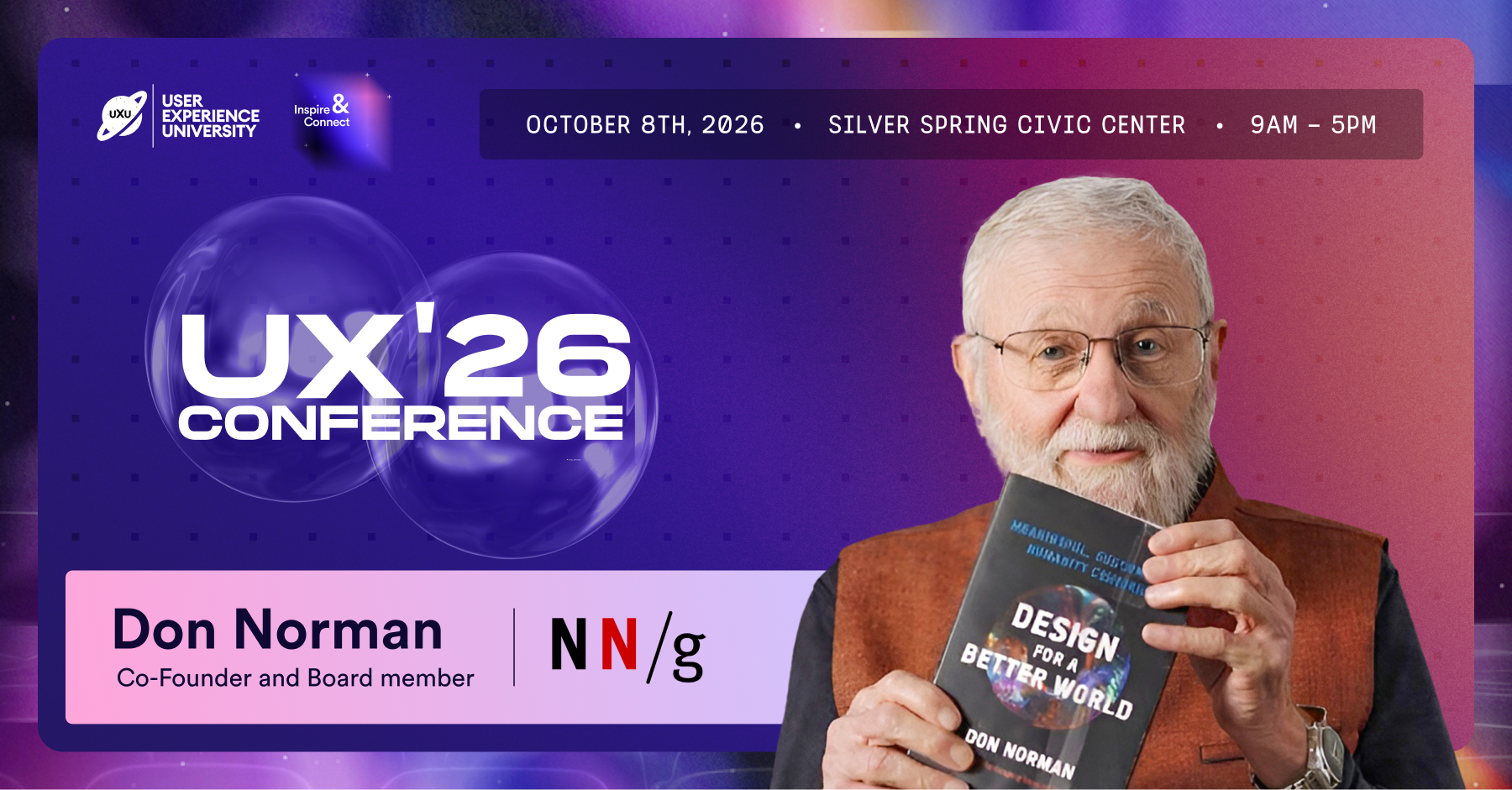
🎯 UXCON26: Meet The Specialists Who Actually Made It Work
You know what’s valuable about talking to senior designers who’ve built careers on specialization? They’ll tell you what actually happened, not the curated LinkedIn version.
The research lead who spent two years doing “everything UX” before finally committing to research and doubling their salary in 18 months. The design systems expert who started in visual design, hated it, and pivoted. The AI product designer who saw the wave early and rode it up.
These are the conversations that help you figure out your own path. Not because you’ll copy theirs, but because you’ll hear the decision points, the doubts, the pivots, the moments they knew they made the right call.
UXCON26 has an entire career development track focused on specialization, positioning, and building expertise that actually pays off. Not theory. Real people who’ve done it.
The people who show up are the ones who get to ask “how did you actually decide?” in person instead of guessing from blog posts.
Let’s talk about shape.
T-shaped vs. I-shaped vs. broken comb (and which you should be)
There are different models for how to think about skill distribution. Here’s what they mean and when each makes sense:
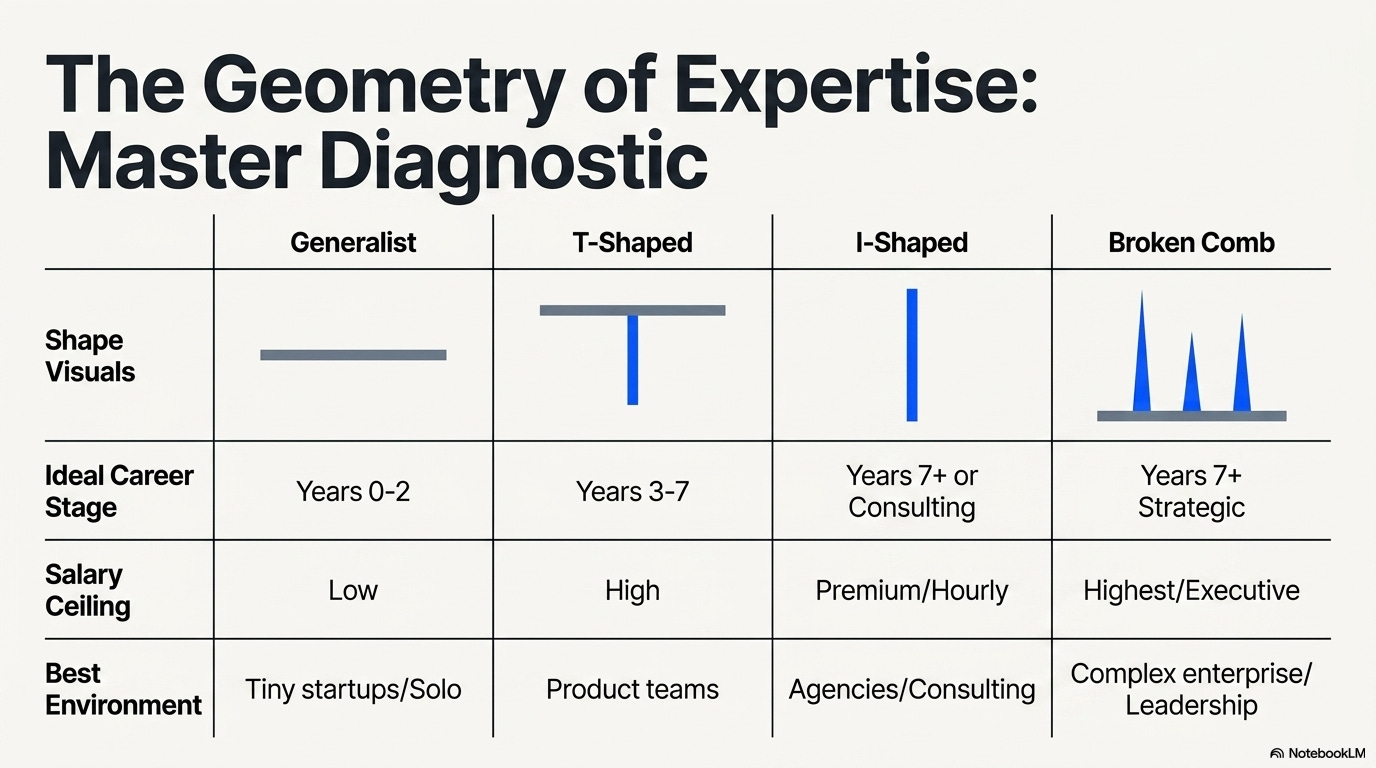
🔷 I-shaped: Deep specialist, narrow focus
What it looks like:
Expert in one specific area (e.g., UX research)
Surface-level knowledge of adjacent skills
Deep vertical expertise, minimal horizontal breadth
Pros: ✓ Can command premium rates as an expert ✓ Clear positioning and personal brand ✓ Hired for very specific, high-value problems
Cons: ✗ Limited flexibility if the market shifts ✗ Can struggle in small teams that need generalists ✗ Risk of becoming irrelevant if specialization becomes obsolete
When it works: Consulting, agencies, large companies with role clarity, established careers (7+ years)
🔷 T-shaped: Deep in one area, broad in others
What it looks like:
Primary expertise in one domain (the vertical bar)
General competence across multiple UX skills (the horizontal bar)
Can go deep when needed, collaborate broadly
Pros: ✓ Balance of expertise and flexibility ✓ Can work independently or in teams ✓ Valued in product companies and startups ✓ Easier to pivot if needed
Cons: ✗ Not as expert as pure specialists in your main area ✗ Not as flexible as true generalists ✗ Requires continuous learning across multiple domains
When it works: Product companies, startups, mid-level roles (3-7 years), most modern UX careers
🔷 Broken Comb: Deep in 2-3 areas, competent in others
What it looks like:
Two or three “spikes” of deep expertise
Competence in foundational skills
Example: Deep in research + design systems, competent in UI and strategy
Pros: ✓ Rare skill combinations make you unique ✓ Can handle complex problems requiring multiple expertises ✓ Higher market value than single specialists ✓ More resilient to market changes
Cons: ✗ Takes longer to develop multiple deep skills ✗ Can feel scattered if spikes aren’t related ✗ Hard to position yourself clearly
When it works: Senior roles (7+ years), strategic positions, niche markets where combined skills are valuable
🔷 Generalist: Broad but shallow
What it looks like:
Basic competence across many UX skills
No deep expertise in anything specific
“Can do a bit of everything”
Pros: ✓ Maximum flexibility ✓ Good for early career exploration ✓ Useful in very small teams
Cons: ✗ Hard to stand out in competitive markets ✗ Lower salary ceiling ✗ Limited career growth past mid-level ✗ Easily replaceable
When it works: Years 0-2, solopreneurship, very small startups, career exploration phase
The recommended path:
→ Years 0-2: Generalist (learn everything)
→ Years 2-5: T-shaped (pick one deep area)
→ Years 5+: Broken comb or deep I (add complementary expertise or go very deep)
Don’t stay generalist forever. By year 3, you should be forming a clear T or starting to specialize.
When generalist skills still matter
Specialization doesn’t mean abandoning everything else. Here’s what you still need to be competent at, regardless of specialization:
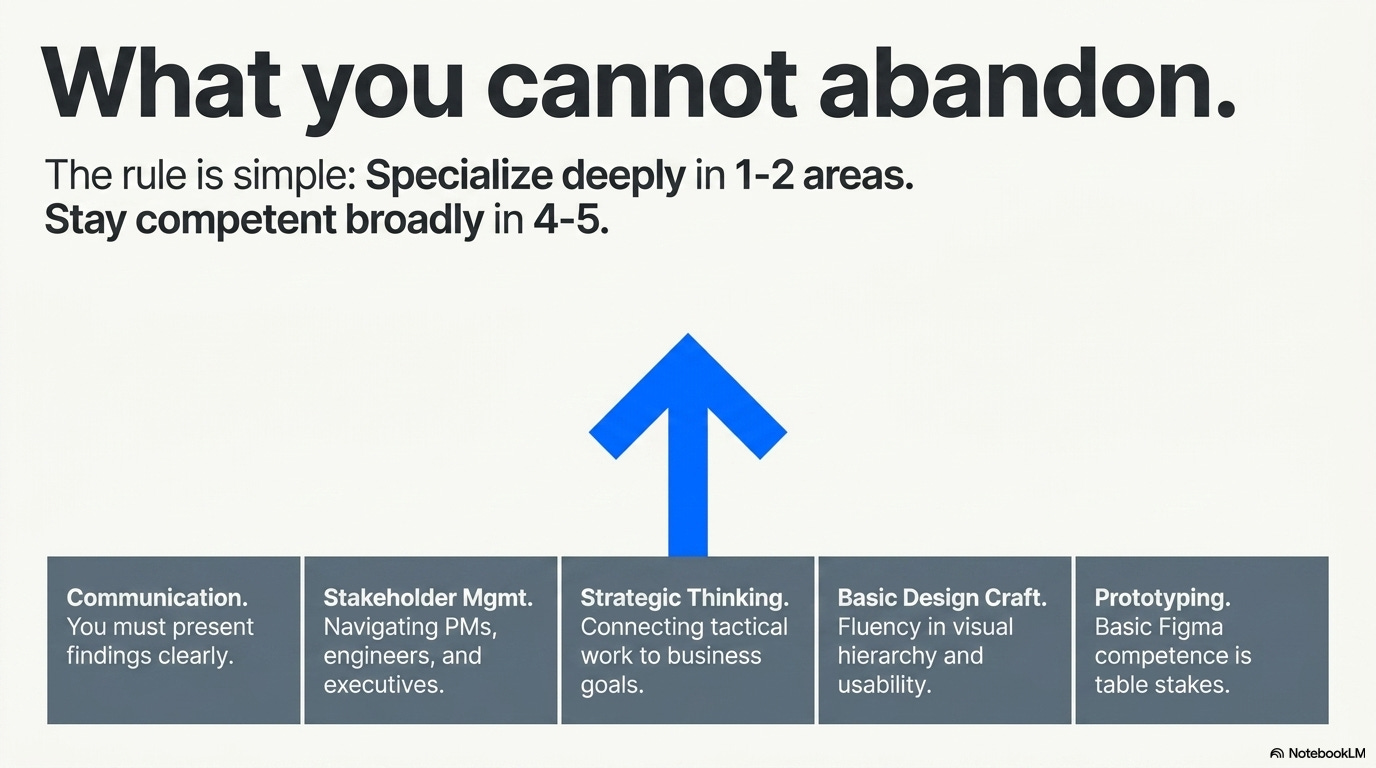
✓ Core skills every UX specialist needs:
→ Communication & presentation
You could be the world’s best researcher, but if you can’t present findings clearly, you’re ineffective. Every specialist needs to communicate well.
→ Collaboration & stakeholder management
Design doesn’t happen in a vacuum. You’ll work with PMs, engineers, executives. You need to navigate those relationships regardless of your specialty.
→ Basic design craft
Even if you’re a researcher, you should understand visual hierarchy, interaction patterns, and basic usability principles. You don’t need to be expert-level, but fluency matters.
→ Strategic thinking
Understanding business goals, user needs, and how your work ladders up to impact. Specialists who only do tactical work don’t advance.
→ Prototyping & communication design
Even researchers and strategists need to communicate ideas visually sometimes. Basic Figma/prototyping competence is table stakes.
The rule:
Specialize in 1-2 areas deeply. Stay competent in 4-5 areas broadly.
You’re not trying to be mediocre at everything. You’re trying to be excellent at something specific while remaining a functional team member across the board.
⚠️ Warning: Don’t over-specialize too early
Specializing at year 1 is premature. You haven’t tried enough things to know what you’re actually good at or enjoy. Give yourself 18-24 months of exploration before committing.
Also, specializations shift. AI design wasn’t a category five years ago. Design systems as a discipline is only about a decade old. If you specialize too narrowly in something emerging, you might ride a trend up—or get stranded when it changes.
Pick specializations with staying power. Human-centered research isn’t going anywhere. Complex problem-solving isn’t going anywhere. Being “the Clubhouse designer” was a bad bet.
📦 Resource Corner
T-Shaped Designer Article (IDEO)
Classic article explaining the T-shaped model and why it matters for modern designers.
Designer’s Career Map (Dan Mall)
Visual framework for understanding different career paths and specializations in design.
Salary Tools (Levels.fyi)
Real salary data showing pay differences between specialized and generalist roles across companies.
Career Ladders for Designers
Examples of how different specializations grow and what skills are expected at each level.
The Shape of Design (Frank Chimero)
Not specifically about specialization, but excellent on finding your unique design perspective.
Positioning for Designers (Philip Morgan)
Focused on consultants but applicable to anyone thinking about how to position specialized expertise.
💭 Final Thought
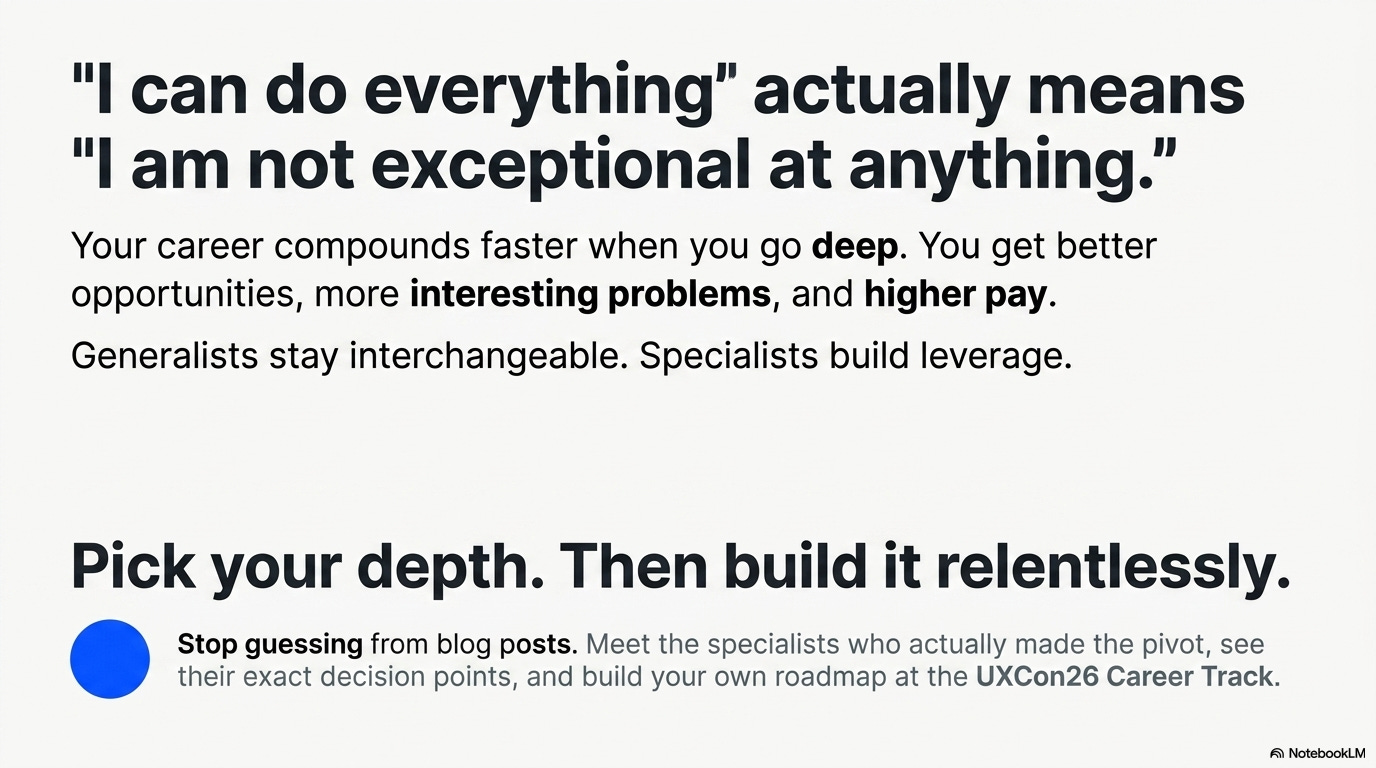
Your career compounds faster when you go deep. You become the go-to person for something specific. You get better opportunities, more interesting problems, higher pay. Specialists build leverage. Generalists stay interchangeable.
Pick your depth. Then build it relentlessly.


