



You’re doing user research. You’re talking to users every week. You’re collecting feedback, running usability tests, conducting interviews. And somehow, your product still feels like it’s missing the mark. Here’s what’s probably happening: you’re only talking to people who already use your product, already understand your category, and already fit your existing mental model. You’re getting feedback that makes your product better for current users while completely missing everyone else. This issue breaks down who you’re not talking to, why that’s killing your growth, and how to actually find the perspectives that matter.
In this issue:
The selection bias in your user research
Who you’re systematically excluding (and why)
Why “power users” are the worst people to design for
How to find non-users and get them to talk to you
What to do with conflicting feedback from different user groups
📦 Resource Corner
The selection bias in your user research
Let’s start with an uncomfortable truth: your current users are not representative of your potential users.
When you recruit for user research, who actually shows up?
People who already use your product regularly
People who like your product enough to spend time helping improve it
People who understand your category and your jargon
People who are tech-savvy enough to join a video call or navigate a prototype
People who have strong opinions about features
These people are valuable. But they’re also a biased sample. They represent one specific slice of your possible audience: the people who already figured out how to use what you built.
Here’s who you’re probably not talking to:
🚫 People who tried your product once and left They’re the majority. For most products, 60-80% of people who sign up never come back. But they’re invisible in your research because they’re not around to recruit. (Source: Product analytics benchmarks)
🚫 People who use competitor products instead of yours They chose something else for a reason. But you’re not talking to them because they’re not in your user base. You only hear from people who picked you.
🚫 People who need what you do but don’t know it yet They have the problem your product solves, but they’re solving it some other way. They’re not searching for your category terms. They’re not in your market yet. And you’re definitely not researching them.
🚫 People who got confused during onboarding and gave up They wanted to try your product but couldn’t figure out how to get value from it. They bounced before becoming “users.” You never hear from them.
🚫 People who can’t afford your product If you have a paywall, you’re only talking to people who can pay. You’re missing everyone for whom price is a barrier, which might be your biggest potential market.
The result: Your research tells you how to make your product better for people who already get it. It doesn’t tell you how to make it accessible to people who don’t.
This is called survivorship bias: you’re only studying the survivors, not the casualties. And the casualties often outnumber the survivors by 10x or more. (Source: Survivorship Bias research)
Who you’re systematically excluding (and why)
Let’s be more specific about the gaps in typical user research, because recognizing them is the first step to fixing them.
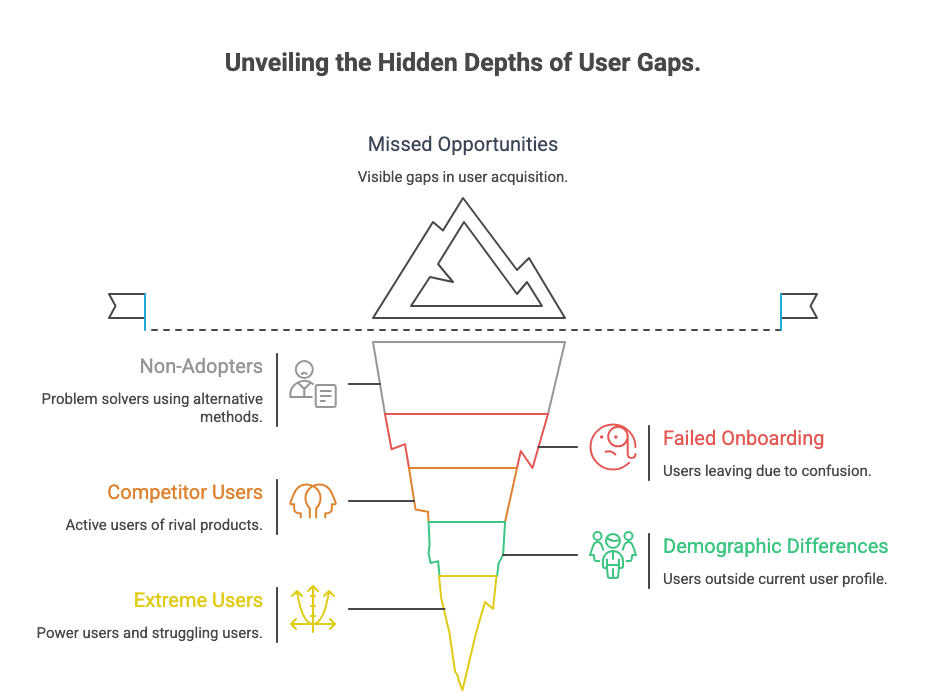
Gap 1: Non-adopters who have the problem you solve
These people need what you do, but they’re solving the problem differently:
Using spreadsheets instead of your SaaS tool
Using pen and paper instead of your app
Just living with the problem unsolved
Using a completely different category of solution
Why you’re missing them: They’re not in your product, so they’re not in your recruitment pool. And they’re not searching for your solution, so they don’t find you.
Why it matters: Understanding why they chose alternatives reveals barriers to adoption you can’t see from inside your user base.
Gap 2: Failed onboarding users
People who signed up, tried to use your product, got confused or frustrated, and left within the first session.
Why you’re missing them: They left before you could build a relationship. You might have their email, but they’re not engaged enough to respond to research requests.
Why it matters: They represent the majority of people who try your product. If you can’t convert them, you can’t grow.
Gap 3: Users of competing products
People actively using a competitor instead of you.
Why you’re missing them: You don’t have access to them. They’re in someone else’s product, not yours. And they’re probably happy there or they’d have switched already.
Why it matters: They chose a competitor for reasons that reveal your weaknesses or your competitor’s strengths. That’s strategic information you’re missing.
Gap 4: People from different demographics or contexts
Your current users might skew young, tech-savvy, English-speaking, or from specific countries. But your potential market might be older, less technical, multilingual, or global.
Why you’re missing them: Your marketing attracts people like your current users. Your product is optimized for people like your current users. So you get more of the same.
Why it matters: If you want to expand beyond your current niche, you need to understand users outside it. But you can’t design for them if you never talk to them.
Gap 5: Extreme users (both power users and struggling users)
Power users: People who use every feature, push your product to its limits, and want more advanced capabilities.
Struggling users: People who barely get value, use only one or two features, and might churn soon.
Why you’re missing them: Most research focuses on “typical” users in the middle. The extremes get filtered out as edge cases.
Why it matters: Power users show you the growth trajectory. Struggling users show you where you’re failing. Both edges are more informative than the middle.
Why “power users” are the worst people to design for
This one is controversial, but it’s true: your most engaged users are often the worst people to base design decisions on.
Power users are not representative. They’re outliers. And designing for outliers makes your product worse for everyone else.
Here’s what happens when you over-index on power users:
❌ Feature creep Power users always want more features, more customization, more power. If you build everything they ask for, your product becomes bloated and complex. New users get overwhelmed.
❌ You optimize for efficiency over learnability Power users value speed and shortcuts. They want keyboard commands, bulk actions, advanced filters. But new users need clarity and simple paths to value. These goals conflict.
❌ You assume knowledge that new users don’t have Power users understand your jargon, your mental model, your edge cases. They give you feedback that assumes expertise. But most users don’t have that expertise yet.
❌ You mistake loud voices for majority needs Power users are vocal. They’re in your Slack community, they write feature requests, they participate in research. But they’re 5-10% of your users. The other 90-95% are silent. If you design for the loud 5%, you’re ignoring the silent 95%.
The paradox: Power users are the easiest to recruit and the most eager to give feedback. So they’re overrepresented in research. But they’re the least representative of your actual market.
This doesn’t mean ignore power users. It means balance their feedback against the needs of average and struggling users. Weight your sample appropriately. (Source: “The Mom Test” by Rob Fitzpatrick)
Okay, quick break. This one’s time-sensitive.
🎉 UXCON26 Easter Weekend Flash Sale

Here’s what nobody tells you about conferences: the talks are great, sure. But the real value? It’s the hallway conversations. The person you meet at lunch who mentions their team is hiring. The senior designer who looks at your work and tells you exactly what’s holding you back. The founder who needs a contractor and you just happen to be standing there.
UXCON26 isn’t about sitting in sessions. It’s about being in rooms where opportunities happen. Where hiring managers actually are. Where the people one email away from changing your career trajectory are just... there. Accessible. Human.
We’re running a 72-hour Easter special that ends Sunday at midnight. We want you in that room. We want you meeting these people. We want you having those conversations that turn into referrals, collaborations, job offers.
This weekend only.
Right, back to research……
How to find non-users and get them to talk to you
Okay, so you need to talk to people outside your current user base. How do you actually find them?
Strategy 1: Mine your failed signups
Look at people who created accounts but never completed onboarding or made it past the first session.
How to recruit them:
Email them: “You tried [product] a few weeks ago. Can I ask what stopped you? I’ll send you a $50 gift card for 20 minutes.”
Frame it as helping improve the product, not defending it
Acknowledge they left for a reason and you want to understand
What to ask:
What were you trying to accomplish?
What confused you or got in your way?
What did you try instead?
What would have made you stay?
Strategy 2: Talk to competitor users
Find people actively using alternatives to your product.
How to recruit them:
Post in relevant subreddits, Facebook groups, or communities: “I’m researching how people use [competitor product]. Looking to interview users for a research study. $75 for 30 minutes.”
Use UserInterviews, Respondent, or similar platforms with specific screening criteria
Ask your network: “Do you know anyone who uses [competitor]?”
What to ask:
Why did you choose that tool?
What other options did you consider?
What would make you switch?
What’s your tool missing that you wish it had?
Strategy 3: Find people who have the problem but haven’t adopted any solution
This is the hardest group to find because they’re not in any product or community yet.
How to recruit them:
Post in adjacent communities: If you make a project management tool, post in subreddits for freelancers, small business owners, or specific industries
Use social media: “How do you currently manage [task]? Looking to interview people about their workflow.”
Ask current users for referrals: “Do you know anyone who struggles with [problem] but doesn’t use a tool for it?”
What to ask:
How do you currently handle this problem?
What have you tried?
Why haven’t you adopted a solution?
What would need to be true for you to pay for a tool?
Strategy 4: Seek out demographic diversity intentionally
If your current users skew heavily in one direction (age, location, technical skill, industry), actively recruit from underrepresented groups.
How to recruit them:
Use recruitment platforms with demographic filters
Post in communities where different demographics gather
Partner with organizations that serve specific groups
Offer higher incentives if needed to overcome barriers to participation
What to ask:
Same questions as usual, but listen for how their context differs from your typical user
Pay attention to assumptions you made that don’t hold for them
Strategy 5: Interview customer support contacts
People who contact support are struggling. They’re not happy users. They’re confused, frustrated, or blocked users. That’s valuable perspective.
How to recruit them:
Ask your support team to offer research participation to people who reach out
“Thanks for contacting us. Would you be willing to do a quick call to help us understand this issue better? We’ll compensate you for your time.”
What to ask:
What were you trying to do when this happened?
What did you expect to happen?
How did this make you feel about the product?
What would have prevented this issue?
🎯 Take-home: The people hardest to recruit are often the most valuable to talk to. If it’s easy to find them, you’re probably talking to the same types of people you always talk to.
What to do with conflicting feedback from different user groups
When you start talking to a more diverse set of users, you’ll get conflicting feedback. Power users want X. New users want Y. Non-users say Z is why they didn’t adopt. What do you do?
Don’t try to make everyone happy. That leads to a bloated, confused product that serves no one well.
Instead, segment and prioritize:
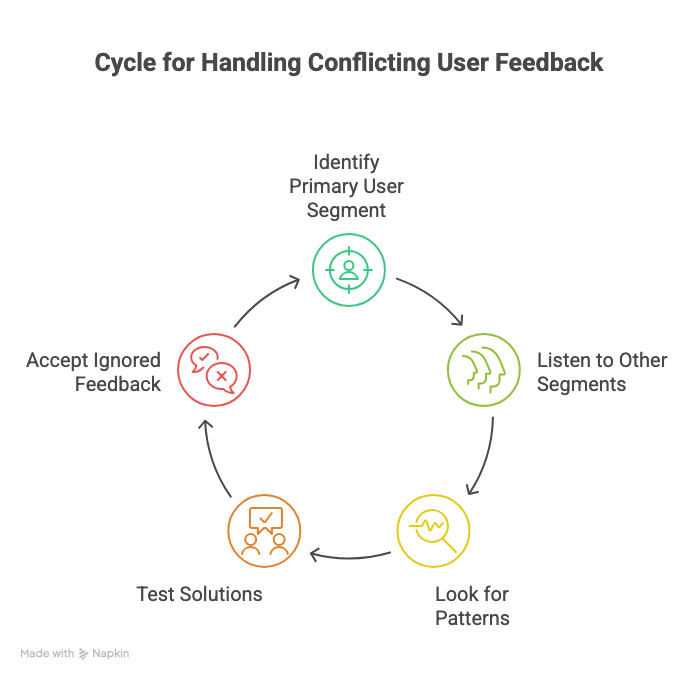
1. Identify your primary user segment
Who is your product primarily for? Not “everyone.” Pick the segment that:
Represents the biggest business opportunity
Has the most urgent problem
Is most likely to pay or grow
Aligns with your company strategy
Design primarily for them. (Source: “Crossing the Chasm” by Geoffrey Moore)
2. Listen to other segments for blindspots
Even if you’re not designing primarily for power users, their feedback reveals:
Where your product could scale
What advanced users eventually need
Technical limitations you might hit
Even if you’re not designing primarily for non-adopters, their feedback reveals:
Onboarding barriers
Marketing message mismatches
Category misunderstandings
3. Look for patterns across segments
Sometimes different groups complain about different symptoms of the same underlying problem. When you see patterns across diverse feedback, that’s a strong signal.
Example: Power users say “I can’t bulk edit.” New users say “I have to do everything one at a time.” Non-users say “It looks like a lot of manual work.” These are all pointing to the same problem: lack of bulk actions.
4. Test solutions with multiple segments
When you design something new, test it with:
Your primary segment (does it work for them?)
A struggling user (does it help them succeed?)
A non-user (does it make adoption clearer?)
You can’t please everyone, but you can avoid breaking things for people outside your primary focus.
5. Accept that some feedback will be ignored
You can’t build everything everyone wants. Some feedback, even good feedback, won’t align with your strategy. That’s okay. Thank people for their input, explain your priorities when appropriate, and move on.
📦 Resource Corner
The Mom Test by Rob Fitzpatrick Essential reading on asking good research questions and avoiding bias in user interviews. Especially good on talking to non-users.
UserInterviews.com Platform for recruiting research participants with specific demographics, behaviors, or tool usage. Good for finding competitor users or non-users.
Respondent.io Another recruitment platform, especially strong for B2B participants and niche professional audiences.
Just Enough Research by Erika Hall Practical guide to doing research that matters. Good chapter on sampling and who to talk to.
Crossing the Chasm by Geoffrey Moore While focused on marketing, the framework for understanding different user segments and how they adopt products is essential for research planning.
Mixed Methods (Research Community) Community and resources for UX researchers. Good articles on recruitment strategies and research bias.
Nielsen Norman Group: Recruiting Participants Research-backed guidance on participant recruitment, including how to find hard-to-reach groups.
💭 Final Thought
Your current users are your present. But if you only design for them, they’re also your future. And that’s a problem if you want to grow.
The people not using your product, the people who tried and left, the people using competitors, they hold the insights that could transform your trajectory. But they’re harder to find. They’re less eager to help. They require more effort to recruit and more care to interview.
Most teams skip this work. They talk to who’s easy to talk to: happy, engaged current users. And then they wonder why their product feels stuck, why growth plateaus, why they can’t break into new markets.
The uncomfortable truth is that the users who love your product the most are often the least helpful for growth. They already love you. They already figured you out. They’re not representative of the people you need to reach next.
If you want to grow, talk to people who don’t get it yet. Talk to people who chose something else. Talk to people who left. They’ll tell you things your biggest fans never will.
And those things might just change everything.


