



You didn’t do all that research. You didn’t run those A/B tests. The “client” was actually a practice project from a bootcamp. The “20% increase in conversion” is a number you made up because every case study needs metrics. And here’s the thing: hiring managers know. They’ve seen hundreds of portfolios and they can smell BS instantly. This issue breaks down why portfolio dishonesty happens, how it backfires, and how to present your actual work honestly in a way that still gets you hired.
In this issue:
The lies hiring managers spot immediately
Why fabricating results is worse than having no results
How to present real work (even when it’s messy)
What to do when you genuinely don’t have metrics
The honesty that actually impresses interviewers
📦 Resource Corner
The lies hiring managers spot immediately
Let’s be direct about what’s happening. Designers, especially junior ones, feel pressure to have impressive portfolios. So they embellish. They exaggerate. Sometimes they straight-up invent things. And hiring managers can tell.
Here are the red flags that scream “this didn’t really happen”:
🚩 Every project has perfect, round metrics “Increased conversion by 25%.” “Reduced bounce rate by 30%.” “Improved user satisfaction by 40%.” These numbers are suspiciously clean. Real metrics are messy: 23.7%, 18%, 34.2%. When every project ends in a multiple of 5 or 10, it looks made up.
🚩 The process is too perfect Real design is messy. You interview the wrong people. Stakeholders change their minds. Developers push back on your design. Timeline gets cut. But portfolio case studies show this perfect linear process: research → insights → wireframes → testing → shipping → success. That’s fiction.
🚩 No mention of constraints, tradeoffs, or failures Every real project has constraints. Budget. Timeline. Technical limitations. Stakeholder opinions. But portfolio projects never mention them. Every decision was optimal. Nothing was compromised. That’s not how work happens.
🚩 “I did everything” (on a team project) “I conducted the research, designed the solution, and shipped the feature.” If this was a real company with a real team, where was the PM? The researchers? The other designers? Taking sole credit for collaborative work is an instant credibility killer.
🚩 The timeline doesn’t make sense “I conducted 15 user interviews, analyzed the data, created wireframes, built high-fidelity mockups, ran usability tests, and launched in 2 weeks.” No, you didn’t. That’s 6-8 weeks minimum. Compressed timelines reveal that the story is fabricated.
🚩 Vague or missing company/client details “A fintech startup” instead of naming the company. “An e-commerce client” without specifics. If it was real work, you’d name them (or explain the NDA). Vagueness suggests it’s a practice project you’re pretending was real.
🚩 The problems are generic, the solutions are trendy “Users found the checkout confusing, so I simplified it” describes every checkout redesign ever. Real projects have specific, messy problems. Generic problems suggest you’re retrofitting a solution you saw elsewhere.
Why this matters: Hiring managers aren’t trying to catch you lying. But when they spot inconsistencies, they start questioning everything in your portfolio. One fabricated detail ruins your credibility on legitimate work.
Join Don Norman at UXCON26
Co-Founder, Nielsen Norman Group · Former VP of Advanced Technology, Apple · Founder, Design Lab at UC San Diego Headlining Keynote

Don Norman is famous for doors that are confusing to open. They are called Norman Doors. If you have ever pushed a door that should be pulled, you have lived inside one of his ideas.
That is what Don Norman does. He makes you see the world differently.
He coined the term “user experience.” He wrote The Design of Everyday Things, the book on virtually every designer’s shelf, now in its revised edition and still as essential as the day it was published. He helped found the world’s first Department of Cognitive Science at UC San Diego. He became Vice President of Advanced Technology at Apple. He co-founded the Nielsen Norman Group, the firm that shaped how the entire industry thinks about human-centered design. He has published 21 books translated into over 20 languages. He holds three honorary degrees and is a member of the National Academy of Engineering.
Hearing Don Norman speak in 2026 is not a checkbox on a conference list. It is a genuine once-in-a-career opportunity.
Why fabricating results is worse than having no results
The instinct makes sense: every article about portfolios says “show impact” and “include metrics.” So if you don’t have metrics, you feel like you need to invent them. But that’s backwards.
Here’s what actually happens when you fake results:
❌ You can’t defend them in interviews “Tell me more about that 30% conversion increase. What were you measuring? How did you isolate your changes from other variables?” If you made it up, you’ll fumble the answer. And now you’ve lost the job and your credibility.
❌ You set expectations you can’t meet If your portfolio shows you consistently deliver 20-40% improvements, that’s what the company will expect when they hire you. When you can’t deliver (because those numbers were fiction), you’ve set yourself up to fail.
❌ You miss the chance to show real thinking Honesty about what you don’t know is more impressive than fake confidence. “We didn’t have analytics set up, so I can’t give you hard numbers, but here’s the qualitative feedback we got” shows self-awareness and intellectual honesty.
❌ It reveals you don’t understand how metrics work Saying “I increased revenue by 50%” without explaining baseline, sample size, timeframe, or confounding variables shows you don’t actually understand measurement. That’s worse than admitting you don’t have data.
The truth that hiring managers won’t tell you: They don’t actually expect junior designers to have perfect metrics on every project. They know you’re early in your career. They know practice projects exist. What they’re looking for is honest thinking and real problem-solving ability.
A case study that says “I don’t have quantitative data, but here’s what I learned from user feedback” is infinitely more valuable than one with fabricated numbers.
How to present real work (even when it’s messy)
Real projects are messy. Constraints are real. You don’t get to do everything perfectly. That’s fine. Actually, that’s better for your portfolio because it shows you understand how design actually works.
Here’s how to present honest, messy work in a way that still gets you hired:
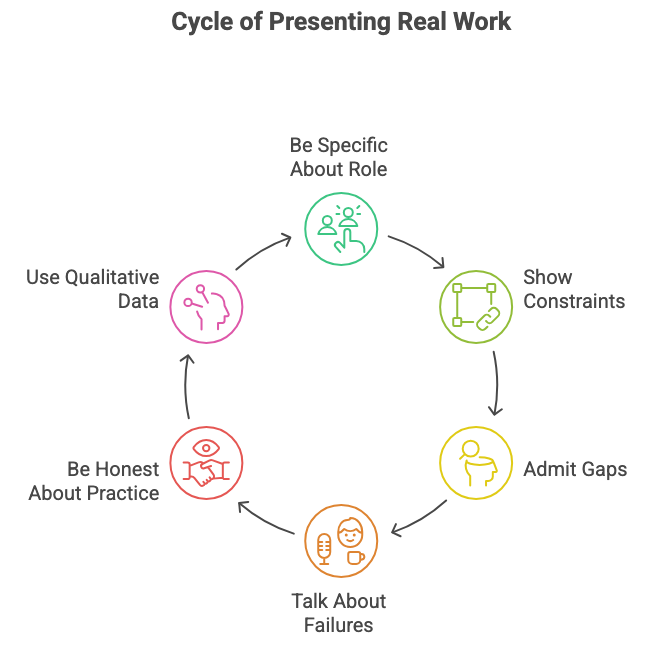
1. Be specific about your role (and the team)
Don’t say “I designed this feature.” Say exactly what you did:
✅ “I was one of two designers on this project. I focused on the mobile experience while Sarah handled desktop. I conducted 6 of the 12 user interviews, and we both participated in synthesis.”
This is honest. It shows collaboration. It shows you understand team dynamics. Hiring managers respect this infinitely more than inflated solo credit.
2. Show the constraints, not just the solution
Every project has limits. Talking about them makes your work more credible:
✅ “We had 3 weeks and a developer handoff deadline, so I prioritized wireframes and basic interactivity testing over high-fidelity mockups. Given more time, I would have tested more variations.”
This shows you make strategic tradeoffs. That’s a professional skill. Pretending constraints didn’t exist makes you look inexperienced.
3. Admit what you don’t know or didn’t measure
Honesty about gaps is professional:
✅ “We didn’t have analytics instrumentation for this feature, so I can’t provide conversion metrics. What I do have is usability test feedback from 5 users and support ticket volume before and after launch.”
This shows you understand the difference between quantitative and qualitative data. It shows you work with what you have. That’s real-world design.
4. Talk about what didn’t work
Failed experiments are learning opportunities. Show them:
✅ “My first concept tested poorly. Users found the navigation confusing. I went back, simplified the structure, and the second round of testing showed significant improvement in task completion.”
Iteration based on feedback is what design actually is. Showing only successes makes you look either inexperienced or dishonest.
5. Be honest about practice projects
If it’s a bootcamp project or self-initiated work, just say so. Then make it rigorous:
✅ “This is a self-initiated project. I identified a real problem with my local library’s website by interviewing 5 regular users. While this didn’t ship, the research and design process are real.”
Nobody expects you to only have shipped work if you’re junior. They expect you to demonstrate thinking. Practice projects are fine if you treat them seriously. (Source: Nielsen Norman Group on Portfolios)
6. Use qualitative data when you don’t have quantitative
User quotes, feedback themes, observation notes, support ticket reduction, stakeholder reactions. These are all valid forms of impact:
✅ “While we didn’t track conversion metrics, we saw support tickets related to checkout drop from ~30/week to ~5/week in the month after launch.”
This is real impact, honestly presented.
What to do when you genuinely don’t have metrics
Most junior designers don’t have access to metrics. Many companies don’t track things properly. Some projects ship and nobody measures the impact. This is normal. Here’s how to handle it honestly:
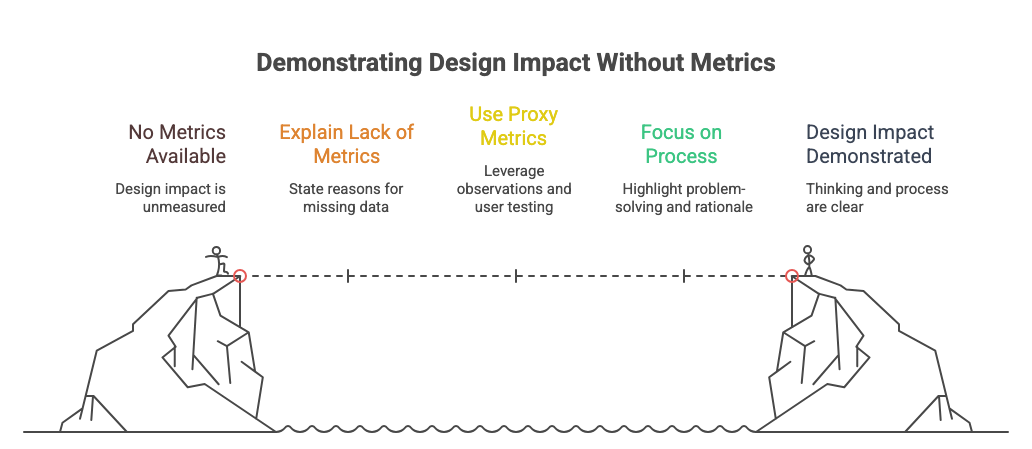
Option 1: Explain why metrics don’t exist
✅ “This was a client project and I didn’t have access to their analytics after handoff.” ✅ “The company didn’t have measurement infrastructure in place for this feature.” ✅ “This was exploratory work that informed strategy but didn’t result in a shipped product.”
These are all legitimate. Just state them matter-of-factly.
Option 2: Use proxy metrics or observations
If you don’t have hard numbers, look for other signals:
✅ “The redesigned form reduced the average support call length from 8 minutes to 3 minutes based on call center reports.” ✅ “User testing showed task completion time dropped from an average of 4 minutes to 90 seconds.” ✅ “In our usability tests, 4 out of 5 users completed the task successfully compared to 1 out of 5 with the old design.”
These aren’t conversion rates or revenue numbers, but they’re real measurements.
Option 3: Focus on the problem-solving process
If you have no outcome data at all, double down on showing your thinking:
✅ “I can’t measure the impact because the project was paused before launch, but I can walk you through how I identified the core user problem and my rationale for the design decisions.”
Your thinking process is actually what hiring managers care about most. The metrics are just evidence that the thinking worked. If you have strong thinking, that’s 80% of what matters.
Option 4: Be upfront that it’s a learning project
If it’s bootcamp work or practice:
✅ “This is a practice project I completed during my UX bootcamp. It’s based on research I conducted with real users, but it’s not a shipped product.”
Then show rigorous process. Show real research. Show thoughtful decisions. The fact that it didn’t ship is fine if the work is solid.
🎯 Take-home: Hiring managers would rather see honest thinking about a small project than fabricated metrics on a fake one.
The honesty that actually impresses interviewers
Here’s the paradox: the things designers think make them look weak are often what actually build credibility.
What you think makes you look bad but actually impresses:
✅ “I made a mistake in my initial approach” This shows self-awareness and learning. Everyone makes mistakes. Acknowledging yours shows maturity.
✅ “I don’t have access to the final metrics” This is honest about real-world constraints. Way better than making numbers up.
✅ “This was my first time doing [research method] and here’s what I learned” Growth mindset. Willingness to try new things. Reflective practice. All good signals.
✅ “The stakeholder pushed back on my recommendation and we had to compromise” This shows you work with real constraints and collaborate with non-designers. That’s a critical skill.
✅ “I would do this differently now” This shows you’re growing and learning from experience. Static skills are less valuable than learning ability.
✅ “I don’t know, but here’s how I’d figure it out” In interviews, admitting you don’t know something and explaining your problem-solving approach is stronger than bullshitting an answer.
What actually makes you look bad:
❌ Taking credit for team work as solo work ❌ Fabricating metrics you can’t defend ❌ Claiming you did research you clearly didn’t do ❌ Presenting polished work with no mention of process or iteration ❌ Being unable to explain your design decisions ❌ Pretending you have no weaknesses or learning areas
The pattern: Honesty about your actual experience and limitations, combined with clear thinking and genuine learning, beats fabricated perfection every time.
Hiring managers aren’t looking for designers who never make mistakes. They’re looking for designers who think clearly, learn from experience, and are honest about what they do and don’t know. That’s what builds trust. And trust is what gets you hired.
📦 Resource Corner
Honest UX Portfolio Examples (Bestfolios) Browse portfolios that show real work with honest context. Look for ones that mention constraints, team roles, and learning.
How to Show Process in Your Portfolio (NN/g) Research-backed guidance on what to include in case studies. Strong on showing thinking over just outcomes.
The Mom Test by Rob Fitzpatrick While focused on customer interviews, the core lesson applies to portfolios: honesty and specificity build more credibility than trying to impress.
Case Study Club Collection of case studies with varying levels of polish and honesty. Good for seeing different approaches to presenting real work.
Lenny’s Podcast: Portfolio Reviews Occasional episodes where industry leaders review portfolios. Listen for what they call out as credible vs questionable.
Portfolios for UX Researchers (Mixed Methods) While focused on research, the advice on presenting rigorous process and being honest about limitations applies to design portfolios too.
Redesigning Your Portfolio (A List Apart) Articles on presenting work honestly and effectively. Good on the narrative structure of case studies.
Final Thought
Portfolio dishonesty happens because designers are scared. Scared they’re not good enough. Scared they don’t have the “right” kind of experience. Scared everyone else’s work is better. So they embellish, exaggerate, or invent to compete.
But here’s what actually happens: the fabrication gets caught, credibility is destroyed, and the job goes to someone else. Or worse, you get hired based on fake credentials and can’t deliver what you claimed.
The alternative is simpler and more effective: be honest about what you did, what you learned, and what you still don’t know. Show real thinking, even on imperfect projects. Admit constraints. Talk about tradeoffs. Present yourself as someone who’s learning and growing, not someone who’s already perfect.
Hiring managers don’t want perfect designers. Those don’t exist. They want honest ones who can think clearly, learn quickly, and work with real-world constraints.
Your real work, honestly presented, is already good enough. Stop lying about it.


