



You are still delivering. Still showing up. Still hitting deadlines, running sessions, pushing pixels, writing reports. From the outside, everything looks fine.
But something feels off. You are tired in a way that a weekend does not fix. Projects that used to excite you feel like tasks to survive. You finish something and instead of satisfaction, you feel... nothing. Or worse, you wonder if it even mattered.
You are not alone. And it is not a you problem.
This issue is about what is actually happening to practitioners in this field right now, why it is hitting so many people at once, and what to do that is more useful than “practice self-care.”
In this issue:
What’s different about burnout in UX right now
The specific things draining the field in 2026
What this looks like for designers vs. researchers
The identity piece nobody talks about
What actually helps
Resource Corner
What’s different about burnout in UX right now
UX burnout is not new. What’s new is the source.
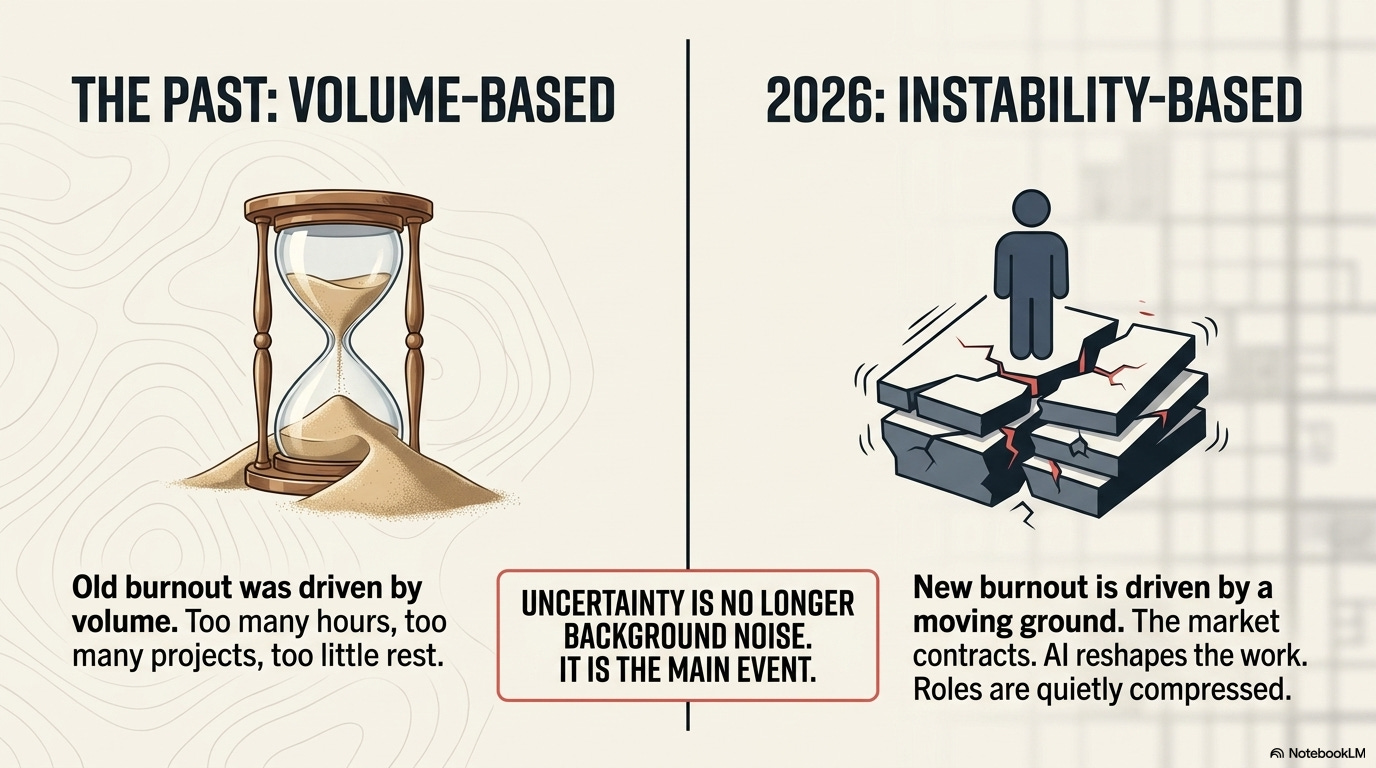
Old burnout came from overwork. Too many hours, too many projects, not enough rest. That is still real. But what’s hitting practitioners hardest in 2026 is something different and harder to name.
Earlier burnout came from long hours. Now it comes from never feeling settled. MockFlow
The ground keeps moving. The tools change. The job description expands. The market contracts. AI reshapes what counts as skilled work. Layoffs hit teams that felt secure. Roles that seemed stable quietly get compressed into other roles. And through all of it, the expectation is that you keep delivering at the same level while absorbing the uncertainty as though it is just background noise.
It is not background noise. It is the main event. And it is exhausting.
The specific things draining the field in 2026
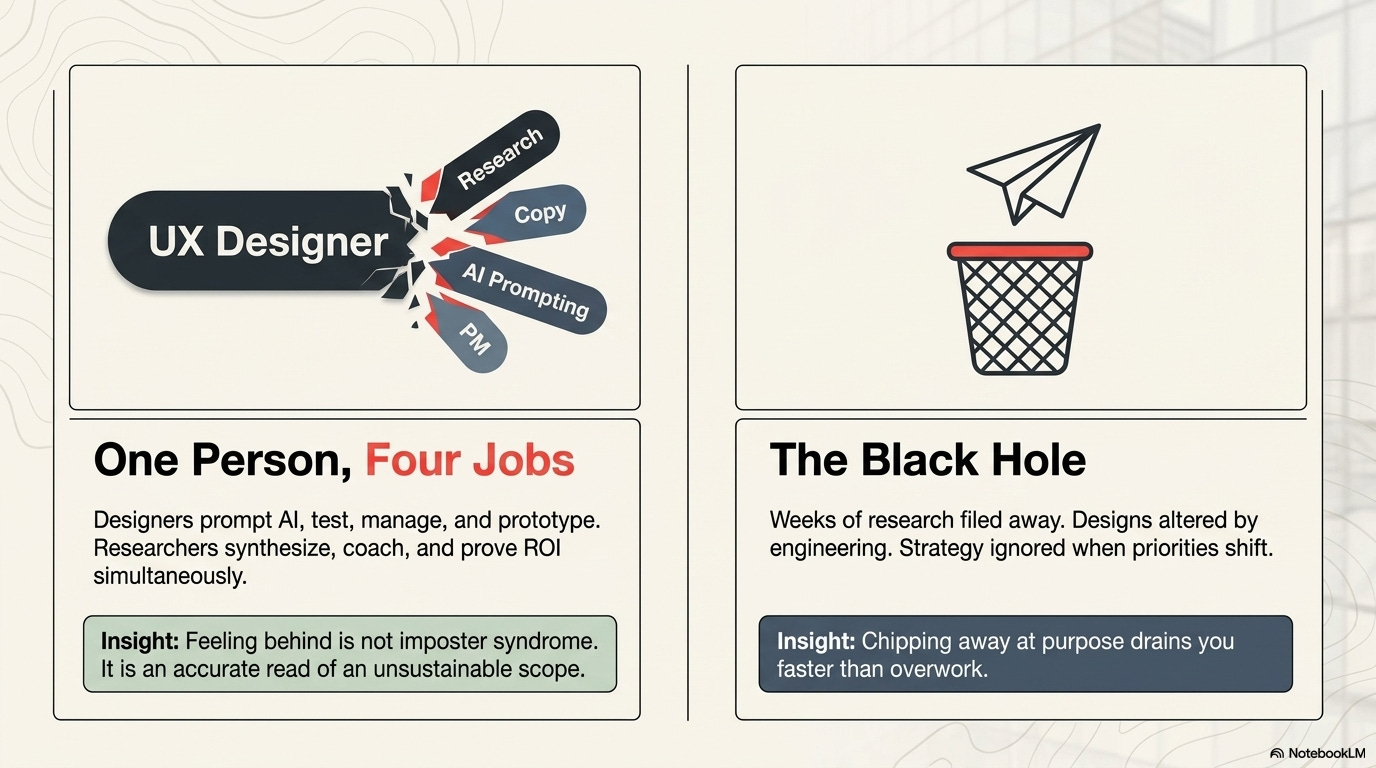
🔴 One person, four jobs
As companies try to do more with less, they create impossible role expectations. The result is burnout, lower quality work, and practitioners stretched too thin to excel at anything. Lyssna
Designers are being asked to research, write, prototype, test, manage stakeholders, and now prompt AI tools on top of it all. Researchers are being asked to run studies, synthesize findings, coach non-researchers, maintain repositories, and prove ROI simultaneously. The job title stayed the same. The scope did not.
When you’re doing two or three jobs at once, you can’t excel at all of them, so you constantly feel like you’re behind or failing. That feeling is not imposter syndrome. It is an accurate read of an unsustainable situation. Akraya
🔴 Work that disappears
Few things drain practitioners faster than effort that goes nowhere.
Weeks of research that get nodded at and filed. Designs that come back from engineering looking nothing like the handoff. Strategy work that gets ignored when priorities shift. Spending weeks on something that never ships because priorities suddenly changed or someone higher up made a last-minute call is not just frustrating. It chips away at your sense of purpose, slowly and consistently. Akraya
When your work does not land, you start to question whether the work matters. When you question whether the work matters long enough, you stop bringing your full self to it. That is the quiet version of burning out. No dramatic collapse. Just a slow dimming.
🔴 Constantly defending the job
In low-maturity teams, practitioners are often treated as pixel polishers instead of problem solvers. Brought in late, expected to make it pretty, and left out of strategy discussions. More time is spent defending the role than doing the actual work. Akraya
Researchers know this particularly well. Explaining why research takes time. Justifying why you need to talk to more than five users. Making the case for why a survey is not the same as a discovery interview. This is not a once-in-a-while conversation. For many practitioners, it is weekly. Possibly daily. And it is exhausting to fight for permission to do your job on top of actually doing it.
🔴 The job market doing what it’s doing
One open design role today easily gets 1,000 or more applications. Most resumes never reach a person. Portfolios are skimmed for seconds. Hiring managers expect senior-level output at junior-level cost. And after all that, you still get ghosted. No rejection. No feedback. No closure. MockFlow
For practitioners who are between roles or quietly looking, this is a specific kind of sustained stress. You update the resume again. Rewrite the case studies again. Wonder what is wrong. Nothing is wrong. The system is just built this way right now, and carrying that uncertainty while also delivering at your current role is a significant weight that most people are carrying silently.
What this looks like for designers vs. researchers
Same field, different flavors.
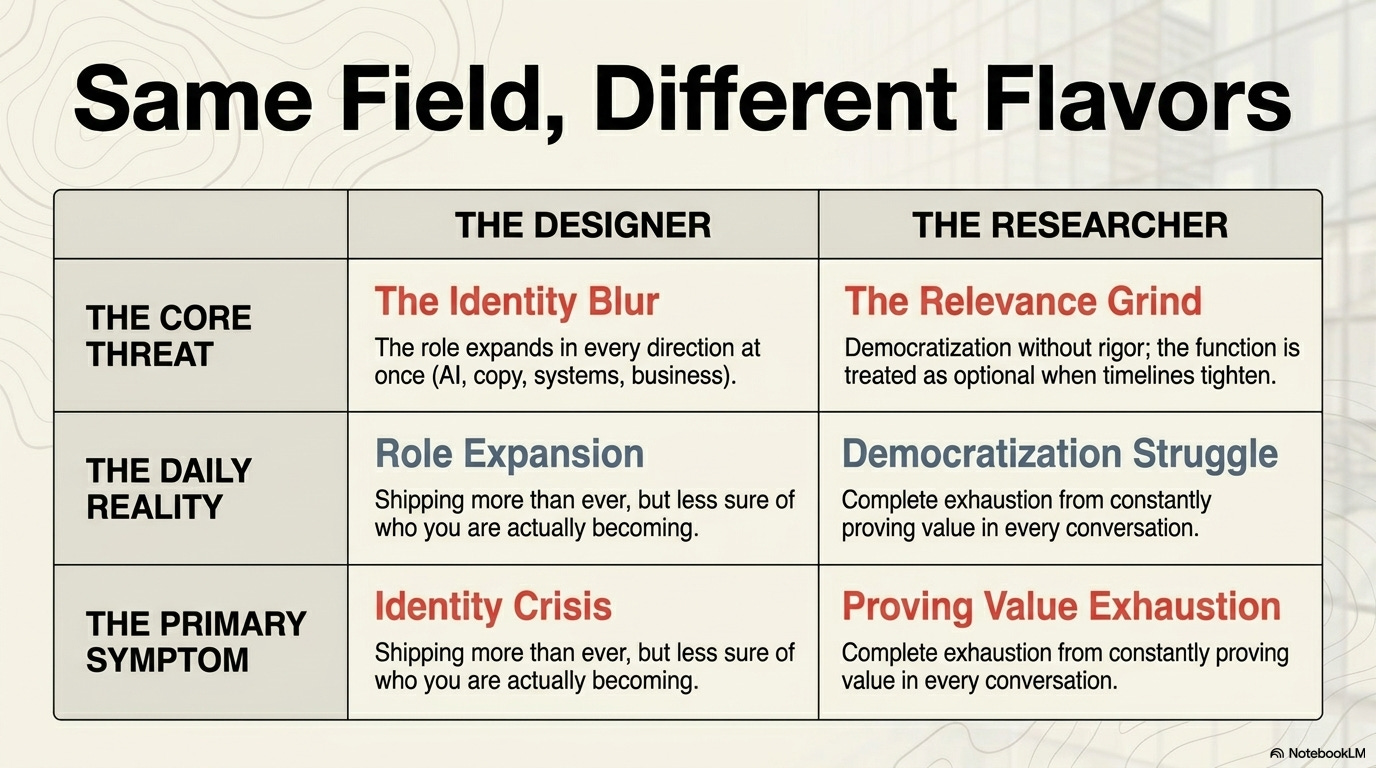
Designers are often dealing with the identity blur. You’re designing, prompting, debugging, writing copy, thinking product, thinking business, thinking systems. Shipping more than ever, but less sure who you’re becoming. Identity uncertainty drains you faster than workload ever did. When the role expands in every direction at once, it becomes hard to know what you are actually supposed to be excellent at. MockFlow
Researchers are often dealing with the relevance grind. Running studies that feed into decisions that have already been made. Watching democratization mean that everyone does research now but nobody does it with the rigor that changes outcomes. Proving value in every conversation while the function quietly gets treated as optional when timelines get tight.
Both are exhausting. Neither is a personal failing.
The identity piece nobody talks about
This one sits underneath everything else and rarely gets named directly.
UX practitioners chose this field because they care. About the work. About the people the work is for. About making things better and more human. That motivation is not just professional. For most people in this field, it is personal.
When the work does not land, when the role keeps expanding, when the field feels unstable, the question that creeps in is not just “is my career okay.” It is “was I wrong about what this work was supposed to be?”
That question is heavier than it looks.
Your biggest risk in 2026 is not being replaced by AI. It is emotionally shutting down while trying to outrun it. MockFlow
And the answer to that question is not a framework or a productivity system. It is permission to acknowledge that the field changed significantly and fast, that it is reasonable to feel disoriented by that, and that disorientation is not the same as being in the wrong place.
What actually helps
Not “meditate more.” Actual things.
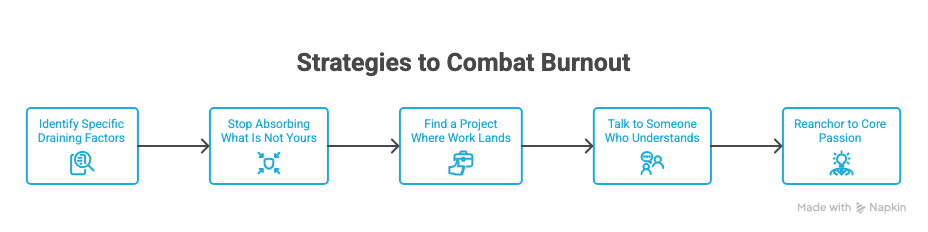
✓ Name what’s draining you specifically
Burnout is easier to address when it has a specific source. Is it the scope of the role? The work that disappears? The constant justification? The uncertainty of the market? Different problems have different responses. Vague exhaustion is harder to move than a specific identified pressure.
✓ Stop absorbing what is not yours to carry
Some of what practitioners are carrying is genuinely theirs: the craft, the decisions, the quality of the work. A lot of what practitioners are carrying is not theirs: organizational dysfunction, leadership decisions made above them, market conditions outside their control. Learning to tell the difference, consistently, is one of the most protective things you can do for yourself in this field right now.
✓ Find one project where the work actually lands
Sustained engagement requires feedback that the work matters. If your main role is not providing that right now, find a context that does. A side project. Volunteering. A mentorship relationship where your input visibly helps someone. Not as a solution to everything, but as a reminder of why you are in this at all.
✓ Talk to someone who gets it
Many practitioners felt disillusioned: experienced UXers were tired of being misunderstood; newer ones couldn’t break in. This is a field-wide experience and a lot of people are carrying it privately. Finding people who are in it too, without it becoming a competition about who has it worse, is genuinely stabilizing. The communities, the Slack groups, the conferences. The point is not networking. The point is not being alone in something that a lot of people are going through simultaneously. LogRocket
✓ Reanchor to the work that made you want this
Not the deliverables. Not the process. The actual thing. A session where someone says “oh, I never thought about it that way.” A design decision that made something easier for somebody. A research finding that genuinely changed what got built. That is why most people in this field are here. Keeping that in view, especially when the surrounding noise is loudest, matters more than any career strategy.
Quick interruption. Genuinely relevant.
🎯 If you’re trying to figure out your next move, this workshop is for you.
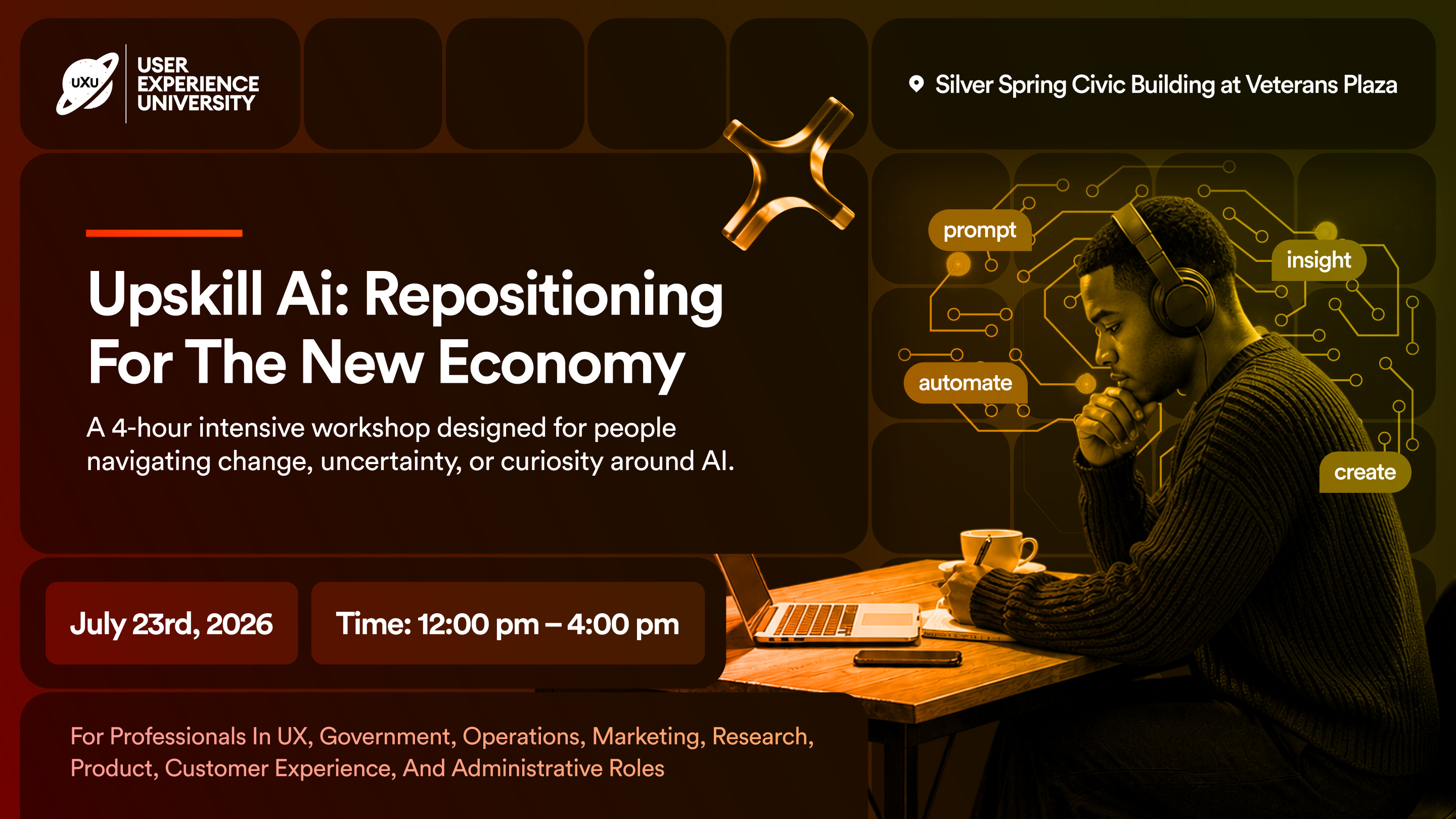
Not a lecture. Four hours of working on your actual stuff: your resume, your pitch, your positioning in a market that keeps moving. You leave with something finished and one clear next step.
📅 July 23, 2025 · 12:00 to 4:00 PM 📍 Silver Spring Civic Building, Silver Spring, MD
📦 Resource Corner
Burnout: The Secret to Unlocking the Stress Cycle by Emily and Amelia Nagoski The most practically useful book on burnout available. Not about productivity. About completing the stress cycle so it does not accumulate. Read this before you read another career book.
The UX Collective: State of UX 2026 The annual read from Fabricio Teixeira and Caio Braga. Honest, field-wide, and validating in a way that most industry reports are not. Especially useful if you have been feeling like something shifted but could not articulate what.
Lyssna UX Design Trends Report 2026 Survey of 100 designers on what they are actually experiencing. The data on role expansion and impossible expectations is worth reading just to know you are not imagining it.
Interaction Design Foundation Community One of the more active communities for UX practitioners to talk honestly about the work and the field. Useful when the conversations in your immediate team are not enough.
💭 Final Thought
The field is not broken. You are not broken. But something genuinely shifted, and pretending it did not is making a lot of people quietly miserable.
A year ago, UX felt like it was on trial. Layoffs and hiring freezes made the field feel unstable, while leaders demanded clearer proof that design work impacted the bottom line. Many practitioners felt disillusioned. Some of that has stabilized. Some of it has not. And the practitioners who are doing okay are not the ones who found a way to feel nothing about all of it. They are the ones who stopped pretending the exhaustion was not there and started addressing it specifically, honestly, and without treating it as a personal failure. LogRocket
You got into this field because you wanted to make things better for people. That instinct is still worth protecting. But you cannot protect it while running on empty and calling it resilience.
Take the week seriously. Not the deliverables. You.


