



There was a moment, not long ago, when UX felt untouchable. Executives were quoting Don Norman in all-hands meetings. Airbnb’s turnaround was being credited to design thinking. Companies were building design and research teams as fast as they could hire. The narrative was simple: empathy wins, user-centered work is good business, and we are the ones who make it happen.
That narrative got a lot quieter.
Not gone. But quieter. And if you have been in this field for more than two years, you have felt it. Fewer decision-making conversations you are included in. Research that gets nodded at and filed away. Designs that come back from engineering looking nothing like what was handed off, and nobody flagged it as a problem.
This issue is about what actually happened and, more importantly, what to do about it.
Speaking of Don Norman, Join Him at UXCON26
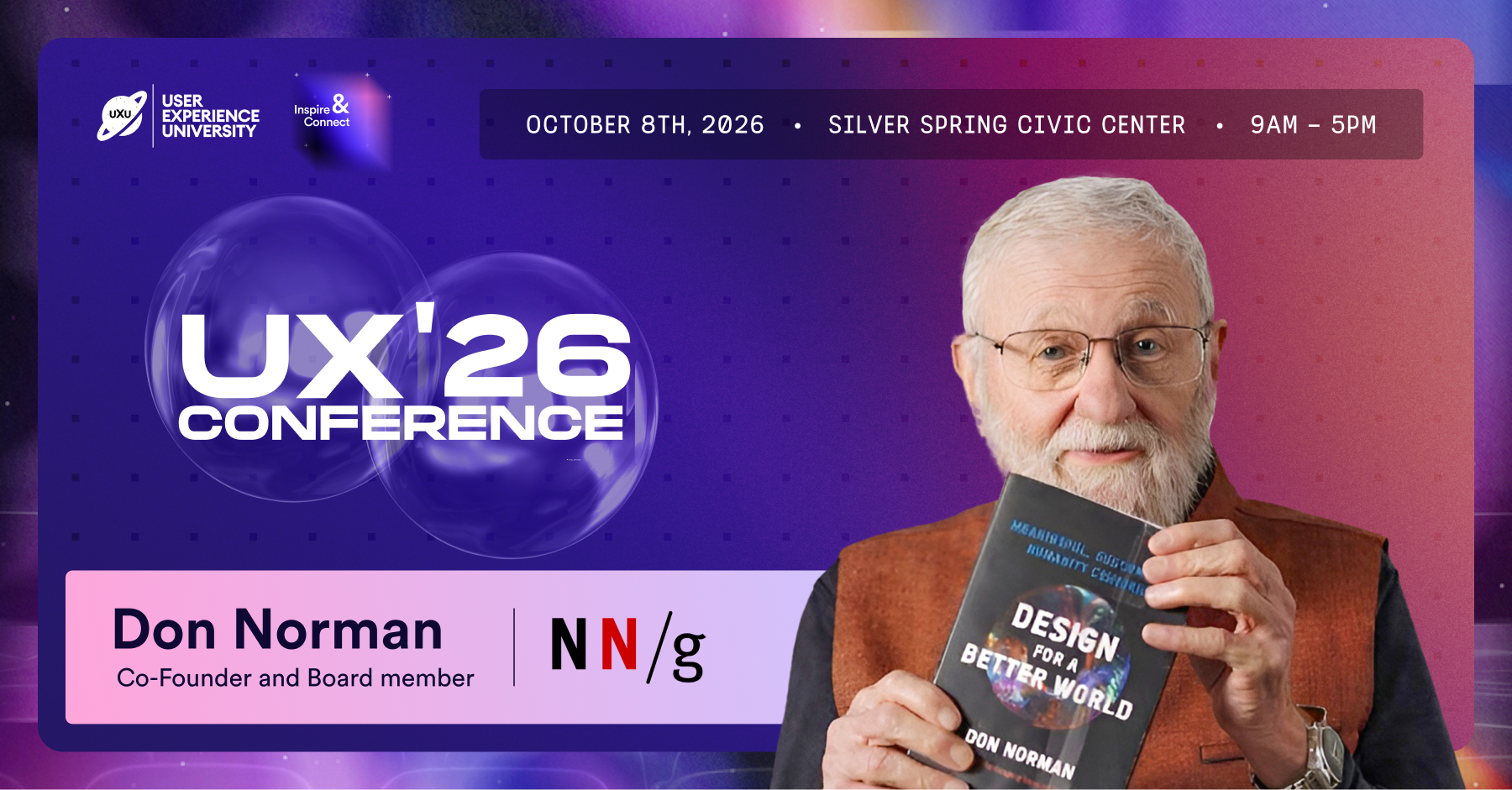
Don Norman is famous for doors that are confusing to open. They are called Norman Doors. If you have ever pushed a door that should be pulled, you have lived inside one of his ideas.
That is what Don Norman does. He makes you see the world differently.
Hearing Don Norman speak in 2026 is not a checkbox on a conference list. It is a genuine once-in-a-career opportunity.
In this issue:
What shifted and when
The ways UX lost influence without noticing
What this looks like for designers vs. researchers
What influence actually looks like now
How to rebuild it, specifically
Resource Corner
What shifted and when
The influence peak was real. Between roughly 2017 and 2022, UX had genuine organizational momentum. Design thinking was being taught in business schools. Chief Design Officer roles were being created. Teams grew. Budgets expanded.
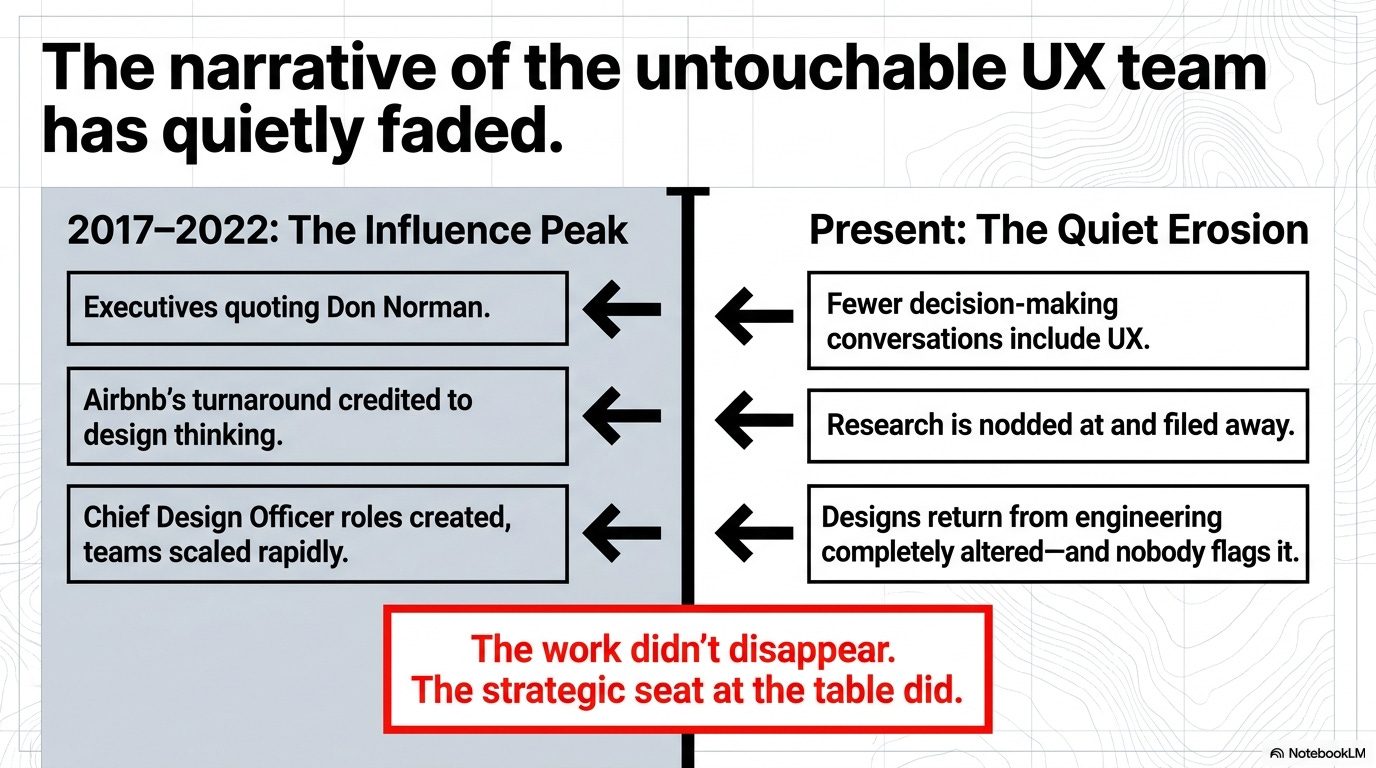
Then a few things happened at once.
Budgets tightened and UX struggled to defend itself in the language leadership speaks. As interest rates rose and budgets tightened, leaders looked for roles easiest to justify financially, and UX often struggled to defend itself with simple, direct metrics. When cuts came, design and research teams were hit hard, partly because they had never built a clear language for their own value that leadership could hold in their hands. LinkedIn
AI gave companies a convenient cover story. AI hype created a misleading narrative that new tools could rapidly replace designers and researchers. That was not true, but the story was convenient in a cost-cutting environment. LinkedIn
But here is the harder part. Some of the influence loss was not done to us. It was allowed. Decisions got made without UX input not because no one cared, but because nobody noticed UX was absent until after the decision was locked. That pattern, repeated across enough sprints and roadmap sessions, becomes the new normal.
The ways UX lost influence without noticing
None of this happened overnight. It accumulated quietly.
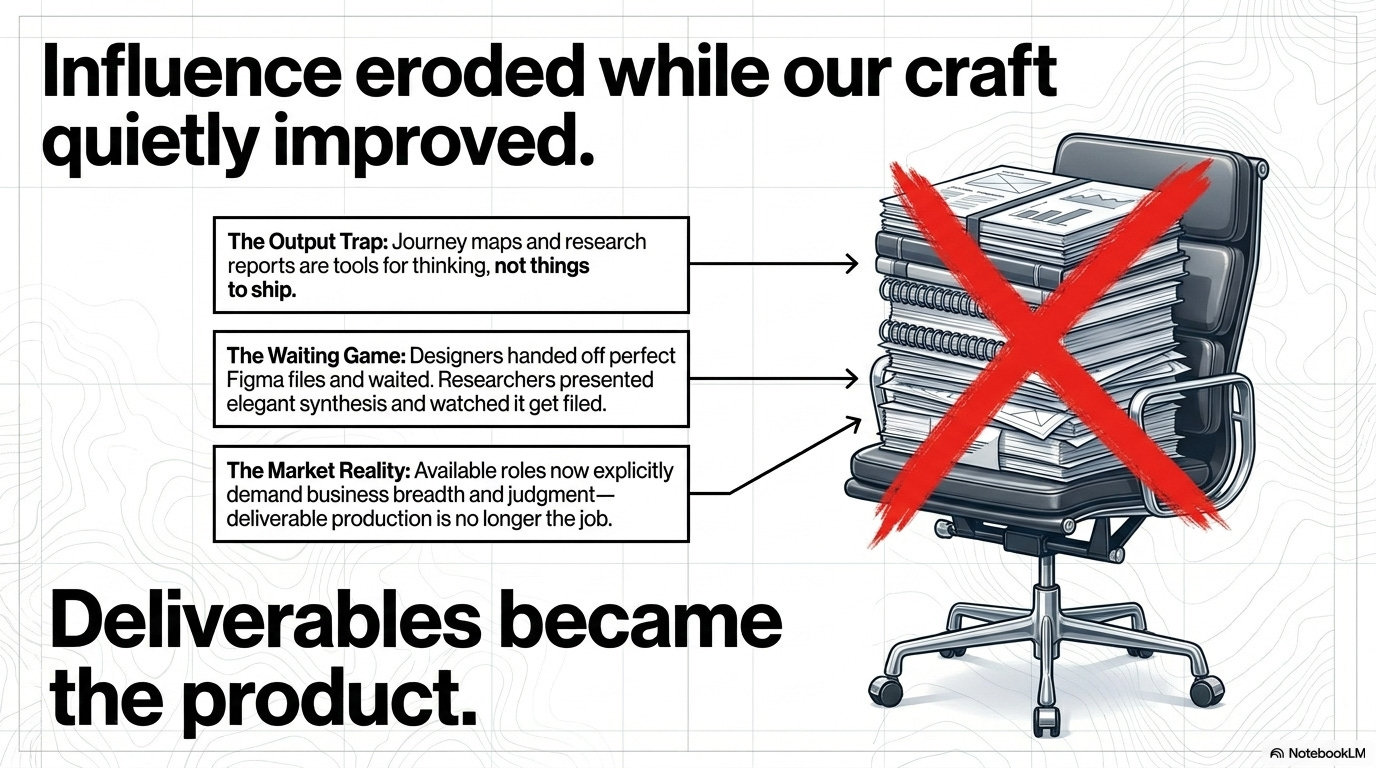
🔴 Deliverables became the product
Journey maps. Research reports. Empathy maps. These are tools for thinking, not things to ship. Somewhere along the way, a lot of teams started treating the artifact as the outcome. Researchers spent weeks on a report that got presented, admired, and filed. Designers handed off Figma files and waited.
Available roles increasingly demand breadth and judgment, not just artifacts. The market is now saying explicitly that deliverable production is not the job. The judgment behind it is. LinkedIn
🔴 Craft got refined while influence quietly eroded
The field got very good at producing thorough, well-documented work. Figma files with perfect component organization. Research decks with elegant synthesis. The craft improved while organizational influence atrophied, because influence is not built through better deliverables. It is built through better decisions and being present when those decisions happen.
🔴 UX stopped speaking the language of the room it wanted to be in
Most UX practitioners speak design and research fluently and business haltingly. Work gets presented in terms of friction, user needs, and experience principles. Leadership hears that and translates it to: interesting, not urgent.
The practitioners who kept their seat learned to translate. Not by abandoning user advocacy, but by anchoring it to things leadership already tracks. Retention. Error rates. Support volume. Activation. These are the numbers that make UX work visible to people who control budgets. Invisible work eventually becomes defunded work.
🔴 Speed swallowed research
This one hits researchers specifically. The biggest challenge in 2026 is speed: teams are under pressure to validate problems and ship faster, often leading to research debt. Research that takes three weeks does not fit a two-week sprint. So teams started skipping it, substituting it, or running versions of it fast enough to be schedulable and shallow enough to be unreliable. Lovable
The result is a strange situation where research is more discussed than ever and less acted on than ever. The gap between what organizations say about research and what they actually do with it is one of the most consistent patterns in the field right now.
What this looks like for designers vs. researchers
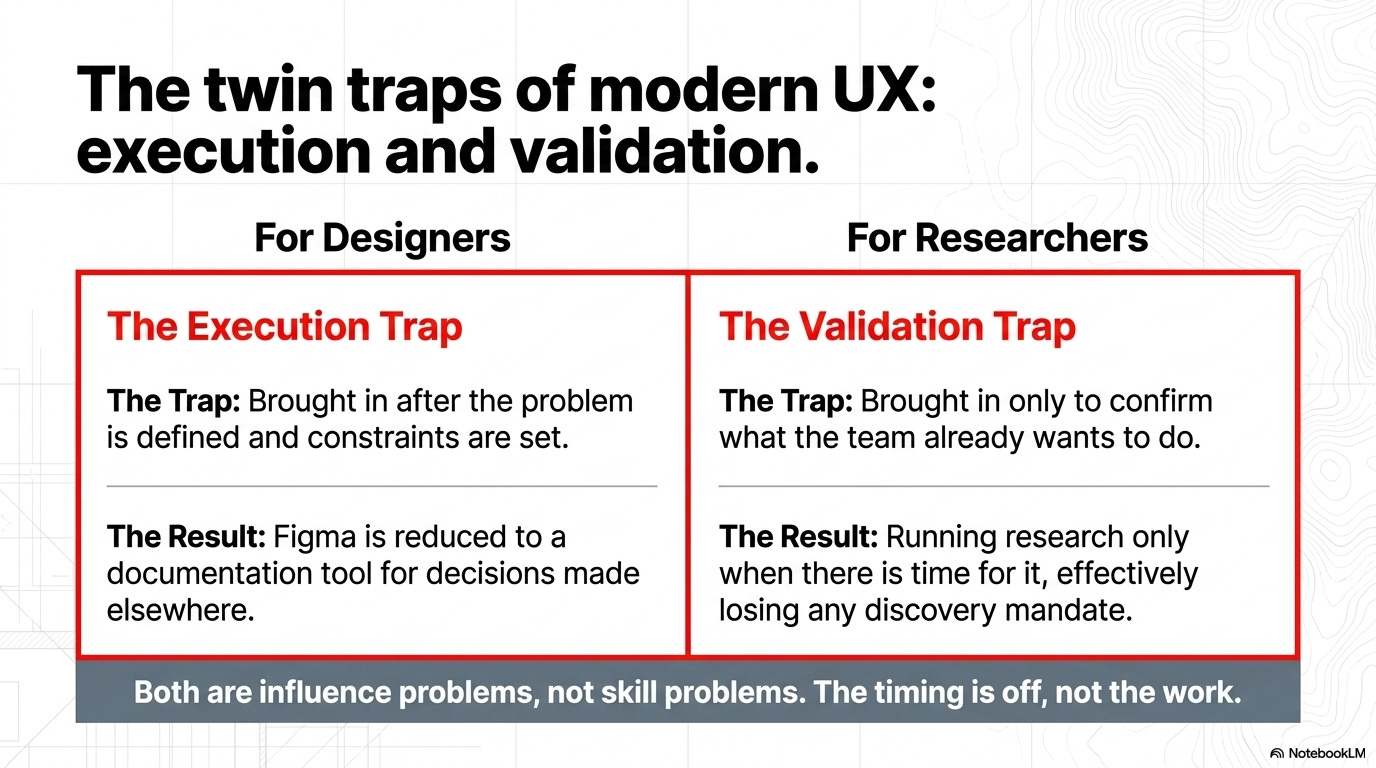
Same problem, different texture
.
For designers: the risk is becoming an execution function. Getting brought in after the problem is defined, the constraints are set, and the decision is basically already made. Figma becomes a documentation tool for decisions that happened elsewhere.
For researchers: the risk is becoming a validation function. Getting brought in to confirm what the team already wants to do, rather than to discover what they should be doing. Research that only runs when there is time for it is research that has already lost its strategic position.
Both of these are influence problems, not skill problems. The work is good. The timing and positioning of the work is what is off.
What influence actually looks like now
The practitioners who thrive treat UX as strategic problem solving, rather than focusing on producing deliverables. LinkedIn
Influence in 2026 does not look like presenting polished work at a sprint review. It looks like being in the room when the problem is being defined. It looks like research findings being cited in the meeting where the roadmap gets decided, not the meeting after it.
Practically, the most influential UX practitioners right now share a few things:
→ They know what decisions are being made before anyone tells them
→ They take positions, not just present options
→ They connect their work to metrics leadership is already watching
→ They make findings available the moment they are relevant, not when the report is finished
→ They are the person a PM calls before the meeting, not during it
That last one is worth sitting with. If you are only being consulted inside formal design reviews or research share-outs, you are downstream of influence. The decisions that shape what you work on are being made in conversations you are not in yet.
How to rebuild it, specifically
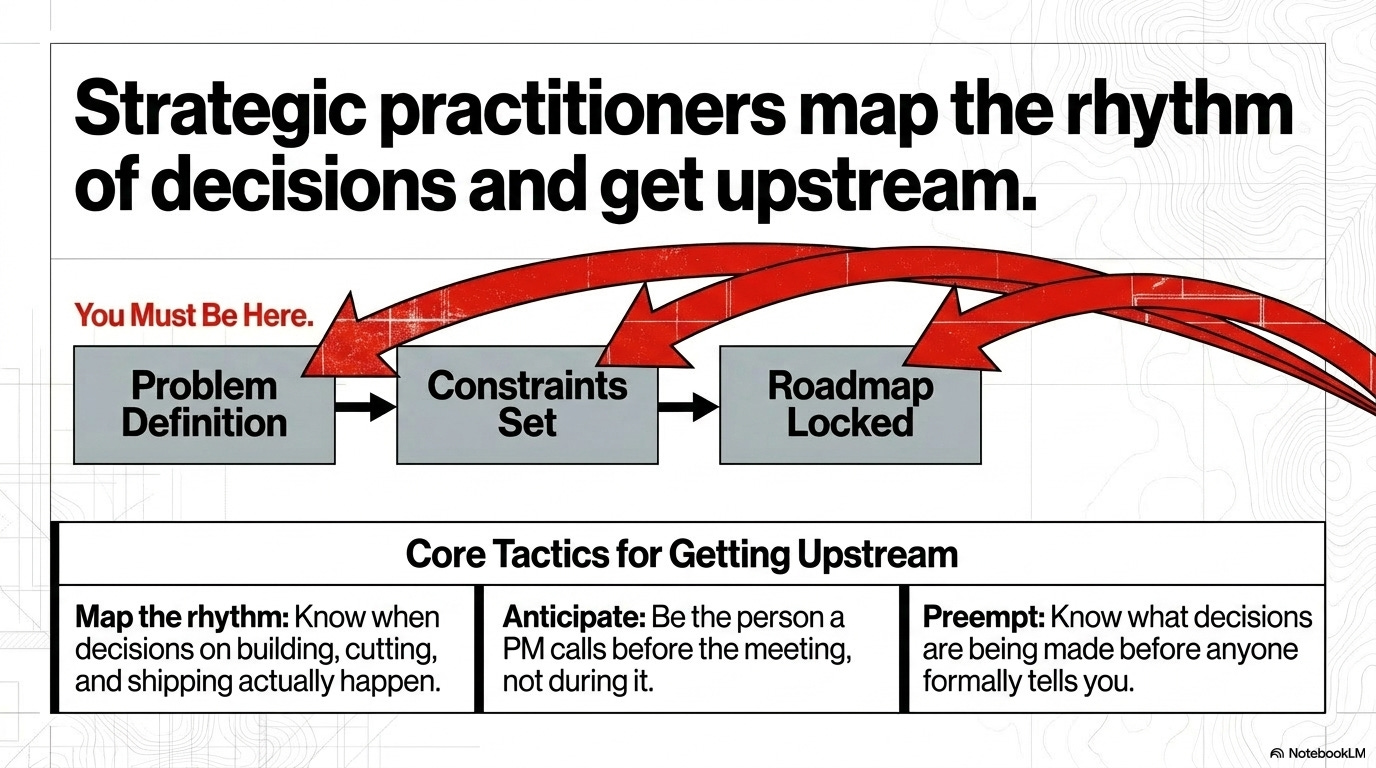
✓ Find out what decisions are being made and get upstream of them
Every product team has a rhythm of decisions: what to build, what to cut, what to test, what to ship. Map that rhythm in your organization. Find where you are currently absent and get present there. Not to add process, but to change the output.
✓ Answer the impact question before anyone asks
Do not wait for leadership to ask what the impact of your work was. Answer it preemptively, every time. Even rough numbers are better than none. A drop in task failure rate. Fewer steps to completion. A reduction in a specific support ticket category. These are the things that make UX legible to people who did not go to design school.
✓ Shorten the distance between insight and action
The research report that takes four weeks to write and two hours to present is not the format that maintains influence in fast-moving teams. A Slack message with one finding and one implication. A five-minute share at the start of a sprint. Insight that arrives when it is needed lands differently than insight that arrives when it is finished.
✓ Take a position
The most influential practitioners in any organization are not the most neutral ones. They are the ones who look at the evidence and say: we should do this. Not “here are three options.” Not “here is what we found.” A recommendation. A stance. Something someone can agree with or push back on. Influence requires having a position to respond to.
✓ Make the user impossible to ignore
This is the irreplaceable part of the job. Share a two-minute clip from a session before the roadmap discussion. Put a quote from a user interview on the first slide of every presentation. Make the person on the other side of the screen feel present in rooms where they are usually abstract. That advocacy, done consistently, is what separates UX practitioners who lead from those who execute.
Quick interruption. This one is for you.
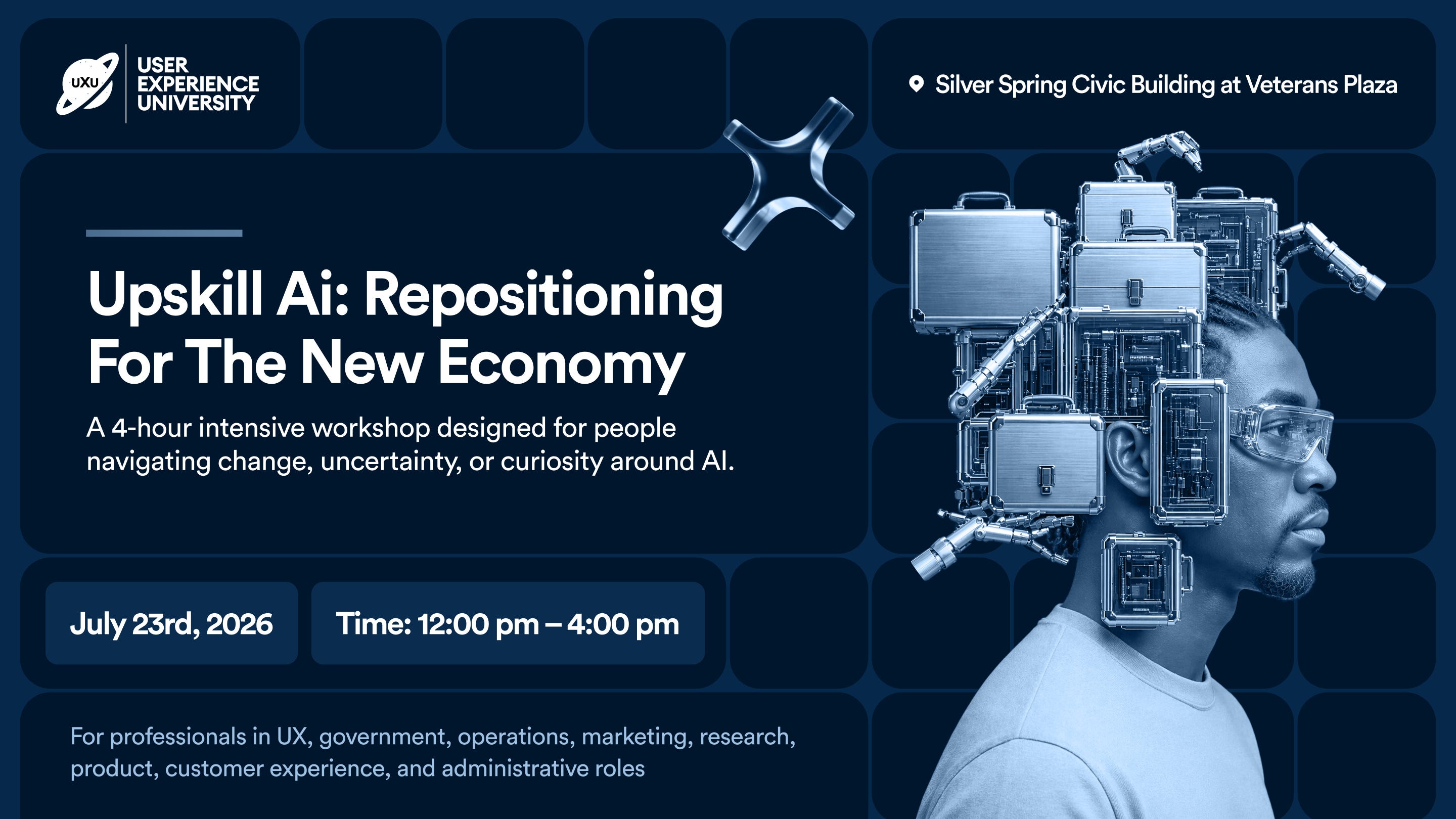
🎯 Not sure where you fit right now? This workshop was built for that moment.
If you have been laid off, watching your field shift, or applying and hearing nothing back, this is not a lecture about what you should have done differently. It is four hours of working on your actual stuff. Your resume, your pitch, your positioning in a market that keeps moving.
No theory. You leave with something finished and one clear next step.
📅 July 23, 2025 · 12:00 to 4:00 PM 📍 Silver Spring Civic Building, Silver Spring, MD
📦 Resource Corner
State of UX 2026 (Nielsen Norman Group) The most grounded annual read on where the field actually is versus where it thinks it is. The section on influence and business impact is worth reading twice.
Articulating Design Decisions by Tom Greever The practical guide to communicating design work in language that lands with stakeholders who do not share your background. One of the most useful books in the field right now.
Continuous Discovery Habits by Teresa Torres The framework most product teams are moving toward. Essential reading for researchers and designers who want to stay upstream of decisions instead of downstream of them.
Measuring the User Experience by Tullis and Albert If you struggle to connect your work to numbers leadership cares about, this is where to start. Practical, not academic.
💭 Final Thought
The seat at the table was never guaranteed. It was earned, and then somewhere along the way, a lot of UX teams stopped earning it daily and started assuming it was permanent.
It was not. Neither is any organizational role.
What UX has going for it is something genuinely hard to replace: the ability to understand what people actually need, as opposed to what they say they want or what the data says they clicked. That skill, applied upstream in decisions rather than downstream in deliverables, is where the influence lives.
The field is not dying. The question of whether UX is still strategic or becoming redundant is one the industry is actively debating in 2026. But the practitioners who are answering that question in their favor are not waiting for organizations to rediscover the value of UX. They are making that value impossible to ignore, one decision at a time. Nielsen Norman Group
That is the work now. Not the Figma file. Not the research report. The decision that those things change.


