



You’re scrolling through job boards again. Every “junior” role wants 2-3 years of experience. Every “entry-level” position lists requirements that sound senior. You’ve applied to 50+ jobs and heard back from maybe three. And you’re starting to wonder if you missed the memo on how anyone actually breaks into this field.
The job market for UX designers is deeply broken right now, but not in the way you think. This issue breaks down what’s really happening, why job posts lie, and the actual path into UX work in 2025.
In this issue:
Why “junior” job posts ask for senior experience
What companies actually mean vs. what they post
The experience paradox (and how to break it)
Alternative paths that actually work right now
How to position yourself when you “don’t qualify”
📦 Resource Corner
Why “junior” job posts ask for senior experience
Let’s start by acknowledging the absurdity: “Junior UX Designer: 3-5 years experience required.” It’s everywhere. And it makes no sense. If someone has 3-5 years of experience, they’re not junior. They’re mid-level at minimum.
So what’s actually happening?
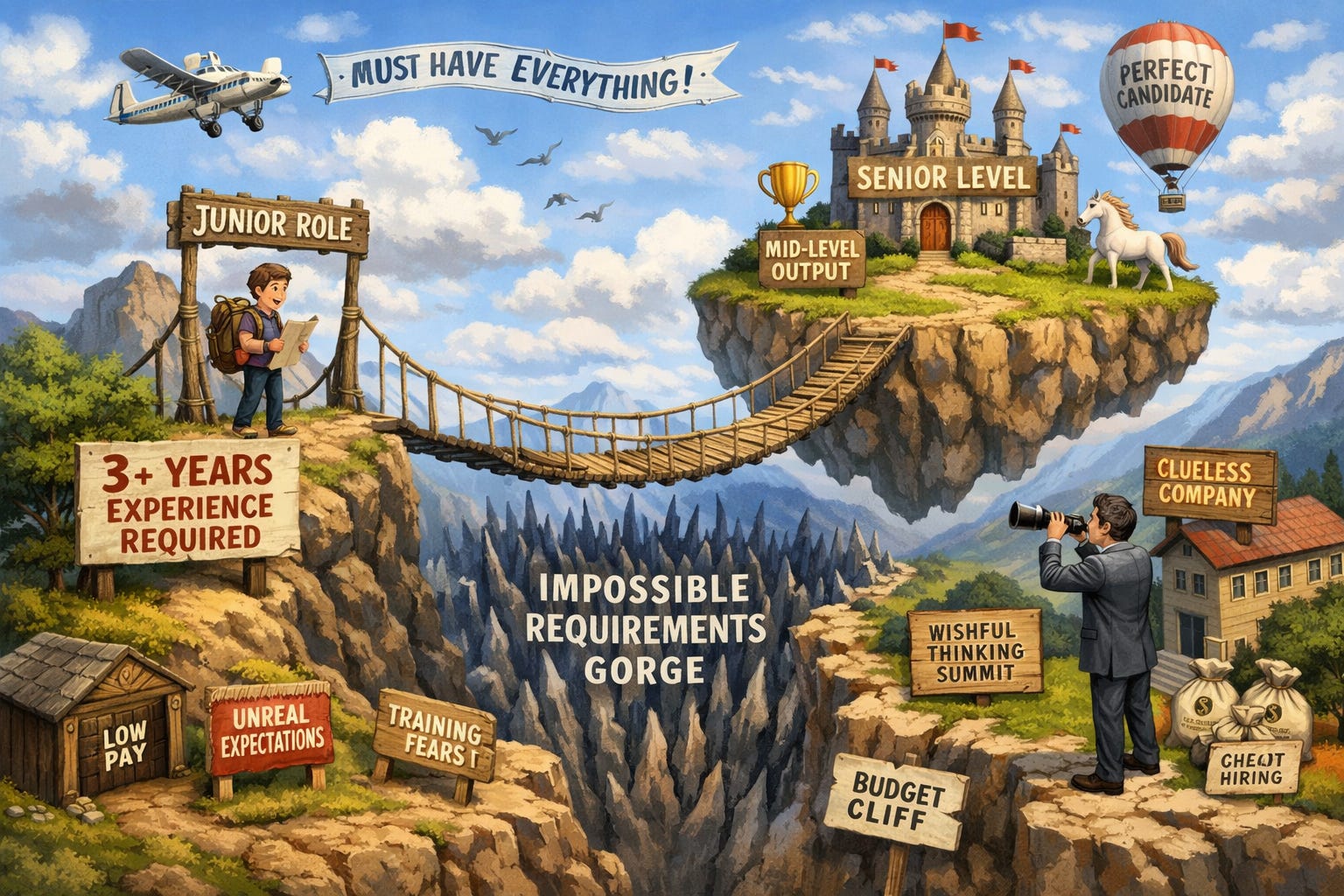
The job post isn’t describing who they want. It’s describing who they wish existed.
Here’s the breakdown of what’s really going on:
🔹 Companies don’t know how to hire for UX Many companies, especially smaller ones or those new to having design teams, don’t actually understand UX career levels. They copy requirements from other job posts. They ask HR to write the posting without designer input. They list everything they think sounds important without understanding what’s realistic.
🔹 They’re scared of training someone Hiring managers have been burned before. They hired someone “junior” who couldn’t do the work. So now they’re hedging. They call it junior to justify the salary, but they want someone experienced enough to hit the ground running. They want junior pricing with mid-level output.
🔹 The job post is a wish list, not requirements That list of “must-haves”? Most of it is “nice-to-haves.” Companies throw everything against the wall hoping to filter for the best candidates. But they’ll absolutely interview people who only meet 60% of the requirements if the portfolio is strong.
🔹 They’re protecting themselves from bad hires By asking for experience, they’re trying to avoid complete beginners who can’t deliver. It’s not that they actually need 3 years. They need someone who can do basic UX work competently. But they don’t know how to screen for that, so they use years as a proxy.
🔹 Budget constraints dressed up as experience requirements Sometimes they can only afford a junior salary but need mid-level work. So they post a “junior” role with inflated requirements, hoping someone desperate or early in their career will take the low pay despite having the skills.
The result: Job posts that don’t match reality. Requirements that discourage qualified people from applying. And a ton of confusion about what “junior” even means.
What companies actually mean vs. what they post
Let’s decode some common job posting language, because what they write and what they actually need are often completely different.
What they post: “3-5 years of UX design experience required”
What they actually mean: “We need someone who can do basic UX work without constant hand-holding. If you’ve done real projects, even practice ones, and can demonstrate competence, we’ll talk to you.”
What to do: Apply anyway if your portfolio shows the skills. Years matter less than demonstrated ability.
What they post: “Experience with user research, wireframing, prototyping, usability testing, visual design, and front-end development”
What they actually mean: “We’re a small team and need someone versatile. You don’t need to be an expert at all of these, but you should be comfortable wearing multiple hats.”
What to do: Show range in your portfolio. Demonstrate you’ve done research AND design AND testing, even if none of it is advanced-level work.
What they post: “Must have shipped products at scale with measurable impact”
What they actually mean: “We want someone who understands the full product lifecycle, not just making pretty screens.”
What to do: If you have ANY shipped work, even a small feature or client project, talk about it. If you don’t, frame practice projects around the full process: research, design, testing, iteration.
What they post: “Portfolio must demonstrate strong visual design skills”
What they actually mean: “We need someone who can make things look professional, not just functional. We don’t want to hire a visual designer separately.”
What to do: If your visual skills are weak, invest in learning design fundamentals. Take existing wireframes and add polish. Study designs you admire and reverse-engineer them.
What they post: “Startup experience preferred”
What they actually mean: “We’re chaotic, under-resourced, and need someone comfortable with ambiguity and fast iteration.”
What to do: Emphasize any experience working independently, wearing multiple hats, or working without clear direction. Show you’re scrappy.
What they post: “Must work well in a fast-paced environment”
What they actually mean: “We’re disorganized and things change constantly. Can you handle that?”
What to do: Be honest with yourself about whether you want this. If yes, show examples of adapting to changing requirements or pivoting quickly.
The pattern: Job posts are often written defensively, listing everything they could possibly want. The actual bar is lower than it looks. Apply if you can do 60-70% of what they’re asking.
The experience paradox (and how to break it)
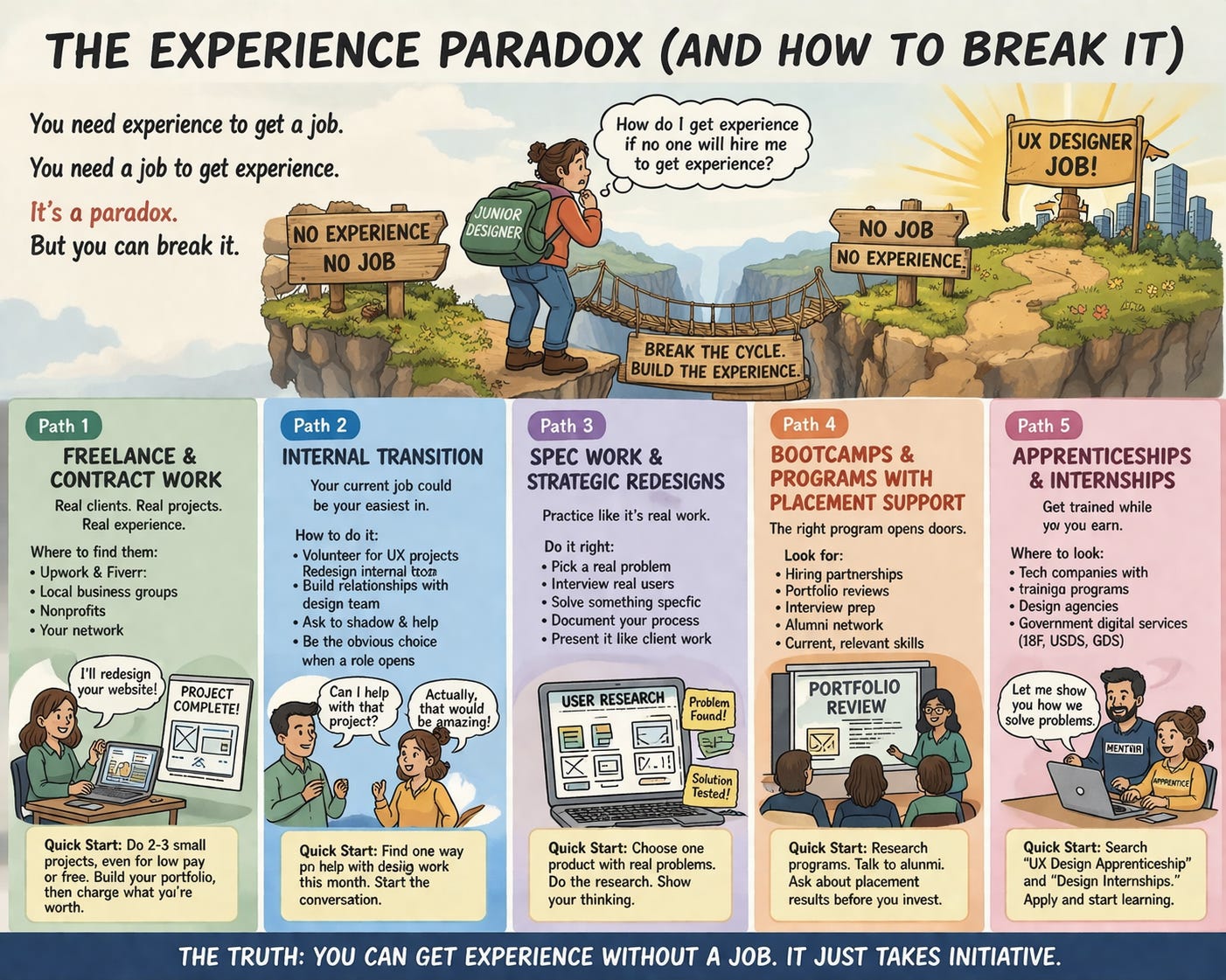
Here’s the trap every junior designer knows: you need experience to get a job, but you need a job to get experience.
Companies want to see that you’ve done real UX work. But how do you get real UX work if no one will hire you to do real UX work?
This is the experience paradox. And it’s real. But it’s not insurmountable.
Here’s how people are actually breaking in right now:
Path 1: Freelance and contract work (even small projects)
You don’t need a full-time job to get experience. You need projects. Small businesses, nonprofits, solo founders, they all need design help and often can’t afford agencies.
Where to find them:
Upwork, Fiverr (yes, really, for building initial portfolio pieces)
Local business communities, chambers of commerce
Nonprofit boards (many need digital help)
Your personal network (someone knows someone who needs a website or app redesigned)
Start small. Charge low or even do a few for free initially just to get real client work in your portfolio. Once you have 2-3 real projects, you can start charging properly and using those as leverage for better opportunities.
Path 2: Internal transition at your current company
If you’re already employed somewhere, even in a non-design role, this is your easiest path in. Companies hire from within because there’s less risk.
How to do it:
Volunteer to help with UX-adjacent projects in your current role
Offer to redesign internal tools or processes
Build relationships with the design or product team
Ask to shadow designers or help with research
When a junior role opens, you’re already a known quantity
This is how a lot of designers broke in: they were in customer support, project management, marketing, or development, and gradually shifted into design.
Path 3: Spec work and redesigns (done strategically)
Practice projects get a bad reputation, but they work if you do them right. The key is treating them like real work, not like school assignments.
How to do it right:
Pick a real product with real problems (not another Spotify redesign)
Do actual user research (interview real users of that product)
Solve a specific, scoped problem (not “redesign the whole app”)
Document your process thoroughly
Present it like client work, not a portfolio exercise
One exceptionally good spec project that shows deep thinking beats five mediocre bootcamp projects every time.
Path 4: Bootcamps and programs with job placement support
Some bootcamps actually have strong hiring networks and job placement support. These work when:
The bootcamp has relationships with companies actively hiring
They offer portfolio reviews and interview prep
They connect you with alumni who can refer you
They teach current, relevant skills
The bootcamp itself isn’t the value. The network and placement support is. Research thoroughly before investing.
Path 5: Start as an apprentice or design intern
Some companies offer apprenticeships or internships specifically designed to bring in people without experience and train them. These are rare but valuable.
Where to look:
Larger tech companies with formal training programs
Design agencies with apprenticeship models
Government digital services (18F, USDS, GDS in UK)
The pay is often low, but the training and resume credibility are real.
The common thread: All of these paths involve doing real work before you have a “real job.” The experience paradox isn’t actually a paradox. You can get experience without employment. It’s just harder and requires more initiative.
Quick pause. This part matters.
🎯 UXCON26: Your Fast-Track Past the Paradox
Here’s what nobody warns you about when you’re trying to break into UX: the actual doors that open don’t come from job boards. They come from someone saying “I know a person.”

Every designer at UXCON26 who’s hiring, mentoring, or just well-connected? They’re the “person” in that sentence. The hiring manager who posts on LinkedIn before the job goes public. The senior who refers people straight to final-round interviews. The founder who needs a contractor next month.
They’re all going to be there. And you’re trying to break in by cold-applying on Indeed.
The difference between struggling for months and landing something next week is often just one conversation with the right person. That’s what you’re paying for.
Back to positioning yourself.
How to position yourself when you “don’t qualify”
You’re going to apply for jobs where you don’t meet all the requirements. That’s normal and expected. But how you position yourself determines whether you get a shot.
Strategy 1: Lead with your strongest work
Your portfolio is your actual resume. If it’s strong, the experience gap matters less. Make sure your best work is first, presented clearly, with obvious process and thinking visible.
When a hiring manager sees exceptional work, they start finding reasons to interview you despite the experience gap. When they see mediocre work, they use the experience gap as an easy rejection reason.
Strategy 2: Address the gap directly in your cover letter
Don’t ignore it. Don’t apologize. Acknowledge it and redirect to your strengths.
✅ “I know you’re looking for 3+ years of experience. I have 1 year of professional work plus extensive self-directed projects. Here’s why I’m confident I can deliver what you need...”
Then talk about specific skills, relevant projects, and what you bring that makes up for less time.
Strategy 3: Show learning ability and growth
If you can’t show years of experience, show rapid learning. Talk about what you’ve learned in the last 6 months. Show iteration and improvement across projects in your portfolio. Demonstrate that you get better quickly.
Companies hiring junior people are really hiring for potential and learning speed, not existing expertise.
Strategy 4: Emphasize transferable skills
If you’re coming from another field, lean into what transfers:
Customer service → User empathy and communication
Project management → Organization and stakeholder management
Development → Technical understanding and feasibility thinking
Marketing → User psychology and persuasion
Don’t just list these. Show how they’ve helped you do better design work.
Strategy 5: Be specific about what you want to learn
In interviews, when they ask about weaknesses or gaps, be honest and specific:
✅ “I haven’t worked on a product at scale yet, so I’m eager to learn how design decisions change when you’re serving millions of users instead of thousands.”
This shows self-awareness and genuine interest in growth. It’s way better than pretending you know things you don’t.
Strategy 6: Network your way in (referrals skip the resume screen)
This is the most effective strategy. A referral from someone internal gets you past the automated filters and experience requirements. Your resume gets seen by a human who’s already biased toward giving you a chance.
Where to build these connections:
LinkedIn (engage with people at companies you want to work for)
Design communities and Slack groups
Local meetups and design events e.g UXCON26
Design Twitter (yes, still useful for this)
Cold outreach to designers for informational interviews
One warm introduction is worth 50 cold applications.
🎯 Take-home: The job requirements are the ceiling of what they hope for, not the floor of what they’ll accept. Apply anyway. Make them say no.
📦 Resource Corner
Cofolios Portfolio examples from designers who successfully got hired. Study what worked for people at your level.
Designer Hangout Slack Large design community with a jobs channel and people willing to give referrals. Active and supportive.
UX Coffee Hours Free mentorship platform connecting junior designers with experienced ones for advice. Good for getting resume/portfolio reviews.
Hexagon UX Another UX community with job postings and a supportive network. Smaller than Designer Hangout but high-quality.
UXCEL Job Search Guide Free course on navigating the UX job search, including how to read job posts and position yourself effectively.
Indeed Career Guide for UX Practical advice on applications, interviews, and breaking into UX. Surprisingly useful resource.
Levels.fyi Salary data and company reviews. Use this to know what’s realistic for your level and location.
💭 Final Thought
The UX job market right now feels impossible if you’re trying to break in. Every job wants experience you don’t have. Every application disappears into a void. Every rejection makes you question if you’re even good enough.
But here’s the reality: companies are still hiring. Designers are still getting jobs. The paths just don’t look like they used to.
The traditional route of applying online, getting interviewed, getting hired, that works for maybe 20% of people now. The other 80%? They’re getting in through referrals, freelance-to-full-time conversions, internal transitions, contract work that becomes permanent, or just showing up in the right communities and meeting the right people.
The job posts are broken. The requirements are inflated. The process is frustrating. But the opportunities are still there if you’re willing to take non-traditional paths and be persistent.
Don’t wait for the perfect job post where you meet 100% of requirements. That doesn’t exist. Apply to things you’re 60% qualified for. Build real work even without real jobs. Network aggressively.
The designers who break in aren’t the most talented ones. They’re the most persistent ones who figure out how to get in the door when the front entrance is locked.
Find the side door. It’s open.


