


You know what to do.
Update your resume. Quantify your impact. Tailor every application. Network authentically. Build your personal brand. Use AI tools. Stay consistent. Trust the process.
You have read all of it. You have probably done most of it. And you are still refreshing your inbox waiting for a response that is not coming.
Here is the thing nobody says out loud: the problem is almost never information. There is more career advice available right now than at any point in history. UX practitioners who are stuck are not stuck because they lack knowledge. They are stuck because something specific in their actual materials, their actual pitch, their actual positioning is not working, and reading another article does not fix a specific problem.
This issue is for the people who are done reading and ready to actually work on the thing.
In this issue:
Why the UX job hunt feels different right now and it is not just in your head
Where AI fits into all of this honestly
Why articles and advice are not the bottleneck
The specific ways AI is helping UX practitioners get hired right now
What actually creates movement
The one thing worth four hours of your time this month
Resource Corner
Why the UX job hunt feels different right now
Because it is different. And not just a little.
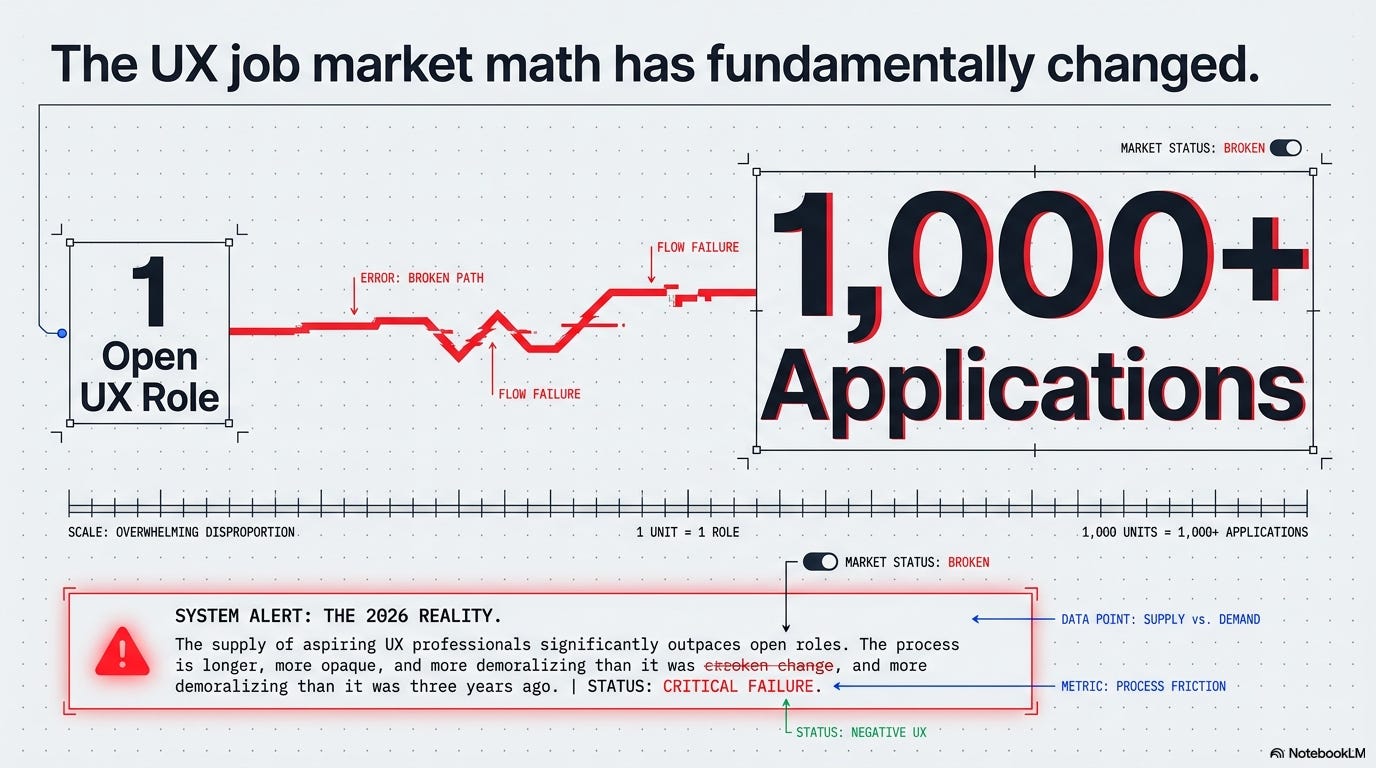
One open UX role easily gets 1,000 or more applications. Most of those applications never reach a person. AI screening tools now filter through thousands of applications before a human ever sees them. Which means you could have genuinely strong work and a well-written resume and still get filtered out before anyone with judgment ever looks at your name. TechCrunchTechCrunch
That is not a you problem. That is a system problem. But knowing it is a system problem does not make it less exhausting to live inside.
The job market in 2026 is still competitive, especially at the junior level, where the supply of aspiring UX professionals significantly outpaces open roles. Senior roles are recovering faster. But across the board, the process is longer, more opaque, and more demoralizing than it was three years ago. Yahoo!
If you have been wondering whether you are imagining how hard this is, you are not.
Where AI fits into all of this honestly
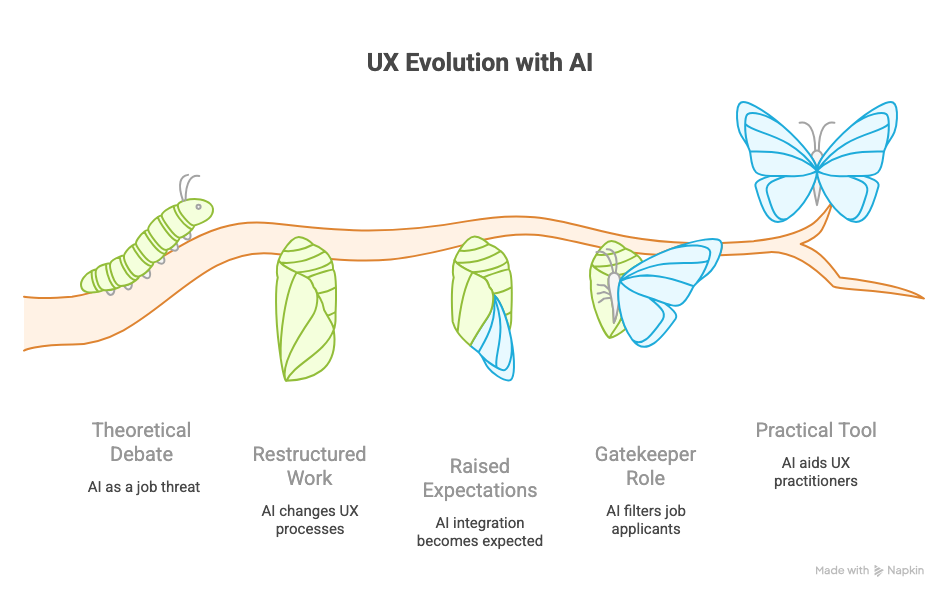
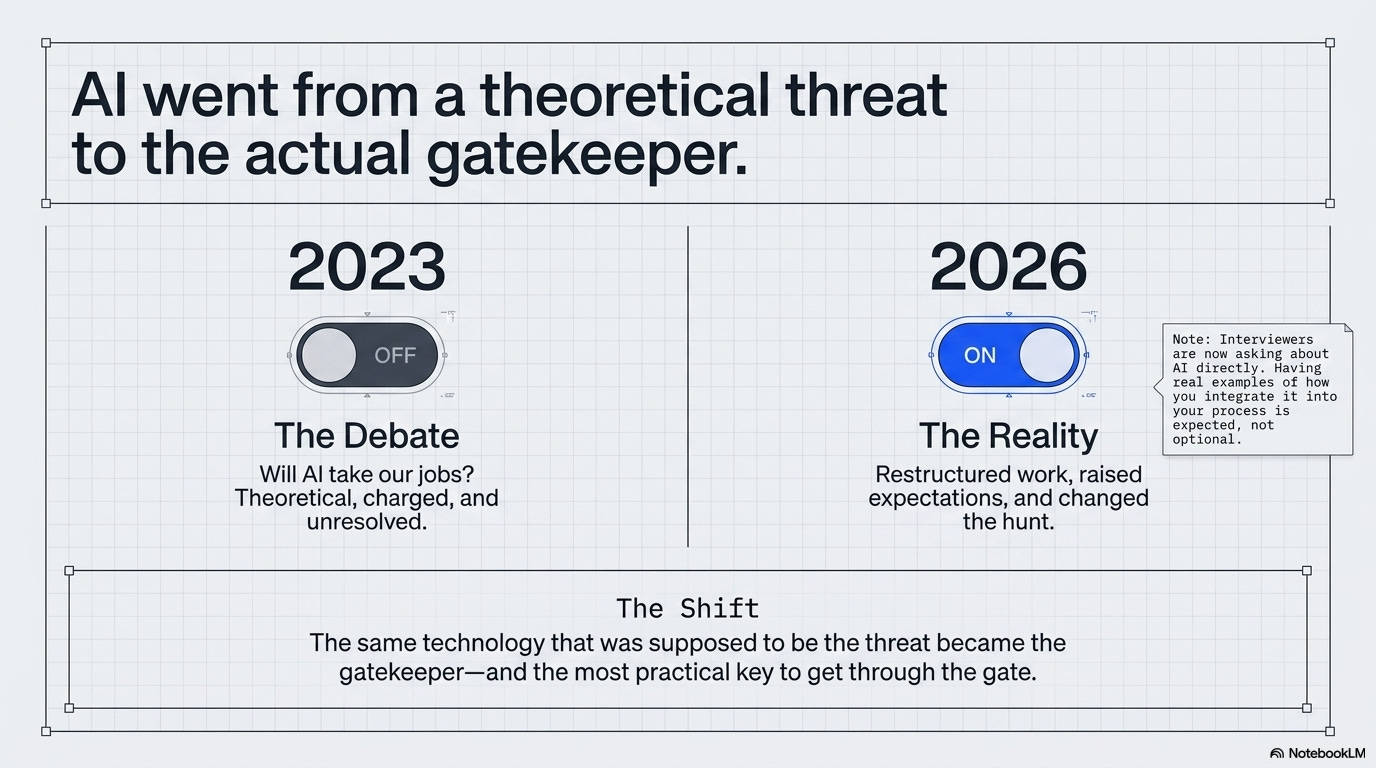
Three years ago the UX field was loudly debating whether AI would take our jobs. It was theoretical, charged, and mostly unresolved.
Here is what actually happened.
AI did not eliminate UX. It restructured the work, raised the expectations, and quietly changed the job hunting process itself. The same technology that was supposed to be the threat became the gatekeeper between practitioners and the interview. And it also became one of the most practical tools available to anyone trying to get through that gate.
The UX practitioners who are moving through this market are not the ones with the most impressive portfolios. They are the ones using every available tool, including AI, to work on the specific things that are not landing.
Interviewers are now asking about AI directly. Having real examples of how you integrate it into your process is increasingly expected, not optional. UXPin
This is not about becoming an AI expert. It is about using what is available to close the specific gap between you and the next conversation.
Why articles and advice are not the bottleneck
Here is the honest version of why most career content, including this newsletter, has a ceiling.
Reading about what to do creates awareness. It does not create change. And the specific thing that is not working in your job search almost certainly requires someone to actually look at your stuff and tell you what is off.
Is it the resume not getting through screening? Diagnosable. Is it interviews happening but no offers? Completely different problem, completely different fix. Is it not knowing how to talk about a gap, a pivot, or a specialization that does not fit a clean narrative? Specific problem. Is it the pitch feeling flat even though the experience is strong? Also specific.
You cannot diagnose these things by reading general advice. You diagnose them by having someone who knows what they are looking for actually look at your materials and tell you the truth.
That is the real bottleneck. Not information. Honest, specific, actionable feedback on the actual thing in front of you.
The one thing worth four hours of your time…
Pause for something urgent.
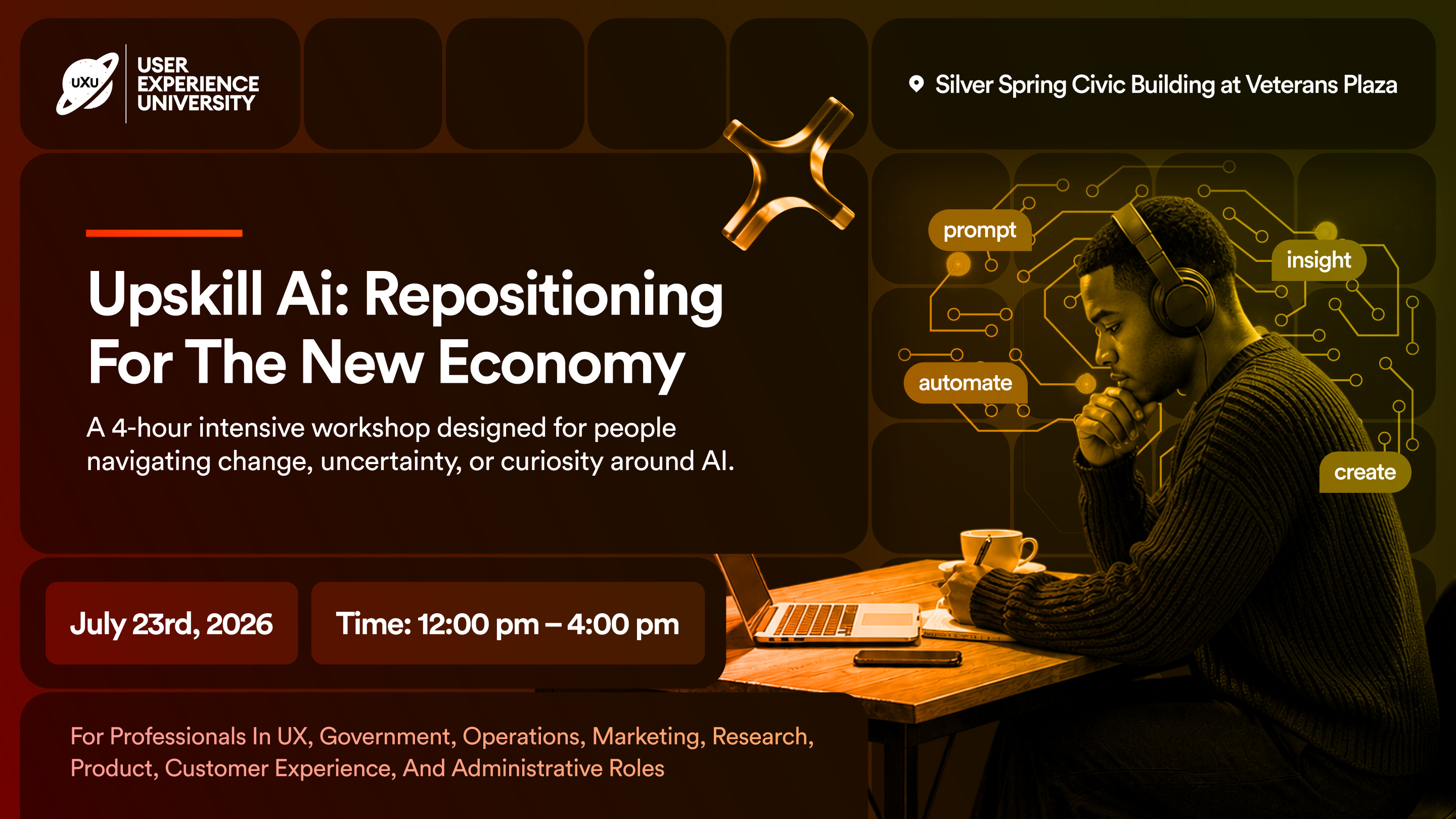
🎯 Your Next Move: A 4-Hour Reality Check That Actually Helps
Look, you can read another article about AI and upskilling and feel motivated for 20 minutes before going back to scrolling LinkedIn and wondering why your applications go nowhere.
Or you can spend four hours in a room with people who are actually doing something about it.
This is not a talk. You are not sitting there listening to someone pontificate about the future of work. You are working. On your actual resume, your actual positioning, your actual next move, with AI tools, with real feedback, with people who do this professionally.
You walk in unclear. You walk out with something finished. A resume that is actually competitive. A pitch that lands. A clearer sense of where you fit in this new economy.
No jargon. No theory. No “10 trends to watch in 2026.” Just practical work on your real stuff with people who are serious about their next move.
📅 July 23, 2025 · 12:00 to 4:00 PM 📍 Silver Spring Civic Building at Veterans Plaza, 1 Veterans Pl, Silver Spring, MD 20910
Four hours. Real work. Real results. That is it.
back to where we stopped…..
The specific ways AI is helping UX practitioners get hired right now
Not in theory. In practice. Here is what is actually working.
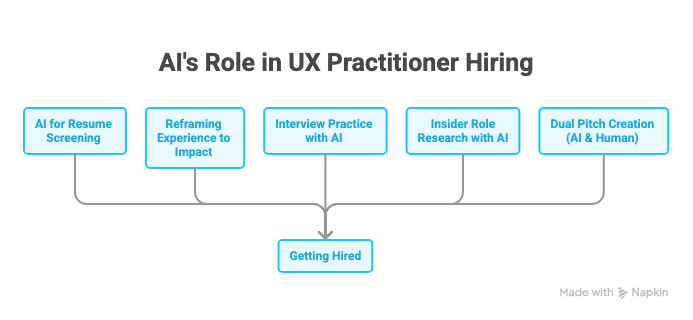
🔵 Getting past the algorithm before a human ever sees the resume
AI screening tools scan resumes for keywords, formatting, and relevance. A resume that reads well to a person but does not mirror the exact language in the job description gets filtered before anyone sees it. Practitioners who are getting through are using AI to compare their resume against specific job descriptions, identify the gaps, and close them before applying. Tools like Jobscan do this in minutes. What used to require guessing is now diagnosable. TechCrunch
🔵 Reframing experience from activity to impact
Most UX resumes describe what the person did. The ones that land describe what changed because of what the person did. Instead of “designed new checkout experience,” something like “redesigned checkout flow that lifted conversion 25% and added $150K quarterly revenue” lands completely differently. AI can help you find that framing for your own work faster than you can alone. Paste a bullet point and ask it to rewrite it leading with the outcome. Do that across your whole resume in an hour. UXPin
🔵 Practicing the interview before it happens
The parts of an interview that go badly are almost always predictable. The vague answer about a stakeholder conflict. The stumble when asked about a project that did not go well. The moment where you know what you want to say but cannot find the words under pressure. AI lets you practice those moments specifically, get pushed on the weak parts, and arrive prepared for the version that actually matters.
🔵 Researching the role like an insider
Walking into an interview having read the company’s job description is table stakes. Walking in having used AI to map the company’s likely product challenges, understand their competitive landscape, and anticipate what problems they are trying to solve is a different conversation entirely. Hiring managers notice the difference immediately. One sounds like a candidate. The other sounds like someone who already understands the context.
🔵 Building a pitch that works for algorithms and humans
The pitch that gets you past ATS screening and the pitch that resonates with a tired hiring manager who has read forty applications today are not identical. AI can help you write both versions and understand where they need to differ. Most practitioners are optimizing for one. The ones getting responses have figured out both.
What actually creates movement
Not more applications. Fewer, more targeted ones.
Not longer case studies. Shorter ones with clearer outcomes.
Not a complete reinvention of your experience. A sharper framing of the experience you already have.
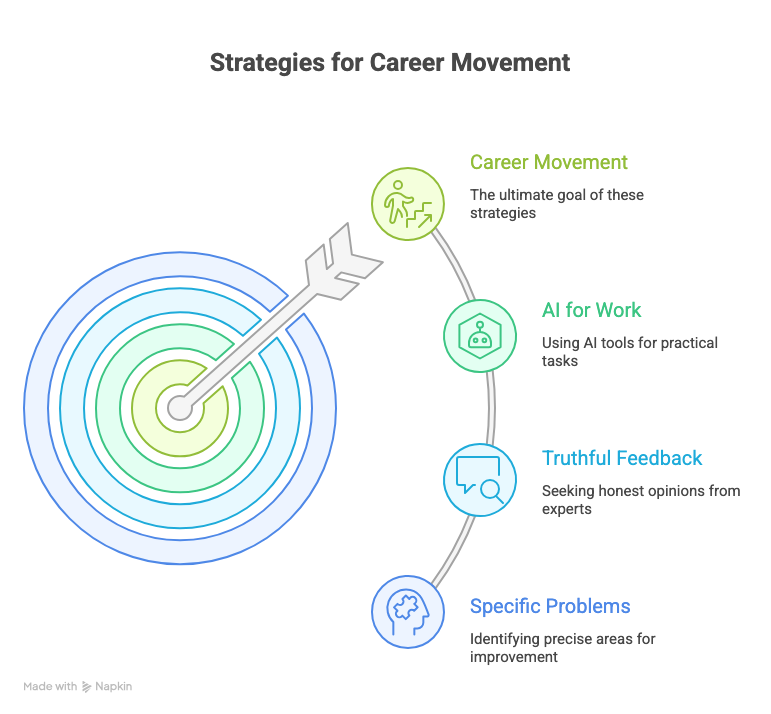
✓ Get specific about what is broken
Not “the market is hard.” The market is hard and something specific in your approach is also not working. Those are two separate problems. One you cannot control. The other you can. Start by naming the specific place where the process is breaking down. That is where to put your energy.
✓ Get your actual materials in front of someone who will tell you the truth
Not a friend who says it looks great. Someone who has seen what gets through screening, what lands in interviews, what makes a hiring manager stop scrolling. That feedback applied to your specific materials is worth more than anything you will read this week.
✓ Use AI for the actual work, not just thinking about it
Open ChatGPT right now. Paste your resume. Ask it what the weakest part is for someone applying for the specific role you are targeting. Be specific about the role. The feedback will not be perfect. It will be faster and more direct than most feedback you will get and you can act on it today.
📦 Resource Corner
Jobscan Paste your resume and a job description. Get a specific ATS compatibility score with exact gaps identified. Do this before your next application and you will understand something concrete about why response rates are low.
ChatGPT Treat it like a tireless thinking partner. Use it to rewrite bullet points, practice interview answers, research companies, and get pushed on the parts of your pitch that are vague. Ask specific questions about specific materials, not general questions about general situations.
Navigating the UX Job Hunt in 2026 by Craig Moser Written from inside the experience, not from a distance. Practical on what is actually moving the needle for people right now, including how to reach out to your network without it feeling like a transaction.
Resume Worded AI-powered resume feedback specifically built around what hiring managers and ATS systems are looking for. More targeted than a general AI tool for the specific problem of getting your resume seen.
💭 Final Thought
You do not have an information problem.
You have a specificity problem. Something specific in your materials, your pitch, or your positioning is not working, and the fix for that is not another article. It is someone looking at your actual stuff and telling you the truth, and then doing something about it in the same session, not next week, not when you feel ready.
The practitioners who are moving through this market are not the ones who found the perfect advice. They are the ones who stopped consuming and started working on the specific thing. They used the tools available, got honest feedback, made the change, and sent the application.
You have been in this field because you are good at figuring out what is broken and making it better. The job hunt is just another broken experience to work through.
Stop reading. Go work on it.


