


Something shifted in the last year and the data makes it impossible to ignore.
The most-used design tool after Figma is now an AI. 46.6% of managers are vibe coding. A skill that did not have a name two years ago is now sitting in the middle of how UX work actually gets done, and a lot of practitioners are learning it quietly so nobody clocks that they were behind. Index.devIndex.dev
If you have been hearing the term and nodding along without being totally sure what it means or how to start, this issue is for you. No hype, no gatekeeping. What it is, why it matters, and a concrete way in.
In This Issue:
What vibe coding actually is (and is not)
Why it took over so fast
What it means for designers vs. researchers
The bar has already moved past “I made a prototype with AI”
A practical starting point for this week
Resource Corner
What Vibe Coding Actually Is (And Is Not)
Let’s clear this up first, because the term confuses people.
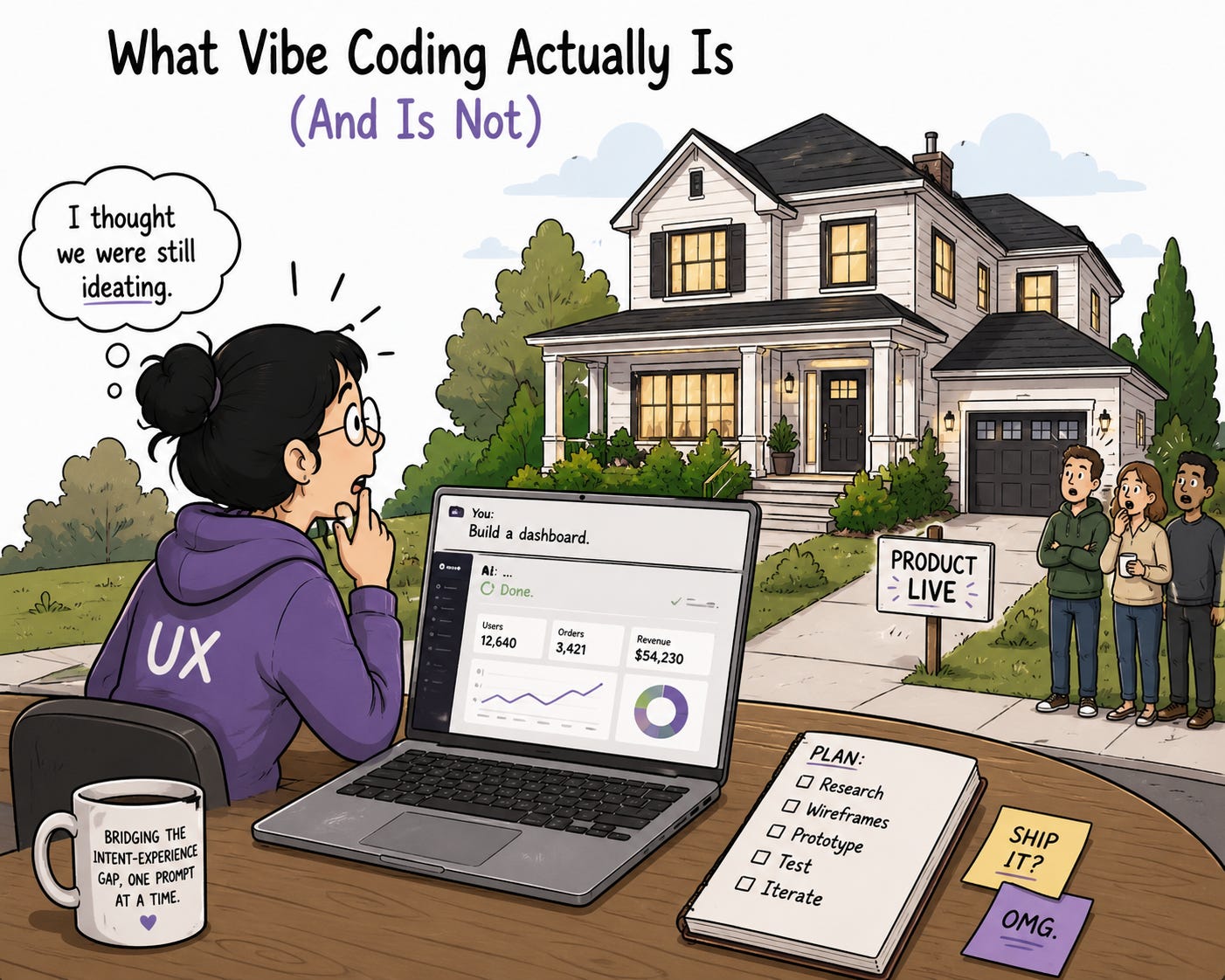
Vibe coding is building working software by describing what you want in plain language and letting AI generate the code. You type “a signup screen with email and password, then a dashboard showing recent orders” and you get a functional, clickable, real thing. Not a Figma mockup that looks interactive. Actual working code running in a browser.
Vibe coding is not “learning to code,” and it is not classic no-code either. It sits in between. You are not writing the code by hand. You are also not dragging pre-built blocks around a template. You are directing an AI to build something real, then refining it through conversation. UX Tigers
For UX practitioners, the significance is specific. The thing you design and the thing the user actually experiences have always been separated by a handoff, a translation, a gap where intent gets lost. Vibe coding collapses that gap. You can build the real experience yourself, test it, feel it, and iterate on it, without waiting for anyone.
Why It Took Over So Fast
A year ago this was a niche curiosity. Now it is mainstream. The speed is worth understanding.
The tools got genuinely good. Lovable and Bolt.new came to dominate the prototyping space, enabling users to create full-stack apps using natural language commands without local setup. Lovable reached $300 million in annualized revenue by January 2026, less than a year after launch. That is not slow adoption. That is a tool meeting a need the field did not know how to name yet. Nielsen Norman Group
The output stopped looking like a toy. Bolt.new emphasizes speed with instant browser-based previews. Lovable is particularly effective for design-focused React apps. These are producing things that look and behave like real products, not rough sketches with placeholder text. Nielsen Norman Group
And the market started rewarding it. Vibe coding, AI prototyping, and research with tools like NotebookLM are now considered baseline technical skills for UX, alongside traditional Figma and usability testing. What was a nice-to-have became a line item on what practitioners are expected to bring. Smashing Magazine
What It Means For Designers vs. Researchers
The same shift lands differently depending on your role.
🔵 For designers
The handoff gap shrinks dramatically. You can build the actual flow, not a prototype that approximates it. You can test real interactions, real states, real edge cases that static mockups hide. The advice now is to build flows, not just screens. Code out the full journey: signup, dashboard, settings, logout, and push it live. Designers who can take an idea all the way to something clickable and real have a different kind of leverage in a room than designers who hand off a file and hope. Smashing Magazine
🔵 For researchers
This is more nuanced, and the data shows it. 39.1% of researchers feel less secure right now, the highest anxiety of any role. But 17.4% feel more valuable. The researchers thriving are the ones integrating AI into their practice rather than waiting for permission. Index.dev
For research, vibe coding is not about replacing your methods. It is about testing faster. Instead of describing a concept to participants or showing them a flat prototype, you can put a working version in their hands and watch them actually use it. You can build a realistic stimulus for a study in an afternoon instead of waiting weeks for design and engineering resources. The research value is in the realism and the speed, not in becoming a builder.
The Bar Has Already Moved Past “I Made A Prototype With AI”
This is the part that matters most and gets missed.
In 2026, nobody is impressed by “I made a prototype with AI” anymore. Everyone has seen stunning UI generated in an hour. Everyone has seen demos that look flawless on the first screen, then completely fall apart on the second. UX Tigers
That last line is the whole game. AI is very good at the first screen. It is much worse at consistency, at the second and third screen, at proper states, at a coherent system that holds together across an entire flow. Generating something that looks good is now trivial. Generating something that actually works as a real, consistent product is not.
What is impressive today is a practitioner who can take an idea and turn it into something that feels like a real product: with rules, consistency, a design system, proper behavior, and a process you can trust. This is exactly where vibe coding transforms from a trend into a real craft. UX Tigers
This is good news for UX people specifically. The thing that separates a flashy demo from a real product is exactly the thing you are trained in: systems thinking, consistency, states, edge cases, the discipline of making something hold together. AI handles the generation. Your UX judgment is what makes the output actually good. The skill is not prompting. It is knowing what good looks like and directing the tool toward it.
There is one real caution worth naming. Around 45% of AI-generated code contains vulnerabilities, and human oversight remains critical for security and quality. For production-level work, traditional programming is still indispensable. Vibe coding is for prototyping, testing, and communicating. It is not a shortcut to shipping production software without engineers. Knowing that line keeps you credible. Nielsen Norman Group
Edward Cupps isn’t blaming AI for the job market, he’s challenging the narrative.
The biggest shake-up didn’t start with AI. It started after COVID.
AI will change how we work. It will boost efficiency. But the real conversation is bigger than replacing jobs, it’s about adapting to a changing industry.
Are we asking the right questions, or just chasing the loudest headlines?
🎟️ Hear Edward Cupps and other industry leaders unpack the future of UX, AI, and innovation at UXCON26.
A Practical Starting Point For This Week
Not a course. Not a rabbit hole. Avoid the “YouTube rabbit hole.” Do not spend hours watching. Here is a way in that takes an afternoon. Smashing Magazine
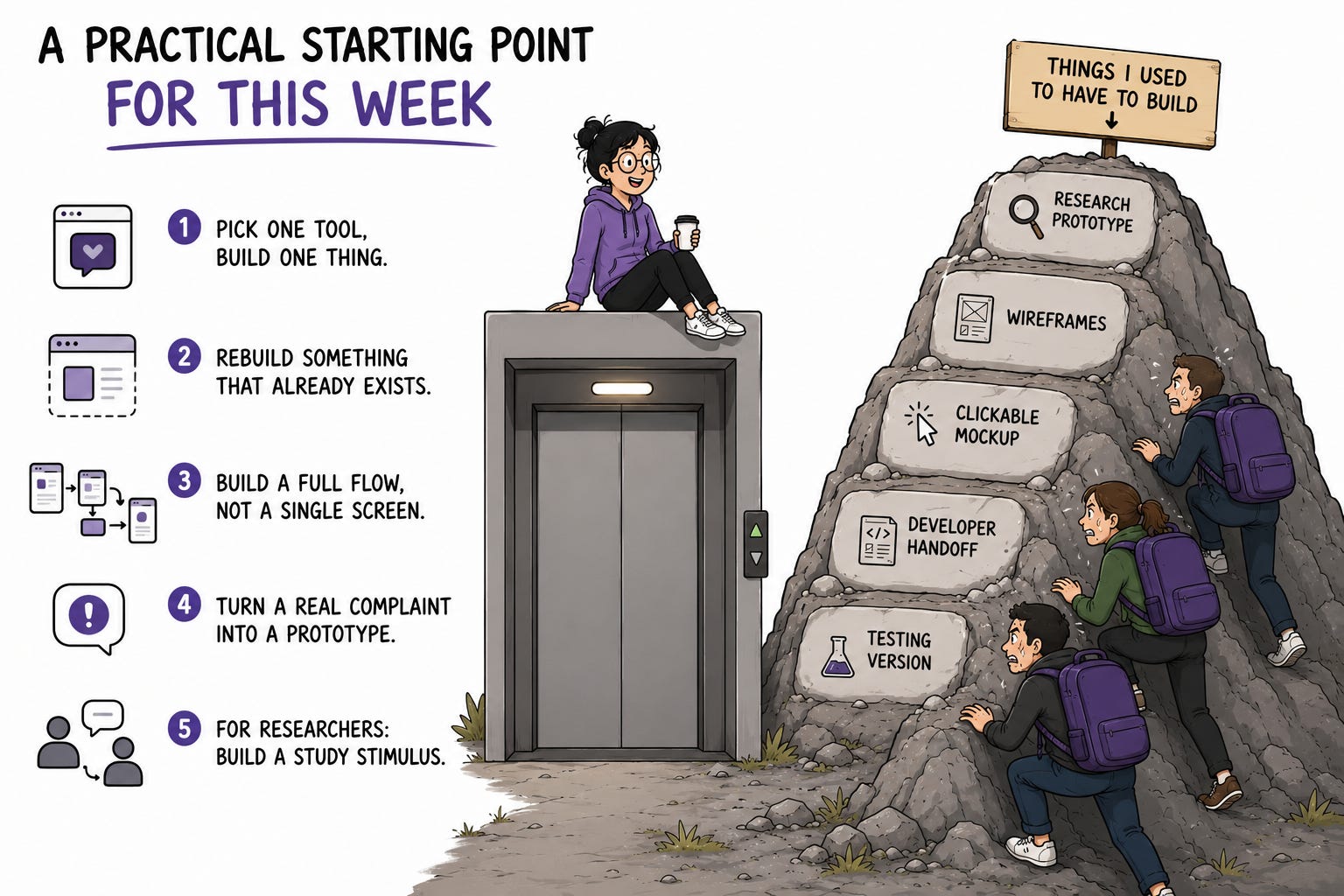
✓ Pick one tool and build one thing
Start with Lovable or Bolt.new. Both are browser-based, no setup. Pick one small, real flow. A login screen leading to a simple dashboard. Describe it in plain language and watch it build. The first time it generates something clickable from your sentence, the whole thing clicks.
✓ Rebuild something that already exists
Pick a favorite app and rebuild its UI. Recreate real apps in code. It is design weightlifting for your hands and brain, not just your eyes. Copying something real teaches you the gap between what looks right and what actually behaves right far faster than building from scratch. Smashing Magazine
✓ Build a full flow, not a single screen
This is where you learn the actual lesson. Do not stop at a landing page. Code out the full flow: signup to dashboard to settings to logout. The moment you go past the first screen is the moment you discover where AI breaks and where your UX judgment becomes essential. Smashing Magazine
✓ Turn a real complaint into a prototype
Grab App Store reviews or posts where users complain. “The dark mode toggle is hidden” becomes your next vibe-coded prototype. Solve real problems with live, clickable builds instead of static mockups. This is also how you build portfolio pieces that show judgment, not just output. Smashing Magazine
✓ For researchers: build a study stimulus
Take a concept you would normally test with a flat prototype and build a working version instead. Put something real in front of participants. Watch how differently they engage with something they can actually use versus something they have to imagine.
📦 Resource Corner
Lovable
The tool that defined this category. Browser-based, natural language, particularly strong for design-focused React apps. The best starting point for most UX practitioners. Free tier is enough to learn on.
Bolt.new
The speed option. Instant browser-based previews, excellent for validating an idea in thirty minutes before committing to anything more involved. Pairs well with Lovable depending on the task.
The Complete Vibe Coding Guide for Designers (Muzli)
The single best written guide on this for UX practitioners specifically. Honest about where the craft actually lives now versus the easy demo. Read this before you start.
Figma Make
If you live in Figma already, this is the lowest-friction way to start, since it builds AI generation into the tool you are already using. Good for designers who do not want to leave their existing workflow.
State of Prototyping Spring 2026 (UX Tools)
The full survey data behind this issue. 1,478 practitioners on how they actually work now. Worth reading directly to understand where the field genuinely is, not where the hype says it is.
💭 Final Thought
Vibe coding sounds like a threat if you frame it as “now everyone can design.” It is not. What it actually does is raise the value of the thing UX people have always been good at.
When anyone can generate a screen that looks good, the screen that looks good stops being valuable. What becomes valuable is the judgment to know whether it actually works. Whether it holds together across a flow. Whether it serves the person using it or just looks impressive in a demo. That judgment is the craft, and the craft is yours.
The practitioners pulling ahead right now are not the ones who can prompt an AI. Everyone can do that. They are the ones who can take what the AI produces and apply real UX thinking to make it into something that actually works.
The tool is new. The skill underneath it is the one you have been building all along.
Open Lovable. Build one flow. See for yourself.


