


There is a peculiar tension at the center of today’s AI landscape. Executives are accelerating adoption, budgets are growing, and models are more capable than ever — yet the people these systems are supposed to serve remain deeply unconvinced.
A 2024 Deloitte report on enterprise AI adoption put it plainly: 78% of business executives believe AI will disrupt their industries within three years, but only 20% trust their AI systems to actually make the right decisions.
This is not a technical failure but a design one, and it has been building for years.
Researchers studying public trust in AI describe a “trust paradox” in which strong confidence in AI’s raw capabilities coexists with profound skepticism about its intentions and ethical grounding. Users are willing to believe the system is competent. They are far less convinced it is on their side.
20% of executives trust AI systems to make the right decisions (Deloitte, 2024)
88% of product leaders say trust frameworks will be a core differentiator by 2026 (McKinsey)
70% of detected AI bias exploits occur in regional, non-English languages
What Went Wrong with HCD
Human-centered design was supposed to prevent this drift. The philosophy — designing technology around human needs, cognition, and limits — was a corrective to systems built for efficiency at the expense of the people using them. For decades it worked. Then something shifted.
“Somewhere along the way, HCD shifted from being a philosophy to becoming a process.”
— Vaibhav Kulkarni, Medium, November 2025
When HCD is reduced to a checklist i.e. conduct user interviews, build personas, run a usability test etc, it loses the moral weight that made it powerful.
Automated systems are being granted more authority than the humans operating them, while the design process that’s producing them is presumably ticking all the right boxes.
We are seeing quieter versions of this pattern everywhere AI is deployed at scale today.
Research from the Journal of Engineering Design confirms that although HCAI is a significant topic in academia, industry practices lag considerably. Design teams that follow HCD rituals without embedding its values find themselves shipping systems that are technically impressive and humanly alienating.
The Skepticism Is Legitimate
It is tempting to frame AI skepticism as a communication problem — “if only we explained the technology better, users would trust it more.” But the skepticism, in many cases, is the appropriate response.
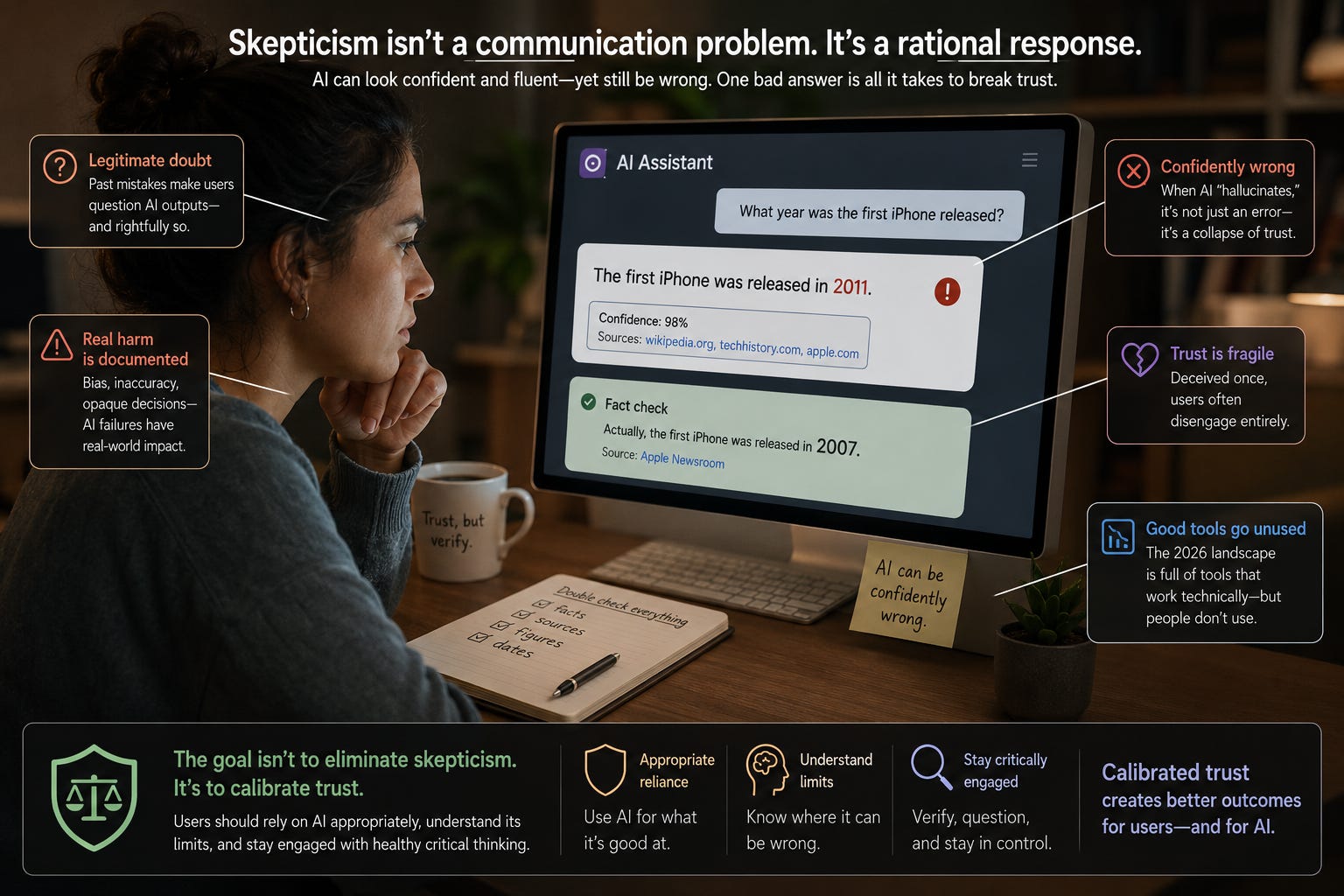
AI systems have caused real harm when poorly designed, developed, or deployed. Research has documented AI limitations including bias, lack of explainability, the absence of causal models, and serious ethical failures. The AI Incident Database and the AIAAIC database have recorded thousands of AI-related accidents.
The goal for UX professionals is not to dissolve skepticism but to calibrate it. Designing for what researchers call “calibrated trust”, a balanced relationship in which users appropriately rely on AI, understand its limits, and maintain a healthy degree of critical engagement.
When AI “hallucinates,” it is more than a system error. It is a collapse of trust. As Smashing Magazine noted in its September 2025 guide on the psychology of trust in AI, trust has become the invisible user interface. Users who are deceived once, even unintentionally, often disengage entirely. The 2026 UX landscape is littered with tools that technically work and practically go unused.
The Designer’s New Brief
If the period from 2023 to 2025 was about proving AI could work, 2026 is about proving it can be trusted. That shift repositions UX from decorator to architect. The central question is no longer “Can AI work?” but “Can AI be trusted?” — and that question lands squarely in the hands of experience designers.
“The designer’s new role is that of a behavior architect, balancing automation with human agency, making autonomy transparent, and ensuring that every interaction reinforces confidence rather than erodes it.”
— Aubergine Solutions, Designing for AI Agents, 2025
Three principles are emerging as the foundation for this work:
1. Transparency by design. AI systems must show their work. Whether it is a loan decision, a diagnosis, or a content recommendation, users need to see why the system reached a conclusion. A result without justification breeds the exact skepticism teams are trying to overcome.
2. Meaningful human control. Researchers define HCAI systems as those designed to augment human capabilities while ensuring meaningful oversight throughout the AI lifecycle — not systems that quietly accumulate authority. The degree of human control must be deliberate, visible, and recoverable.
3. Inclusive from the start. Inclusive design ensures AI works for everyone, not just the demographics represented in development teams. With nearly 70% of detected bias exploits occurring in non-English languages, designing for global diversity is not optional but a prerequisite for trust.
Where Human Designers Remain Irreplaceable
A recurring concern in design communities is that AI will displace the professionals working to make it more humane.
The evidence points the other direction. What is shifting is the nature of the work, and for those willing to adapt, the shift is toward greater strategic importance, not obsolescence.
AI provides user data, heatmaps, and engagement metrics, but humans interpret this data to create interfaces that are intuitive and emotionally resonant. Automation handles variation testing and content optimization, freeing designers to focus on storytelling, user empathy, and ethical framing. The firms that are winning in this landscape are not those who automated their design process — they are those who used AI to go faster while humans decided where to go.
💡 What this means for your practice:
The most durable career positioning in UX right now is not tool fluency, it’s judgment.
The ability to translate AI-generated insights into decisions that serve real humans, across diverse contexts, is something no model replicates.
Build your portfolio around that translation work: the moments where you overrode the data, advocated for an underrepresented user group, or redesigned a system’s failure state to preserve trust.
UXCON26 — Inspire & Connect
Everything this issue has covered, trust, transparency, the crisis of confidence between humans and AI systems, will be at the center of the conversation at UXCON26.
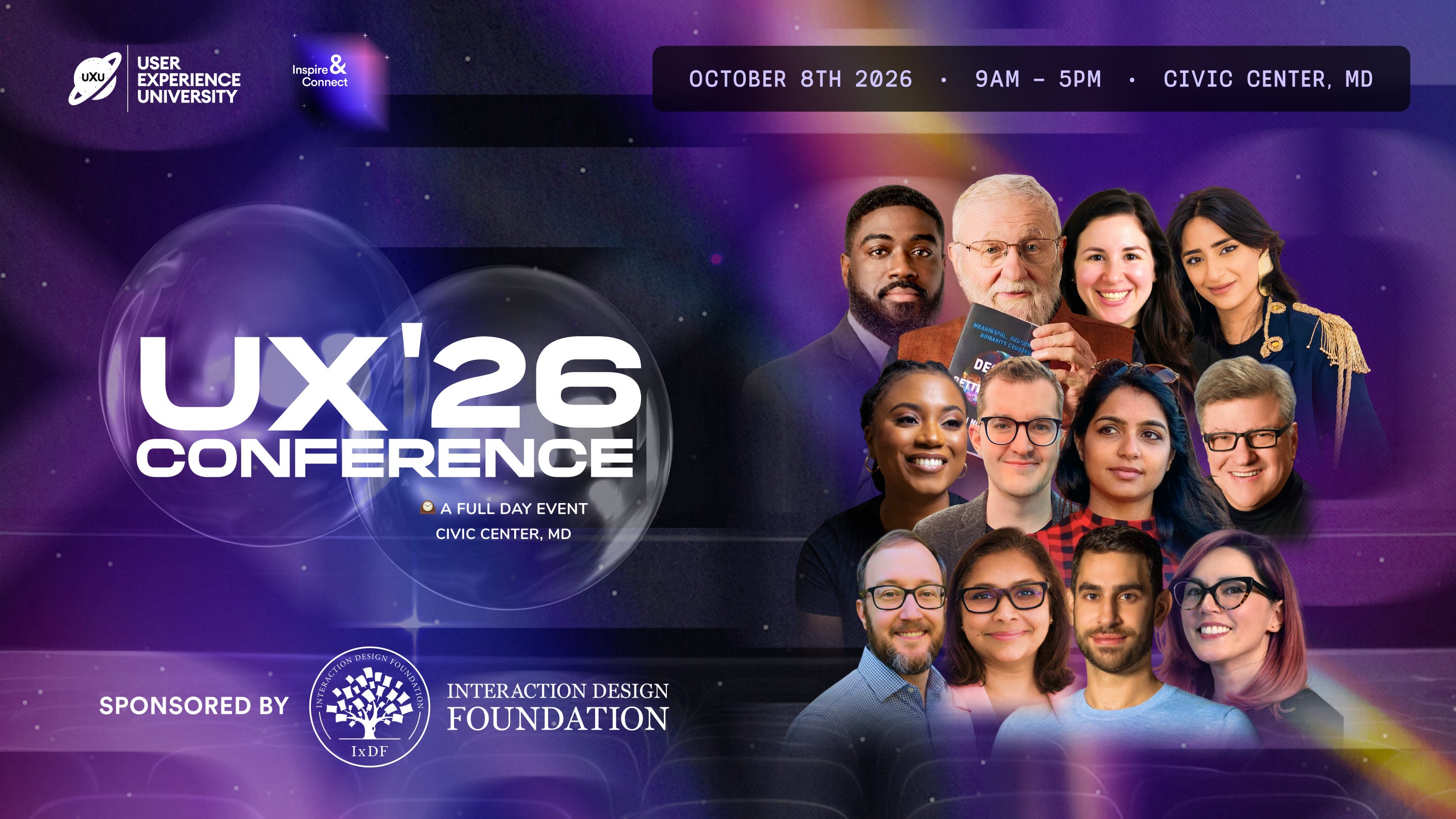
Our theme Inspire & Connect, carries more weight than it might seem. The act of connecting — designer to designer, researcher to practitioner, idea to community — is itself a form of resistance against the drift this issue describes. Human-centered design does not happen in isolation. It never did.
This year’s headliner Don Norman, the person who gave our profession much of its foundational language, has spent decades arguing that technology must serve human needs, not the other way around. His presence at UXCON26 is not just a marquee booking. It is a statement about what this moment calls for: a return to first principles, delivered by the person who articulated many of them.
If you believe UX professionals have a responsibility to close the gap between AI capability and human trust, UXCON26 is where that conversation continues, in person, with the people doing the work.
Looking Ahead
For us UX professionals, this is the mandate. Human-centered design in the era of AI skepticism is not about defending users from technology. It is about building systems where trust is earned interaction by interaction, through transparency, through control, through genuine inclusion, until skepticism is not a barrier to adoption but a healthy, calibrated feature of how people engage with AI at all.
That is not a technical problem. It never was.
Resource Corner
How UX design can help build trust in AI systems
Aubergine Solutions, 2025The design psychology of trust in AI: crafting experiences users believe in
UXmatters, November 2025Trust is the new benchmark for AI, and UX owns the outcome
CMSWire, February 2026UX and AI in 2026: from experimentation to trust
CleverIT Group, March 2026Human-centred design in the age of automation: reclaiming the human in the loop
Vaibhav Kulkarni, Medium, November 2025Designing for AI agents: a human-centered approach for 2025
Aubergine Solutions, September 2025Predictions for AI in 2025: collaborative agents, AI skepticism, and new risks
Stanford HAI, December 2024The psychology of trust in AI: a guide to measuring and designing for user confidence
Smashing Magazine, September 2025Human-centered AI: advancing ethical, transparent, and context-aware systems
ScienceDirect, Technology in Society, March 2026


