


For roughly fifteen years, digital product design ran on one quiet assumption: attention is the goal. Capture it, hold it, maximize time-in-app, and win. Notifications, streaks, autoplay, infinite scroll, red badges. An entire toolkit built to pull people in and keep them there. It worked, in the narrow sense that engagement numbers went up.
Something is shifting in 2026, and it is worth paying attention to.
People are exhausted. Attention is hyper-fragmented, and users are actively seeking simplicity and relief from products that constantly fight for their focus. The result is a genuine change in what good design means. The most forward-looking products are no longer competing to capture the most attention. They are competing to respect it.
This issue is about that shift, why it is happening, and what it means for how you design.
In this issue we’ll cover:
Why the attention economy hit its limit
What calm technology actually is
From the attention economy to the intention economy
What this looks like in real design decisions
The business case for respecting attention
Resource Corner
Why the attention economy hit its limit
The attention economy did not fail because it stopped working mechanically. Streaks still drive engagement. Notifications still pull people back. It hit its limit because people noticed, and started to resent it.
The core problem is saturation. Users in 2026 are overwhelmed by overstimulation. Every app is fighting for a slice of a finite, shrinking pool of attention, and the cumulative effect is fatigue. When every product treats a person’s focus as something to extract, the person’s overall experience of their digital life becomes exhausting, and they start looking for the products that do not do this.
There is a cultural current underneath it too.
Accenture identified a phenomenon called “social rewilding,” where people are deliberately disconnecting to prioritize real experiences over digital ones. This is not a fringe wellness trend. It is a mainstream reaction to years of digital overstimulation, and it changes the calculus for every product.
Fighting a user’s desire to disconnect is now fighting the current. The smarter move is to support it.
This year, designers are rewarded for judgment rather than novelty, for clarity rather than spectacle. A few extra clicks or one more attention-grab that used to seem clever now simply loses people.
What calm technology actually is
Calm technology is emerging as a deliberate response to digital saturation. The idea is simple to state and hard to practice: design tools that respect our limited attention instead of constantly soliciting it.
The philosophy is not new, it traces back to work at Xerox PARC decades ago, but 2026 is when it stopped being theory and became a competitive advantage. A calm technology approach helps conserve a user’s mental energy and, counterintuitively, creates a more enjoyable experience precisely because it asks less of them.
In practice, calm technology translates into concrete choices. E.g:
A drastic reduction in notifications.
More silence, more stillness in the interface.
Minimalism centered on essential function rather than decoration.
The interface does its job and then gets out of the way, instead of continually tapping the user on the shoulder.
As a result, good UX becomes felt, not seen. A calm product is not one a person raves about for its flashy interface. It is one they use, accomplish what they came for, and leave without friction or residue. The absence of noise is the feature. That is a genuinely different definition of success than the one the field operated on for the last decade, and it requires designers to resist the instinct to add.
What shift are we seeing as a result……
The field is moving from an attention economy to an intention economy.
In the attention economy, the product’s job was to capture your focus and direct it, usually toward more time in the app. In the intention economy, the product’s job is to understand what you actually want to accomplish and help you do it, ideally with as little friction and time as possible. The measure of success flips. Time-in-app used to be the win. Now, for a growing category of products, getting you what you need quickly and letting you go is the win.
This shift is accelerated by agentic UX, where a user delegates a task to an AI rather than navigating to do it themselves. Instead of scrolling through a travel site for an hour, a person hands an agent the mission of organizing a trip. The user’s intention, not their sustained attention, becomes the thing the product is built around. Design is no longer an end in itself but a lever serving user intention.
The question stops being “how do we keep them here longer” and becomes “how do we help them accomplish their actual goal and get on with their life.”
What this looks like in real design decisions
This is not abstract philosophy. It shows up in specific, everyday choices.
🔵 Notifications become intentional, not reflexive
The default of notifying users about everything is being replaced by notifying them only about what genuinely matters to them, when it matters.
🔵 Interfaces respect attention by default
Users now expect control, and interfaces that respect attention perform better. Giving people control over what demands their focus, and defaulting to less rather than more, is becoming an expectation.
🔵 Dark patterns are disappearing on purpose
As users grow more aware of manipulative tactics, designers are intentionally avoiding dark patterns as part of ethical, sustainable design. The attention-extraction toolkit, fake urgency, confirmshaming, roach-motel flows, is not just legally risky now.
🔵 Clarity beats spectacle
The move is toward cognitive clarity over sensory richness. Removing visual clutter, simplifying flows, limiting theatrics. The question shifts from “how do we make this more exciting” to “will this reduce effort.”
Quick pause. This belongs in the room.
🎯 UXCON26 · One Day · The Whole Community
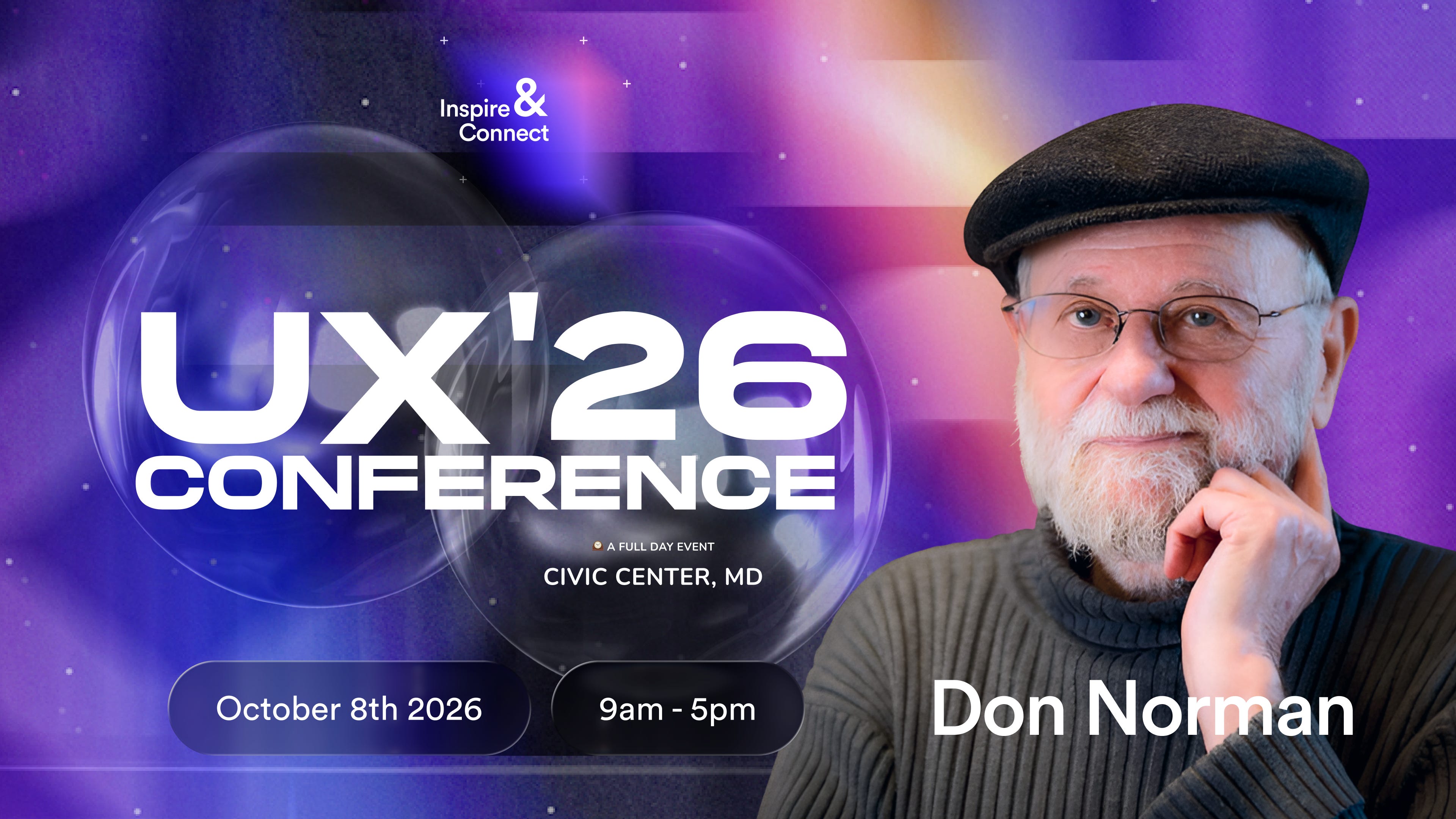
Shifts like this one, from capturing attention to respecting it, from screens to intention, are exactly the conversations the field needs to have out loud, together.
On October 8, 2026, the UX community comes together for a full day built around where this work is really heading. Headlining is Don Norman, who coined the term user experience and at 88 is still challenging this field to design more honestly and more humanely. Alongside him are practitioners from Netflix, The New York Times, Target, UserTesting, and Skylight, hosted by Jeremy Miller of the Beyond UX Design podcast.
Three keynotes. Two panels. One room. The conversations that stay with you.
📦 Resource Corner
Calm Technology by Amber Case
The definitive resource on designing technology that respects attention, from the person who brought the concept into modern practice. The principles are short, memorable, and directly applicable. Start here.
Designing Calm Technology by Amber Case (O’Reilly)
The full book version, with practical patterns for building products that inform without overwhelming. Essential for anyone trying to move from attention-grabbing to attention-respecting design.
UX Design Trends 2026 (UX Design Institute)
Strong overview of the calm, sustainable, and human-centered shift, including the W3C Web Sustainability Guidelines and how they connect to lighter, more respectful design.
Digital Minimalism by Cal Newport
Not a design book, but the clearest articulation of why people are seeking relief from attention-hungry technology. Understanding the user mindset behind “social rewilding” makes you better at designing for it.
The Sustainable Web Manifesto
A short, practical statement of principles for building digital products that are lighter, more honest, and more resilient. Useful for connecting calm design to sustainability in concrete terms.
💭 Final Thought
We spent a decade learning to capture attention. The more interesting challenge, and the one that defines good design now, is learning to deserve it.
Design for the person’s intention, not their attention. Everything good follows from that.


