



Here is a quiet thing that happens in this field all the time.
Two people do genuinely similar work. Same years in, same quality of output, both running research, both shipping design, both sitting in the same kinds of meetings. One of them makes $108,000. The other makes closer to $148,000. Neither is more talented. The difference is not effort or skill. It is that one of them understands how the market names and prices what they do, and the other does not.
The 2026 salary data makes this gap impossible to ignore, and it also makes it fixable. This issue is about understanding where the money actually sits in UX right now, and how to make sure your work is positioned to be paid for what it is worth.
In this issue:
The title trap that anchors people to the wrong number
Why research is not the low-paid path anymore
The skills that genuinely move your salary
Where the highest ceilings are hiding
How your employer shapes your pay more than you think
Resource Corner
The title trap that anchors people to the wrong number
The most expensive mistake in UX compensation is treating your title as a label instead of a price tag.
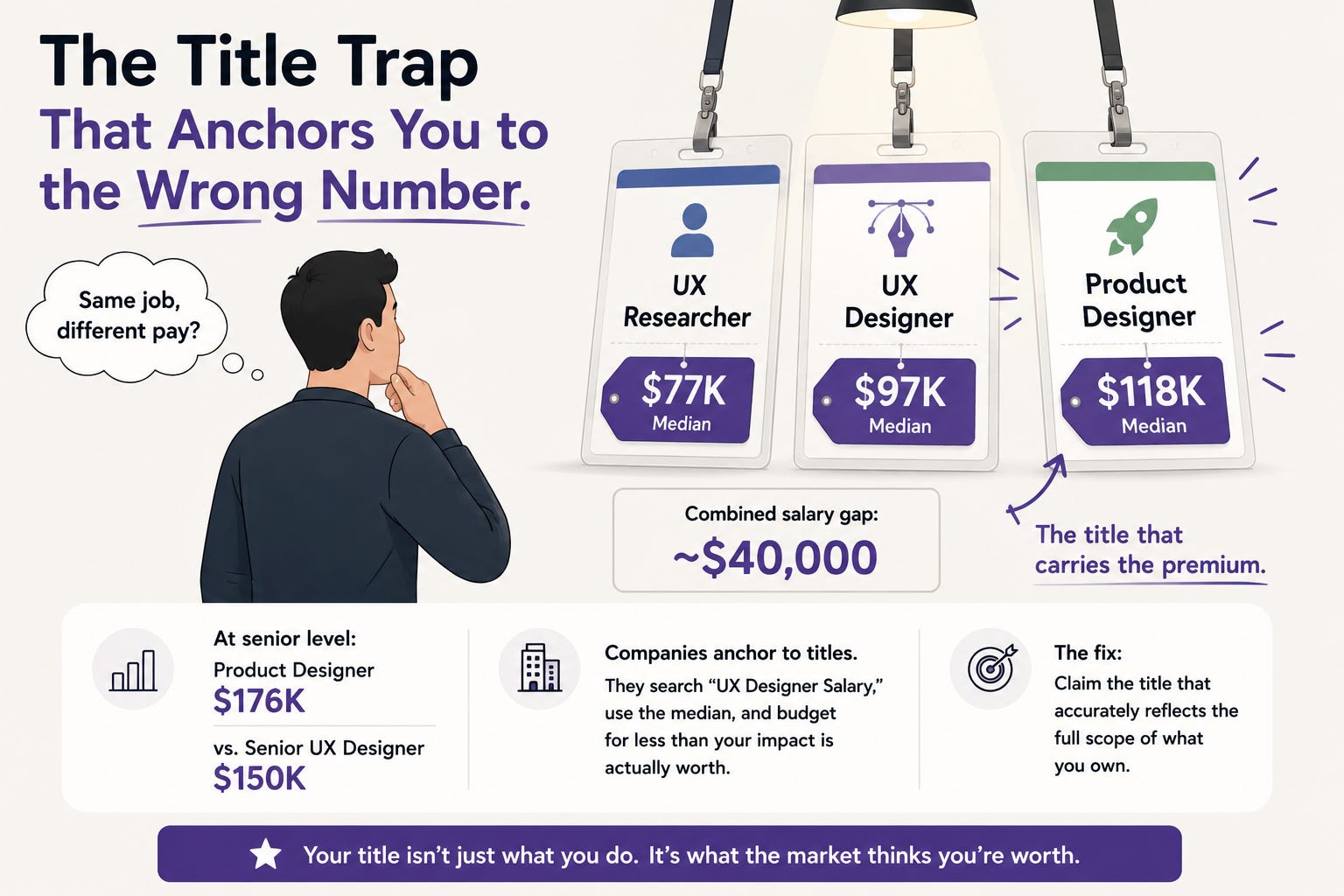
To people outside the field, “UX designer,” “UX researcher,” and “product designer” sound like the same job with different words. They are not, and the market pays them very differently. Across those three titles sits a combined salary gap of about $40,000, with the US range running from $77,000 to $175,000 depending on which one you land under.
The word doing the heaviest lifting right now is “product designer.” At most tech companies, that title has come to mean someone who owns the full arc of a problem, from research through to shipped interface. Because it signals ownership rather than execution of one slice, it carries the highest median of the common titles, around $118,000, and the gap widens at senior levels, where product designers clear $176,000 against roughly $150,000 for senior UX designers.
The trap is subtle. If your title says “UX designer” but you are actually doing research, strategy, and end-to-end design, you are likely anchored to a lower band than your work justifies. Recruiters see this constantly: a company searches “UX designer salary,” uses the median, and budgets for a role that is genuinely worth $30,000 more. The fix is not to inflate your title dishonestly. It is to make sure the title you claim reflects the fullest accurate description of what you actually own.
Quick pause. This one is directly relevant.
3 DAYS TO GO
🎯 Upskill AI Workshop · July 23, 2026 · Silver Spring
We made it easier to join.
We’ve reduced the workshop fee to just $49.99 because practical AI skills shouldn’t be out of reach for the people who need them most.
The clearest rising salary premium in UX right now belongs to practitioners who can genuinely fold AI into their workflow, not just prompt for a draft here and there. That is a 10–15% premium tied to a skill many people in the field have not actually built yet.

This workshop is a hands-on, four-hour session built for exactly that gap. No theory, no trend lists. Real work moving you from occasional AI use into workflow-level fluency across research synthesis, journey mapping, and design systems, with feedback from people who do this for a living.
📅 July 23, 2026 · 12:00 to 4:00 PM
📍 Silver Spring Civic Building, Silver Spring, MD
Why research is not the low-paid path anymore
A stubborn myth in UX is that moving toward research means moving down in pay. In 2026, that is simply wrong, and believing it is expensive.

UX researchers earn a median around $105,000, competitive with generalist designers, and specialized researchers climb well past that, into the $130,000 range. More importantly, the direction is upward. The layoffs of 2023 cut a lot of dedicated research functions, and companies are now discovering the cost of that: product teams making worse decisions without anyone rigorously understanding the user. Some are rehiring researchers outright. Others are folding research into the design role and paying more for the combination.
Either way, the research premium is climbing. Designers who bring formal research skills, real usability testing, interviews, and structured analysis, earn 10 to 15% more than those who do not. This is one of the clearest and most durable premiums in the current market, and it is one many practitioners actively hide by burying their research work under a generalist framing.
If you have genuine research capability, it should be central to how you present yourself, not a footnote. Whether you position as a researcher or a designer who does rigorous research, making that skill visible is one of the most reliable ways to move your band.
The skills that genuinely move your salary
Here is a hard truth about tools: everyone has Figma now. Expert-level Figma is expected, not rewarded. It is the price of entry, not a differentiator. The skills that actually shift your number in 2026 are the ones that connect design outward, to code, to data, and to AI.
The premiums are specific and worth knowing:
▸ Front-end development (HTML, CSS, JavaScript, Webflow) adds the most, roughly 15 to 25%, because it collapses the gap between design and what actually ships.
▸ AI integration into your real workflow, not just prompting for drafts, carries a 10 to 15% premium, and it is rising fast because so few practitioners have genuinely built it into how they work.
▸ Data analysis, the ability to read behavioral data and translate it into design decisions, adds another 10 to 15% and compounds directly with research skills.
The mistake most people make is spreading thin across all of these, ending up with surface familiarity in each and a premium in none. The better strategy is to pick one that sits adjacent to your existing strength and go deep enough to name it on your resume with real evidence behind it. One demonstrable premium skill beats a scattered list every time.
Where the highest ceilings are hiding
If you want a specialization with genuine room to grow, one of the strongest in 2026 is also one of the least visible: design systems.
Design systems engineers build the shared infrastructure that lets an entire organization ship consistently, the component libraries, the tokens, the documentation, the bridge between design and engineering. The work requires both design sensibility and real technical depth, which makes qualified people rare, and rare is what the market pays for. The ceiling reflects it: Head of Design Systems roles run $160,000 to $200,000 and beyond, because at scale a design system is treated as strategic infrastructure, not a support function.
The appeal here is not just the number. It is that this lane has far less supply-side competition than visual or generalist design, where thousands of similar portfolios compete for the same roles. If you find yourself drawn to the systematic, technical side of the work more than the individual screen, this is an underexploited path with a high ceiling. You can start where you are, by owning a piece of your current team’s system, and build genuine expertise from there.
How your employer shapes your pay more than you think
Two practitioners with identical skills and titles can still end up far apart based on a single factor most people underweight when job hunting: where they work.
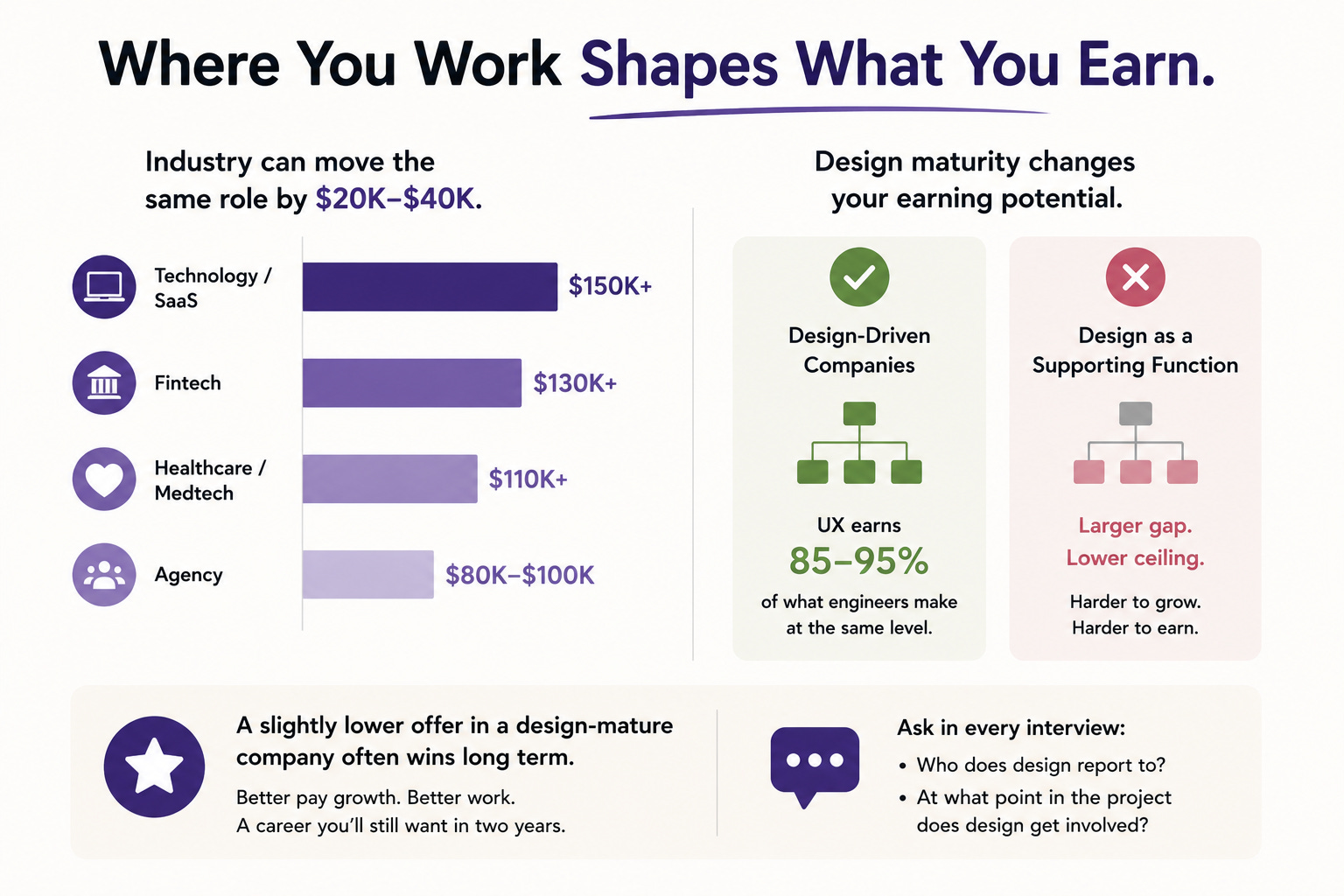
Industry alone can shift the same role by $20,000 to $40,000. Technology and SaaS pay the most, with senior product designers regularly clearing $150,000. Fintech pays strongly because the products are complex and compliance-heavy. Healthcare and medtech are growing fast and increasingly well-compensated. Agencies tend to pay lower base salaries but offer broader project exposure, which has its own value early in a career.
The deeper factor is design maturity. At companies where design genuinely drives decisions, UX practitioners earn 85 to 95% of what software engineers make at the same level. At companies where design is a supporting function that makes things look nice after the decisions are made, that gap widens sharply, and so does the ceiling on how far you can grow.
This is why a slightly lower offer at a design-mature organization often beats a higher one where design is decoration. Not just for pay growth, but for whether the work is any good and whether you will still want to be there in two years. The question worth asking in every interview: who does design report to, and at what point in a project does design get involved?
📦 Resource Corner
UX Designer Salary Guide 2026 (KORE1)
Written by a recruiter who hears the budget number before the candidate does. The most honest breakdown of how title and scope create the $25,000 to $40,000 gaps in this field. Read it before any negotiation.
UX Salary by Specialisation (UX Designer Salary)
Independent, current data on how each specialization pays, from UI to research to design systems, with the reasoning behind every gap and a calculator to benchmark yourself.
The 2026 UX Salary Report (User Interviews and Levels.fyi)
Nearly 20,000 real salary records across designer, researcher, and research-ops roles. The most rigorous dataset available for understanding where you actually stand.
UX/UI Designer Salary 2026 (Webflow)
The clearest breakdown of which specific skills carry which premiums, with real percentages. Practical for deciding what to learn next.
The UX Job Market in 2026 (UX Design Institute)
Which roles and skills are in highest demand, backed by the 2026 Figma design-leader survey. Useful for positioning yourself where the market is actually moving.
💭 Final Thought
The uncomfortable lesson in all of this is that being good at the work and being paid for the work are two different skills, and the field trains people well in the first while barely mentioning the second.
The healthcare researcher who started at $148,000 instead of $120,000 did not become more capable in the span of a few conversations. Someone simply reframed her work in the language the market already rewards. The value was always there. What changed was whether it was visible.
That is the real takeaway. The market in 2026 is paying genuine premiums for research rigor, technical fluency, AI integration, and systems thinking. If you have any of those and they are hidden inside a vague title or a generalist framing, you are leaving money on the table that is already yours to claim.
Know what your work is actually worth. Then make sure the words you use for it, everywhere from your resume to your own head, finally agree.


