



For 20 years, journey mapping has followed roughly the same production line: interviews, transcripts, affinity clustering, a workshop with sticky notes, and eventually a polished artifact that gets hung on a wall and slowly goes stale.
In 2026, most of that production line has an AI agent standing somewhere inside it. The question our community keeps asking us isn’t “should we use AI in research” anymore?” It’s “which parts of the process can an agent actually own, and which parts still need us?”
From Static Maps to Living Systems
The most visible shift is speed. Journey mapping platforms now let researchers describe a scenario or upload raw material ( interview transcripts, survey exports, support logs), and receive a working draft map in minutes, grounded in that actual data rather than assumption. Some tools go further, connecting journey maps and personas directly to external AI agents so the map becomes a live component in a broader workflow rather than a one-time deliverable.
70–90%
Estimated reduction in manual analysis time when AI drafts journey maps from research data, according to ZipTie’s 2026 framework for AI-era journey mapping.
But faster isn’t automatically better. Practitioners cited in that same research describe AI-drafted maps as plausible but shallow, and the data backs up the caution: adoption of AI tools among UX researchers has climbed sharply, yet the large majority still worry about output accuracy and fear that human insight is being devalued in the rush to automate. The efficiency gain is real. The quality gate is still a person.
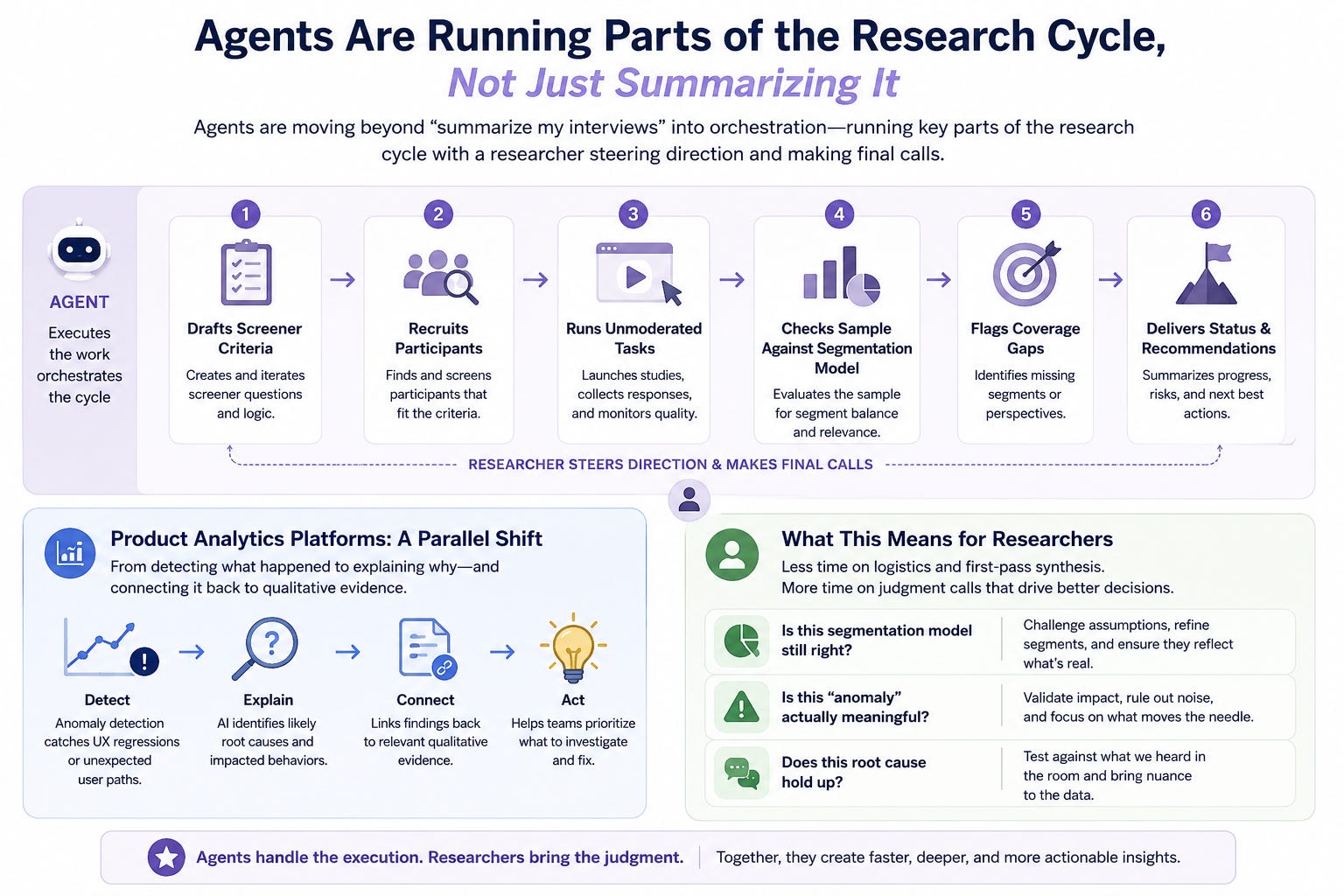
The more interesting shift for design research workflows specifically is that agents are moving beyond “summarize my interviews” into orchestration. Picture an agent that drafts screener criteria, recruits participants, runs unmoderated tasks, checks the resulting sample against a segmentation model, and flags coverage gaps on its own — with a researcher steering direction and making final calls rather than executing every step.
Product analytics platforms have followed a similar path, adding anomaly detection that catches UX regressions or unexpected user paths before they surface as support tickets, now paired with likely root causes linked back to qualitative evidence.
That’s a meaningful change in what a researcher’s day looks like. Less time on logistics and first-pass synthesis, more time on judgment calls: is this segmentation model still right, is this “anomaly” actually meaningful, does this root cause hold up against what we heard in the room.
The Twist Nobody Put on a Journey Map Template
“Are there any models for mapping journeys for non-human actors?”
That’s the question product teams are increasingly asking, and the honest answer is that early models exist but they break most of the assumptions baked into a traditional eight-stage journey map when applied to non-human actors.
AI agents now interact with products directly, through APIs, MCP servers, browser automation, which means your product has two users to design for: the human, and the agent acting on the human’s behalf. The term for this is Agent Experience, or AX, coined by Netlify CEO Mathias Biilmann in early 2025.
The catch: an empathy map doesn’t transfer. An agent doesn’t get frustrated — it returns an error code, retries, or fails silently. As a result, teams may need two parallel artifacts going forward:
A human-side journey map capturing emotional and behavioral signals, and
An agent-side map capturing task signals pulled from API, MCP, and integration logs, both feeding the same product decisions.
If your organization builds anything with an API surface, this is worth putting on your 2027 roadmap conversation now, not later.
What This Means for the Role, Not Just the Artifact
Nielsen Norman Group’s 2026 State of UX report is fairly direct about where this leaves practitioners: AI can improve the “jagged” edges of research work and may hit watershed moments for certain activities the way it has for programming, but human direction, curation, and verification remain essential for turning insights into products people actually want. The report’s broader framing is that anyone treating UX as a checklist of deliverables is genuinely exposed — standardized design output is becoming easy to automate. What isn’t easy to automate is curated taste, research-informed contextual understanding, and careful judgment.
The Practitioner Takeaway
NN/G’s research points to a specific profile of who does best in this environment: adaptable generalists who treat UX as strategic problem-solving rather than a pipeline of deliverables. AI can produce a research artifact in seconds. It can’t yet tell you whether that artifact is aimed at the right problem, that’s still YOUR JOB.
Where the Line Actually Sits Right Now
Let agents own: first-draft synthesis, screener logistics, participant recruitment, coverage checks against segmentation models, anomaly flagging in behavioral data.
Keep for yourself: problem framing, deciding which anomalies actually matter, validating AI-drafted personas or maps against real transcripts, and any judgment call that determines what the team builds next.
Watch closely: whether your product has an API/agent surface worth mapping separately from your human journey — Agent Experience is early, but it’s not hypothetical anymore.
Don’t skip: tracing AI-generated insights back to source data before they go into a deck. “Plausible but shallow” is the exact failure mode practitioners are already reporting.
The teams getting the most out of AI in research right now aren’t the ones with the most tools. They’re the ones who’ve decided, deliberately, where the human checkpoint lives.
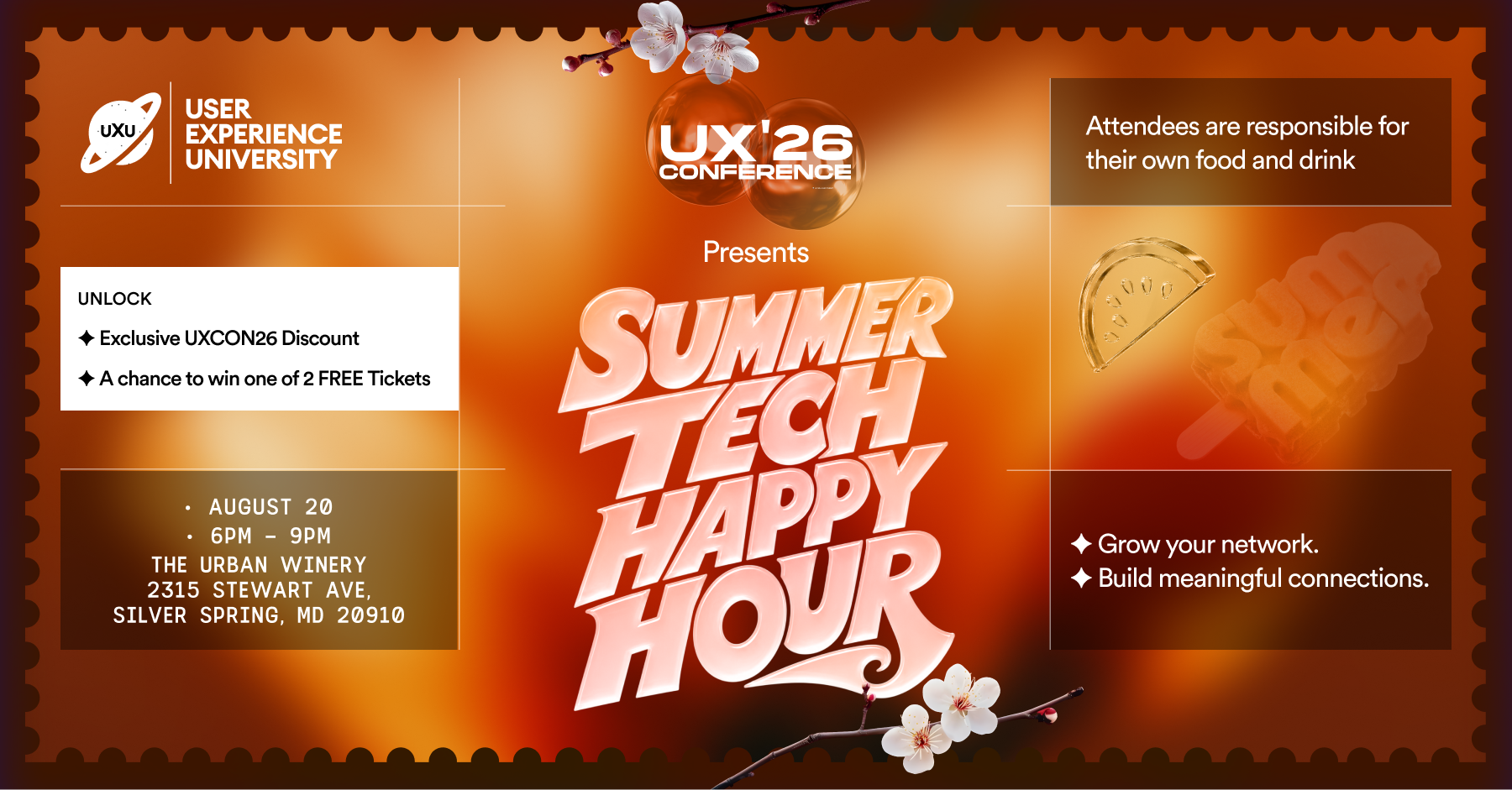
UXCON Summer Tech Happy Hour
This month on Aug 20th, join us for a FREE, no-pressure evening to connect with the people shaping UX, product, design, and tech across the DMV at The Urban Winery in Silver Spring, MD.
No panels. No pitch decks. Just good conversation with people who get it.
Why?
✺ Meet practitioners, hiring managers, and collaborators from across the community
✺ Walk away with real leads, referrals, and new connections
✺ Enter to win one of two free UXCON26 tickets
✺ Unlock an exclusive UXCON26 discount, available only to those attending the Happy Hour.
Resource Corner
Levdikova, T. (2026). AI Mapping in UXPressia: Visualize Your Customers’ Journeys. UXPressia Blog. uxpressia.com/blog/ai-mapping
ZipTie.dev (2026). How to Map the AI User Journey: A 6-Stage Framework for 2026. ziptie.dev/blog/how-to-map-the-ai-user-journey
UXmatters (2026). The Future of UX Research: Navigating AI-Powered Tools and Methods. uxmatters.com
O’Sullivan, K. (2026). Your User Journey Map is a Beautiful Lie. Userpilot Blog. userpilot.com/blog/user-journey-map
Nielsen Norman Group (2026). State of UX 2026: Design Deeper to Differentiate. nngroup.com/articles/state-of-ux-2026


