



Notion’s The Great Renovation report maps organizations onto a four-level AI maturity model - from AI as a “thought partner” all the way to AI running critical workflows autonomously.
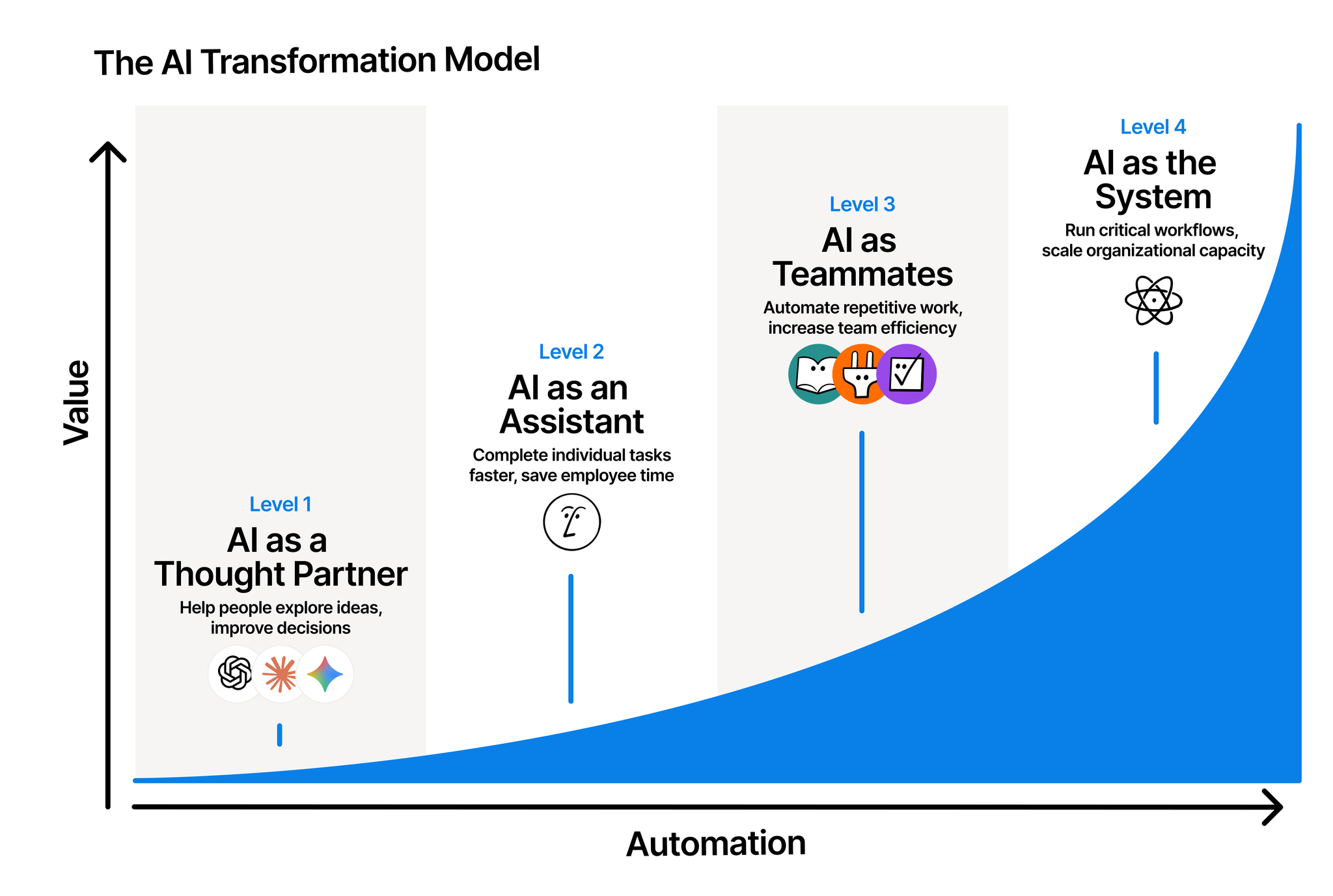
Most companies are still stuck at Level 1 or 2. Only 12% have reached Level 3 or 4, where AI actually reshapes how teams work.
Buried in the role-by-role breakdown is a number every UX professional should sit with: Design (UX/UI) sits at just 14% Level 3–4 adoption - behind IT Admin (24%), Executive/C-suite (23%), and Product Management (15%). We’re not leading this shift. We’re trailing the roles closest to infrastructure and decision-making.
Here’s what the data says, and what to actually do with it.
By the numbers
Design (UX/UI) at AI maturity Level 3–4 - 14%
Customer experience as a top AI investment reason (Level 3–4 orgs) - 37% (+8pp)
Owner/CEO respondents at Level 3–4 vs. individual contributors - 39% vs. 6%
Decision makers who say investment outpaces employee readiness (Level 4) - 68%
“Automating repetitive tasks” as an AI workflow, Level 1–2 → Level 3–4+ - 18pp
1. UX owns the exact metric mature orgs now chase
At Level 1 and 2, the business case for AI is cost and productivity. At Level 3 and 4, customer experience becomes the fastest-rising motivation for investment. That’s a UX conversation, not an engineering one, Create but it will go to whoever shows up with the framing and the metrics first.
Career move: Stop pitching AI projects as “efficiency wins.” Reframe your UX/AI work in terms of customer experience outcomes and new capability creation, the two reasons rising fastest among the most mature organizations. That’s the language leadership is already starting to reward.
Before we continue…..
BECOME A UXCON26 VOLUNTEER
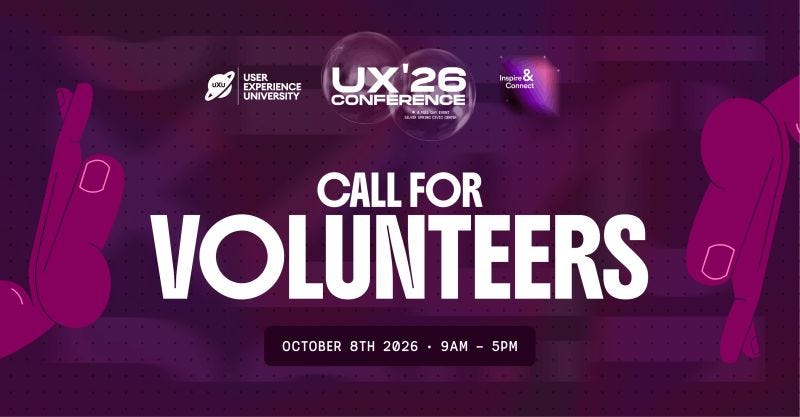
🚨 UXCON26 is powered by more than speakers and sessions.
It's powered by the people behind the scenes.
We're looking for passionate volunteers who want to experience one of the biggest UX events from the inside. Whether you're growing your network, building real event experience, or looking to contribute to the UX community, this is your chance.
Learn. Connect. Make an impact.
If you've ever wanted to be part of something bigger than yourself, this is your moment.
📅 October 8, 2026
📍 Silver Spring Civic Center
⏰ 9:00 AM – 5:00 PM
Applications are now open. Join the team that makes UXCON26 unforgettable.
back to where we stopped…….
2. Seniority - not tool skill - is the strongest signal of AI maturity
Owner/CEO respondents are more than 6x more likely than individual contributors to be operating at Level 3 or 4. This holds across every region and industry in the dataset. The gap isn’t about who knows the tools best - ICs are often the heaviest daily users. It’s about who has the authority to embed AI into a workflow, not just use it inside one.
Career move: If you’re an IC, your path to visible impact isn’t “use more AI tools” — it’s proposing a workflow-level change and getting a decision-maker to sponsor it. Attach yourself to governance conversations (AI policy, tool standardization, measurement frameworks) where UX has real standing to contribute.
3. The work is shifting from craft tasks to “systems work”
As organizations mature, individual tasks like writing, researching, and brainstorming actually see AI usage decline in relative share. What rises sharply: automating repetitive workflows (+18pp), routing work across tools (+15pp), and generating technical outputs (+12pp). Mature orgs haven’t replaced individual craft — they’ve layered systems thinking on top of it.
Career move: The differentiated skill isn’t “I can prompt an AI to draft copy” — everyone can do that now. It’s designing the workflow: how research findings route into design decisions, how AI-assisted outputs get reviewed, where the handoffs are. That’s a UX systems-design skill, and it’s rare.
4. “Too many AI tools” is now the fastest-growing complaint — and a UX problem in disguise
Among the most mature organizations, “too many AI tools” jumped +14pp as a top adoption challenge - the single largest increase of any listed friction point. Fragmented, poorly integrated tools are exactly the kind of experience problem UX research and IA methods are built to diagnose.
Career move: Position yourself as the person who audits and rationalizes the AI tool stack, not just the person who designs the next feature. Internal tool experience audits are an underexploited niche right now, and almost no one outside UX is positioned to do them well.
5. Mid-market is where the action is - not enterprise
Mid-market companies (500–999 employees) lead Level 3–4 adoption at 17%, while enterprise (5,000+) trails at just 7%. Scale brings more structure, but also more barriers — enterprise UX roles may see slower AI-driven change than mid-market ones.
Career move: If you’re job hunting or freelancing and want AI-forward UX work, mid-market companies (roughly 500–1,000 employees) are statistically your best bet right now, not the household-name enterprises.
This week’s action items
Reframe one current AI-adjacent project around customer experience or capability impact, not efficiency.
Identify one workflow (not one task) you could redesign with AI - and who needs to sponsor it.
Ask your org: how many AI tools are we actually running, and does anyone own that inventory?
If you’re job-seeking, filter your search toward mid-market companies (500–1,000 employees).
Resource corner
→ Full report: Notion, The Great Renovation: Inside the AI Transformation (2026), fielded via Qualtrics, N=6,118 across 10 markets.
→ Notion’s AI Transformation Model:


