


A user signs up for your product. They are curious but not committed. They have signed up for four other tools this month and abandoned three of them. The clock is already running.
What happens in the next minute decides almost everything.
Most drop-offs happen during the first session. Even small moments of friction can push users away quickly. And the bar for how fast you need to deliver value has dropped sharply. The AI onboarding benchmark is now around 60 seconds to value, with the strongest flows giving users useful output from very little input. everyday uxeveryday ux
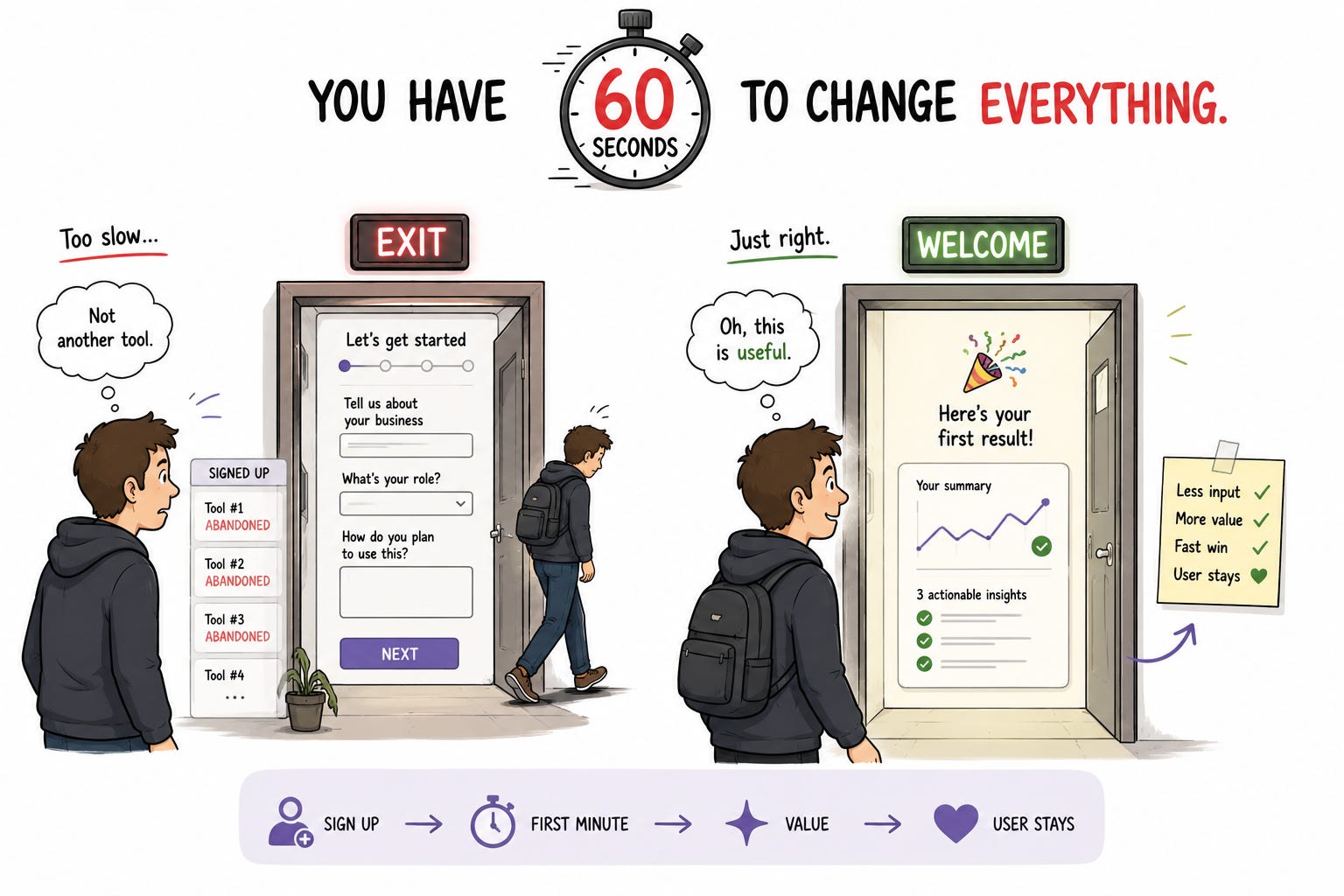
Sixty seconds. That is the new standard. This issue is a hands-on playbook for designing the most consequential minute in your entire product, whether you are a designer shaping the flow or a researcher trying to understand why people leave.
In This Issue:
Why the first session decides everything
The 60-second standard and where it came from
The most common onboarding failures
A practical framework for the first minute
What researchers should be doing here
Resource Corner
but first….
Become a UXCON26 Volunteer
UXCON26 is coming October 8 and we are building the team that makes it all happen behind the scenes.
Volunteering at UXCON26 means being part of one of the most anticipated UX events of the year. You will be surrounded by some of the sharpest minds in the field, contributing to a day the community will remember, and connecting with practitioners, leaders, and speakers who are shaping where this industry is going next.
If you are passionate about UX, love bringing people together, and want to show up for this community in a meaningful way, we would love to have you on the team.
Why The First Session Decides Everything
Onboarding is not a phase users patiently move through. It is a test they are running on you, often unconsciously, and they are looking for a reason to quit.
The onboarding phase is when you are at the highest risk of losing a user, especially if the experience is complicated and clunky. UX Tigers
The reason is simple psychology. A new user has invested almost nothing. There is no sunk cost holding them. Their tolerance for confusion is at its lowest point in the entire customer lifecycle because they have no proof yet that the payoff is worth the effort. Every second of friction is weighed against a near-zero commitment, which means even small obstacles tip the scale toward leaving.
This is also the moment with the highest leverage. Get it right and you have a user who has felt the value, formed a habit, and crossed the line from curious to committed. Get it wrong and the best product in the world never gets a second chance to prove it.
The 60-Second Standard And Where It Came From
The expectation around onboarding speed has shifted dramatically, and AI is the reason.
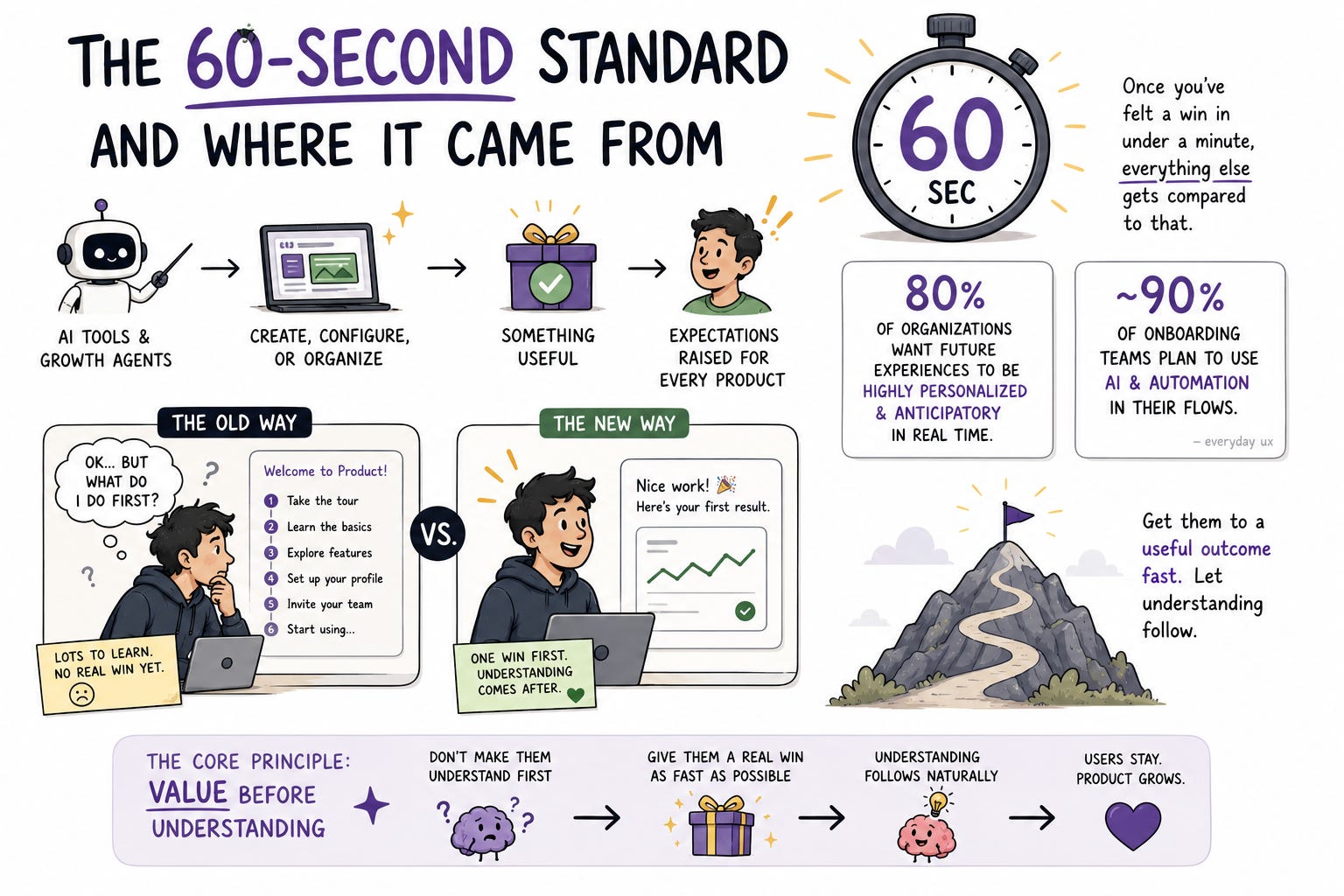
Onboarding has moved into a new phase. AI tools and product growth agents are making onboarding more outcome-driven. AI can help users create, configure, or organize something useful before they fully understand the product. everyday ux
This changed what users expect everywhere, not just in AI products. Once someone experiences a tool that delivers a useful result in under a minute, every other product gets measured against that. 80% of organizations want future customer experiences to be highly personalized and anticipatory in real time, and nearly 90% of onboarding teams planned to use AI and automation in their flows. everyday ux
The core principle behind the 60-second standard is “value before understanding.” You do not need the user to fully comprehend your product before they feel its benefit. You need to get them to a useful outcome fast, and let understanding follow. The old model of a guided tour explaining every feature is being replaced by getting the user to one real win as quickly as possible.
The Most Common Onboarding Failures
These are the patterns that kill first sessions. Most products commit at least two of them.
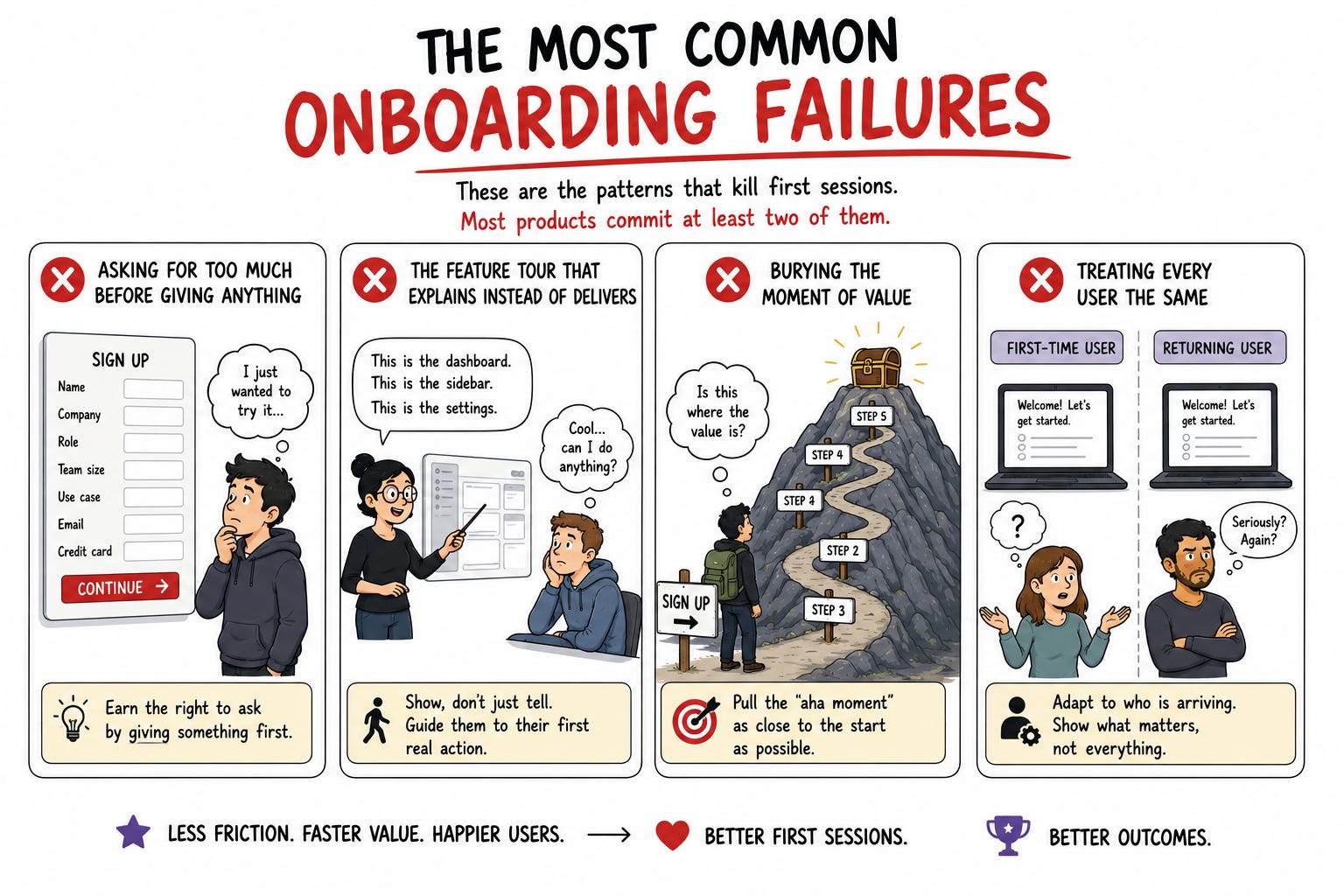
🔴 Asking for too much before giving anything
The signup flow that demands name, company, role, team size, use case, and a credit card before the user has seen a single moment of value. Every field you ask for before delivering value is a chance for the user to reconsider. Earn the right to ask by giving something first.
🔴 The feature tour that explains instead of delivers
The walkthrough that points at every button and panel while the user waits to actually do something. The best flows hand-hold users through an interactive walkthrough while helping them set up their account and complete a first real action, rather than just describing features. Showing someone the controls is not the same as getting them to their destination. UX Tigers
🔴 Burying the moment of value
Every product has an “aha moment,” the point where the user first feels why the product matters. The most common onboarding mistake is putting that moment too far in. If your value lives five steps deep, most users never reach it. The job of onboarding is to pull that moment as close to the start as possible.
🔴 Treating every user the same
First-time users see simplified interfaces while experienced users get advanced options. Adaptive onboarding reduces cognitive overload by showing only what matters at the moment. A returning user forced through the same beginner tour as a first-timer is a user you are actively annoying. Onboarding should adapt to who is actually arriving. Uxplaybook
A Practical Framework For The First Minute
Here is a structure you can apply to your own onboarding this week.
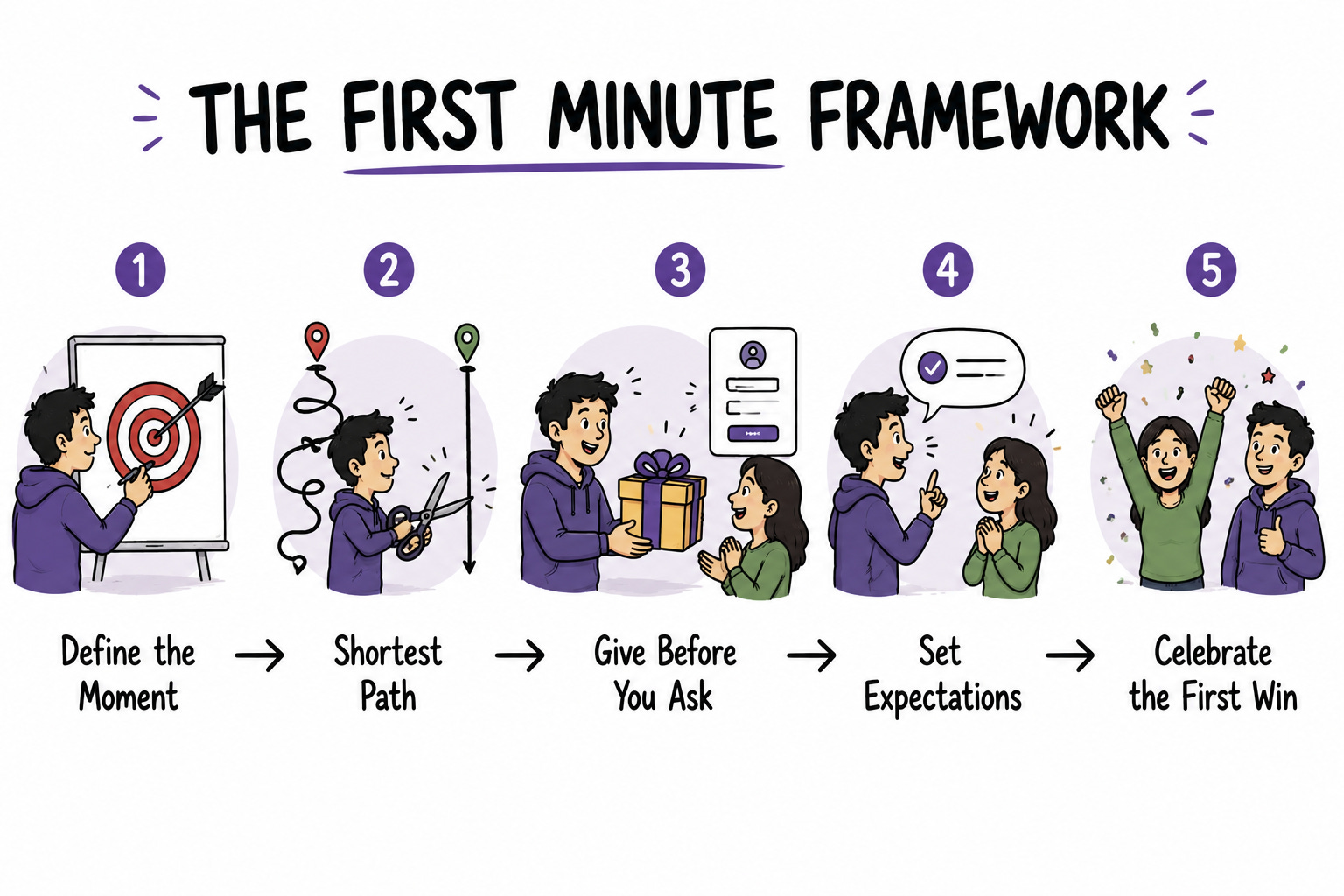
✓ Step 1: Define your moment of value precisely
Before designing anything, answer one question: what is the single moment where a new user first feels “oh, I get it, this is useful”? Not a feature. A felt outcome. For a design tool, it is seeing their first real design appear. For a writing tool, it is the first useful draft. Name that moment exactly. Everything else in onboarding exists to get the user there faster.
✓ Step 2: Map the shortest path to it
Onboarding strategy starts before the first screen. Map the user’s mental model, identify the moment of value, and design the shortest possible path from signup to that first success. Count the current steps between signup and value. Then ruthlessly cut. Every step you remove between arrival and the aha moment increases the odds the user stays. Slickplan
✓ Step 3: Deliver value before demanding information
Flip the usual order. Let users experience something useful first, then ask for the details you need. The credit card, the profile setup, the team invitation can all come after the user has felt why your product is worth the effort. Give, then ask.
✓ Step 4: Use microcopy to set expectations and reduce anxiety
Even a small welcome message or tooltip can set expectations and improve the experience. Tell users what is about to happen, how long it will take, and what they will get. “This takes about a minute and you will have your first project set up by the end” removes the uncertainty that causes people to bail. Nielsen Norman Group
✓ Step 5: Make the first win obvious and celebrate it
When the user reaches the moment of value, mark it. A subtle confirmation, a clear “you just did the thing” signal. A subtle animation after completing an action reassures users that it was successful. People need to feel the win, not just technically achieve it. The feeling is what makes them come back. Uxplaybook
UXCON26 - Inspire & Connect
The best UX professionals don’t just keep up with change. They help shape it.
UXCON26 is where the conversations defining the future of design happen. It’s where researchers, designers, product leaders, and innovators come together to exchange ideas, challenge assumptions, and leave with practical strategies they can apply immediately.
This year’s theme, Inspire & Connect, reflects what our industry needs most: meaningful collaboration in a world that’s changing faster than ever. And with Don Norman headlining, you’ll hear from the pioneer whose work laid the foundation for human-centered design—and whose thinking continues to influence how we build products in the age of AI.
Whether you’re looking to sharpen your skills, expand your network, or gain fresh perspectives from some of the brightest minds in UX, UXCON26 is where you need to be.
Don’t just watch the future of UX unfold. Be in the room helping shape it.
What Researchers Should Be Doing Here
Onboarding is one of the richest and most underused areas for research, and the findings tend to be unusually actionable.
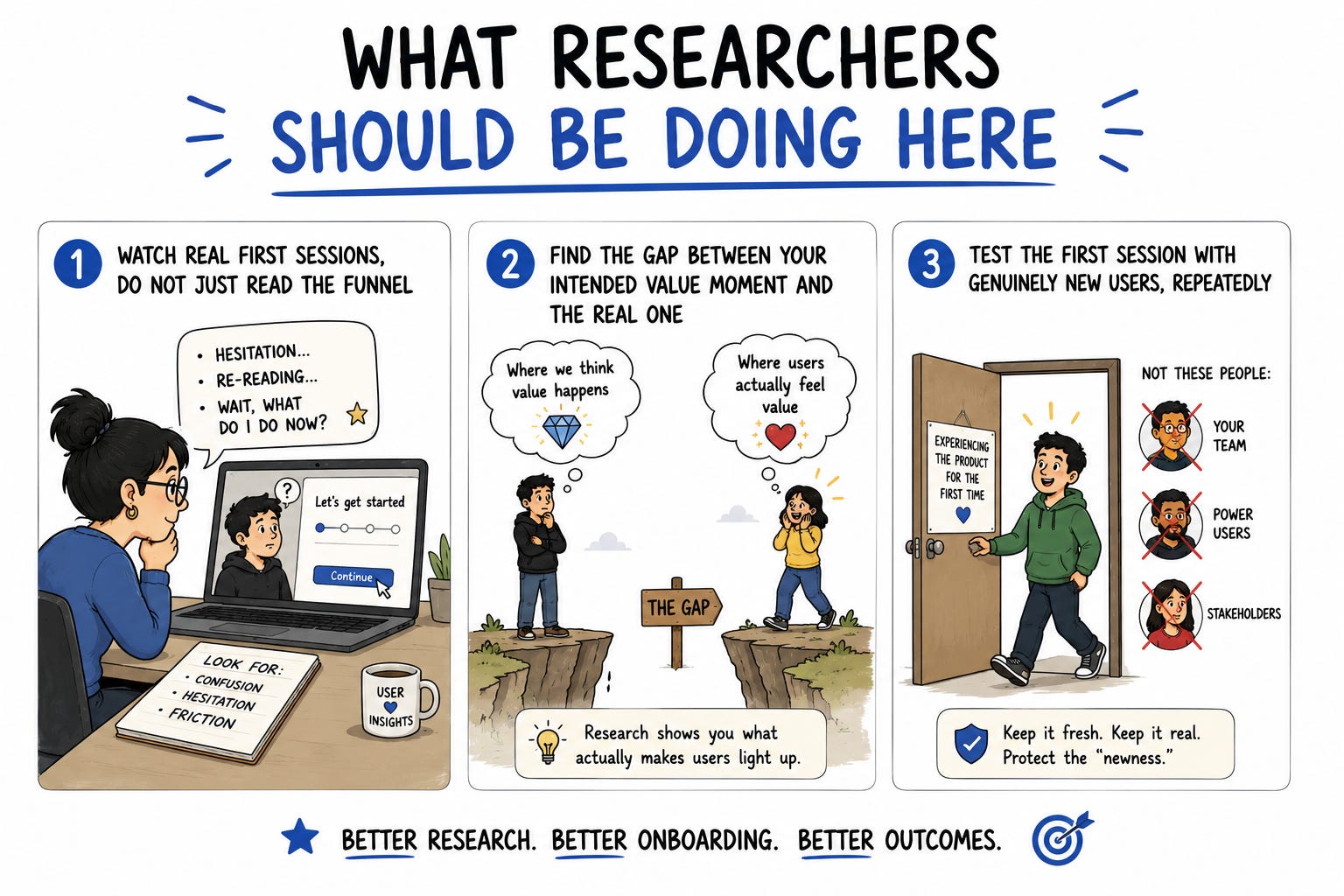
🔵 Watch real first sessions, do not just read the funnel
Analytics tell you where people drop off. They do not tell you why. Watching a real person go through your onboarding for the first time, ideally someone who has never seen the product, reveals the exact moments of confusion that the funnel only hints at. The hesitation before a button. The re-reading of an instruction. The visible “wait, what do I do now” moment. That is where the gold is.
🔵 Find the gap between your intended value moment and the real one
The moment you think delivers value and the moment users actually feel it are often different. Research surfaces that gap. Sometimes the thing your team is most proud of is not what makes users light up. Sometimes a small, overlooked feature is the real hook. Only research tells you which.
🔵 Test the first session with genuinely new users, repeatedly
The single most common research mistake in onboarding is testing with people who already understand the product. Your team, your power users, your stakeholders all carry knowledge a new user does not have. Onboarding research is only valid with people experiencing the product cold. Recruit for true newness and protect that in your study design.
📦 Resource Corner
Onboarding UX Examples: What AI Is Changing (Userpilot)
A walkthrough of real onboarding flows from 30+ tools, with specific attention to how the 60-second standard is reshaping first experiences. Practical and example-heavy.
17 Best Onboarding Flow Examples (Whatfix)
A catalogue of real onboarding flows broken down by what works and why. The best single reference for seeing patterns across products before designing your own.
The Elements of User Onboarding by Samuel Hulick
The foundational resource on onboarding strategy. Older but still the clearest articulation of why value-first onboarding beats feature-first. The teardown approach is worth studying.
Adaptive Onboarding in 2026
Specific breakdown of how personalized and adaptive onboarding works in practice, with context on serving different user types within a single flow.
Hooked by Nir Eyal
On how products build habits in the critical early period. Use it to understand the psychology, and pair it with an ethical lens, since the same principles can be used well or manipulatively.
💭 Final Thought
You spend months building a product. Users decide whether it is worth their time in about a minute. That asymmetry feels unfair, but it is the reality every product faces, and the only response is to take that minute as seriously as it deserves.
The shift to the 60-second standard is not really about speed for its own sake. It is about respect. Users are telling you, through their behavior, that their time and attention are valuable and that the burden is on you to prove your product earns them quickly. Onboarding done well is an act of respect for that. It says: we know your time matters, here is something useful, fast.
Get the user to one real win before they have a chance to doubt you. Everything else, the features, the depth, the mastery, has time to unfold later. But only if you win the first minute.
Open your own onboarding. Time how long it takes to reach the first moment of real value.
Then start cutting.


