


There is a version of this job where you execute.
Someone brings you a problem, a brief, a deadline. You research, you wireframe, you test, you ship. You do it well. You do it consistently. And then one day you look up and realise the product decisions are happening somewhere you are not invited, the AI tools are doing the first three rounds of ideation before you open a file, and nobody is quite sure what your role is supposed to be anymore.
Not because you did anything wrong. Because you were very, very good at the version of this job that no longer needs you to do it alone.
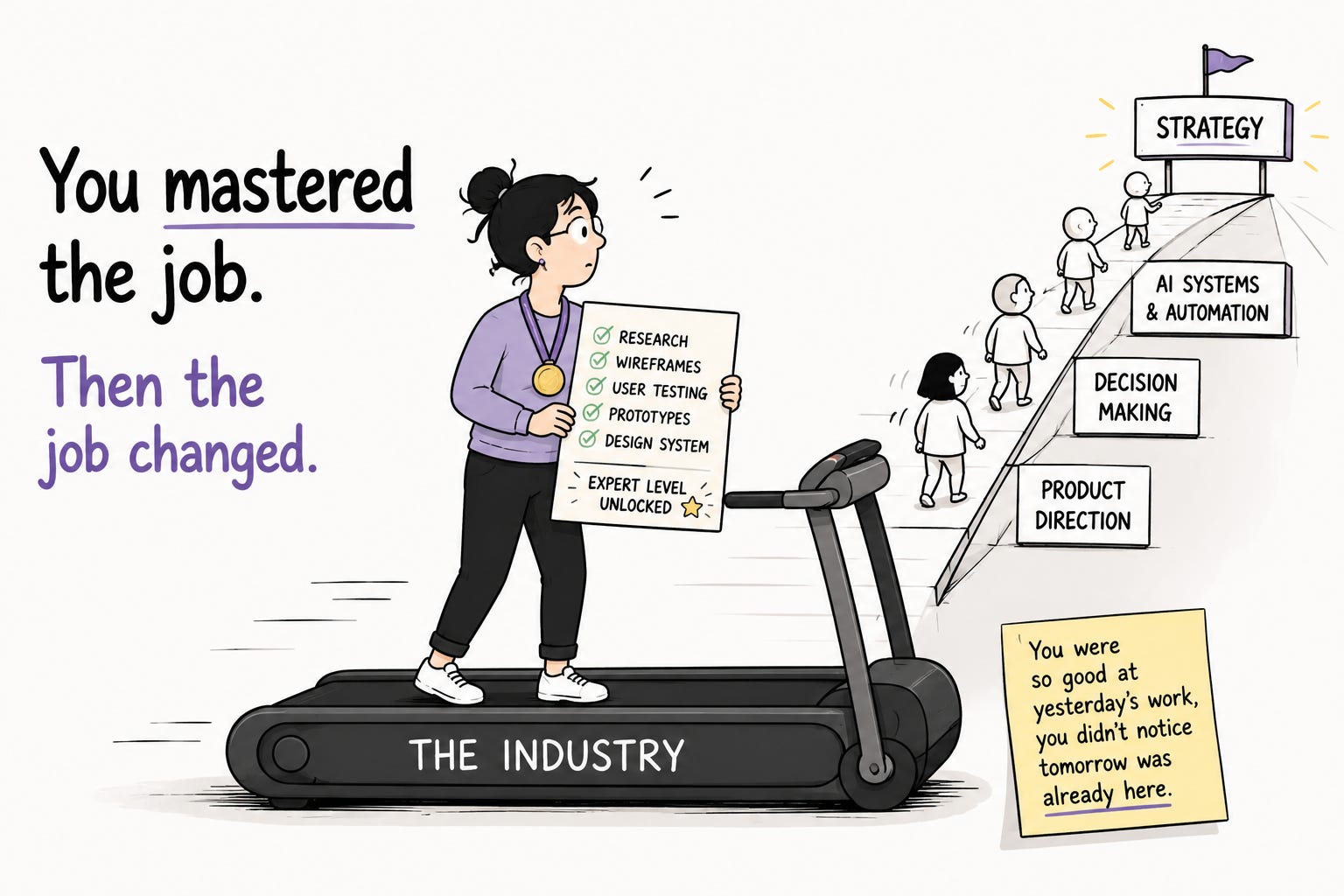
This issue is about the shift underneath the shift. Not just AI, not just layoffs, not just “the industry is changing.” But the specific thing that is changing about what UX work actually is, and what it means for how you need to show up in it.
In This Issue:
The executional trap and how good practitioners fall into it
What is actually being automated and what is not
The new shape of UX influence
Why “a seat at the table” is the wrong goal
How to reposition yourself before someone repositions you
Resource Corner
BUT FIRST….
Happy Juneteenth from UXU. Here’s a gift.

Freedom means something different to everyone who carries it. But at its core it has always been about the right to take up space, to be seen, to bring your full self into the room and have it matter.
That is exactly what UXCON26 is built around.
This weekend, in honor of Juneteenth, we are opening early bird pricing on UXCON26 tickets from Friday June 19 through Sunday June 21 only. It is our way of saying thank you to a community that shows up, asks hard questions, and refuses to let the work be less than it should be.
October 8 is the day the UX community comes together. Don Norman, the person who gave this field its name, headlines a lineup that includes practitioners from Netflix, The New York Times, Target, UserTesting, and Skylight. Three keynotes. Two panels. Workshops. One room full of people who still believe great design changes lives.
The offer closes Sunday at midnight.
The Executional Trap
Here is how it happens, and it happens to the best people.
You join a team. You are skilled, you are reliable, you learn the product fast. You become the person who delivers. Stakeholders learn they can hand you a problem and you will come back with something good. This feels like success, because it is success, at first.
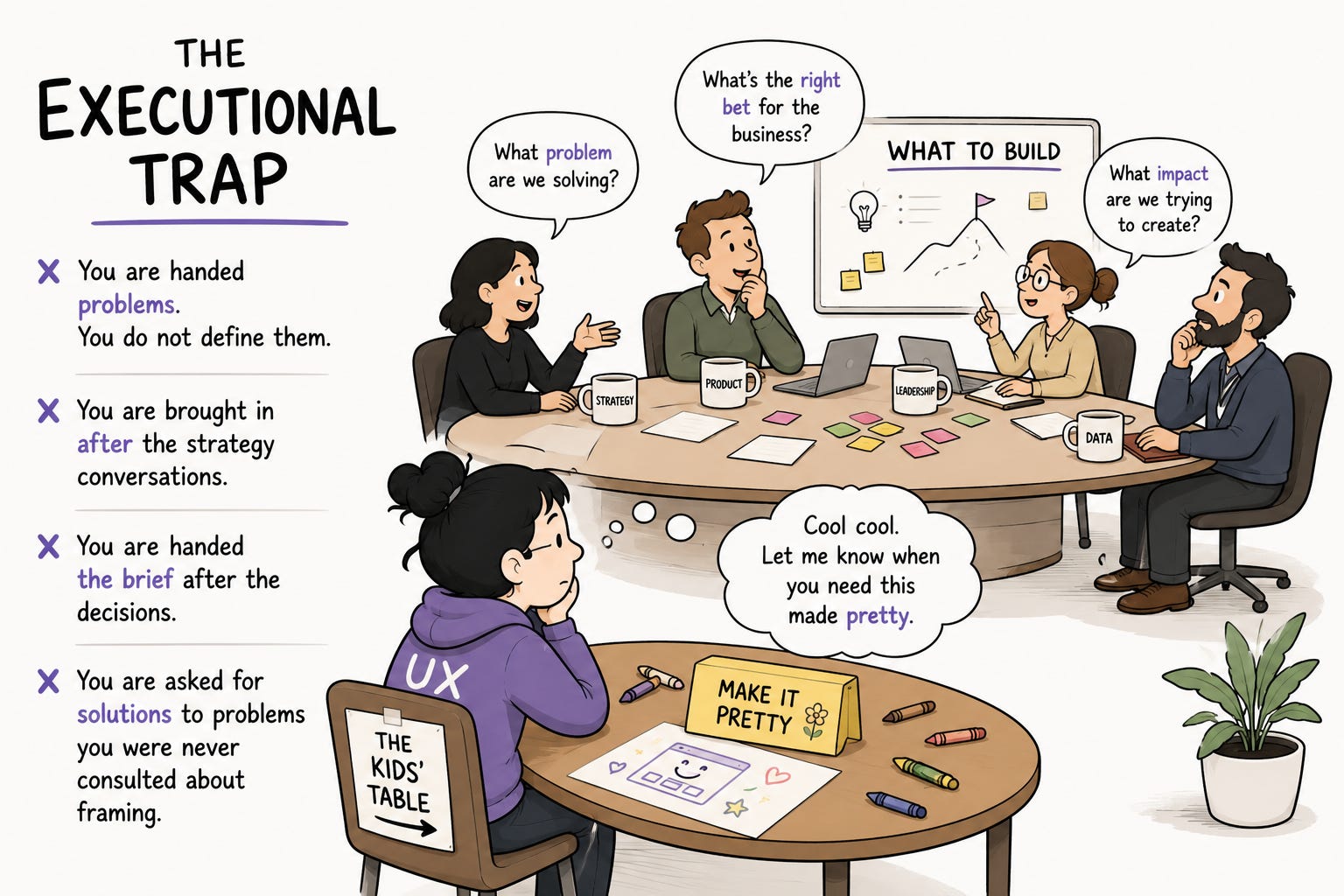
But over time, a pattern sets in:
You are handed problems. You do not define them.
You are brought in after the strategy conversations.
You are handed the brief after the decisions.
You are asked for solutions to problems you were never consulted about framing.
Slowly, without anyone intending it, your role becomes execution. Smart, high-quality execution. But execution nonetheless.
NN/g’s State of UX 2026 put it plainly: available roles are increasingly demanding breadth and judgment, not just artifacts. The practitioners who are thriving are not the ones who do UX best in the traditional sense. They are the ones who have moved upstream, into the problem definition, the strategic framing, the decisions about what gets built and why.
The executional trap is not a character flaw. It is a structural gravity that pulls every practitioner toward it. Recognising it is the first move.
What Is Actually Being Automated
Let us be specific, because vague anxiety is not useful.
What AI tools are genuinely absorbing right now:
Early ideation
Pattern-based wireframing
Usability heuristic checks
Basic research synthesis
Copy generation and asset production
First-draft flows
Work that used to take days now takes hours. Work that used to take hours now takes minutes. This is real, it is accelerating, and pretending otherwise is not a strategy.
What AI tools cannot do:
Sit in a room with a frustrated sales team and figure out that the product problem is actually a positioning problem
Notice that the research finding everyone is ignoring is the most important one in the deck
Build the trust with an engineering lead that makes them pick up the phone before a bad decision gets locked in
Know which stakeholder needs to hear something a certain way, or not yet, or from someone else entirely
NN/g’s research on the return of the UX generalist is clear on this: the skills that cannot be replaced are the strategic-oriented ones. Adaptability, judgment, the ability to synthesise across disciplines. Those compound. The deliverables do not.
The practitioners who are scared are the ones whose value lived primarily in the craft of production. The practitioners who are not scared are the ones who were always doing something harder to name: the judgment calls, the organisational navigation, the translation between user reality and business decision.
If you have been doing that work, you have something the tools do not. If you have not, this is the moment to start.
The New Shape of UX Influence
For a long time, UX influence looked like great artifacts. The beautiful deck. The airtight research report. The prototype that made the room go quiet.
That still matters. But it is table stakes now, and table stakes do not get you influence anymore.
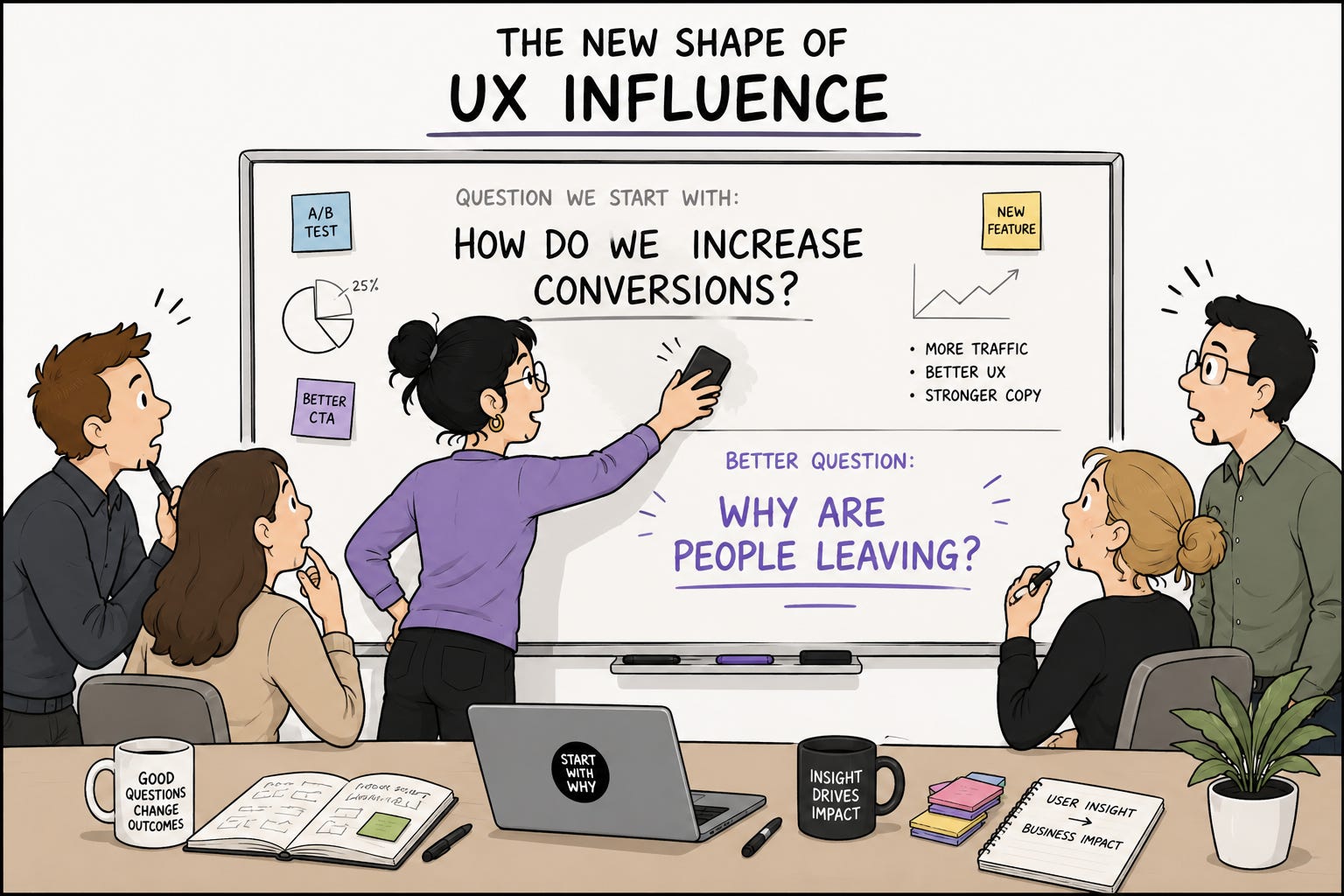
The new shape of UX influence is harder to put in a portfolio. It looks like this:
Being the person who reframes the brief before work begins. IDEO has built an entire methodology around this idea, that the quality of your question determines the quality of your solution. Most teams skip straight to answering. The practitioner who slows that down and reshapes the question is doing the highest-value work in the room.
Being the person who connects the user insight to the business metric. Not “users are frustrated” but “this friction point is the primary driver of the drop-off that is costing us this number.” Speaking the language of the people who make budget decisions is not selling out. It is getting your work taken seriously.
Being the person who builds relationships across the organisation. Not just within the design function. One real relationship in engineering, finance, or operations, someone who trusts your read and will tell you what is actually being discussed, is worth more than a hundred LinkedIn connections.
Being the person who can say, calmly and with evidence, that the team is solving the wrong problem. And be believed.
None of this replaces craft. All of it extends it into territory that is genuinely hard to automate.
Why “A Seat at the Table” Is the Wrong Goal
UX practitioners have been told for a decade that the goal is a seat at the table. Get into the strategy meetings. Be present when decisions get made.
The problem with this framing is that it positions you as a supplicant. You are asking for access to someone else’s conversation. And access granted can be access revoked.
The practitioners who have real influence do not have a seat at the table. They have shaped what the table is discussing. There is a difference, and it is not subtle.
Positional authority gets you into the room, but it does not make people trust your judgment. Trust in your judgment comes from a track record of being right about things that mattered, communicated in ways people could act on. That shift does not happen through org chart maneuvering. It happens through consistent, visible, well-communicated judgment over time.
The goal is not access. The goal is to become someone whose perspective is sought before a decision, not presented to after one.
How to Reposition Yourself Before Someone Does It for You
This is not a dramatic career pivot. It is a series of small, consistent moves in a different direction.
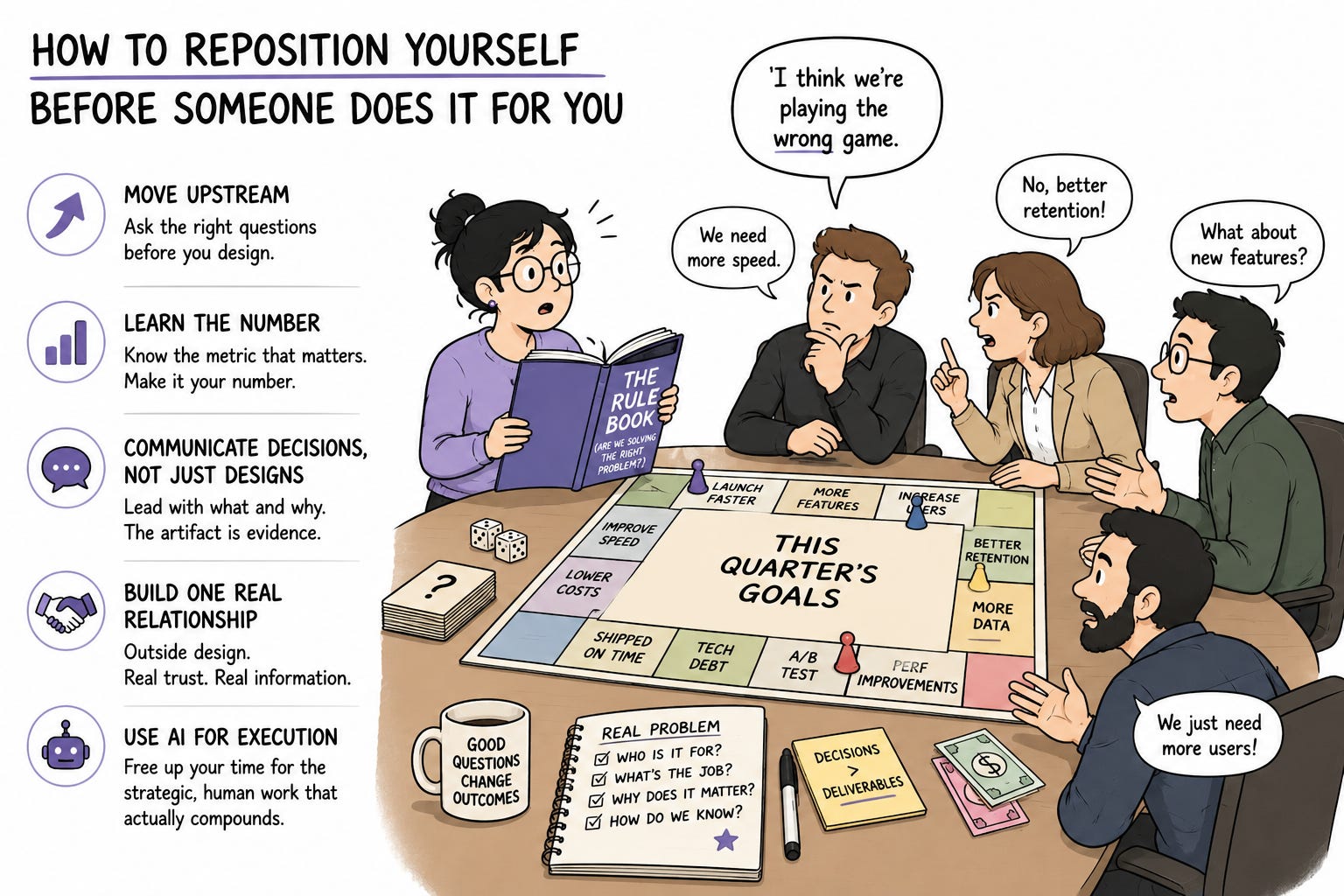
Move upstream on every project you can. Before you open a design tool, ask: what is the problem we are actually solving, for whom, and how do we know? Make those questions your first deliverable, not your opening ritual.
Learn the number your stakeholders care about. Not vaguely, specifically. What is the metric that determines whether your product area is considered successful this quarter? Make that number your number. Track it. Reference it. Connect your design decisions to it explicitly.
Start communicating decisions, not just designs. When you share work, lead with what you decided and why, not what you made. The artifact is evidence of the decision. The decision is what gets remembered.
Build one real relationship outside design. Not a networking contact. A person in engineering, finance, product, or operations who trusts your read on things and will tell you what is actually being discussed. Organisations run on informal information. If you only have it from inside your function, you are seeing a fraction of the picture.
Use AI aggressively for the execution layer. Not because the craft does not matter, but because time you free up from production is time you can redirect toward the strategic and relational work that compounds. Practitioners who are using the tools well are not being replaced. They are creating capacity that slower-moving peers do not have.
📦 Resource Corner
State of UX in 2026 by Nielsen Norman Group — The clearest annual read on where the field actually is right now. The 2026 edition is direct about what is changing and what practitioners need to prioritise. Worth bookmarking and returning to quarterly.
The Return of the UX Generalist by NN/g — The research case for why broad skills, adaptability, and strategic thinking are becoming more valuable than deep specialisation. Useful ammunition for internal conversations about how your role should evolve.
Articulating Design Decisions by Tom Greever — The most practical guide to making your reasoning visible to stakeholders who only see the surface. Directly addresses the gap between doing good work and getting credit for it. The 2nd edition is available via O’Reilly.
Org Design for Design Orgs by Peter Merholz and Kristin Skinner — The clearest framework for understanding where design influence comes from structurally, and what organisational shapes produce it or destroy it. Essential context for anyone navigating where their team sits and how to grow its footprint.
The Making of a Manager by Julie Zhuo — Written by a former VP of Product Design at Facebook. Every chapter is relevant whether you manage people or not. One of the best books written on how influence actually works inside organisations.
What Is Design Thinking by IDEO U — A short, sharp read on why reframing the problem is the most important design skill. Useful for anyone who wants language and a framework for moving upstream on their projects.
Mind the Product: UX content library — The language and frameworks your product partners are using. Understanding them makes you easier to work with and much harder to sideline.
💭 Final Thought
The field is not dying. It is shedding a skin.
The version of UX work that was primarily about production, about being the person who could translate a brief into a finished artifact faster and better than anyone else, that version is under genuine pressure. Not gone, but no longer sufficient on its own.
What is not under pressure is judgment. Context. The ability to sit with ambiguous, high-stakes, politically complicated problems and come back with a frame that makes the path forward clearer. That has always been the harder and more valuable half of this work. It just did not always need to be the visible half.
It does now.
The practitioners who will look back on this period as the moment their careers accelerated are the ones who decided, consciously, to move in the direction of the hard work rather than the comfortable work. Who started treating organisational navigation as a design problem. Who used the tools to buy back time and spent that time on the things that compound.
You already know how to make complicated things simple. You have always known how to understand what people actually need versus what they say they want.
Apply that to your own career. Figure out what the organisation actually needs from you right now. And go be that, before someone decides they can manage without you.
You cannot automate your way to influence. But you can design for it.


