


Think about the best thing you ever shipped.
The flow that finally worked. The research that quietly changed a roadmap. The redesign that made a confusing thing simple. Now answer honestly: did anyone notice?
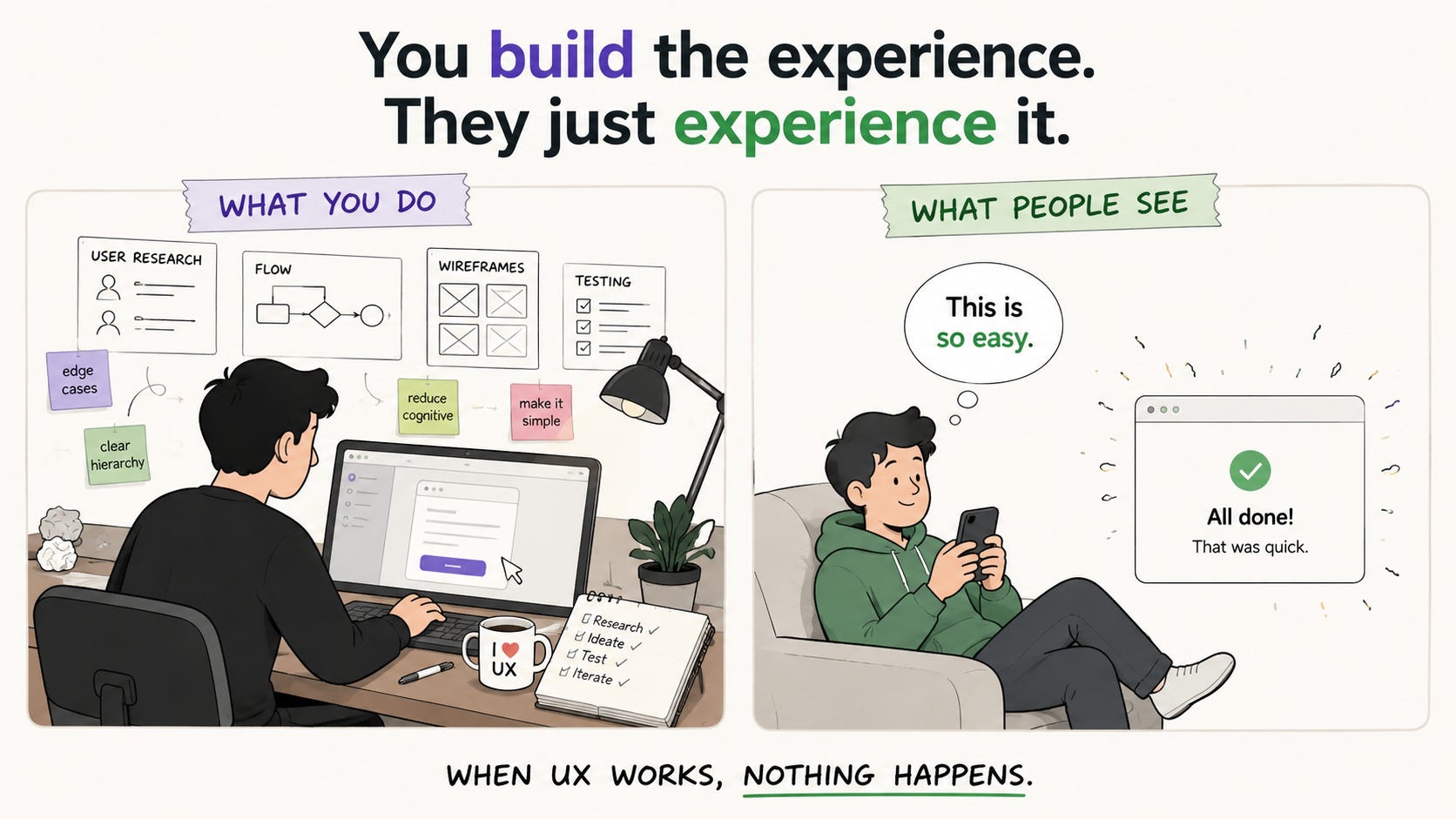
Probably not. Because when UX is done well, nothing happens. No complaints. No support tickets. No confused users. No drama. The product just works, people just use it, and everyone moves on with their day.
This is the Shakespearean curse of UX: the better you do your job, the less anyone sees you did it at all. Index.dev
Nobody warns you about this when you enter the field. This issue is about the paradox at the center of UX work, why it quietly affects your career and your confidence, and how to handle it without becoming bitter or burning out.
In This Issue:
The paradox nobody warns you about
Why bad design gets noticed and good design does not
What invisibility costs you, professionally and personally
The invisible work behind the invisible work
How to make your impact visible without ruining the work
Resource Corner
The Paradox Nobody Warns You About
There is a paradox at the heart of design, one no one really warns you about when you are just starting out: the better your work is, the less likely anyone is to notice it. Nielsen Norman Group
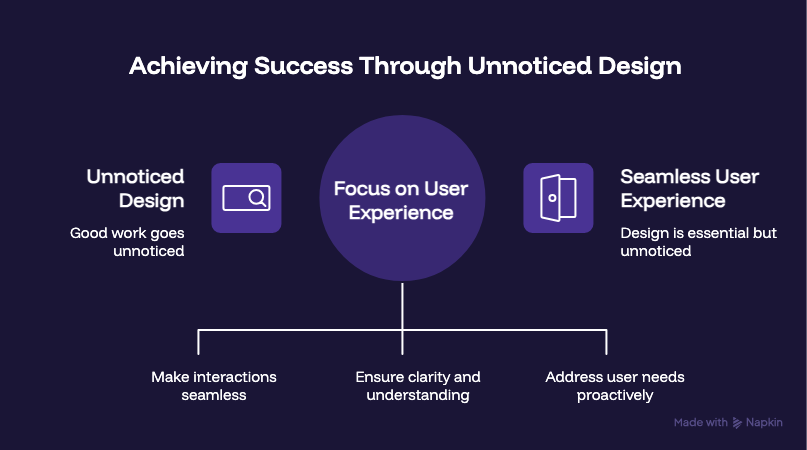
Every other discipline gets to show its wins. Engineers ship features people can see. Marketers point to campaigns and numbers. Sales closes deals. UX, when it succeeds, produces an absence. An absence of friction. An absence of confusion. An absence of complaints.
Good design is like oxygen. Essential but unnoticed until it is missing. UX Tigers
Think about the doors you have not noticed. The ones where your hand just went to the right spot and the thing opened and you walked through and kept moving. No friction, no confusion, no tiny moment of feeling slightly dumb in public. That door did its job perfectly. Nobody is writing a review about it. UX Tigers
That door is your career. You are building hundreds of those doors. And the silence that follows good work is simultaneously the proof that it worked and the reason nobody is thanking you for it.
Become a UXCON26 Volunteer
UXCON26 is coming October 8 and we are building the team that makes it all happen behind the scenes.

Volunteering at UXCON26 means being part of one of the most anticipated UX events of the year. You will be surrounded by some of the sharpest minds in the field, contributing to a day the community will remember, and connecting with practitioners, leaders, and speakers who are shaping where this industry is going next.
If you are passionate about UX, love bringing people together, and want to show up for this community in a meaningful way, we would love to have you on the team.
Why Bad Design Gets Noticed And Good Design Does Not
This is not unfair luck. It is how human attention works, and understanding it makes the invisibility easier to carry.
We do not spend our time thinking about how good the chair is that we are sitting in. We only come to realize the flaws of a design when it cannot perform the function it is supposed to. UX Design
Human brains are wired to conserve energy. When an experience flows smoothly, the brain stays in autopilot. Nothing gets flagged. Nothing gets remembered. The experience does not register as an experience at all. It registers as just doing the thing.
Friction is what wakes the brain up. The form that will not submit. The button that does not do what it promised. The navigation that hides the one thing you came for. These moments register. They generate emotion. They get remembered, complained about, screenshotted, and posted.
Which means the entire feedback system of the world is structurally biased toward noticing design failure and ignoring design success. Users do not praise a great UX. They simply use it without frustration. Your best work is competing for attention against an attention system that is designed not to give it any. LinkedIn
Once you understand that, the silence stops feeling personal. It is not that people do not appreciate your work. It is that your work, when it succeeds, is specifically designed to not require their attention. Silence is the success condition.
What Invisibility Costs You, Professionally And Personally
It would be nice to end the story there. Embrace the silence, take pride in the craft, move on. But the invisibility has real costs that deserve naming.
🔴 Promotion conversations are built on visible impact
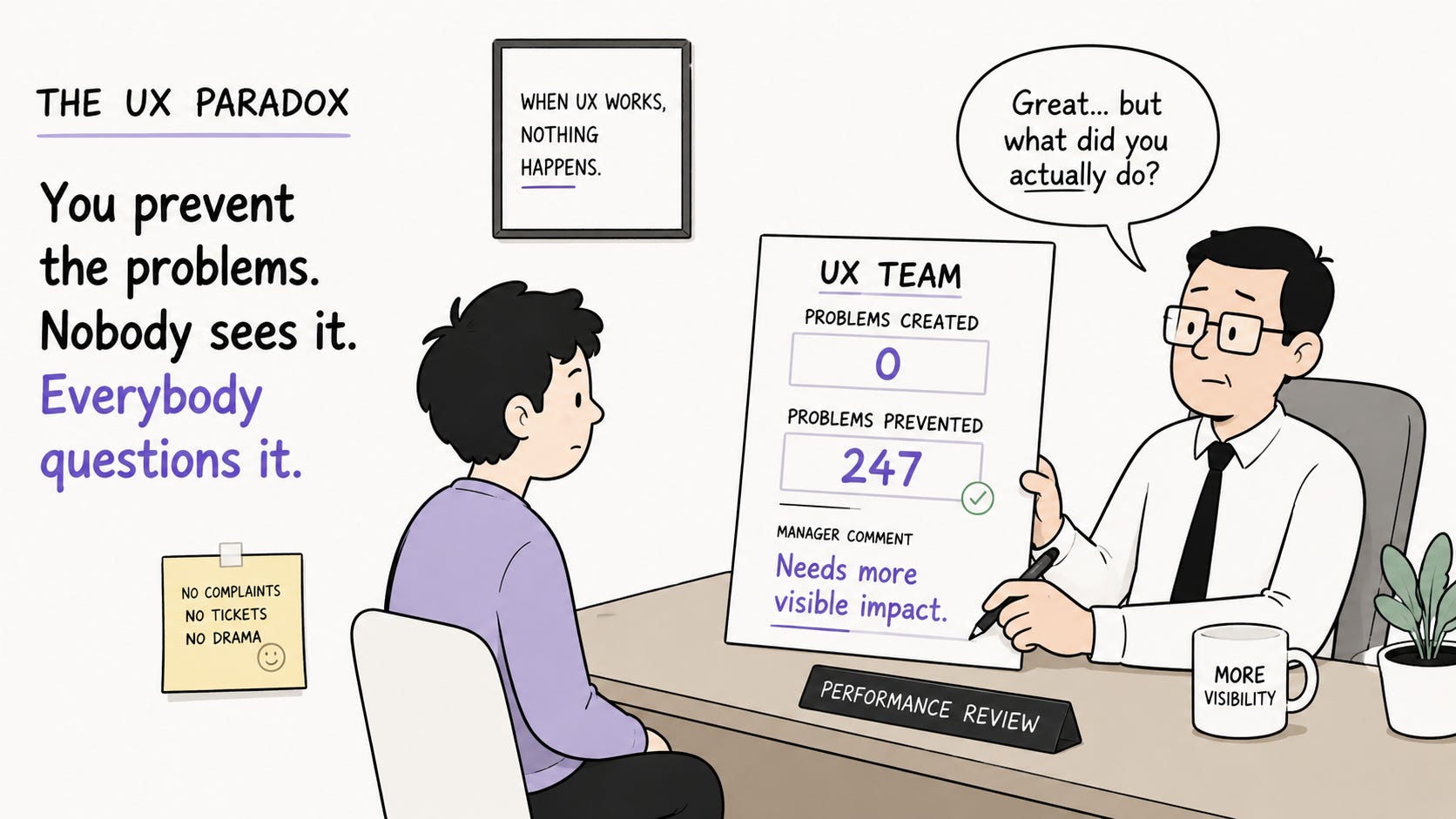
When leadership discusses who gets promoted, the question is what has this person visibly done. The engineer shipped twelve features. The marketer grew the channel. The UX practitioner... prevented hundreds of problems nobody ever saw? Avoided redesigns that never had to happen? Prevention does not present well. Absence has no slide deck.
🔴 Budget decisions follow visible value
Teams whose value is visible get resourced. Teams whose value is invisible get questioned. When cuts come, the function whose impact is hardest to point to is the most exposed. This is part of why UX teams were hit so hard in the layoff waves. The work was good. The evidence was silent.
🔴 It quietly erodes your own confidence
This is the personal cost that compounds. You can know intellectually that your work matters while emotionally absorbing years of nobody noticing it. The absence of feedback starts to feel like an absence of value. Practitioners who have done excellent work for years sometimes struggle to articulate their own impact, not because it was not there, but because nobody ever reflected it back to them.
If you have ever felt like you are doing more than what your role seems to define, you probably are. And that invisible layer of work is not extra. It is the craft. UXPin
The Invisible Work Behind The Invisible Work
The interface that nobody notices is only the surface layer of what goes unseen. Underneath it sits an entire body of work that is invisible even to the people on your own team.
The stakeholder conversation that prevented a bad idea from reaching the roadmap. The research finding that quietly killed a feature that would have failed. The twenty versions that were explored and rejected before the one that shipped. The accessibility decisions that meant the product worked for everyone and therefore generated no complaints from anyone. The questions asked in a kickoff that reframed the entire problem.
If you take requirements at face value, you can still design something. But if you spend time unpacking them, asking why something is needed, how it will be used, what success looks like, the problem often changes. And with it, the solution. UXPin
That unpacking is invisible. The disasters you prevented are unprovable. Nobody can see the version of the product that would have existed without you. And yet that difference, between what shipped and what would have shipped, is arguably the truest measure of what a UX practitioner contributes.
How To Make Your Impact Visible Without Ruining The Work
The answer is not to make the design louder. The design should stay invisible. The answer is to make the work around the design visible. There is a difference.
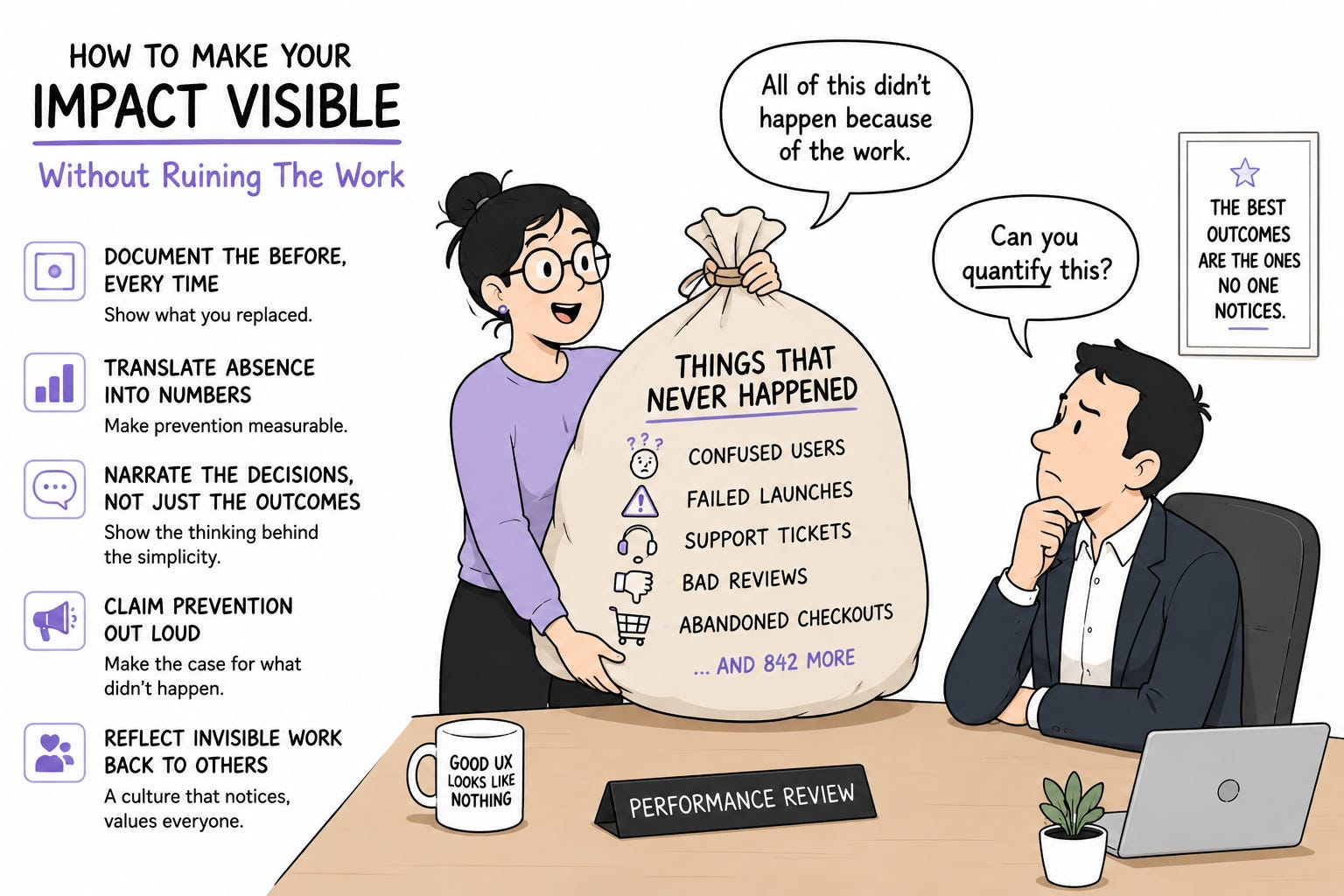
✓ Document the before, every time
The single most powerful habit. Screenshot the old flow. Record the confused usability session. Save the support ticket volume. Capture the baseline metric. Invisible work becomes visible the moment you can show what it replaced. Without the before, your after looks like nothing happened. With it, the same after tells the whole story.
✓ Translate absence into numbers
Support tickets that dropped. Error rates that fell. Task completion time that shortened. Drop-off that decreased. These are absences made measurable. They are the closest thing prevention has to a slide deck. Track them even when nobody asks, because by the time someone asks it is too late to establish the baseline.
✓ Narrate the decisions, not just the outcomes
Share the rejected versions. Explain what the research ruled out. Walk stakeholders through why the simple-looking solution took three weeks. Often the most powerful design choices are the ones nobody sees happening, until the results become impossible to ignore. People cannot value reasoning they never saw. Showing the thinking is not self-promotion. It is making the craft legible. Index.dev
✓ Claim prevention out loud
“This redesign means we will not need the support documentation we were planning.” “This finding saved us from building a feature users would not have adopted.” Prevention claims feel awkward because they point at things that did not happen. Make them anyway. Nobody else is keeping that ledger for you.
✓ Reflect your colleagues’ invisible work back to them
The fastest way to change a culture that ignores invisible work is to start noticing it in others. When a researcher’s finding quietly reshapes a decision, say so in the meeting. When a designer’s flow ships and nothing breaks, point out that nothing breaking was the achievement. A team that names invisible work creates the conditions where everyone’s invisible work counts.
📦 Resource Corner
The Design of Everyday Things by Don Norman
The book on why good design disappears and bad design screams. If you have never read it, this is the foundational text on everything in this issue. If you read it years ago, it reads differently once you have lived the paradox.
Articulating Design Decisions by Tom Greever
The most practical guide to making your reasoning visible to stakeholders who only see the surface. Directly addresses the gap between doing good work and getting credit for it.
Measuring the User Experience by Tullis and Albert
How to turn absences into numbers. Essential for building the evidence base that makes invisible impact legible to people who make budget and promotion decisions.
Do the Most Good by Mina Markham
A talk worth rewatching about once a year on doing meaningful work whether or not anyone is watching. Genuinely restorative when the invisibility is wearing on you. Index.dev
The Invisible Work of Design
A short, honest read on the paradox itself. Worth bookmarking for the days when the silence gets loud.
💭 Final Thought
If you are a practitioner and you often feel like your best work keeps vanishing into the background, take heart. That is often the clearest sign you are doing it brilliantly. Nielsen Norman Group
The user who never noticed your navigation found what they needed. The customer who never contacted support completed their task. The person who never thought about your form filled it out and moved on with their life. Thousands of small moments where nothing went wrong, because you made sure nothing would.
That is the job. It has always been the job. You pushed. It opened. That is the whole story. UX Tigers
But do not confuse the work being invisible with you being invisible. The design should disappear. Your contribution should not. Keep the before screenshots. Track the absences. Narrate the decisions. Claim the prevention. Make the craft legible even as the craft itself stays silent.
Because the silence was never emptiness. It was thousands of doors, opening exactly when someone expected them to.
You built those.


