


The hardest part of design often has very little to do with design itself.
There is a neat version of product design that many of us are taught.
You receive a problem → understand the user → explore ideas → prototype → test → refine → and hand the solution over.
Then there is what actually happens on product teams.
The PM has already committed to a launch date.
Engineering tells you the interaction you designed will add another sprint.
Leadership wants something that feels “more innovative.”
Research is pointing in one direction while the business is pushing in another.
Someone brings up a competitor halfway through the review.
A stakeholder who was barely involved suddenly has strong opinions about the final design.
Sometimes, after weeks of work, the entire direction changes because of a conversation you weren’t in.
This is the part of design we don’t talk about nearly enough.
For many designers, the hardest part of the job isn’t Figma, prototyping, usability testing, or choosing the right interaction pattern. It’s navigating the people, priorities, constraints, and decisions surrounding the work.
Figma’s research into modern product teams found that 55% of product builders surveyed are already taking on work outside their traditional roles, as the boundaries between design, product, and engineering continue to blur. (Figma)
That shift matters because the designer who thrives on a product team today isn’t necessarily the person who can produce the most polished screens. It’s the person who can operate well inside the system around those screens.
So what should designers get better at?
1. A lot of design problems are actually alignment problems:
Get aligned before you start designing
One of the most common challenges on product teams is that everyone thinks they’re solving the same problem when they aren’t.
Example: A feature might be described as having a “conversion problem.”
To Product, that could mean more users need to complete onboarding. Marketing may see it as a messaging issue. Customer Support might be reacting to repeated complaints. Engineering may be concerned about performance. Design may believe the root issue is usability.
Everyone can leave the same meeting believing they are aligned while quietly working toward different outcomes.
Atlassian’s 2025 State of Teams research found that knowledge workers and executives spend roughly 25% of their time searching for information and answers. (Atlassian)
When context is fragmented, alignment becomes harder. Sometimes the most valuable design work happens before a single frame is created. Make sure everyone is solving the same problem.
2. Then there is the problem of getting into the conversation early enough
Get into the room earlier
Many designers know the experience of being brought into a project after the important decisions have already been made.
The feature has been prioritized. The requirements are written. The deadline has been communicated. The technical approach has been discussed.
Then UX gets the request: “Can you design this?”
At that stage, there may be very little actual design left to do. You are mostly shaping a solution that already exists.
Push for earlier collaboration.
Bring engineers into exploration. Involve research before the roadmap is fixed. Ask to join conversations where product decisions are being shaped, not just reviewed.
Figma found that 80% of developers believe businesses would benefit from designers and developers working more closely together, and 55% of front-end developers want to be involved earlier in the design process.
This is a big part of the conversation we’re creating space for at UXCON26.
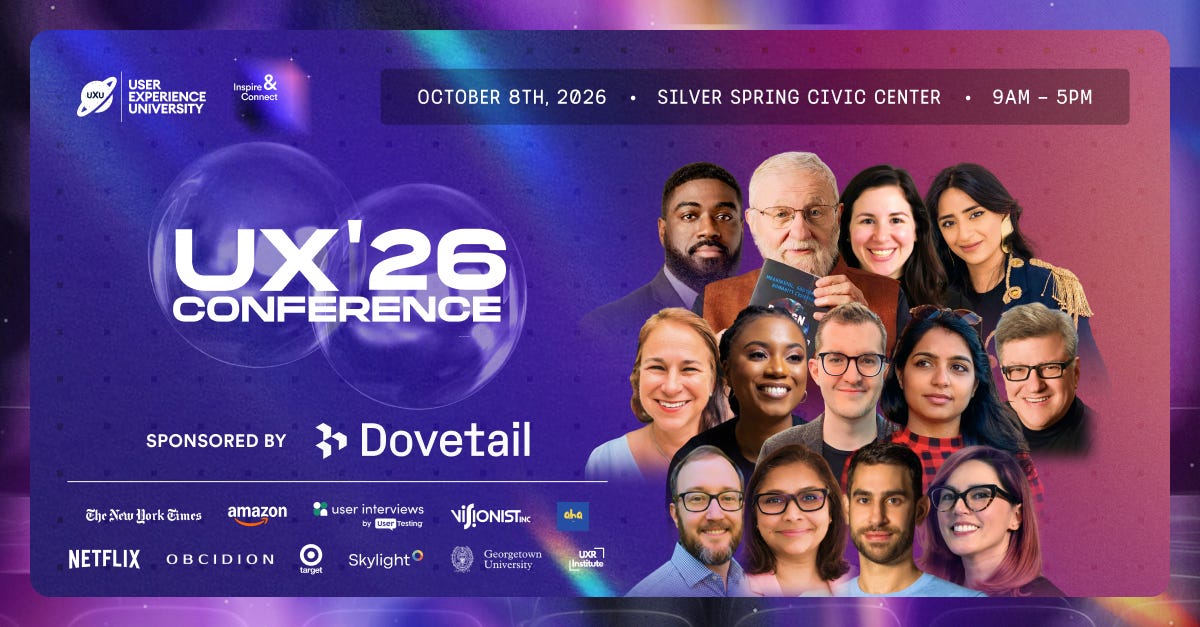
This year’s conference isn’t only about becoming better at the craft of UX. It’s about becoming better at doing UX inside real organizations, alongside the people who influence whether our work succeeds.
One of the things we’ll be talking about is the realities of working in our industry:
Collaboration, Careers, AI, Research, Leadership, Influence,
and what it takes to create better products when no one discipline controls the entire outcome.
3. The work also requires a lot more influence than authority
Stop presenting screens. Present decisions
One of the biggest career shifts in design happens when you realize that producing a good solution doesn’t automatically mean the organization will choose it.
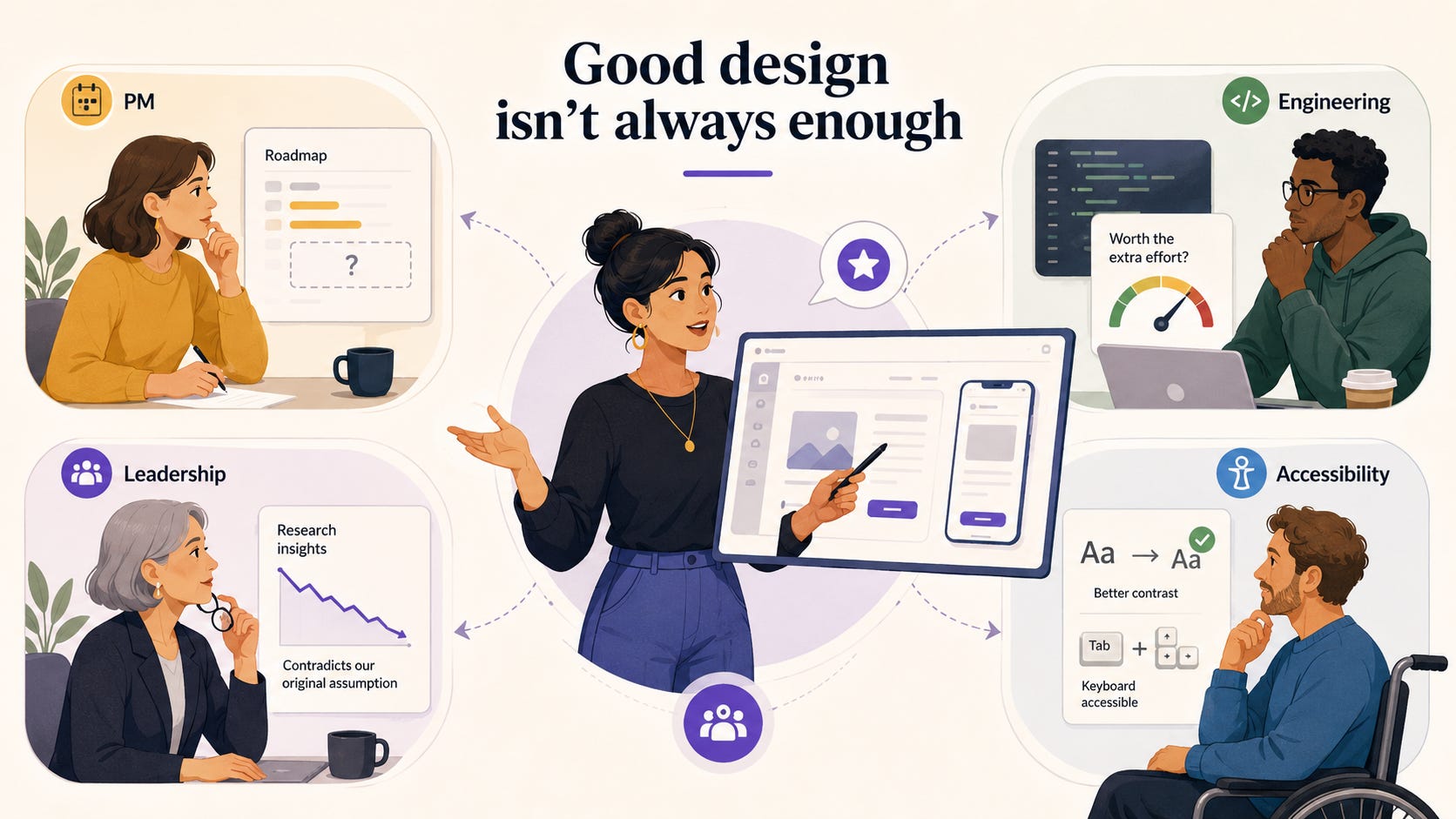
You may need to convince a PM to reconsider scope, persuade engineering that an interaction is worth the additional effort, help leadership understand why research contradicts their original assumption, or explain why a seemingly small accessibility decision matters.
And most of the time, none of those people report to you, and that means as a designer you have to develop influence.
This is where design rationale becomes much more important than simply presenting a polished screen. If the conversation is reduced to “I like this” versus “I don’t like this,” the person with the most organizational authority will usually win.
The ability to explain why something should be designed a certain way can become just as important as knowing how to design it.
4. The answer isn’t to become the UX police
Learn to make trade-offs
There is a stage many designers go through where everything starts looking like a UX violation.
You learn the principles. You understand accessibility. You study usability heuristics. You become more familiar with research. Then someone proposes something questionable and your instinct is to protect the user at all costs.
Sometimes that pushback is absolutely necessary.
But constantly positioning UX against Product, Engineering, Marketing, or the business usually makes design less influential rather than more influential.
Real product development is an exercise in trade-offs.
There are constraints like deadlines, legacy systems, budgets, technical limitations, compliance requirements etc that you should be aware of. These constraints don’t disappear because a solution is more user-centered.
The more useful question becomes:
Given the constraints we have, what parts of the experience are most important to protect?
That shift changes your relationship with the team and that is often where seniority starts to show.
5. AI is making this even more obvious
Get better at judgement, not just craft
As design tools become faster and more capable, execution itself is becoming less of a differentiator.
If everyone can generate concepts faster, create prototypes faster, synthesize research faster, and explore more directions in less time, then the value of the designer begins to shift.
Judgment becomes more important.
Knowing:
Which problem deserves attention.
Whether the team’s assumptions are sound.
When something is ready to test.
Which research matters.
When the team is moving quickly toward the wrong solution.
AI can accelerate output but it cannot remove the need for someone to decide whether that output makes sense in the context of users, the product, the business, and the team building it.
Resource Corner
Figma — State of the Designer 2026
Nielsen Norman Group — UX Stakeholder Engagement 101
Nielsen Norman Group — UX Maturity Model and Four Factors in UX Maturity
A parting shot….
Becoming a stronger designer isn’t only about improving what happens inside the design file.
It’s also about getting better at everything that happens outside of it.


