


Why do some UX leaders seem to get a “yes” in rooms where others struggle just to be heard?
It’s tempting to assume the difference is stronger research, a more polished prototype, or a better presentation.
Often, it isn’t.
The difference is that they understand who actually influences the decision, what those people care about, and where support or resistance is likely to come from before the meeting even begins.
No matter how human-centered your process is, your work still has to survive the organization around it.
And that requires a different kind of UX skill.
The work before the UX work
UX professionals spend a lot of time learning how to understand users.
We map journeys. We conduct interviews. We identify pain points. We test prototypes. We advocate for the people using the product.
But as you move into leadership, there is another system you have to learn to understand:
Your organization.
Nielsen Norman Group has written about the power dynamics UX teams face, noting that decisions about what gets built and funded are often controlled by product, engineering, or other leaders rather than UX itself.
That means a brilliant solution can still die because:
Finance thinks it is too expensive.
Engineering sees six months of additional complexity.
Product is under pressure to ship this quarter.
Marketing has already promised something different.
An executive simply isn’t convinced this problem deserves attention.
None of these people necessarily disagree with UX.
They are looking at the same decision through different incentives, risks, and responsibilities.
That is why UX leadership increasingly requires more than technical mastery.
It requires relationship mapping.
The Strategic Relationship Map
Stakeholder mapping itself isn’t new. A common approach plots stakeholders according to their power and interest. Nielsen Norman Group recommends going further by also considering a stakeholder’s attitude toward UX, because a highly influential UX skeptic demands a very different strategy from an enthusiastic supporter.
For UX leaders, we can simplify that into a useful diagnostic:
Plot people across two dimensions:
How much influence do they have?
and
How supportive are they of UX?
You end up with four broad groups:
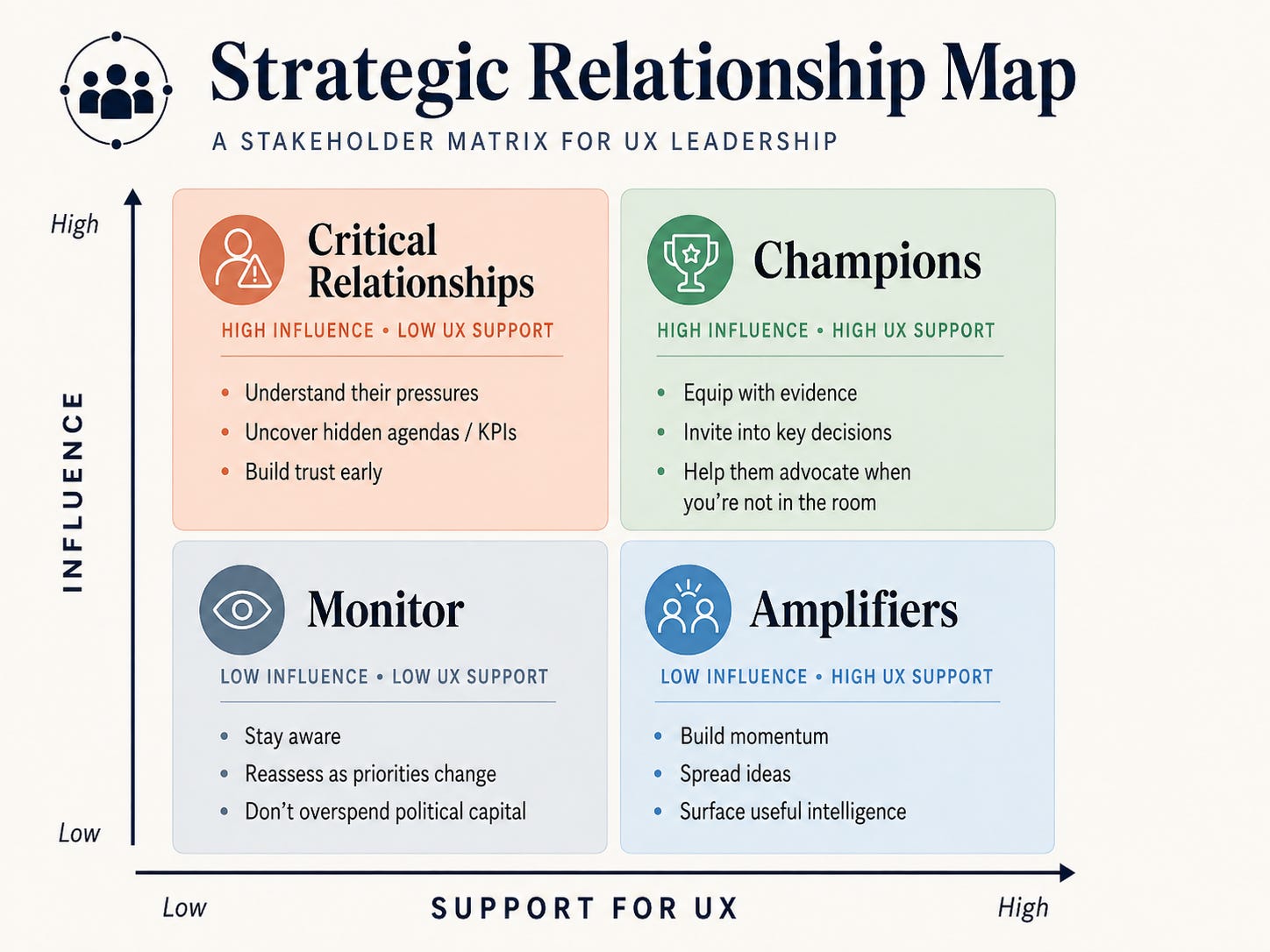
High influence + High UX support
Your Champions
These are the people who already believe in the work and have enough organizational influence to help move it forward.
Don’t simply keep them informed.
Give them evidence they can carry into rooms where you aren’t present.
High influence + Low UX support
Your Critical Relationships
This may be the most important quadrant.
Resist the temptation to label these people “difficult stakeholders.”
Instead, get curious.
What pressure are they under?
What has made them skeptical?
What would they need to see before supporting the work?
Turning one influential skeptic into an informed ally can be more valuable than winning another ten people who already agree with you.
Low influence + High UX support
Your Amplifiers
These people may not control budgets or roadmaps, but they can spread ideas, provide intelligence, build momentum, and strengthen your case.
They are often underestimated.
Low influence + Low UX support
Monitor
You probably don’t need to spend significant political capital here today.
But stakeholder positions change. Teams reorganize. People get promoted. Priorities shift.
Your relationship map should move with them.
Tip: NN/g similarly recommends revisiting stakeholder maps because changes in leadership, priorities, interest, and attitudes can materially change the landscape surrounding UX work.
Then ask the question we often forget:
What keeps this person up at night?
This is where the map becomes powerful.
When we say someone has a “hidden agenda,” it doesn’t necessarily mean something sinister.
Usually, it means there are priorities influencing their decision that haven’t been said out loud.
Your VP of Product may be thinking about adoption.
Your Engineering Director may be worried about technical debt.
Your CFO may be watching cost.
Your Growth Lead may have a conversion target.
Your executive sponsor may have promised the board a launch before the end of the quarter.
If you walk into the room talking only about “what users told us,” you may be solving only one part of the decision.
The better questions are:
What is this stakeholder accountable for?
Which KPI determines whether they had a good quarter?
What risk are they trying to avoid?
What would make supporting this work easier for them?
Then connect the user problem to that reality.
Not by watering down the research but by translating it.
That is influence.
Harvard Business Review has similarly argued that organizational politics cannot simply be ignored; relationships create a form of currency inside organizations. Effective stakeholder engagement depends on ongoing dialogue, action, and compromise—not simply presenting UX findings and expecting agreement.
And……..
Creating relationships is one of the reasons we’re excited about UXCON26.
This year’s conversation goes beyond what any one UX discipline can accomplish on its own. Researchers, designers, product teams, engineers, strategists, and leaders increasingly have to figure out how to build together.
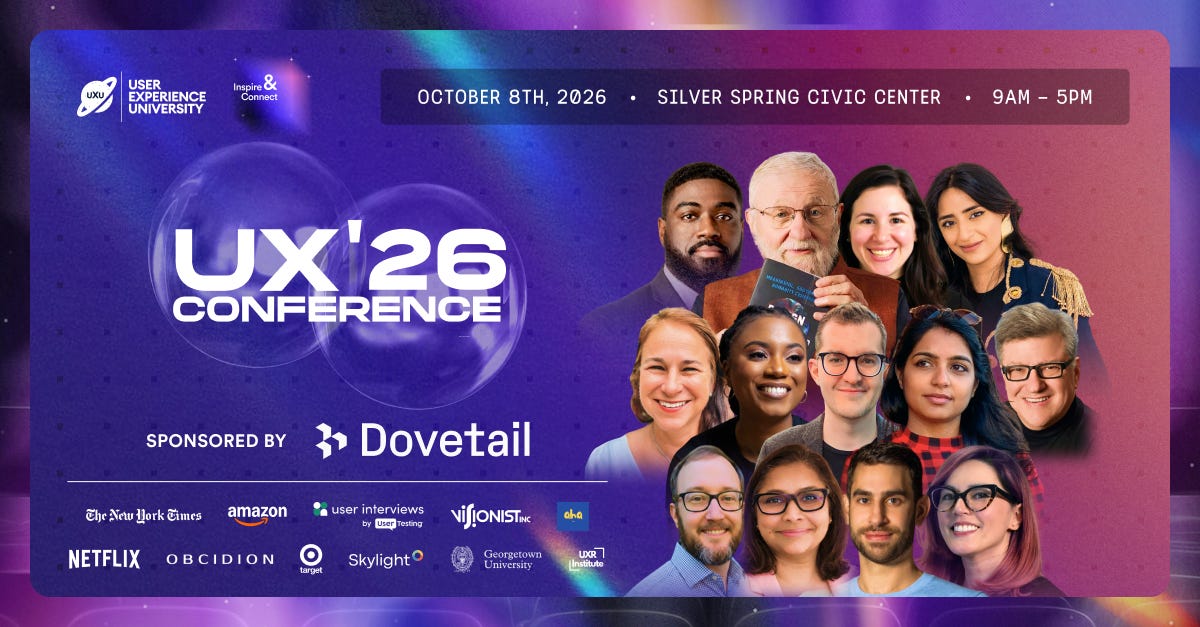
As we put it at UXCON26:
UX has never been a solo act. It’s a team sport.
Your next breakthrough might come from:
Understanding Product differently.
Finally getting Engineering involved earlier.
Having a conversation with a leader whose priorities you hadn’t understood.
Simply meeting someone who has figured out how to navigate the same organizational challenge you’re facing.
Come for the ideas | Come for the conversations |Come meet the people shaping what UX becomes next.
Use the map before the project starts
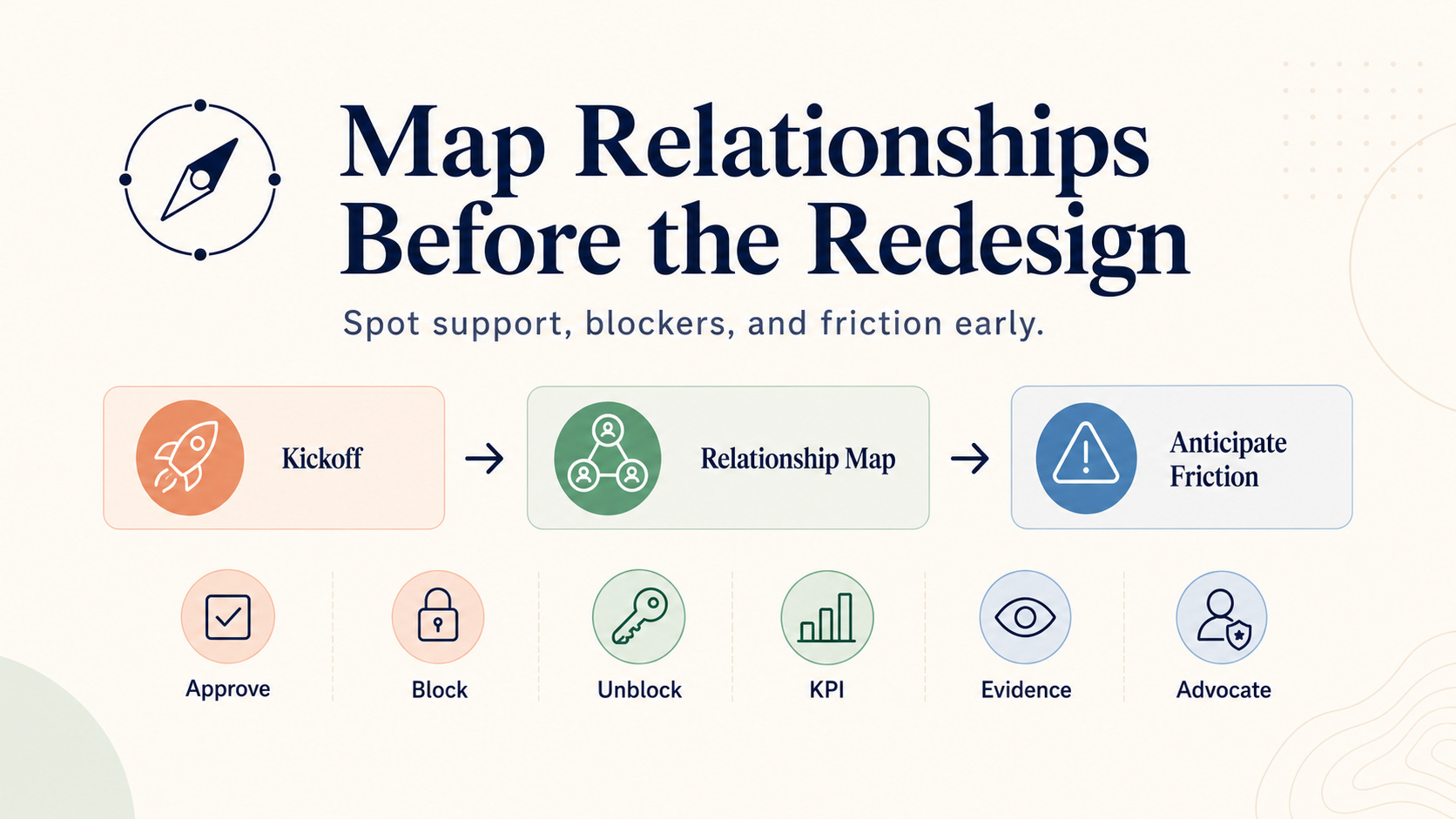
Imagine kicking off a major redesign.
Before opening Figma, building a research plan, or scheduling your first usability test, create your relationship map.
Ask:
Who can approve this?
Who can quietly kill it?
Who can unblock it when things get difficult?
Whose KPI might this project threaten?
Who needs to see evidence early rather than at the final presentation?
Who will advocate for the user when UX isn’t in the room?
Suddenly, stakeholder management stops being something you scramble to do when there is resistance. It becomes part of your strategy from day 1, and perhaps most importantly, you can begin predicting where friction will emerge before the project reaches that point.
The Final Note.
UX professionals already know how to understand people whose perspectives differ from their own. We do it with users every day.
Relationship mapping simply asks us to bring some of that same curiosity to the people inside our organizations.
That change in posture is small but the effect on your influence can be enormous.
Resource Corner
Nielsen Norman Group, Stakeholder Analysis for UX Projects
Nielsen Norman Group, UXers Need to Think Like Product Leaders
Nielsen Norman Group, UX Stakeholder Engagement 101
Harvard Business Review, You Can’t Sit Out Office Politics


