



Mastering stakeholder relationships has less to do with perfect insights and more to do with decoding how your audience receives information. Every stakeholder processes research differently. Some want precision. Some want impact. Some want connection. Some want action… yesterday.
This edition breaks down the communication archetypes you’ll meet in the wild — and gives you practical strategies to tailor your delivery so your insights land every single time.
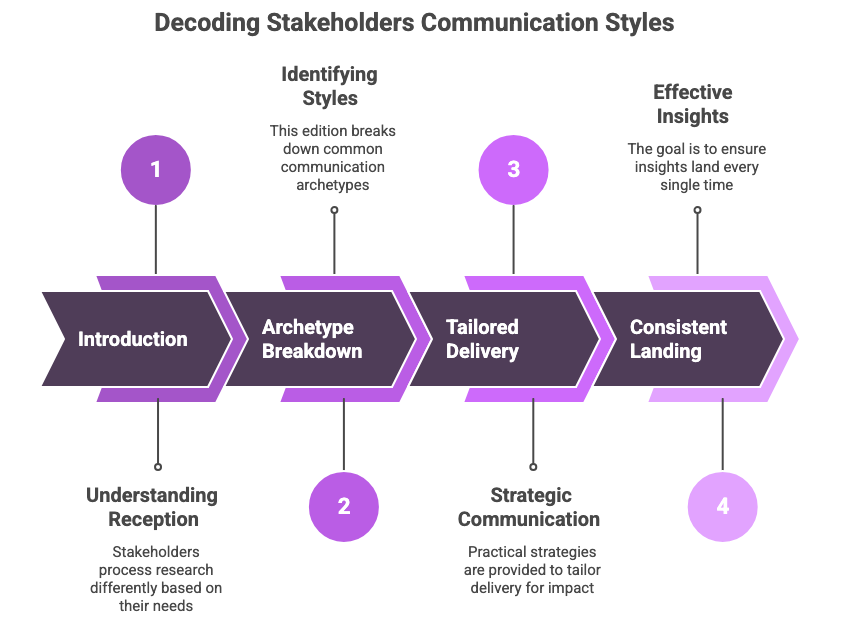
In This Issue we’ll cover:
• Why Your Insights Get Lost
• The Four Stakeholder Communication Styles
• How to Identify Stakeholder Styles
• Tailoring Your Message for Maximum Impact
• Your Next Steps to Influence
Why Your Insights Get Lost
Your research is brilliant, but your recommendations get ignored. Why?
This is one of the most common frustrations among UX researchers. You dig deep, uncover high-value insights, craft a solid report… and then stakeholders skim it, misunderstand it, or worse, shelve it.
Here’s what’s really going on:
1. It’s rarely about the insight quality. It’s about the translation.
You’re speaking in “research,” but they’re listening in their own communication dialect.
2. Influence lives in the how, not the what.
The best insights in the world fall flat when delivered in a style that doesn’t match how your stakeholder processes information.
3. Misalignment slowly erodes trust.
When stakeholders feel overwhelmed, confused, or under-informed, they disengage — even if they don’t say it out loud. Over time, this creates friction, missed opportunities, and weaker collaboration.
The solution? Tailored communication.
Unmasking the Four Communication Archetypes
Every stakeholder is a mix of styles, but one usually dominates. Once you recognize it, you unlock influence faster than any presentation trick.
The Analyst
They value: logic, precision, granular data, evidence
They fear: subjectivity, ambiguity, rushed decisions
They say things like:
“Can you show the breakdown by cohort?”
“What was the sample size?”
How to speak Analyst:
Lead with the methodology and numbers before the story.
Provide tables, segmentation, dashboards, and raw data access.
Be ready with backup slides, they will ask.
Avoid emotional framing; use neutral, factual language.
The Visionary
They value: big ideas, long-term strategy, innovation
They fear: stagnation, tactical thinking, failure to scale
They say things like:
“What does this mean for the future?”
“How does this shape our roadmap?”
How to speak Visionary:
Lead with insights tied to impact and opportunity.
Use bold, forward-looking language.
Show how research informs direction, not just decisions.
Summaries should be short, crisp, and strategic.
The Connector
They value: collaboration, relationships, user stories, emotional resonance
They fear: siloed work, lack of empathy, conflict
They say things like:
“What did people say in the interviews?”
“Let’s walk through a user’s journey.”
How to speak Connector:
Use storytelling, quotes, themes, and personas.
Highlight human impact over metrics.
Bring people together,,, they love co-creation moments.
Anchor insights in shared values and cross-team alignment.
The Executor
They value: clarity, speed, action steps, outcomes
They fear: overthinking, long reports, blockers
They say things like:
“What do we need to do right now?”
“What are the top three fixes?”
How to speak Executor:
Put the TL;DR at the top, bold.
Provide checklists, priorities, and timelines.
Keep meetings short; send materials ahead if possible.
Avoid deep theoretical explanations unless asked.
Last year at UXCON25, Jeremy Miller shared a simple truth:
Stakeholders are people.
And they all communicate differently.
Some want data.
Some want charts.
Some want bullet points.
Some want a quick summary.
Some want the full story.
And if you don’t understand how they think, your work won’t land. No matter how good it is.
Because truth is, great UX isn’t just about users. It’s about understanding decision-makers too.
This is the kind of thinking we’re building on at UXCON26.
If you want your work to move forward,
you need to know how to move people first.
UXCON26 is where those conversations continue. 💛
Your Archetype Decoder Ring: How to Identify Stakeholder Styles
You don’t need a personality test - just a keen eye and intentional questioning.
Observation Power-Ups
Watch for:
Verbal cues: Do they ask for data? Stories? Vision? Next steps?
Meeting behavior: Do they take notes? Brainstorm aloud? Drive the agenda?
Preferred format: Do they skim slides or dive into documentation?
Question Mastery
Use targeted questions to identify what matters most:
“What format helps you review findings quickly?”
“How do you prefer updates - high level or detailed?”
“What business goals should I anchor this research to?”
Their answers reveal their archetype instantly.
Feedback Loops
Don’t wait to guess - ask.
“Was this format helpful?”
“Is there anything I should adjust next time for clarity?”
Small feedback creates massive long-term influence.
Tailoring Your Message for Maximum Impact
Now that you know their style, shape your delivery so that it speaks directly to them.
1. Storycraft for Each Archetype
Analyst: charts → analysis → conclusion
Visionary: conclusion → future vision → strategic logic
Connector: narrative → quotes → implications
Executor: recommendations → priorities → quick wins
2. Visual Communication Magic
Adapt your visuals:
Analysts → structured dashboards, tables
Visionaries → conceptual diagrams, future-state models
Connectors → user journeys, emotion maps
Executors → simple action lists, “before/after” visuals
3. Follow-Up That Sticks
Tailor how you reinforce your message:
Analysts → send documentation + optional deep dives
Visionaries → send a one-pager of strategic possibilities
Connectors → schedule collaborative workshops
Executors → send next steps and deadlines
This is how insights stay alive beyond the meeting.
Your Next Steps to Influence
This isn’t a one-time trick, it’s a framework for long-term relational excellence.
1. Be Proactive, Not Reactive
Before each engagement, map your stakeholders and their archetypes. Anticipate their needs before they ask.
2. Refine Continuously
After every session, reflect:
What landed well?
Where did energy drop?
What could be tailored better next time?
Communication style mastery compounds over time.
3. Turn Stakeholders into Champions
When people feel understood, they trust you. When they trust you, they support you. When they support you… they advocate for your work even in rooms you’re not in.
That’s how you build influence that outlives any individual project.
Final Word
Great researchers uncover truth.
Extraordinary researchers communicate truth in a way that transforms teams, decisions, and products.
Decode the archetype. Tailor the message. Build the bond.
Your influence will become unbreakable.


