



There’s a strange tension in UX right now. We have more powerful tools than ever, yet many UX professionals are asking increasingly fundamental questions about the future of the profession.
AI can generate interfaces in seconds, summarize interviews, analyze feedback, write research plans, produce prototypes, generate code, and turn an idea into something clickable before the rest of the team has finished discussing the problem.
So naturally, people are asking:
What is my role now?
What skills actually matter in 2026?
Will AI replace UX designers and researchers?
If everyone can generate a polished interface, what actually makes a designer valuable?
These aren’t hypothetical questions anymore. They are becoming part of everyday conversations within product and design teams.
Truth is, the future of UX may have less to do with how quickly we can make things and much more to do with how well we decide what should be made in the first place.
This is what we’ll be discussing at UXCON26
This year, we’re taking the conversation beyond “what’s new in UX?”
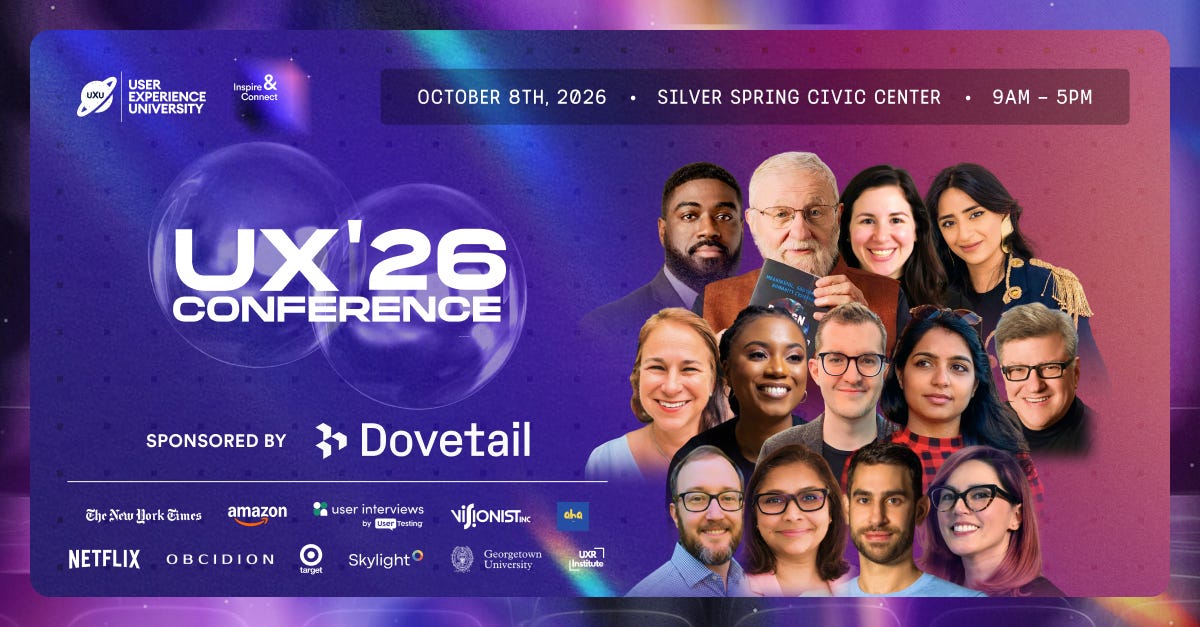
UX doesn’t happen in isolation anymore. Researchers work with designers. Designers work with engineers. Product managers influence research. Executives influence product decisions. AI is changing everyone’s workflow.
The future of UX won’t be built by one discipline working alone. It will be built by people who can think across disciplines, challenge assumptions, understand people and work together.
The goal isn’t for you to leave with another folder full of slides. It’s for you to leave with a new idea, a new perspective, a new connection or perhaps even a new direction for your career.
The AI problem isn’t that AI can design
It’s that AI can make us skip the thinking.
One of the most interesting conversations happening in design right now isn’t whether AI can produce attractive interfaces. It obviously can. The more important question is whether we can still recognize when we’re solving the wrong problem.
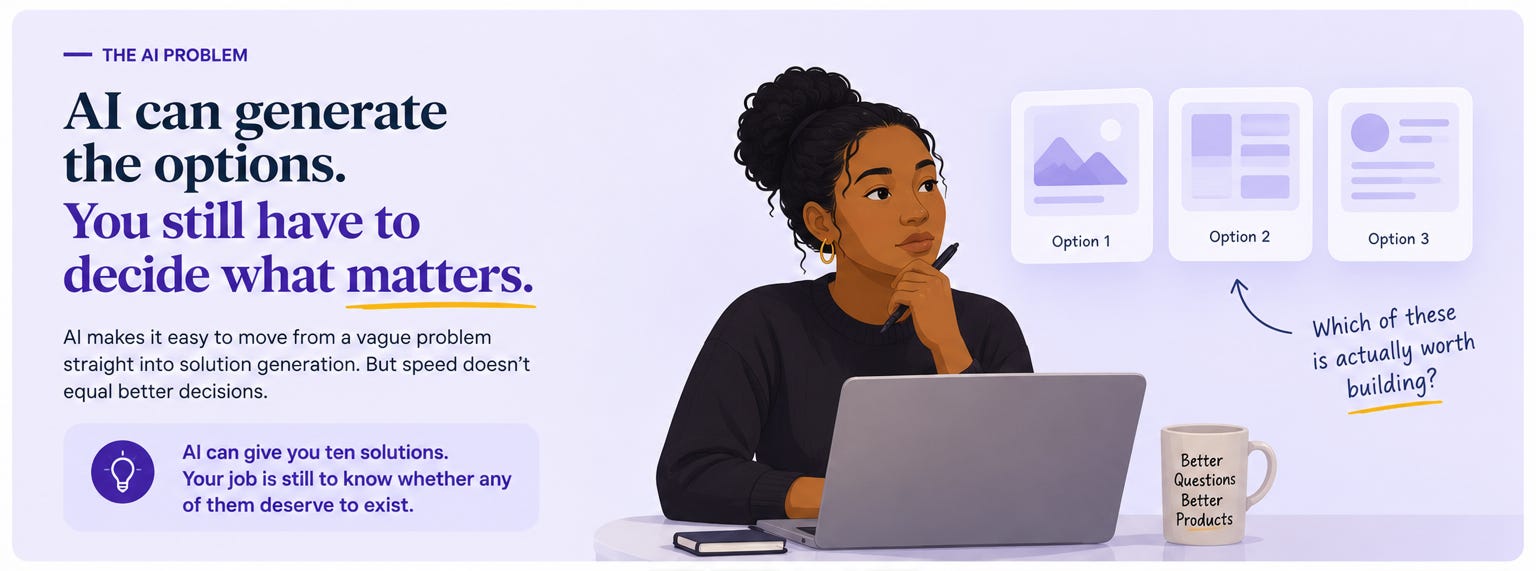
A growing concern within the design community is that AI makes it incredibly easy to move from a vague problem straight into solution generation. Instead of spending time understanding the user, defining the problem and exploring the underlying context, teams can now ask an AI tool to produce 5 interface concepts before the original question has even been properly framed.
Traditionally, UX encouraged us to move through a process of understanding, defining, exploring, testing, learning and iterating. AI makes it incredibly easy to skip several of those steps and go straight to “generate.”
The second process is faster. But faster doesn’t necessarily mean better.
This is why some of the most valuable UX skills in the AI era may actually be the ones that feel least productive on paper: asking better questions, challenging assumptions, recognizing ambiguity, understanding context, interpreting human behavior, making trade-offs and knowing what not to build.
AI can give you ten solutions. Your job is still to know whether any of them deserve to exist.
The interface is changing too
For decades, UX has largely meant designing interfaces for humans. We designed screens, buttons, menus, forms, navigation systems and search experiences intended to help people accomplish something.
We’re now moving into a world where another kind of “user” is beginning to interact with those same systems: AI agents.
Nielsen Norman Group recently highlighted this emerging shift, noting that AI agents can increasingly navigate websites, fill out forms, compare options and execute transactions on behalf of people.
Consider a simple request: “Find me the best flight to New York next Friday, under $800, with one checked bag.”
Traditionally, you would open a website, search for flights, apply filters, compare results and make the decision yourself. As of now, AI agents are performing many of these actions on people’s behalf.
The implication for UX is fascinating. What happens when the person ultimately benefiting from an interface isn’t the person directly interacting with it?
That changes how we think about accessibility, content structure, navigation, forms, permissions, feedback, error handling, authentication and trust. We’re beginning to design systems that need to communicate effectively with both humans and machines.
The idea of a “user” is becoming more complicated, and UX has a significant role to play in figuring out what that means.
The prompt isn’t the interface
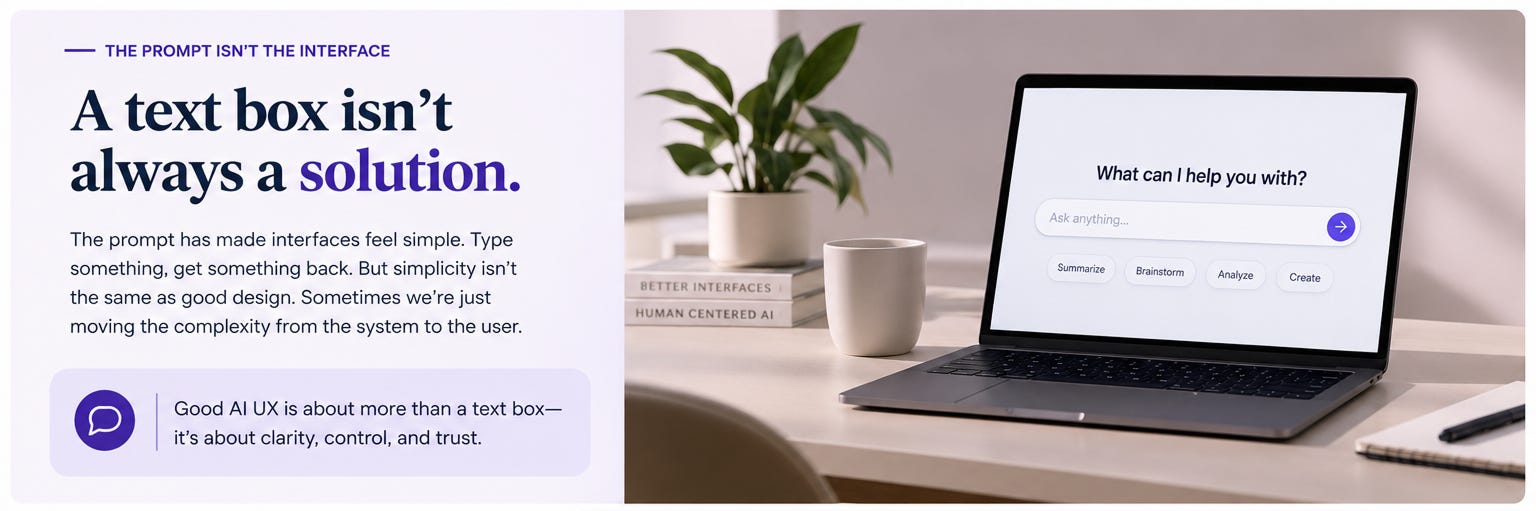
There’s another interesting development happening at the same time. AI products have popularized the idea that the interface can simply be a text box: type something, get something back.
Designers are beginning to question whether this actually represents good interaction design.
UX Collective recently explored the argument that the prompt itself isn’t necessarily an interface. We’ve spent decades moving away from command-line interactions toward interfaces that help people understand what they can do. Now we’re giving people an empty box and effectively saying, “Tell the machine what you want.”
That isn’t always simplicity. Sometimes it’s simply transferring the complexity from the system to the user.
Good AI UX therefore isn’t just about building a chatbot. It’s about deciding how much control the user should have, when a system should take initiative, how people understand what the AI is doing, and how they correct it when it gets something wrong.
Recent research into proactive AI agents is already exploring ideas such as calibrated initiative, transparency, contestability, privacy and evaluation beyond simple task accuracy.
In other words, we’re not just designing interfaces anymore. We’re increasingly designing relationships between people and systems that can act.
So, are UX designers becoming less important?
Probably not. But the kind of value they provide is changing.
When production becomes cheaper, judgment becomes more valuable.
If AI can generate 50 interface concepts, generating interface concepts is no longer much of a competitive advantage. If AI can summarize 200 interviews, producing a summary isn’t necessarily the differentiator. If AI can write code, being able to write a small amount of code isn’t automatically what makes you valuable.
The differentiator becomes your ability to determine which output is actually useful.
Can you spot the missing context?
Can you identify the dangerous assumption?
Can you recognize the insight hidden inside contradictory research?
Can you explain why the obvious solution isn’t the right one?
And perhaps most importantly: Can you influence what the organization does with what you’ve learned?
Figma’s 2026 AI research offers an interesting signal here. Its research found increasing collaboration between traditionally separate roles, with developers participating in design and designers participating in development at significantly higher rates than previously reported.
AI isn’t simply automating design. It is also changing who gets involved in the design process.
The designer increasingly needs to understand technology. The researcher needs to understand product strategy. The product manager needs to understand user behavior. The developer is increasingly involved earlier in the product experience.
The UX professional of the future may therefore be less of a specialist working inside a neatly defined box and more of a connector between customer needs, research, product strategy, design, technology and business.
What should UX professionals actually learn in 2026?
This may be one of the most common questions being asked across the industry: “What should I learn to stay relevant?”
The easiest answer is to produce another list of tools. Learn Figma AI. Learn ChatGPT. Learn Claude. Learn AI prototyping. Learn AI research tools.
And yes, learn them.
But don’t confuse tool fluency with professional growth.
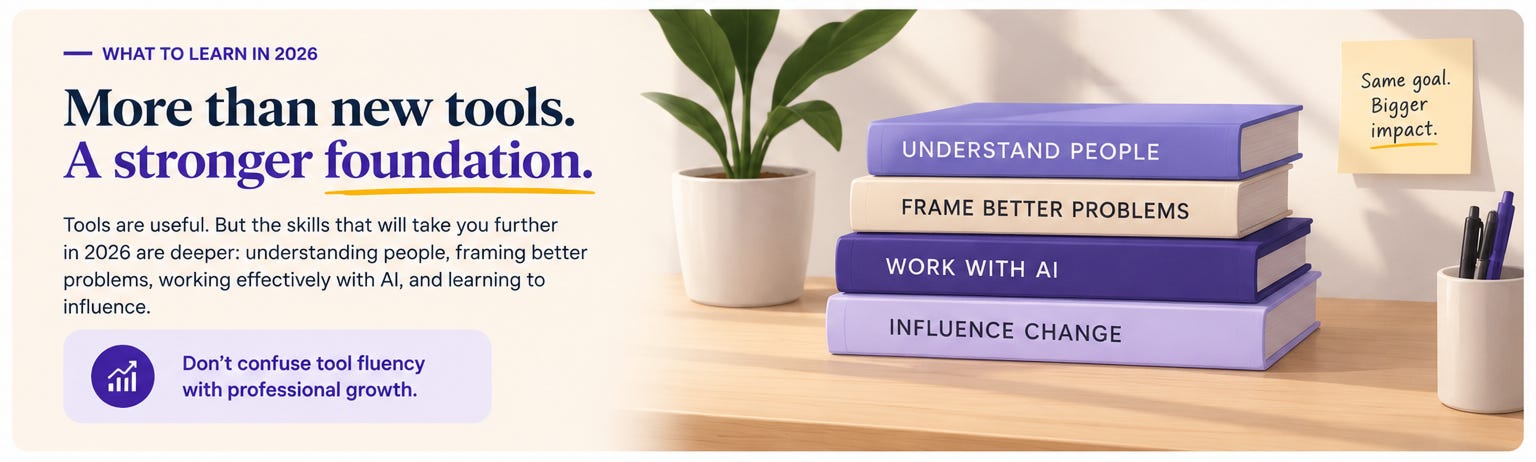
A stronger UX learning strategy for 2026 starts with:
Becoming excellent at understanding people.
Interviewing, observation, contextual inquiry, usability testing, qualitative synthesis and behavioral analysis aren’t becoming less important because AI exists. If anything, the ability to understand people becomes more important as technology becomes more capable.The second skill is problem framing.
Don’t arrive at the meeting with five solutions simply because AI helped you generate them. Arrive with a better understanding of the problem.
The third is learning to work with AI.
AI can be incredibly useful for research preparation, transcription, initial synthesis, competitive analysis, prototyping, documentation, coding and exploration. But human judgment still needs to remain in the loop. While AI can improve efficiency, removing human interpretation can flatten nuanced feedback into overly rigid categories.And finally, learn to influence.
Great research doesn’t automatically change decisions. A beautiful design doesn’t automatically get approved. A brilliant recommendation doesn’t automatically become a roadmap item. UX professionals need to understand stakeholders, communicate clearly, negotiate trade-offs, tell compelling stories and make the case for their recommendations.
The UX career question nobody can answer alone
Technology is making it easier than ever to work alone. AI can brainstorm with you, critique your design, write your research plan, generate your prototype and help you code.
But the more we automate individual production, the more valuable human connection becomes.
Some of the most important things in our profession aren’t learned from another tutorial. They’re learned from conversations:
hearing how another researcher handled a difficult stakeholder,
discovering how another designer navigated a career transition
meeting someone who has been solving the exact problem you’ve been struggling with.
That’s what makes a good conference valuable and…….
Resource Corner
If you’re thinking seriously about where UX is heading, these are worth exploring:
Figma’s 2026 AI Report — research into how designers, developers and product managers are adapting to AI and collaborating across disciplines.
AI Agents as Users — an introduction to designing experiences that increasingly involve both humans and AI agents.
The Prompt Is Not an Interface — a look at why conversational AI shouldn’t automatically mean putting a text box at the center of every experience.
When Design Stops Asking Why — an exploration of what happens when AI makes solution generation easier than problem framing.
The future of UX isn’t something we can predict
But we can participate in shaping it.
AI will continue to change our tools. Interfaces will continue to evolve. Agents will become more capable. Organizations will continue to rethink how product teams work. Some UX roles will change dramatically, while entirely new ones will emerge.
But one thing remains remarkably constant: we’re still designing for people.
The better we understand people, technology, organizations and each other, the better equipped we’ll be to navigate whatever comes next.


