



The Uncomfortable Truth
We’ve all heard it:
“Just pivot.”
“Switch careers.”
“Start fresh.”
The advice sounds bold. Liberating. Strategic.
But here’s the reality most people don’t say out loud:
Not every pivot is strategic.
Sometimes, it’s a signal that something deeper isn’t working.
And if you pivot without clarity, you don’t escape confusion.
You carry it with you.
Why Mid-Career Pivots Feel So Urgent
Many professionals hit a point where they feel:
Stuck
Under-recognized
Behind peers
Disconnected from their work
And the easiest story to tell yourself is:
“Maybe I’m just in the wrong field.”
Sometimes that’s true.
But often, the problem isn’t the field.
It’s the lens you’re using to evaluate it.
When a Pivot Is a Symptom, Not a Strategy
A pivot becomes risky when it’s driven by:
Burnout without reflection
Comparison without context
Trends without self-awareness
Fear disguised as ambition
Changing paths without understanding the root cause leads to pattern repetition.
New title.
Same frustration.
What a Strategic Pivot Actually Looks Like
A real pivot isn’t reactive.
It’s reflective.
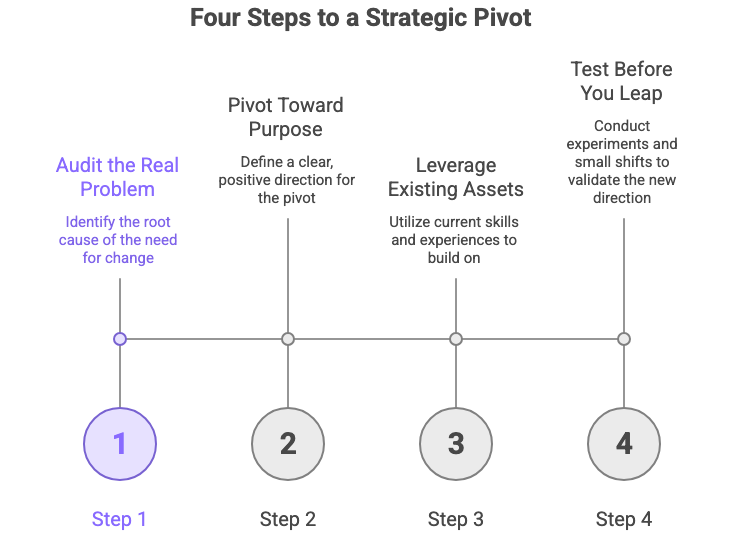
1. You audit the real problem
Ask:
Is it the industry?
The environment?
The role design?
The leadership around me?
Clarity changes everything.
2. You pivot toward something, not away from something
Escaping pain creates weak direction.
Moving toward purpose creates strong momentum.
3. You leverage what you already have
The strongest pivots reuse:
Your thinking patterns
Your problem-solving skills
Your lived experience
A smart pivot compounds identity.
It doesn’t erase it.
4. You test before you leap
Strategic pivots often look like:
Side projects
Internal role shifts
Adjacent skills
Experiments, not exits
Momentum before motion.
UX Gameboard Challenge
Scenario
Tunde has worked in UX for five years.
Lately, he feels stuck and sees people online moving into AI, product strategy, and startups.
He decides, “UX is saturated. I need to pivot out fast.”
Three months later, he still feels uncertain.
Your Challenge
Identify one flawed assumption in Tunde’s thinking.
Suggest one step he could take to pivot more strategically.
💬 Think you know the answer? Drop your thoughts in the comments, your response might be featured in next week’s Gameboard reveal!
Take-Home Exercise (10 minutes)
Before considering any pivot, write down:
One thing you’re running from.
One thing you’re genuinely drawn to.
One skill you want to carry into your next chapter.
This simple reflection separates emotional pivots from intentional ones.
Why This Conversation Matters Now
In fast-changing industries like UX,
career movement is normal.
But clarity is the real advantage.
The people who thrive long-term aren’t the ones who move the fastest.
They’re the ones who move with self-awareness.
UXCON26: Navigating Career Evolution With Clarity
At UXCON26, we’re having more honest conversations about:
Career reinvention
Staying relevant without panic
Growing without losing yourself
Building long-term clarity in a fast-changing field
If you’re thinking about your next chapter,
you’re not alone.
👉 Join us at UXCON26 and navigate what’s next with intention.
See you next Wednesday.
Remember:
A pivot isn’t powerful because it’s bold.
It’s powerful because it’s clear.


