



Open ten UX resumes. Every single one says some version of:
“Team player with strong communication skills”
“Collaborative designer who works well with cross-functional teams”
“Passionate about creating user-centered experiences”
Hiring managers see this hundreds of times per role. It means nothing. Worse than nothing, actually, because it takes up space where you could be saying something that actually differentiates you.
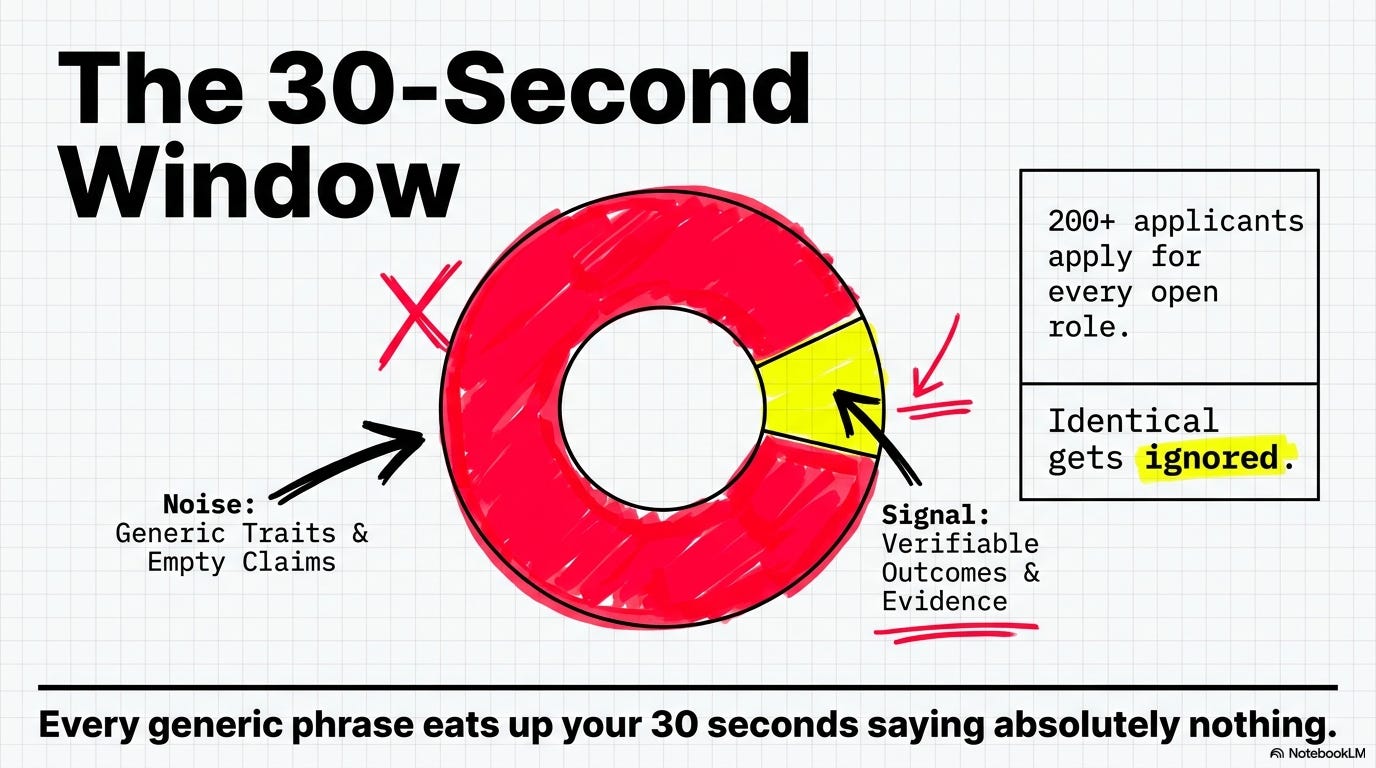
Here’s what’s happening: everyone’s trying so hard to sound hireable that they’ve all started sounding identical. And in a market where 200+ people apply for every open role, identical gets ignored.
What we’re covering:
Why “team player” language is a red flag, not a strength
The phrases hiring managers immediately skip over
What actually makes someone memorable in applications
How to show collaboration without saying “collaborative”
What to say instead when you have nothing specific to point to
The words that make hiring managers stop reading
Let’s be specific about what kills your resume the moment a hiring manager sees it:
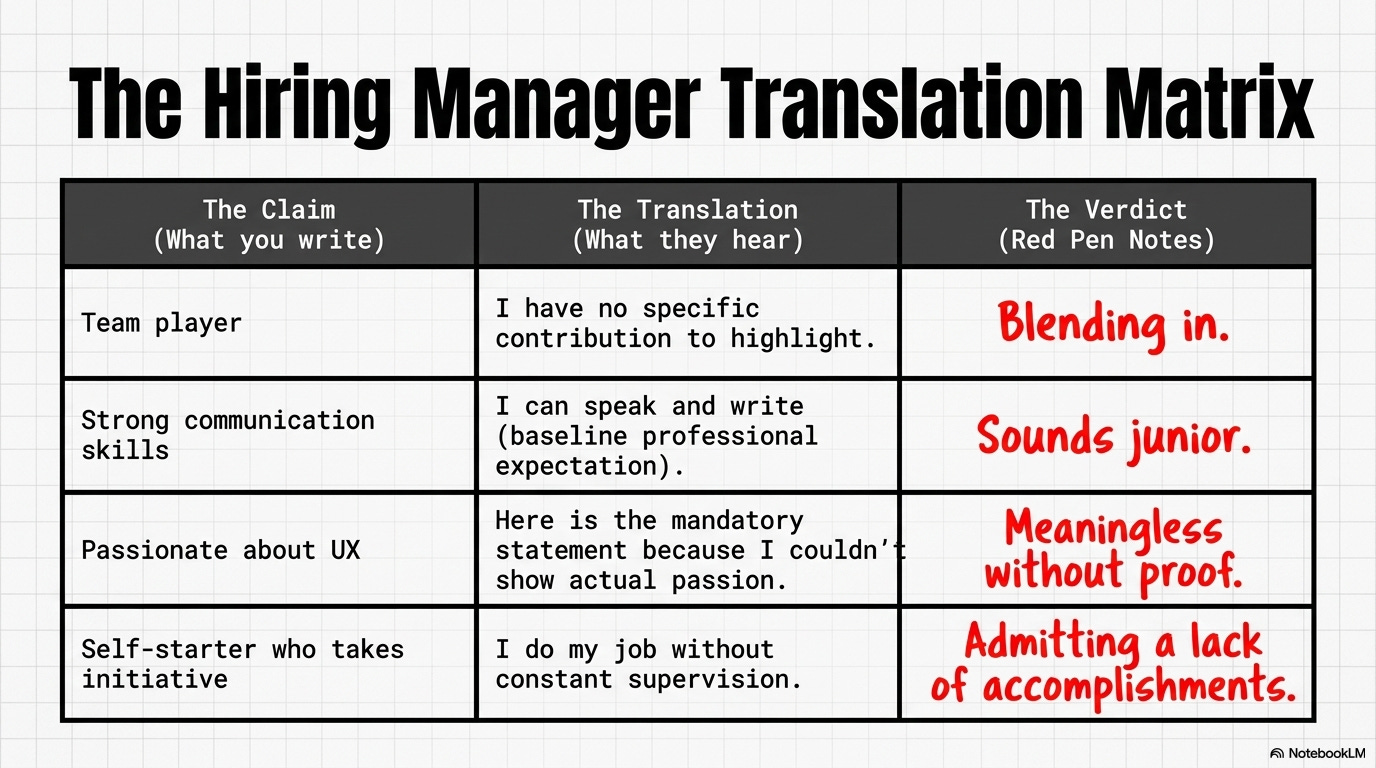
❌ “Team player”
Translation: “I don’t have anything specific to say about my actual contribution, so here’s a generic trait everyone claims.”
Every single person applying to this role says they’re a team player. You’re not differentiating. You’re blending in.
❌ “Strong communication skills”
Translation: “I can speak and write, which is the baseline expectation for any professional job.”
This is like saying “shows up on time” or “uses a computer.” It’s assumed. Saying it out loud makes you sound junior.
❌ “Passionate about user experience”
Translation: “I’m applying for a UX role and I’m supposed to care about UX, so here’s the mandatory statement.”
Passion is demonstrated through work, not declared through adjectives. Saying you’re passionate without showing it is meaningless.
❌ “Detail-oriented”
Translation: “I don’t make obvious mistakes, which again, is baseline expectation.”
Everyone claims this. It’s unverifiable. It fills space without adding information.
❌ “Creative problem-solver”
Translation: “I solve problems, which is literally the job description for design.”
This is so generic it could apply to any role in any industry. It says nothing about what makes you different.
❌ “Works well under pressure”
Translation: “I don’t completely fall apart when things get stressful.”
Again, baseline expectation. Not a differentiator.
❌ “Self-starter who takes initiative”
Translation: “I do my job without needing constant supervision, which you definitely expect at this level.”
If this is your selling point, you’re admitting you have no actual accomplishments to highlight.
The pattern:
All of these phrases are traits, not evidence.
They’re adjectives describing how you see yourself, not specific examples of what you’ve actually done.
Hiring managers don’t care how you describe yourself. They care what you’ve delivered and how you work.
When your resume is full of traits and empty of specifics, you sound inexperienced or like you’re hiding a lack of real accomplishments.
Reality check: If you deleted every generic trait from your resume and it became 30% shorter, your resume was 30% fluff.
What hiring managers actually want to see
Instead of traits, show evidence:
Instead of: “Collaborative team player”
Write: “Partnered with PM and 3 engineers to ship checkout redesign that reduced abandonment from 68% to 34% in 8 weeks”
Why it’s better:
Shows who you worked with (PM, engineers)
Shows what you delivered (checkout redesign)
Shows measurable impact (abandonment rate)
Shows timeline (8 weeks)
That’s collaboration demonstrated through outcomes, not claimed through adjectives.
Instead of: “Strong communication skills”
Write: “Presented research findings to C-suite, resulting in 6-month roadmap pivot and $200K budget reallocation to user-facing features”
Why it’s better:
Shows you communicated to senior leadership (C-suite)
Shows your communication had impact (roadmap pivot, budget shift)
Shows scale ($200K)
Your communication skills are proven through what happened as a result, not stated as a trait.
Instead of: “Passionate about user experience”
Write: “Initiated and led quarterly usability testing program that identified 12 high-priority issues across 3 products, 8 of which were fixed within 2 sprints”
Why it’s better:
Shows you created something that didn’t exist (initiated program)
Shows consistency (quarterly)
Shows impact (identified issues, got them fixed)
Shows initiative (you started this, it wasn’t assigned)
That’s passion demonstrated through action, not claimed through words.
Instead of: “Detail-oriented designer”
Write: “Established component library documentation system that reduced design-to-dev handoff errors by 40% and saved team 5 hours/week”
Why it’s better:
Shows what you built (documentation system)
Shows measurable improvement (40% error reduction)
Shows efficiency gain (5 hours/week)
Your attention to detail is proven by the system you created, not stated as a personality trait.
Instead of: “Creative problem-solver”
Write: “Redesigned complex B2B workflow that reduced 12-step process to 4 steps while maintaining compliance requirements, resulting in 60% faster task completion”
Why it’s better:
Shows specific problem (12-step process)
Shows constraint (compliance)
Shows solution (reduced to 4 steps)
Shows outcome (60% faster)
Your problem-solving is proven through what you solved, not claimed as an attribute.
The shift:
Stop describing yourself. Start showing what you’ve done.
Traits are claims. Outcomes are evidence. Evidence is what gets you hired.
How to show value when you’re early in your career
“But I don’t have big outcomes yet. I’m junior. What do I say?”
Fair question. Here’s how to write a compelling resume even without senior-level impact:
→ Focus on contribution, not outcome
Weak: “Team player on redesign project”
Strong: “Conducted 8 user interviews and synthesized findings into 3 key insights that informed navigation redesign direction”
You might not own the final outcome, but you can own your specific contribution.
→ Highlight process quality and learning
Weak: “Detail-oriented designer”
Strong: “Iterated through 5 wireframe versions based on usability testing feedback, shipping final design that scored 8.5/10 on SUS scale”
Shows you know how to work through a process and measure results, even on smaller projects.
→ Point to things you initiated
Weak: “Self-starter who takes initiative”
Strong: “Created weekly design critique practice for team of 4 designers, increasing feedback frequency from monthly to weekly”
Starting something, even small, shows initiative better than claiming initiative.
→ Show technical skills through usage
Weak: “Proficient in Figma and design tools”
Strong: “Built component library in Figma with 40+ documented components used across 3 product teams”
Don’t list skills. Show how you applied them to build something real.
→ Include relevant side projects or spec work
Weak: “Passionate about accessibility”
Strong: “Redesigned local nonprofit website to meet WCAG 2.1 AA standards, improving accessibility score from 68 to 94”
Real work, even unpaid, beats empty claims about passion.
The principle:
Even without senior-level impact, you can show what you built, learned, or initiated.
You just have to get specific instead of hiding behind generic traits.
What to do right now
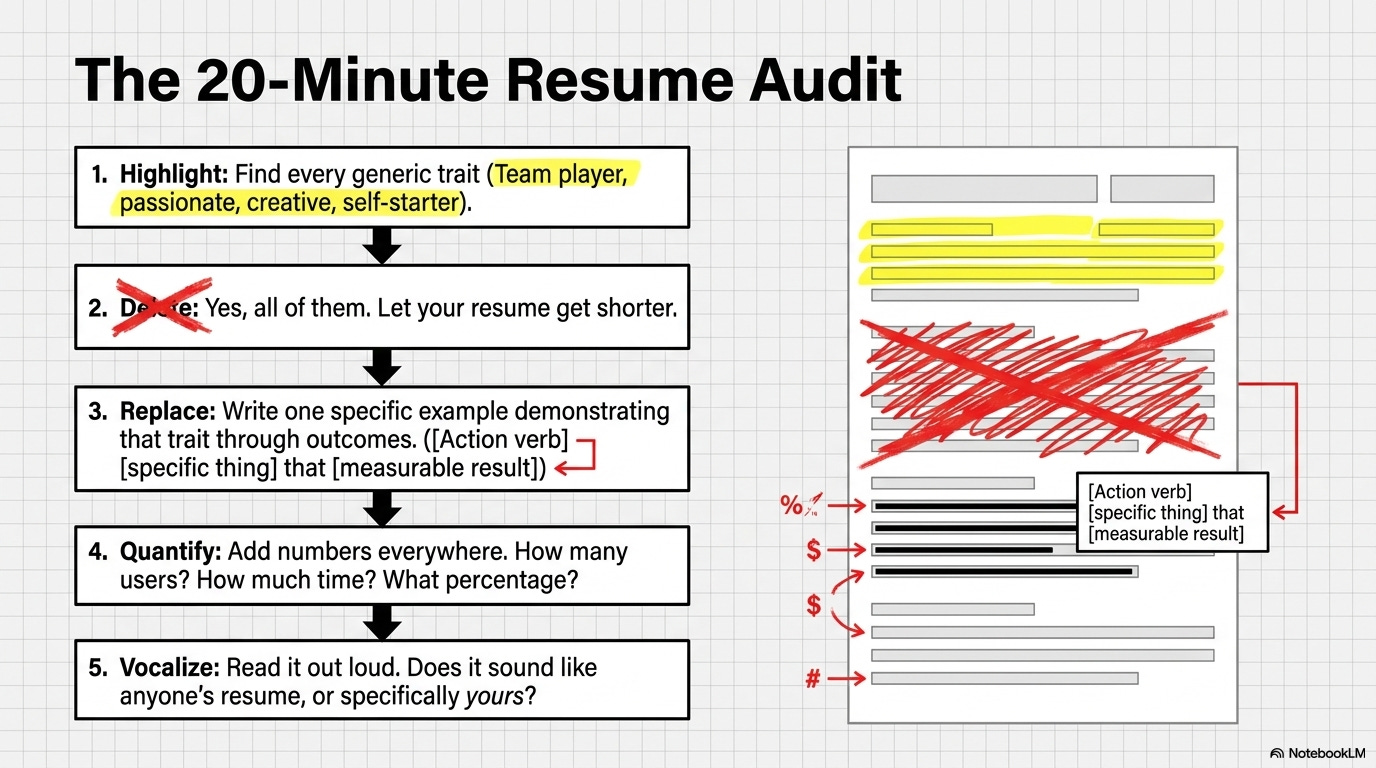
Take 20 minutes and audit your resume:
Step 1: Highlight every generic trait
Find every instance of:
Team player
Strong communication
Passionate
Detail-oriented
Creative
Self-starter
Any other adjective that describes personality
Step 2: Delete them all
Yes, all of them. Your resume just got shorter. That’s good.
Step 3: Replace with evidence
For every trait you deleted, write one specific example of work that demonstrates that trait through outcomes.
Format: “[Action verb] [specific thing] that [measurable result]”
Examples:
Led [project] that [outcome]
Built [system] that [impact]
Redesigned [feature] resulting in [metric]
Conducted [research] that informed [decision]
Step 4: Add numbers everywhere possible
How many users? How much time? How many interviews? What percentage? How much money?
Numbers make vague contributions concrete.
Step 5: Read it out loud
If it sounds like it could be anyone’s resume, keep revising.
If it sounds like specific things you actually did, you’re getting close.
The test:
Could someone else copy-paste your resume and claim it as their own work?
If yes, it’s too generic. Get more specific.
If no, because the work is clearly yours and nobody else’s, you’ve got it.
🎯 Your Next Move: A 4-Hour Reality Check That Actually Helps
Look, you can read another article about AI and upskilling and feel motivated for 20 minutes before going back to scrolling LinkedIn and wondering why your applications go nowhere.
Or you can spend four hours in a room with people who are actually doing something about it.
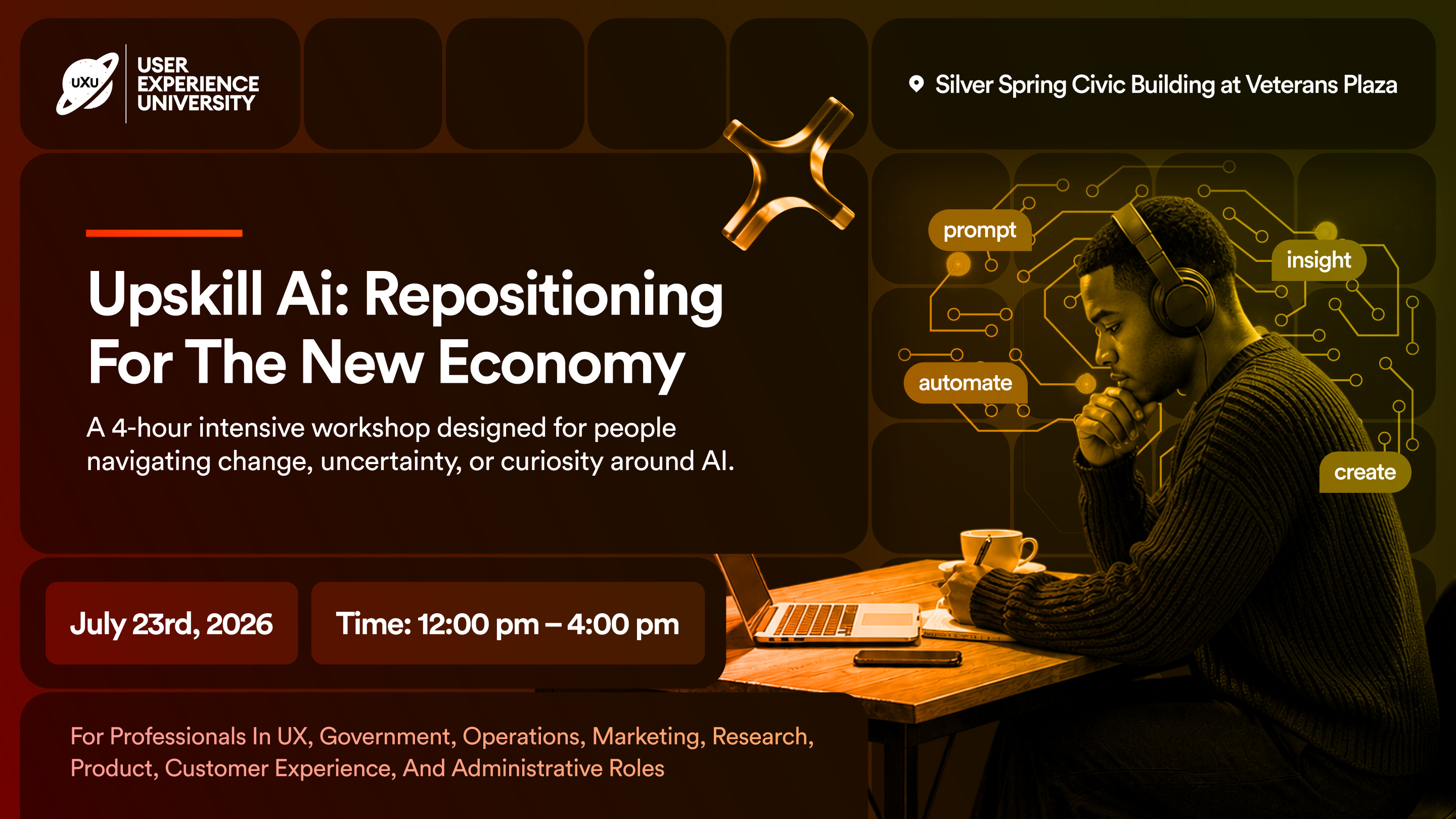
July 23, 2025 · 12:00–4:00 PM Silver Spring Civic Building at Veterans Plaza 1 Veterans Pl, Silver Spring, MD 20910
This isn’t a talk. You’re not sitting there listening to someone pontificate about the future of work. You’re working, on your actual resume, your actual positioning, your actual next move, with AI tools, with real feedback, with people who do this professionally.
You walk in unclear. You walk out with something finished. A resume that’s actually competitive. A pitch that lands. A clearer sense of where you fit in this new economy.
No jargon. No theory. No “10 trends to watch in 2026.” Just practical work on your real stuff with people who are serious about their next move.
📦 Quick Resources
Indeed Resume Guide
Practical examples of showing impact vs stating traits.
Harvard Resume Guide
Action verb lists and accomplishment statement formulas.
Google XYZ Formula
“Accomplished [X] as measured by [Y] by doing [Z]” - simple structure that works.
💭 Final Thought
Being a team player isn’t bad. Having communication skills isn’t bad. Being passionate isn’t bad.
But saying these things on your resume is bad. Because everyone says them. And when everyone says the same thing, no one stands out.
Hiring managers reviewing 200 applications don’t have time for generic traits. They’re scanning for evidence of real work, real impact, real thinking.
Your resume has maybe 30 seconds to prove you’re worth interviewing. Every generic phrase wastes those seconds saying nothing.
Show, don’t tell. Specifics over adjectives. Evidence over claims.
Then maybe you’ll actually get a callback.


