



93% of UX practitioners are already using AI tools in their work. That number sounds like progress. But there is a quieter number sitting underneath it that tells a more honest story.
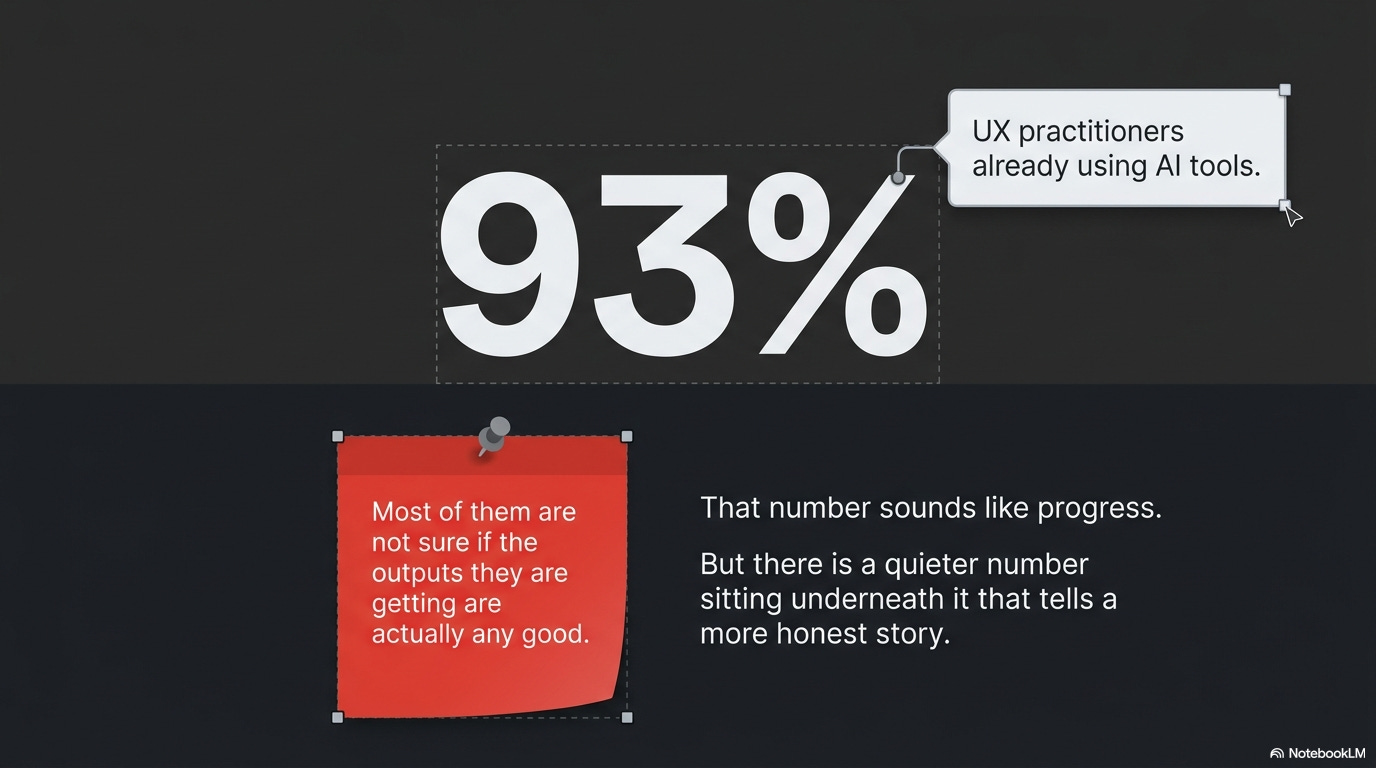
Most of them are not sure if the outputs they are getting are any good.
Using a tool and using it well are two completely different things. And right now, the gap between those two things is producing a lot of confident work built on shaky foundations. This issue is about that gap, why it matters specifically for UX, and what AI literacy actually looks like in practice.
In this issue:
In This Issue, we’ll cover:
Why using AI is not the same as understanding it
What bad AI use looks like in UX specifically
What AI literacy actually means for practitioners
The questions worth asking before you trust any output
How to build this skill without starting from scratch
Resources to help shape your understanding in AI
Why Using AI Is Not The Same As Understanding It
Every UX practitioner knows the difference between a user who can operate a product and a user who actually understands it.
One clicks through.
The other knows why things work, notices when something is off, and adapts when the expected path breaks.
Right now, most practitioners are the first kind of user when it comes to AI.
Designers who understand how AI tools work can make better decisions about when and how to use them, while still applying strong UX fundamentals. That understanding is the part most people are skipping. They are adopting the tools without interrogating the outputs.
And in a field where the quality of insight directly shapes what gets built for people, that is a problem worth taking seriously. UX Design
The value of AI in research is entirely dependent on the quality of the human judgment surrounding it. Which means the field’s most urgent project is not learning to use the tools. It is being honest about what human judgment in research actually consists of. Lyssna
What Bad AI Use Looks Like In UX Specifically
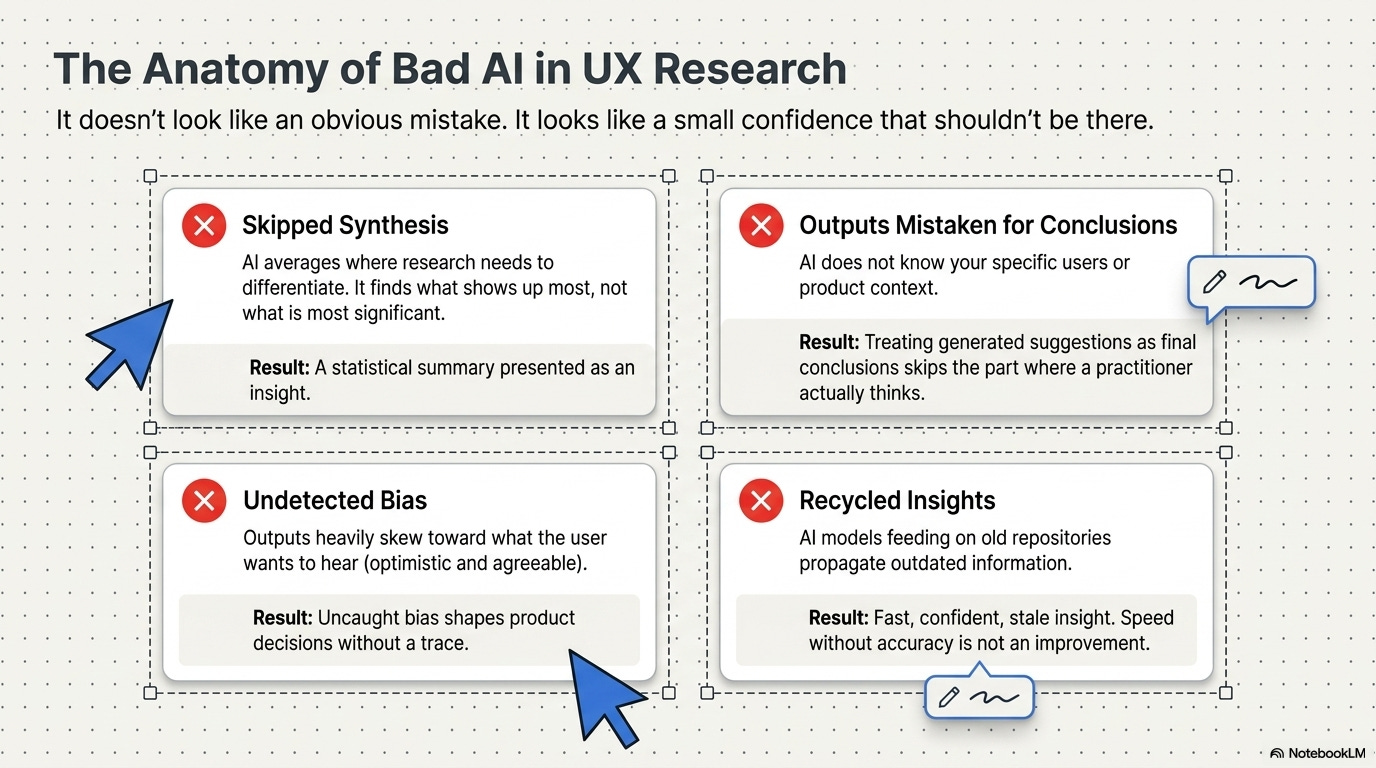
It does not usually look like an obvious mistake. It looks like a small confidence that should not be there.
🔴 Synthesis that skips the hard part
AI is genuinely fast at pulling themes from interview transcripts. It is also genuinely bad at knowing which themes matter. AI averages where research needs to differentiate. It finds what shows up most. It does not find what is most significant. A researcher who hands synthesis entirely to AI and presents the output as findings is presenting a statistical summary, not insight. Lyssna
🔴 Outputs mistaken for conclusions
AI cannot accurately prioritize research questions or determine appropriate methods. It can suggest. It can generate. It can produce something that looks like a research plan or a set of interview questions or an analysis framework. But it does not know your specific users, your product context, or what actually matters in this study. Using AI output as a starting point is smart. Treating it as a conclusion skips the part where a practitioner actually thinks. LinkedIn
🔴 Bias going undetected
AI outputs skew toward what the user wants to hear: optimistic, agreeable, unchallenging. If you prompt an AI to analyze research and it tells you users love the concept, that output is shaped by how you asked as much as by what the data actually says. Practitioners who do not know this are not catching it. And uncaught bias in research shapes product decisions in ways nobody traces back to the AI prompt that started it. Lyssna
🔴 Old insights recycled at scale
AI tools learning from organizational repositories will automatically propagate outdated insights at scale. If your research repository is full of studies from two years ago and your AI synthesis tool is pulling from it, you are producing fast, confident, stale insight. Speed without accuracy is not an improvement. Lyssna
Quick interruption. This one is for you.
🎯 Not sure where you fit right now? This workshop was built for that moment.
If you have been laid off, watching your field shift, or applying and hearing nothing back, this is not a lecture about what you should have done differently. It is 4 practical hours of working on your actual stuff. Your resume, your pitch, your positioning in a market that keeps moving.
No theory. You leave with something finished and one clear next step.
📅 July 23, 2025 · 12:00 to 4:00 PM 📍 Silver Spring Civic Building, Silver Spring, MD
What AI Literacy Actually Means For Practitioners
✅ Knowing what the tool is actually doing
Not at an engineering level. At a practical level. AI language models predict likely next words based on patterns in training data. They do not reason. They do not verify. They do not know when they are wrong. Knowing this changes how you read every output they produce.
✅ Treating outputs as drafts, not answers
Always review AI outputs. Use them as drafts or hypotheses rather than final answers. This sounds obvious. It is not practiced consistently. The speed of AI output creates a psychological pull toward acceptance. Literacy means resisting that pull by default. LinkedIn
✅ Prompting with context, not just instructions
Provide context and constraints in your prompts. Specify the user segment, product maturity, and research goal. Break big tasks into smaller, modular prompts. A vague prompt produces a vague output that looks specific. A well-constructed prompt that includes real context produces something you can actually work with. LinkedIn
✅ Keeping a human at the center of every AI-assisted workflow
The question worth asking honestly is whether the infrastructure exists to protect and develop human judgment in research, not just accelerate the parts AI can handle. Literacy means knowing where in the process your judgment is irreplaceable and protecting that space, even when the AI could technically fill it. Lyssna
The Questions Worth Asking Before You Trust Any Output
Before using AI-generated content in your work, run it through these:
→ Does this reflect the actual context of my users or a generalized version?
→ What would this output look like if my prompt had been slightly different?
→ Am I agreeing with this because it is accurate or because it sounds confident?
→ Who is accountable for this output if it turns out to be wrong?
→ What would I need to verify before I present this to a stakeholder?
None of these questions take long. Together they change the quality of everything you produce with AI assistance. Maintaining an audit trail of AI-generated and human-edited content and labeling what was machine-produced is not just an ethical practice. It is how you stay honest with yourself about where your judgment ends and the tool’s output begins. LinkedIn
How To Build This Skill Without Starting From Scratch
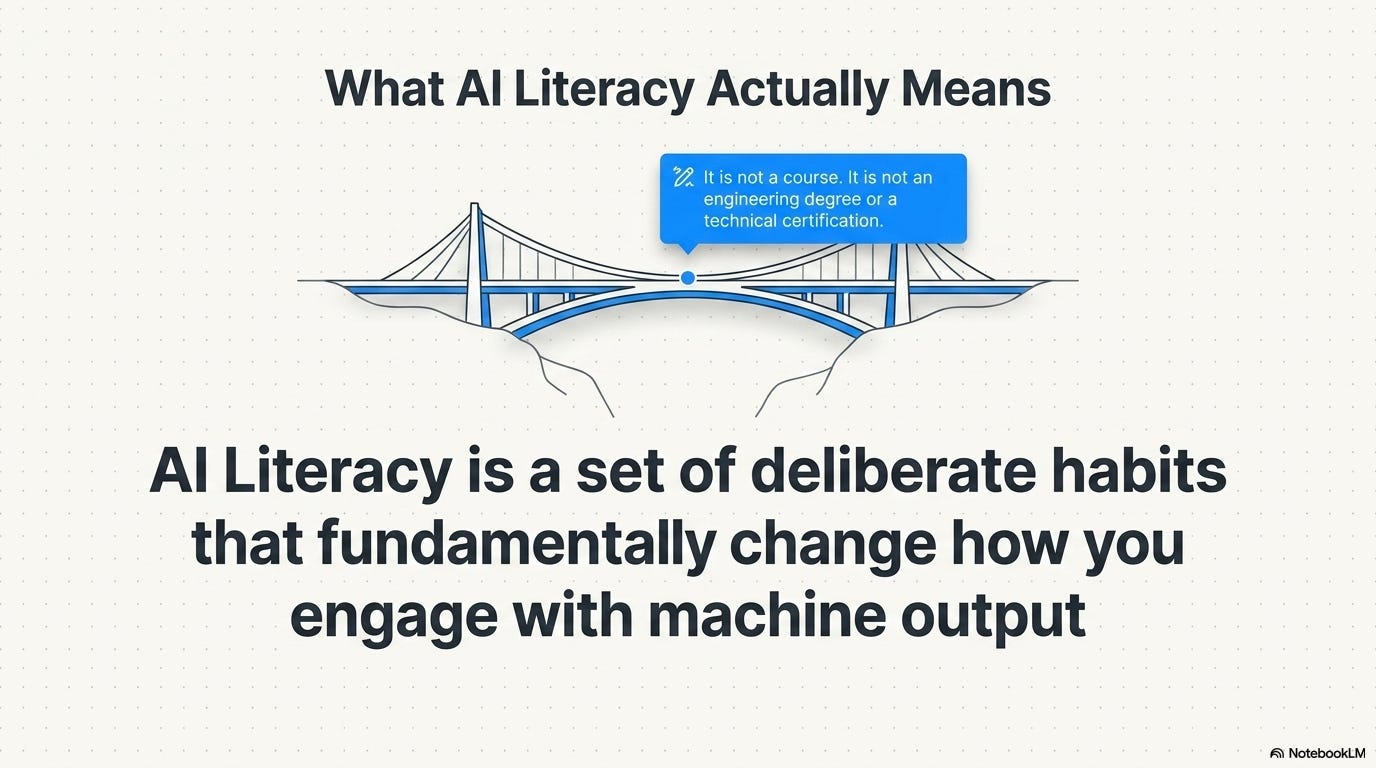
AI literacy does not require becoming technical. It requires becoming deliberate.
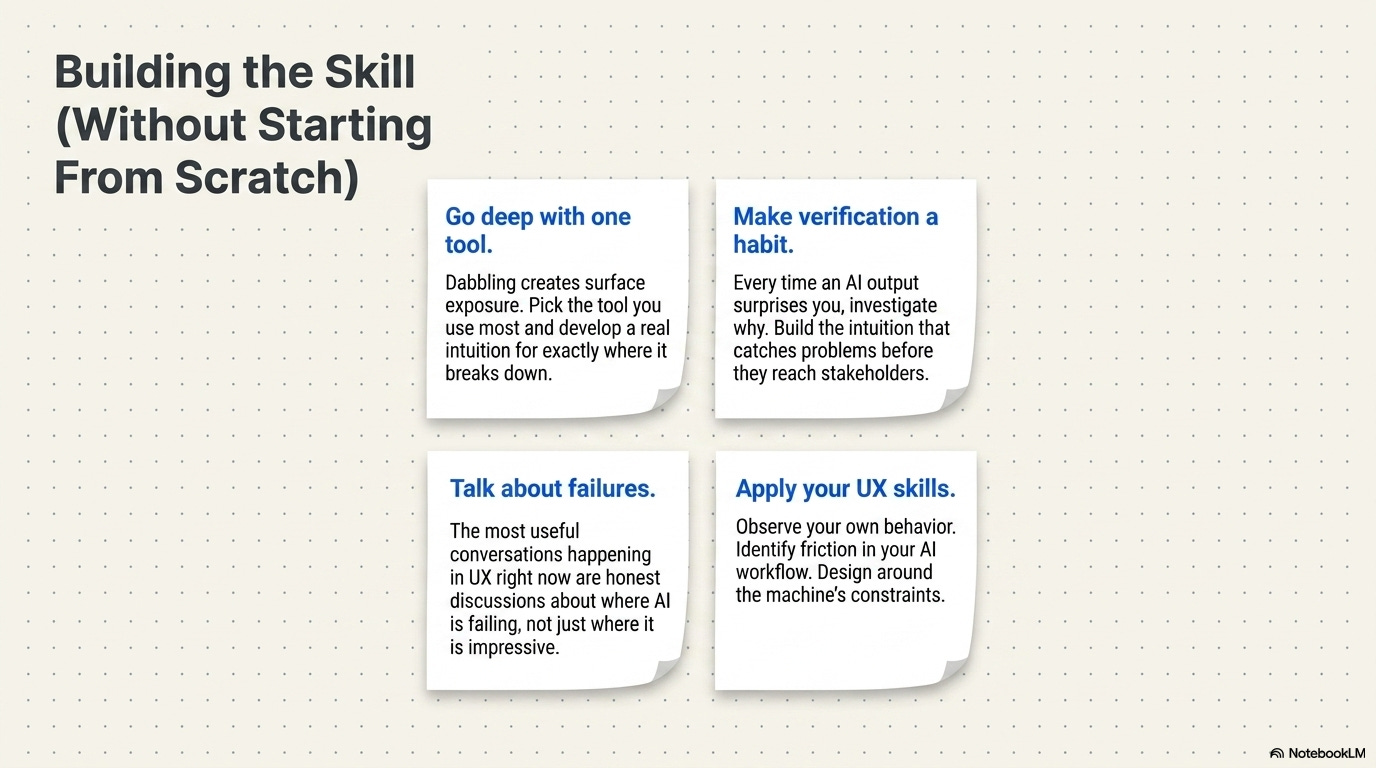
✓ Start with one tool and go deep Most practitioners are dabbling across many tools. Pick one you use most, read about how it actually works, and develop real intuition for where it is reliable and where it breaks down. Depth with one tool teaches you more than surface exposure to ten.
✓ Make verification a habit before it becomes a crisis Every time an AI output surprises you, pleasantly or otherwise, investigate why. That investigation builds the intuition that catches problems before they reach a stakeholder presentation.
✓ Talk to other practitioners about what is not working The questions UX leaders are fielding right now are less about what tools to use and more about how to adapt, how to evolve research practices and ensure AI becomes an accelerator rather than an obstacle. The most useful conversations happening in the field right now are the honest ones about where AI is failing, not just where it is impressive. Index.dev
✓ Apply your own UX skills to how you use AI You already know how to observe behavior, identify friction, and design around constraints. Apply that to your own AI workflow. Where does it break down? Where do you reach for it out of habit rather than genuine usefulness? Where is it saving time on the right things versus the wrong ones?
📦 Resource Corner
Maze Future of User Research Report 2026 The most comprehensive data available on how research teams are actually using AI right now. Particularly useful on the gap between adoption rates and confidence in outputs.
AI for UX Research: What Actually Works in 2026 (Great Question) A five-part series written by practitioners for practitioners. Honest about what AI does well and where it falls apart in a research context.
HEARTS Framework (UXinsight) A practical audit for checking whether an AI-assisted workflow still has a human at its center. Human-led, Experience-focused, Amplification not Automation, Rigorous and Responsible, Trustworthy and Transparent, Safe and Sustainable. Worth bookmarking.
How to Use AI for UX Research (Parallel HQ) Practical walkthrough of the research lifecycle showing specifically where AI adds value and where human judgment cannot be substituted. Good on prompt construction.
AI Fundamentals for UX (UX Design Institute) If you want structured learning rather than self-directed exploration, this is the most relevant course available for UX practitioners building practical AI literacy.
💭 Final Thought
The field does not have an AI adoption problem. It has an AI literacy problem.
Getting to 93% adoption is impressive. But adoption without understanding produces something that looks like progress and functions like risk. Confident outputs from poorly constructed prompts. Synthesis that skips interpretation. Bias that nobody caught because nobody knew to look.
The practitioners who will get the most from AI in 2026 are not the ones using the most tools. They are the ones who understand what the tools are actually doing well enough to know when to trust them and when to push back.
That skepticism is not resistance to AI. It is exactly the kind of critical thinking this field has always been built on. Apply it to the tools the same way you apply it to everything else.


