



For most of the internet’s history, inclusive design was treated as a legal footnote, something you bolted on after the product was built.
That era is ending. Regulatory pressure from the EU’s European Accessibility Act, a $8 trillion global disability market, and a growing body of research proving that inclusive products simply perform better have converged into a single, undeniable signal: designing for everyone is no longer a values statement. It is a competitive strategy and in today’s issue, we’ll discuss where we are, where we’re going, and what you need to do right now.
In this edition we’ll cover:
The State of Play
The Regulatory Landscape
7 Shifts in Inclusive Design
The Practitioner Roadmap
Resource Corner
The State of Play
1.3B people globally live with some form of disability — 15% of the world population
$8T global market potential of customers with disabilities and their networks (Return on Disability Group)
69% of users with access needs click away from websites they find difficult to use — taking spend with them
Sources: WHO, Return on Disability Group 2020, Click-Away Pound Survey
The gap between the scale of the opportunity and the current state of practice is staggering.
Over 70 million adults in the United States, more than 1 in 4, live with a disability. People with disabilities in the US alone control $490 billion in collective disposable income. And yet the majority of digital products still fail basic accessibility audits. Automated tools, when teams bother to run them at all, catch only 30–40% of real accessibility barriers. The rest require human testing, which most organizations skip entirely.
“Most companies overlook this substantial consumer segment despite these impressive figures. This oversight isn’t just an ethical mistake — it’s a missed chance for growth.”
— Bricx Labs Inclusive Design Analysis, 2026
Companies that lead on disability inclusion realize 1.6x more revenue, 2.6x more net income, and 2x more economic profit than their peers, per a landmark Accenture study that has now been replicated across industries.
Companies making products available to all see a 28% increase in revenue, because accessible designs reach four times as many consumers.
The World Economic Forum found disability-inclusive businesses report 30% higher profit margins.
These are structural advantages available to any organization willing to prioritize inclusion from the start rather than retrofit it at the end.
AI can now do in seconds what used to take you a week. So where does that leave you?
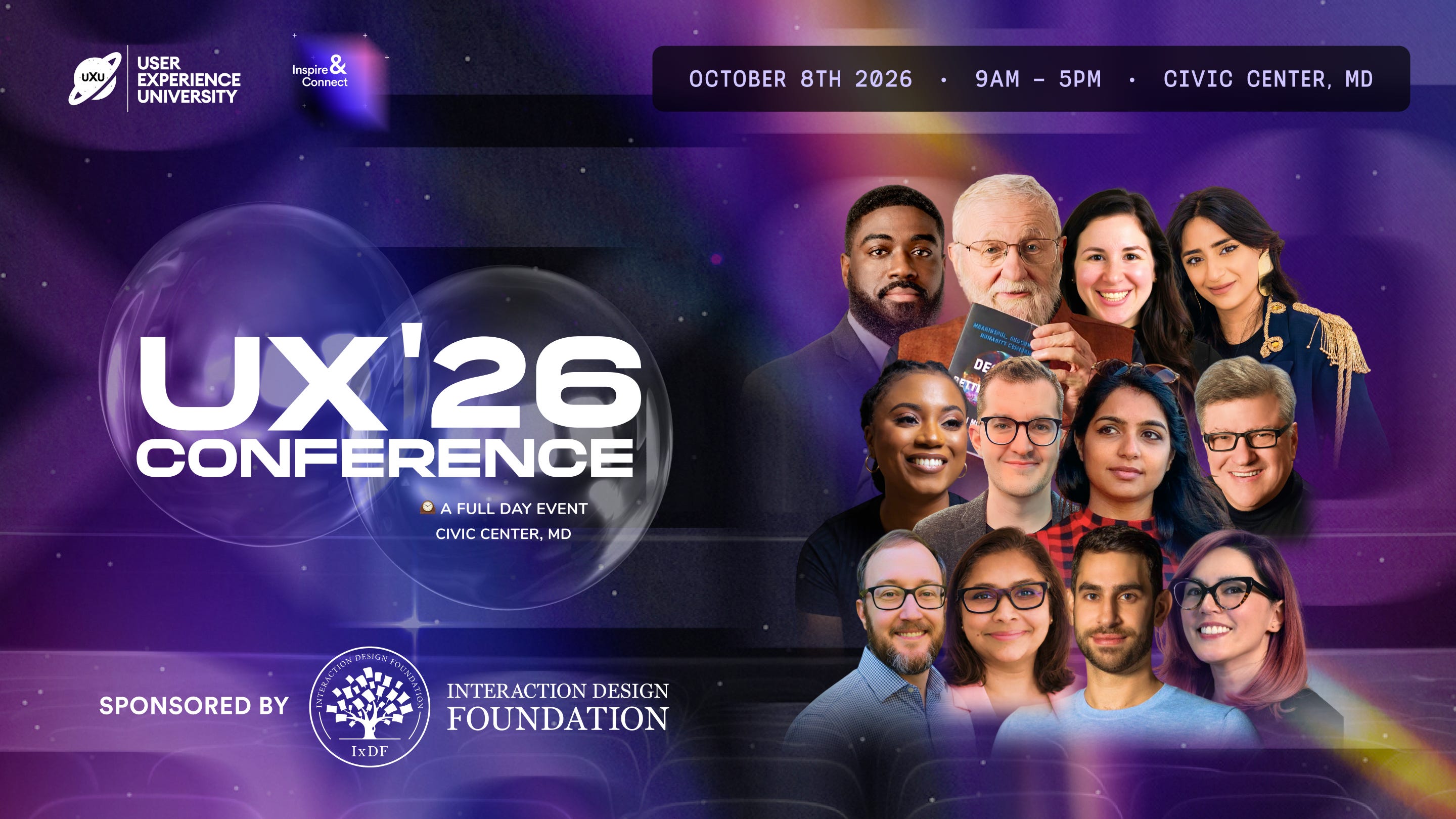
Every week there’s a new tool that drafts wireframes, writes copy, generates user flows, the things that used to be your job security. And the question quietly sitting underneath all of it is: if AI can produce the deliverable, what exactly am I bringing to the table?
The answer isn’t panic. It’s positioning. UXCON26 brings together practitioners from Netflix, The New York Times, Target, and more who are already working through this exact shift, alongside Don Norman, the person who defined what user experience even means in the first place.
October 8. One day. The conversations that actually answer the question.
back to where we stopped….
The Regulatory Landscape
Compliance Is No Longer Optional.
The European Accessibility Act (EAA), now in force since June 28, 2025, mandates accessibility for a broad range of products and digital services across all 27 EU member states — including e-commerce, banking, transport, and telecommunications.
Penalties for non-compliance can reach €100,000 or 4% of annual revenue. Enforcement is intensifying through 2026 as monitoring authorities ramp up auditing. Any business serving EU customers, regardless of where it is headquartered, is covered.
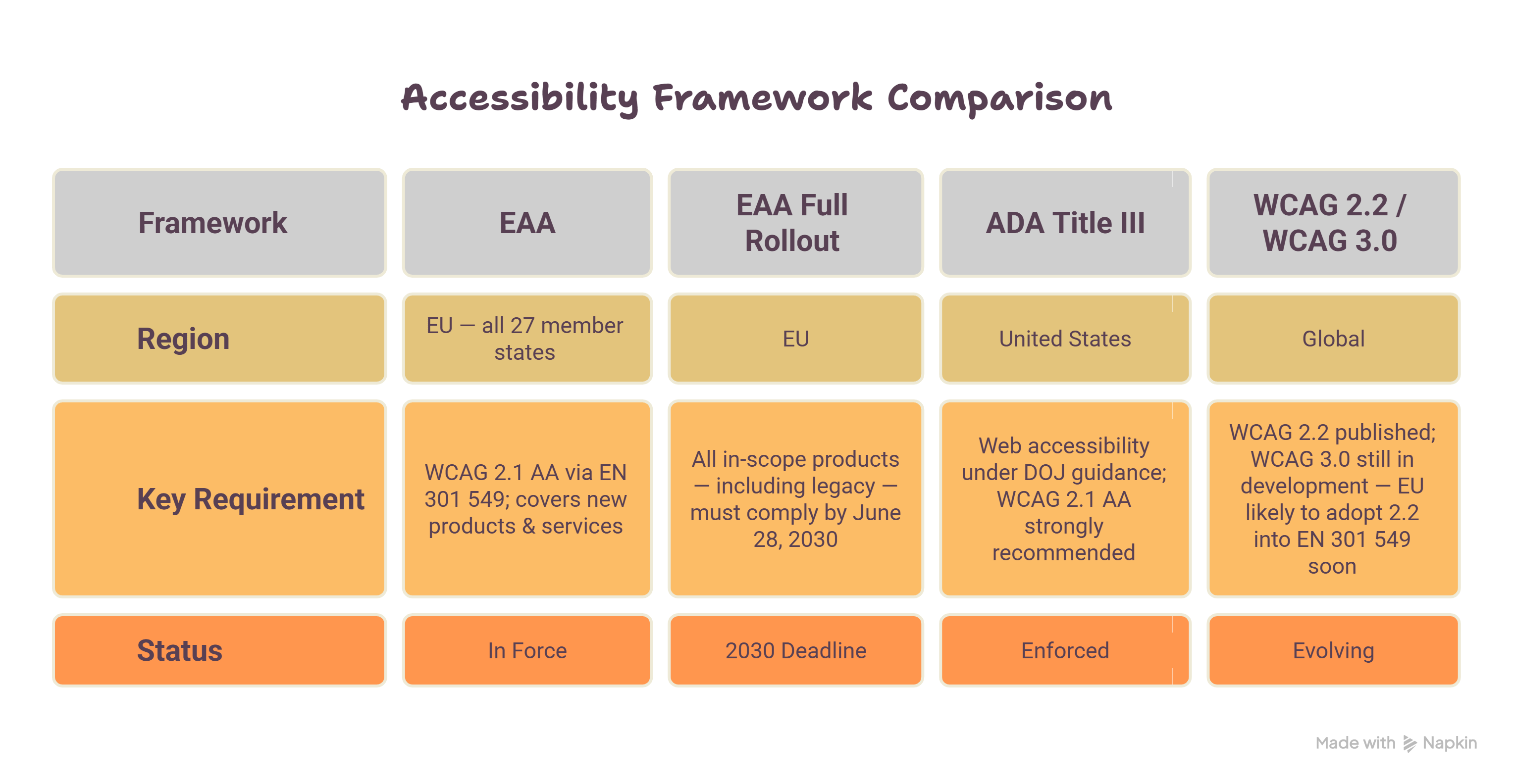
This regulatory shift has a direct career implication: fluency in WCAG standards, accessibility auditing, and inclusive design documentation is rapidly moving from a niche specialization to a baseline expectation. Teams that have embedded accessibility into their design systems and development pipelines before a compliance audit arrives are in a fundamentally different position than those scrambling to retrofit.
Seven Shifts Defining the Next Generation of Inclusive Design
SHIFT 01: From compliance to genuine usability - the “second-class experience” problem
Designers and researchers are increasingly recognizing that meeting legal standards does not automatically produce a usable or welcoming experience. When accessibility accommodations feel hidden, awkward, or clearly bolted on, users notice - and they remember.
SHIFT 02: People with disabilities at the table - not as an afterthought, but from day one
More organizations are involving people with disabilities early in the design process — in discovery research, usability testing, and design critique - rather than as a final accessibility review checkbox. When inclusive design is informed by real use cases and real users from the start, fewer costly fixes are needed later.
SHIFT 03: AI as an accessibility enabler - but with firm limits
In practice, AI is being used to identify accessibility issues at scale, summarize remediation priorities, restructure documents, and detect patterns in user research data. However, 89.3% of practitioners still validate AI-generated accessibility test results with human testers - a recognition that AI catches patterns, not context.
The emerging view: AI lowers the barrier for teams to produce more accessible products at speed, but it does not replace the judgment required to evaluate complex, real-world edge cases. Human expertise remains the floor, not the ceiling.
SHIFT 04: Multimodal interaction as an accessibility requirement, not a feature
As voice, gesture, camera input, and haptics become standard interaction modes, the overlap between multimodal UX and accessibility becomes undeniable. For products serving users in high-distraction environments - healthcare workers, drivers, field technicians - and for users with motor, vision, or cognitive differences, multimodal design has shifted from an enhancement to a usability requirement.
Designers who prototype across input modes and understand how to create seamless fallbacks between them are building skills directly applicable to accessibility-first product work.
SHIFT 05: Ethical design systems - bias reduction and AI boundaries built in
Design systems are evolving to include ethical guidelines: how to reduce bias in AI-powered features, define boundaries for data use, maintain fairness across diverse populations, and document accessibility requirements at the component level. This trend reflects a maturation in how teams think about their design systems — not as a library of UI components, but as a codified set of organizational values made operational.
SHIFT 06: User-defined preferences as the new design baseline
Reduced motion, high contrast, dark mode, text scaling, and captions are shifting from optional settings to expected defaults. Products that honor what users have already told their operating system about how they want to interact signal respect, reduce cognitive load, and build trust.
SHIFT 07: Inclusive design beyond the screen - physical, spatial, and environmental
Digital accessibility is expanding into everything connected to technology - smart devices, kiosks, payment terminals, AR/VR environments, and packaged goods. These interfaces create new barriers when they rely on touch, reach, speed, or fine motor control.
Designs that tackle these barriers and create disability access improve experience for everyone, and designers who can think across physical and digital contexts will be increasingly valued.
Six Principles for Building an Inclusive Design Practice
Knowing the trends is only half the work. Here is how to operationalize inclusive design across your team, portfolio, and career - at any level of seniority.
Research with, not about
Include people with disabilities in every research phase - interviews, card sorts, usability tests, and critique sessions. Make it a standing practice, not a special study. Document participation rates in your case studies to signal your commitment.
Embed accessibility in your design system
Every component in your library should carry accessibility annotations - keyboard behavior, ARIA roles, contrast ratios, focus order. A design system without these is incomplete. Start with your most-used components and work outward.
Test beyond automated tools
Automated scanners catch 30–40% of issues. Build manual testing with screen readers (NVDA, VoiceOver, JAWS) and keyboard-only navigation into your QA cycle. Even one hour per sprint of manual accessibility testing dramatically improves real-world outcomes.
Learn the regulatory landscape
Understand WCAG 2.1/2.2 at the AA level and how it maps to the EAA, ADA Title III, and Section 508. Knowing which standards apply to your client’s product and why - makes you a more credible and valuable partner in product conversations.
Make the business case fluently
Know the numbers: $8T global disability market, 1.6x revenue advantage for inclusive leaders, 28% revenue increase from accessible design, 69% abandonment rate for inaccessible sites. You should be able to make the ROI case for inclusive design in two minutes, without slides.
Document your inclusive design process
Your portfolio needs to show inclusive design decisions explicitly - who was included in research, which accessibility standards were targeted, what tradeoffs were made and why. This level of process documentation distinguishes senior practitioners in hiring reviews
Emerging Role To Watch
Accessibility Experience Strategist
This emerging title sits at the intersection of UX research, product strategy, and regulatory compliance.
Organizations navigating the EAA and ADA simultaneously - while trying to improve genuine usability for disabled users, not just pass audits — need someone who can translate legal requirements into design system decisions, user research into remediation priorities, and business outcomes into an inclusive design roadmap.
The role didn’t exist five years ago. In 2026, it’s one of the most underfilled positions in product-mature organizations.
Resource Corner
7 Inclusive Design Trends to Watch in 2026
Equal Accessibility LLC · Mar 17, 2026State of Digital Quality in Accessibility 2026
Applause · Apr 2026 (survey of software dev, QA, product & accessibility professionals)
Inclusive & Accessible UX Design Trends: How Regulations and User Needs Are Shaping Digital Products
USAenlinea · May 2026
Why Accessibility Is Becoming a Bigger Design Priority in 2026
Daily Business Group · Jun 2026
European Accessibility Act: Complete Compliance Guide 2026
AllAccessible · updated Jun 2026
EAA and WCAG: A Guide to EU Accessibility Compliance
Aquent · Oct 2025
8 Proven Inclusive Design Examples from Top Brands (2026 Update)
Bricx Labs · 2026
The Business Case for Inclusion: Why Disability Inclusion Matters Today
Disability Belongs™ · Feb 2026
Industry Literature Review: Business Case for Disability Inclusion
Disability:IN & Accenture (landmark study, 2023 update)
The Business Case for Digital Accessibility
W3C Web Accessibility Initiative (WAI) · evergreen
Closing the Disability Inclusion Gap with Business Leadership
World Economic Forum
Accessible XR in 2026: What Meta Horizon Worlds Teaches Us About Inclusive VR Design
Equal Entry · Feb 25, 2026
💭 Final Thought
It is tempting to read all of this as a numbers story. The $8 trillion market. The 1.6x revenue advantage. The penalties. And those numbers matter, because they are what finally moved inclusive design from the bottom of the backlog to the center of the strategy.
But the numbers were never the reason. They are just the argument that finally worked.
Behind every statistic is a person who clicked away because a form would not work with a screen reader, or who assumed, again, that this product was not built with them in mind. The retrofit era is ending. The teams that build inclusion in from the first sketch will not just pass the audit. They will make products that work for more people, more of the time, which was the point before anyone attached a dollar figure to it.
Build it in. Not because the law says so, though it does. Because the people on the other side of the screen have been waiting long enough.


