



Two things worth your attention this week.
One is about how your users are actually navigating information right now, which is probably not what you are designing for. The other is about how UX teams learn from what they ship, which most teams are either skipping or doing badly enough that it does not matter.
Both are about the same underlying thing: using the right tool for the right problem.
In This Issue, We’ll Cover:
GenAI vs. search: what users are actually doing
What this means for how you design
Project postmortems: why most teams skip them or do them badly
What a good postmortem actually looks like
How both topics connect
Resource Corner
A note before we dive in
“Before we get into it...”
Happy Memorial Day 🇺🇸

Today we pause to honor the men and women who gave everything so we could keep building, creating, and connecting. It’s a day worth slowing down for - a moment of gratitude before we jump back into the work we love.
In that spirit, we’re passing along a little something to you. Click the link below to save on your tickets
GenAI vs. Search: What Users Are Actually Doing
The story being told in most headlines is wrong.
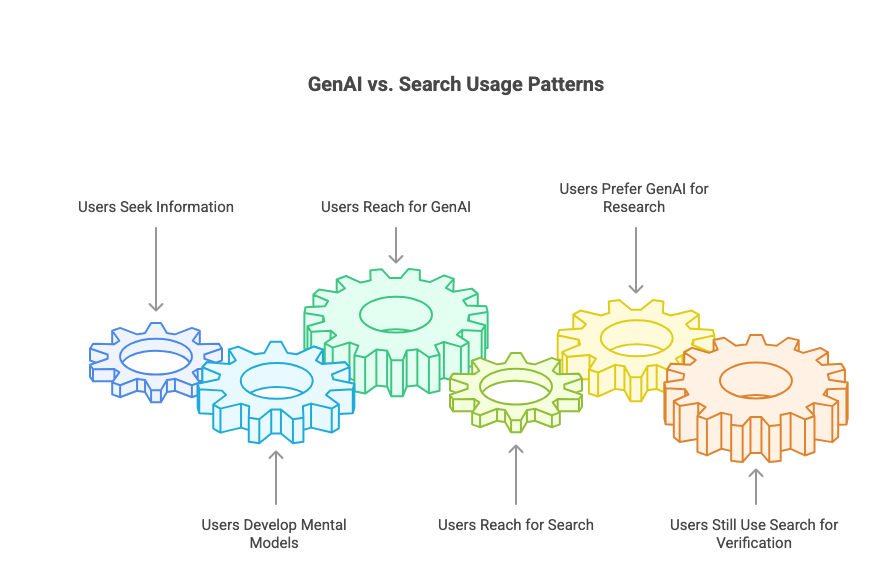
AI is not replacing search. Users are not abandoning Google for ChatGPT. What is actually happening is more interesting and more relevant to how you design information experiences.
ChatGPT adoption does not reduce Google usage. It expands overall information-seeking behavior. Users are searching more overall, not simply shifting between platforms. Imidef
Users are developing sophisticated mental models about which tool fits which need. And the split is consistent enough to be designed around. Nielsen Norman Group
✅ People reach for GenAI when:
→ The question is complex or multi-part and requires synthesis across maUXCON26
ny sources → They are starting from a vague place and do not know exactly what to search for
→ The task involves ideation, content creation, or complex problem-solving that benefits from conversational interaction
→ They want a summarized answer without clicking through multiple pages Nielsen Norman Group
✅ People reach for traditional search when:
→ Accuracy is critical and they need to verify the source
→ They want control over where the information comes from
→ The stakes of getting it wrong are high
→ The query is transactional or navigational, where familiar formats and trusted sources matter more Nielsen Norman Group
42% of people now prefer using AI chatbots over search engines for multi-step research. But that same group is still opening Google when they need to verify something specific. These are not competing loyalties. They are complementary behaviors triggered by different kinds of need. UX Design
What This Means For How You Design
If you are designing any experience that involves information retrieval, decision-making, or research, this data should change your assumptions.
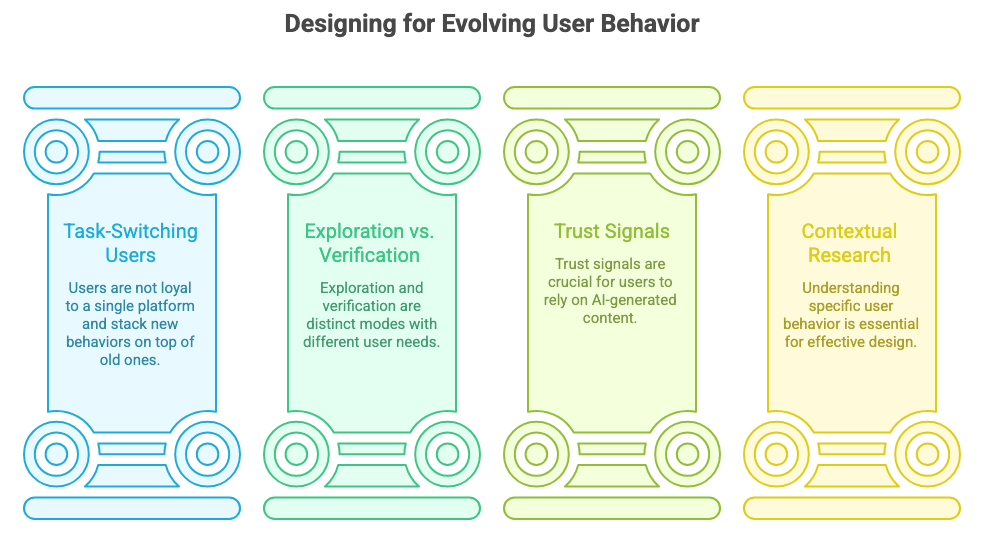
🔵 Your users are task-switching, not platform-loyal
Consumers do not delete old behaviors. They stack new ones on top. AI is creating new types of information-seeking behavior that did not exist three years ago: multi-turn research conversations, real-time synthesis of multiple sources, task completion inside a single interface. These coexist with traditional search rather than replacing it. Uxuniversity
Designing as if your users arrive with a clear, formed query is designing for a behavior that is increasingly rare. Many of them are arriving in exploration mode, using conversational tools to figure out what they are even looking for before they come to you.
🔵 Exploration and verification are different modes with different needs
When users are exploring, they want synthesis, flexibility, and low friction. When they are verifying, they want sources, dates, authors, and transparency about where the information comes from. These are not the same experience. A product that collapses both into one interaction is likely underserving both.
🔵 Trust signals matter more now, not less
As AI-generated content becomes more prevalent, the traditional search format, with its multiple perspectives and familiar integrations, continues to inspire greater trust for high-stakes decisions. Users are getting more deliberate about when they trust an AI summary and when they want to trace information back to a source. Designing clear trust signals into your information experiences is not a nice-to-have. It is a response to a real behavioral shift. Nielsen Norman Group
🔵 This is a research question worth investigating in your specific context
General data gives you a direction. It does not tell you where your specific users sit on the exploration-to-verification spectrum or at what point in their journey they switch modes. That is worth a study. Session recordings, interview questions about how people arrived at your product, and usability testing that starts before the product opens are all ways to surface this in your specific context.
Project Postmortems: Why Most Teams Skip Them Or Do Them Badly
Staying on the theme of using the right tool for the right problem: after a project ends, the right tool is a postmortem. Most teams either do not use it at all or use it so poorly it produces nothing actionable.
A postmortem is a structured analysis of a completed project that asks three questions. What happened? Why did it happen? What do we change because of it?
The first misconception worth clearing up: postmortems are not just for failures. You should absolutely run one when your new onboarding flow tanks, but you should also run one when your redesigned checkout process works. Success often teaches us more than failure, but only if we actually interrogate it. Baymard
The teams skipping postmortems entirely are leaving institutional knowledge on the table. The teams running them badly are doing something arguably worse: creating the feeling of learning without any of the actual change.
Here is what makes most postmortems useless:
🔴 Running them too late Memory fades within days. Emotional context evaporates. A postmortem run six weeks after a launch is reconstructing history, not examining it. Schedule it within two weeks of completion. One week is better.
🔴 Blame dressed up as analysis The best postmortems reveal that incidents were caused by decisions that seemed reasonable at the time but turned out to be wrong. Getting there requires an environment where people can say that without consequence. If the culture does not support that, the postmortem becomes a performance rather than a practice. Phygital+
🔴 Lessons that go nowhere A postmortem report sitting in a shared drive nobody opens is not a learning system. It is a filing system. Every lesson needs to be linked to specific types of deliverables, checklists, and knowledge systems that people actually reach for on the next project. If the insight does not change a template, a process, or a default decision, it did not actually land. Superhuman
🔴 Only looking at what went wrong Identifying what worked effectively matters just as much. Postmortems that only examine failure miss the opportunity to understand what to deliberately repeat. TechCrunch
What A Good Postmortem Actually Looks Like
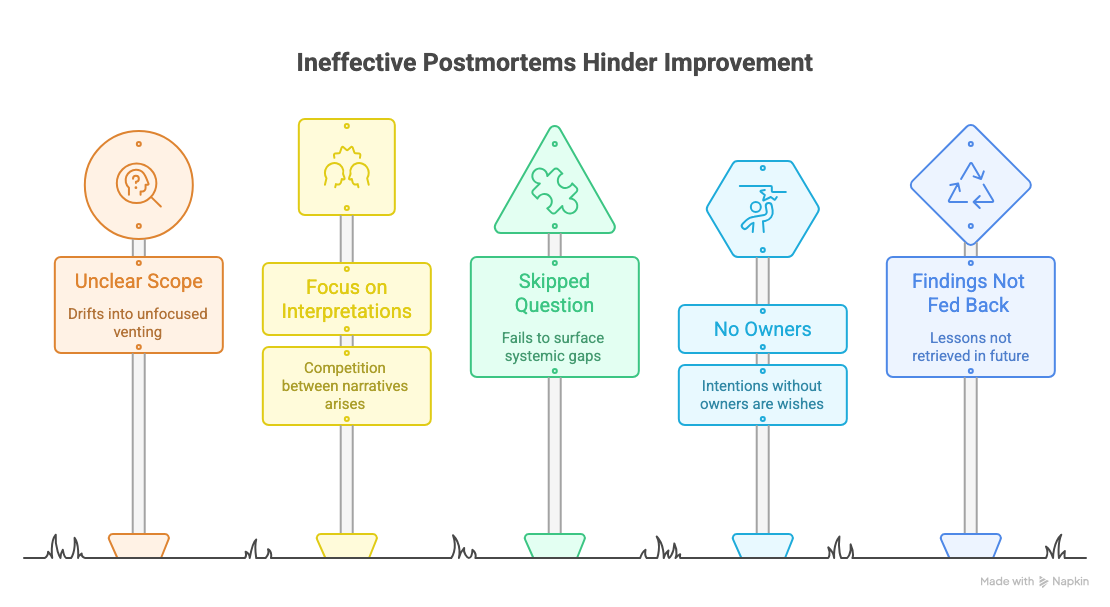
✓ Set the scope before anyone walks into the room
What project? What time period? What decisions are in scope? Without clear boundaries, postmortems drift into unfocused venting. Put the scope in the calendar invite.
✓ Start with facts, not interpretations
What happened, in sequence, as a matter of record? Get everyone aligned on the timeline before anyone starts explaining why. This prevents the meeting from becoming a competition between narratives.
✓ Ask the question most teams skip
What would we have needed to know earlier to make a better decision? This surfaces the real systemic gaps: the research that was missing, the brief that was unclear, the stakeholder misalignment that caused a problem two months before the problem showed up visibly. Fixing those is worth far more than fixing the symptom.
✓ End with owners, not intentions
Every action item needs one person accountable and one deadline. Not “the team will consider this going forward.” One person, one date, one specific change. Intentions without owners are wishes.
✓ Feed the findings back into the system
Link every lesson to specific deliverables so teams can retrieve relevant lessons when working on similar tasks in future. A postmortem that changes a research brief template or adds a question to a stakeholder kick-off checklist has actually changed something. One that produces a PDF has not. Superhuman
📦 Resource Corner
Semrush: ChatGPT Is Not Replacing Google: 260 billion rows of clickstream data on what actually happened to Google usage after people started using ChatGPT. The expansion hypothesis explained with real numbers.
How ChatGPT Is Challenging Google’s Dominance in 2026: Breakdown of query types and which platform wins each one. Useful for understanding exactly where the split happens between exploration and verification behavior.
Post-Mortem Meetings: How to Run Them Effectively: Practical guide on running the meeting itself, including how to build the psychological safety that makes honest postmortems possible rather than performative ones.
Blameless Postmortem Guide and Free Checklist: Step by step walkthrough covering before, during, and after. The free checklist is worth downloading before your next project wraps up.
Dovetail If you want postmortem findings to actually be findable and usable on the next project, this is the most purpose-built place to store them. Institutional knowledge needs a home to be worth anything.
💭 Final Thought
Both topics this issue are about the same thing: knowing which tool fits which problem and actually learning from what happens when you get it wrong.
Your users have already figured out the first part. They are switching between AI and search based on what each task actually requires, without overthinking it. The design implication is to stop assuming they arrive at your product in one mode and start designing for the reality that they arrive in several.
Your team is still figuring out the second part. Most UX teams are not running postmortems consistently. The ones that are, are often doing it in a way that produces documentation instead of change. The gap between a team that learns from every project and one that does not compounds over time in ways that are hard to see until they are obvious.
Run the postmortem. Actually close the loop. Use the right tool for the right moment.


