



Research often finishes strong and then quietly fades.
Insights live in decks. Notes live in tools. Decisions wait.
Two weeks later, the roadmap moves on without them.
This issue shows how to move research out of storage and into action. Not months later. Within two weeks.
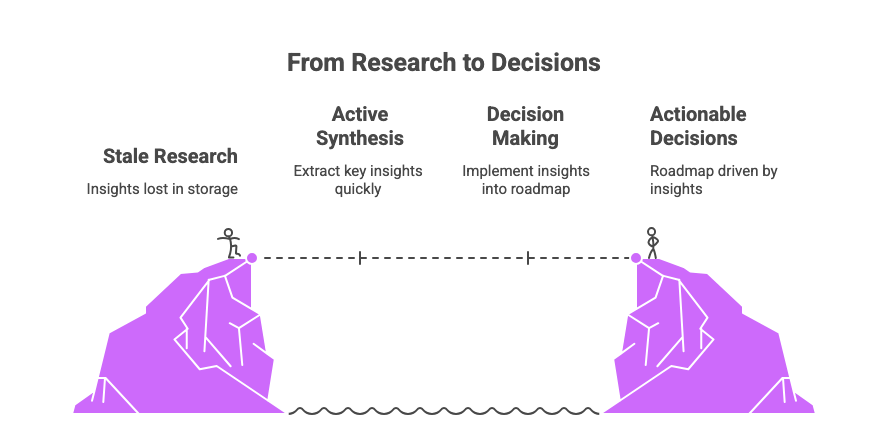
In This Issue
• Why insights stall
• What “research to decision” actually means
• The two-week conversion model
• Week one breakdown
• Week two breakdown
• Common failure points
• Take-Home Exercise
But first….
The UX industry is shifting... fast.
AI is rewriting the way we work, teams are demanding business outcomes, and careers are moving through rooms, not résumés.
That’s why UXCON26 matters.
It’s not just talks and workshops... it’s where the people shaping the field show up.
This year, we’re joined by Don Norman whose work defined User Experience before most of us even had the title.

Because the future of UX won’t be decided on Twitter threads or slides.
It’ll be shaped in conversations, in debates, and in the rooms where perspective and community collide.
If you’re ready to evolve with the field, connect with the right minds, and learn from the voices who built it, this is your moment.
BACK TO WHERE WE STOPPED….
Why insights stall
Research stalls when it answers interesting questions instead of decision-shaping ones.
Decision-shaping means directly informing what to build, change, or stop.
Common blockers include:
• Too many insights
• No clear owner for decisions
• No agreed next step
• Research framed as information, not direction
Research only matters when it changes what happens next.
What “research to decision” actually means
Turning research into decisions means translating learning into action.
A decision means choosing a direction, priority, or trade-off.
This could be:
• What problem to focus on
• Which idea to invest in
• What not to build
• What to test next
If research does not narrow options, it has not finished its job.
The two-week conversion model
This model assumes research already exists.
You are not starting from scratch.
The goal is not perfection.
The goal is clarity.
Two weeks is enough to:
• Synthesize insight
• Align on meaning
• Decide direction
• Secure roadmap placement
Week One: From raw insight to clear meaning
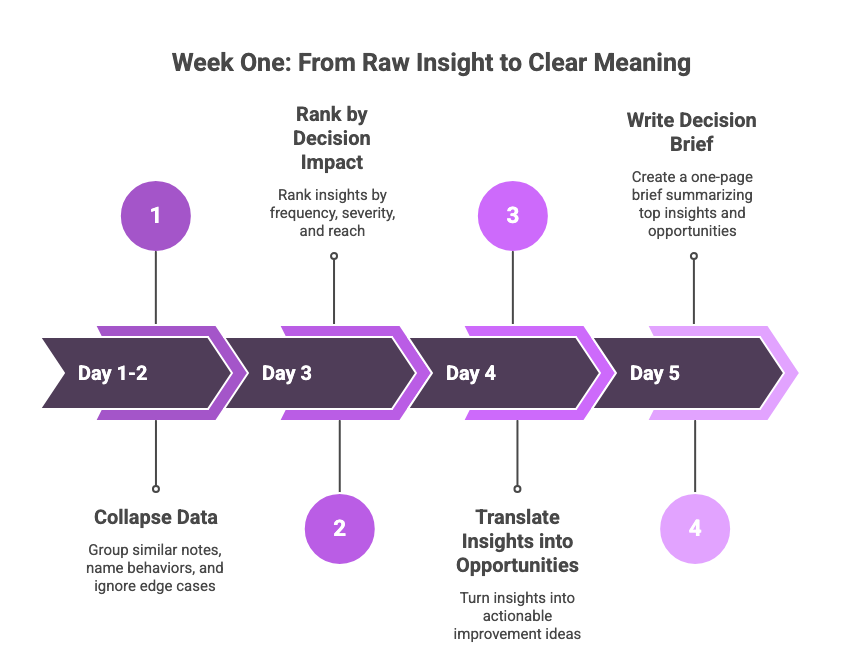
Day 1 to 2: Collapse the data
Stop reading everything.
Start grouping patterns.
A pattern means a repeated behavior, pain, or workaround seen across users.
Do three things:
• Cluster similar notes
• Name the behavior in plain language
• Ignore edge cases for now
Clarity beats completeness.
Day 3: Rank by decision impact
Not all insights deserve action.
Decision impact means how much an insight could change direction if acted on.
Rank insights by:
• Frequency
How often it appears
• Severity
How much it blocks success
• Reach
How many users it affects
High impact insights rise quickly.
Day 4: Translate insights into opportunities
An opportunity describes what could improve if the insight is addressed.
Insight:
“Users hesitate before continuing.”
Opportunity:
“Reduce uncertainty during the first step.”
Opportunities turn observation into direction.
Day 5: Write the decision brief
Create a one-page brief. No slides.
Include:
• Top three insights
• Why they matter
• What could improve if addressed
• Open questions
This brief is the bridge between research and planning.
Week Two: From meaning to commitment
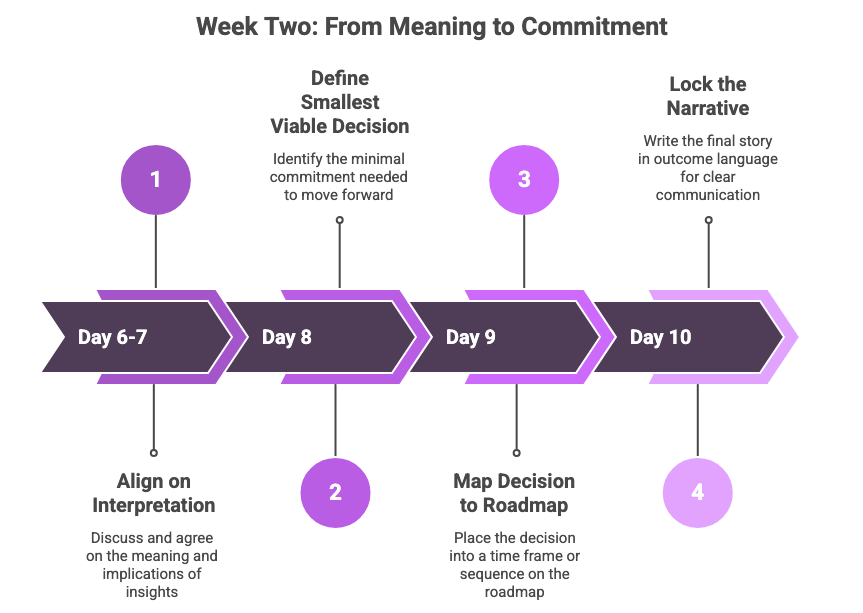
Day 6 to 7: Align on interpretation
Share the brief.
Talk through meaning, not methods.
Interpretation means agreeing on what the insight implies, not debating how it was collected.
Ask:
• What surprised us
• What risk feels highest
• What would hurt most if ignored
Alignment reduces rework later.
Day 8: Define the smallest viable decision
Avoid solution overload.
A smallest viable decision means the minimal commitment that moves things forward.
Examples:
• Focus on one segment
• Prioritize one journey
• Run one targeted experiment
Decisions do not need to be permanent to be useful.
Day 9: Map decision to the roadmap
Roadmaps represent intention, not certainty.
Mapping means placing the decision into a time frame or sequence.
This could be:
• Next sprint
• Next cycle
• Next discovery focus
If it cannot be placed anywhere, the decision is not clear enough.
Day 10: Lock the narrative
Write the final story in outcome language.
Outcome language explains what changes because of the decision.
Example:
“We are focusing on first-time success to reduce early drop-off.”
This narrative travels further than raw data.
Common failure points
• Waiting for perfect synthesis
• Treating insights as deliverables
• Skipping interpretation conversations
• Presenting too many options
• Not naming the trade-off
Decisions require constraint.
Take-Home Exercise
Use this exercise with your next research project.
Pick one completed study
Identify the top three patterns
Write one opportunity per pattern
Choose one opportunity to act on
Define the smallest decision it enables
Place that decision on a two-week timeline
If you cannot complete this exercise, the research is not ready.
Resource Corner
Opportunity framing
Teresa Torres – Opportunity Solution Trees
https://www.producttalk.org/opportunity-solution-tree
How to turn research insights into actionable decisions
Turning Answers Into Insights: How Research Drives Better ...
Final Thought
Research does not create value by existing.
It creates value by narrowing choices.
When insights become decisions quickly, teams move with confidence instead of debate.
Two weeks is enough to move from learning to commitment.
Anything longer is usually avoidance.


