



In real life, people change.
Someone who struggled last year may be confident today.
Someone who made mistakes before may have learned and improved.
Someone who once liked one thing may now prefer something else.
Human growth depends on this ability to move forward.
But many digital products today do not move forward with users.
They remember everything.
Every search.
Every click.
Every mistake.
Every preference.
And that creates new UX problems that designers now have to solve.
This issue explains what “AI memory” really means, why it matters for users, and how to design systems that support growth instead of trapping people in their past.
In This Issue
• Why forgetting is important for learning
• What AI memory means in products
• How constant memory affects users
• The UX risks of permanent data
• How to design systems that allow change
• Take-Home Exercise
• Resource Corner
but first….
Love UX? This one is for you. ❤️
This Valentine’s, fall in love with your next chapter in UX.
We’ve unlocked a limited Valentine’s offer for the next 3 days only.
A chance to step into the conversations, connections, and moments that shape careers.

People come to UXCON for different reasons.
Some come for clarity.
Some come for confidence.
Some leave with opportunities they didn’t even know they needed.
If you’ve ever felt stuck, unsure, or ready for more, you’ll feel at home here.
We’ve unlocked a 3-day Valentine’s offer, valid till Sunday.
Come see what happens when the right people are in the same room.
Why forgetting is important for learning
People learn through trial and error.
Trial and error means trying something, failing, adjusting, and trying again.
When people know their mistakes will not follow them forever, they feel safe to explore.
For example:
• A new user tries the wrong feature
• A learner answers questions incorrectly
• A shopper buys the wrong product
Over time, they improve.
But if systems treat early mistakes as permanent signals, growth slows down.
Users become cautious.
They stop experimenting.
That hurts learning and confidence.
What “AI memory” means in real products
AI memory means systems store past behavior and use it to influence future experiences.
This includes:
• Previous searches
• Messages and chats
• Viewing history
• Purchase behavior
• Feature usage
• Feedback patterns
This data is used to:
• Recommend content
• Suggest actions
• Personalize screens
• Predict interests
• Rank options
Memory makes systems feel “smart.”
But it also makes them less flexible.
Less flexible means slower to adapt when users change.
How permanent memory affects users
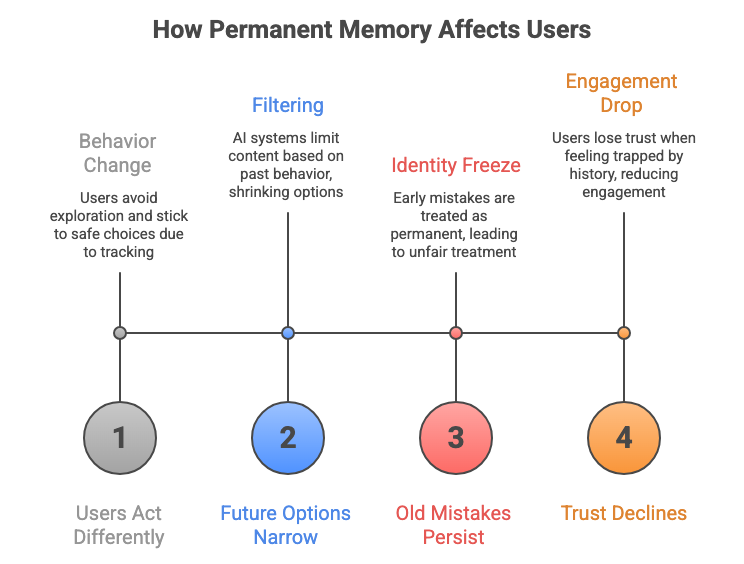
1. It shapes how people behave
When users know everything is tracked, they act differently.
They avoid searching for things they are unsure about.
They hesitate to try new features.
They stick to “safe” choices.
This reduces exploration.
Exploration means trying new things to learn what works.
2. It narrows future options
AI systems learn from past behavior.
If someone once showed interest in something, the system keeps showing similar content.
Over time, options shrink.
This is called “filtering.”
Filtering means limiting what users see based on old data.
3. It keeps old mistakes alive
Examples:
• A learner who struggled early gets easier tasks forever
• A shopper who returned items gets fewer recommendations
• A user who clicked wrongly once gets poor suggestions
These systems treat early behavior as permanent identity.
That is unfair to users who have changed.
4. It reduces trust
When users feel trapped by history, they trust the system less.
Trust means believing the product works in your best interest.
Without trust, engagement drops.
UX risks of permanent memory
If not designed carefully, AI memory creates serious problems.
Identity lock-in
Identity lock-in happens when systems assume users never change.
Example:
Someone who once used beginner content never gets advanced material.
Reduced confidence
Users who feel judged by past behavior doubt themselves.
They think:
“This system thinks I am bad at this.”
Limited growth paths
Products fail to support learning journeys.
Learning journeys mean how users move from beginner to advanced.
Privacy fatigue
Users feel overwhelmed by constant tracking.
They stop caring and disengage.
How to design systems that allow change
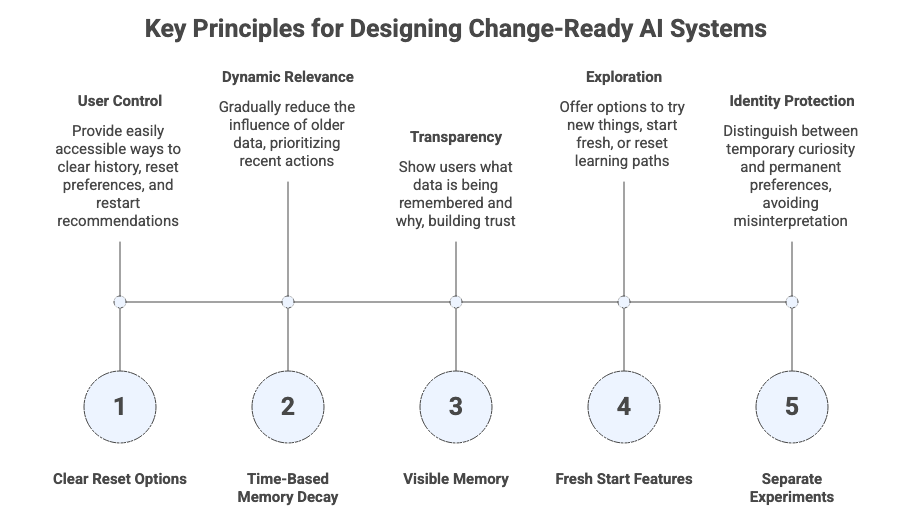
Good UX in AI products must include “digital forgiveness.”
Digital forgiveness means allowing users to reset, improve, and evolve.
Here are practical ways to do that.
1. Provide clear reset options
Let users:
• Clear history
• Reset preferences
• Restart recommendations
Do not hide these settings.
2. Use time-based memory decay
Old data should matter less over time.
Memory decay means older behavior slowly loses influence.
Recent actions should matter more.
3. Show what is being remembered
Make stored data visible.
Example:
“Based on your recent searches…”
This helps users understand the system.
4. Support fresh starts
Add features like:
• “Try something new”
• “Start fresh”
• “Reset learning path”
These invite exploration.
5. Separate experiments from identity
Do not treat temporary curiosity as permanent preference.
Trying once does not mean “this is who I am.”
Examples in everyday products
Good memory design looks like this:
• Music apps that refresh recommendations
• Learning apps that re-evaluate skill level
• Writing tools that ignore old drafts
• Fitness apps that restart programs
• Shopping apps that let users edit interests
These systems adapt as people grow.
Take-Home Exercise
Use this to evaluate any AI-powered product.
List what user data is stored
Check how long it influences experience
Find reset options
Test if new behavior overrides old data
Design one improvement that supports change
Example:
Add a “Reset recommendations” button.
Resource Corner
How AI “remembers”, and what it means for you as a builder
Why memory is key to AI products and UX design
AI Meets UX: How Designers Should Be Thinking About ...
Final Thought
People grow.
Good products grow with them.
AI memory can improve experiences.
But without thoughtful design, it can limit users instead of supporting them.
Great UX in the AI era means building systems that remember what matters and forget what no longer helps.
That is how products earn long-term trust.


