


The mid-level UX role is changing fast.
In the past, being solid at execution was enough.
In 2026, mid-level designers are expected to own direction, not just delivery.
This issue breaks down what “ownership” really means and where mid-level designers need to step up to stay relevant and trusted.
In This Issue
• Why the mid-level role is shifting
• What ownership actually means
• Six areas mid-level designers must own
• What not to wait for permission to do
• Take-Home Exercise
• Resource Corner
Why the mid-level role is shifting
Tools are faster. Templates are everywhere.
Execution is no longer scarce.
What is scarce is judgment.
Judgment means making sound decisions with incomplete information.
By 2026, teams expect mid-level designers to reduce uncertainty, not add more work.
What ownership actually means
Ownership does not mean doing everything alone.
Ownership means:
• Seeing a problem through
• Making decisions visible
• Connecting work to outcomes
• Taking responsibility for impact
It is about influence, not authority.
Six things mid-level designers must own
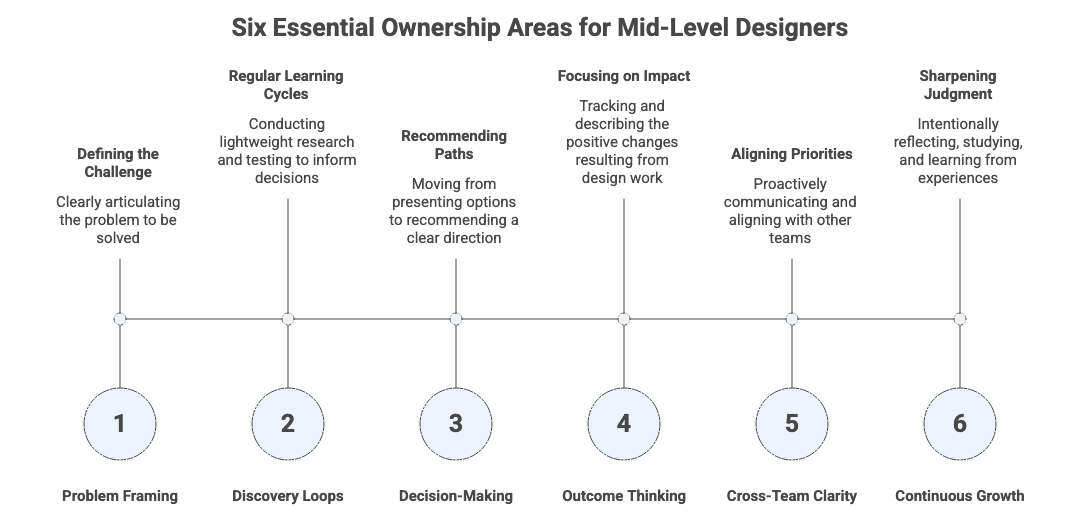
1. Problem framing
Problem framing means clearly defining what issue is being solved.
Mid-level designers must stop waiting for perfect briefs and start clarifying messy problems.
If you cannot explain the problem in one sentence, the work will drift.
2. Discovery loops
Discovery loops are small cycles of learning and testing.
Owning discovery means running lightweight research regularly, even with constraints.
You do not need permission to ask good questions.
3. Decision-making
Decision-making means choosing a direction and naming trade-offs.
Mid-level designers must move from presenting options to recommending paths.
A recommendation signals confidence and clarity.
4. Outcome thinking
Outcome thinking means focusing on what changes, not what ships.
Mid-level designers must track what their work improves, even roughly.
If you cannot describe the outcome, the work feels incomplete.
5. Cross-team clarity
Clarity means helping others understand what matters and why.
Mid-level designers should proactively align on priorities, constraints, and success signals.
Clear communication reduces rework and builds trust.
6. Continuous growth
Growth means intentionally sharpening judgment over time.
This includes:
• Reflecting on decisions
• Studying stronger practitioners
• Learning from failures
Waiting for promotion criteria slows progress.
What not to wait for permission to do
• Clarify the problem
• Talk to users
• Propose a direction
• Write a short decision brief
• Track outcomes after launch
Ownership starts before the title changes.
Upcoming…..
Mastering UX & Product Management Collaboration
Great products don’t happen in silos.

They happen when UX and Product teams make decisions together, understand tradeoffs, and share the same outcomes.
Join us for a practical session where UX pros and Product Managers unpack how work really gets done. Learn how to influence direction without formal authority, navigate collaboration breakdowns, and leverage AI in your workflows while building stronger, more productive relationships across teams.
Walk away with frameworks, language, and actionable ideas you can apply immediately with your team.
Stop working in silos. Start building together.
JOIN US AT UXCON26
Some careers aren’t planned on a road map, they’re shaped by choices, pivots, and moments of courage.
At UXCON25, Dan Flounders didn’t just sit on a panel, he shared the personal journey that brought him there. The setbacks, the learning curves, and the quiet decisions that compound into leadership. It was a powerful reminder that experience isn’t measured by titles, but by the stories that sharpen your perspective.
Conversations like these are why UXCON isn’t just a conference, it’s a catalyst.
🎟️ UXCON26 tickets are now available, grab yours today:
Take-Home Exercise
Use this exercise to identify your next growth step.
Think about your current work
Identify one area where you are mostly executing
Choose one way to increase ownership this month
Write down one decision you will influence
Track the outcome
Small steps compound quickly.
Resource Corner
Why UX Designers Are Shifting Away From Their Careers
User experience(UX) design career path - Lyssna
Highest Paying Jobs in UI UX and What’s Reshaping the ...
Final Thought
Mid-level designers who wait for permission will stall.
Those who take ownership, clarify problems, and connect work to outcomes will move forward, regardless of title.
In 2026, ownership is the real differentiator.


