



You’ve sent out 47 applications this month. Maybe you got two responses, both rejections. You keep hearing “we went with someone else” or just... silence. Meanwhile, you’re watching people with fewer years of experience land interviews. Here’s what nobody’s telling you: it’s probably not your skills. It’s your portfolio. And the fix is simpler than you think.
In this issue:
Why “good work” isn’t enough to get interviews
The 3 things that get your portfolio closed in 30 seconds
What hiring managers actually look for (and how long they look)
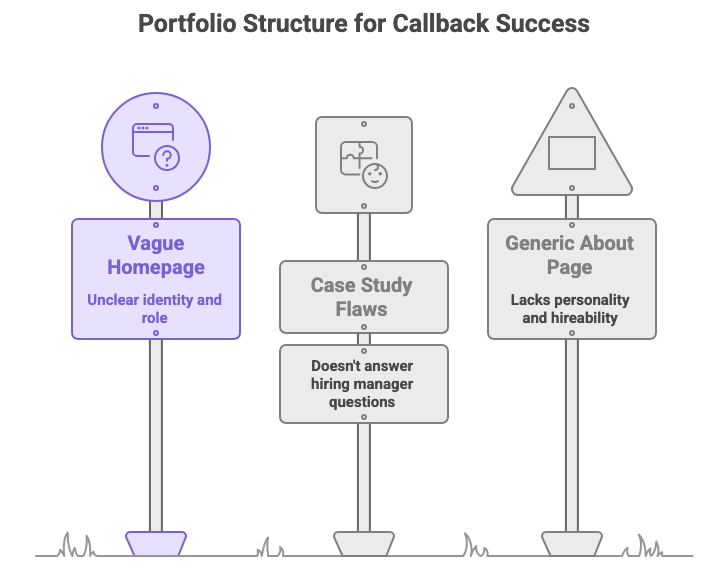
The portfolio structure that gets callbacks
How to present projects when you don’t have “real” client work
📦 Resource Corner
Why “good work” isn’t enough to get interviews
Here’s the hard part: your design skills might actually be solid. Your screens might look great. Your prototypes might be smooth. But none of that matters if a hiring manager closes your portfolio after 30 seconds.
And that’s the reality. Most hiring managers spend less than 2 minutes on a portfolio during initial screening. Some spend 30 seconds. They’re not studying your work deeply. They’re looking for reasons to move you to the “yes” pile or the “no” pile, fast.
This isn’t because they’re lazy. It’s because they’re looking at 50+ portfolios for a single role. They need a filtering mechanism. And that mechanism isn’t “is this person talented?” It’s “can this person clearly show me they can do the job I’m hiring for?”
That’s a different question. And most portfolios don’t answer it.
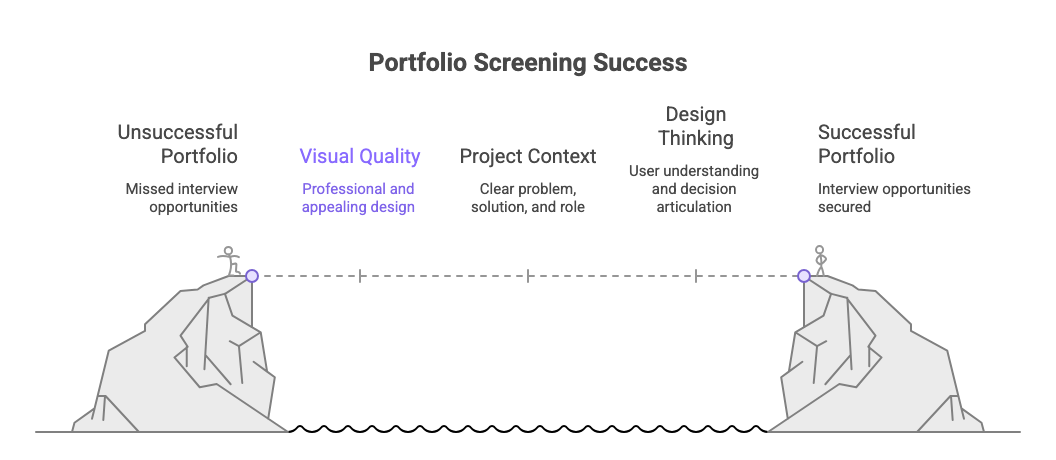
Here’s what actually happens when someone opens your portfolio:
First 10 seconds: They’re scanning for visual quality and professionalism. Does this look like the work of someone who takes design seriously? This is surface-level, but it matters.
Next 20-40 seconds: They’re looking for context. What kind of projects are these? Can I quickly understand what you did? Is there a clear problem and solution?
If you make it past that: They’re reading one project more carefully to see if you think like a designer. Do you understand users? Can you articulate decisions? Do you show process or just outcomes?
Most portfolios fail at step 2. They show beautiful screens with no context, or they bury the context so deep that hiring managers give up looking for it.
Join us this Thursday in Silver Spring

Something feels off when UX and Product aren’t actually working together. You feel it in the meetings. You feel it in the product.
This Thursday we’re fixing that conversation.
Ivan Carter, Leo Hoar, Tad Marsili, Caitlin Cooper, and Teyibo are coming together to talk about what real collaboration looks like, what gets in the way, and what actually works.
Come through. It’s free, it’s in Silver Spring, and it’s worth your Thursday evening.
March 5 · 6 to 9 PM EST Silver Spring Civic Building · Silver Spring, MD
The 3 things that get your portfolio closed in 30 seconds
Let’s be specific about what kills portfolios quickly. These aren’t subtle issues. They’re instant disqualifiers.
❌ 1. No clear explanation of what you actually did
“Redesigned the checkout flow for an e-commerce app” tells me nothing. Did you do user research? Did you design the whole thing solo? Were you one person on a team of five? Did you just make it look prettier or did you solve a real problem?
Hiring managers need to know what YOUR contribution was. Not the team’s. Not the company’s. Yours. When this is unclear, they assume you didn’t do much, or worse, that you’re hiding something.
The fix: Every project needs a clear “My Role” section right at the top. Be specific. “I conducted 8 user interviews, synthesized findings into 3 key pain points, designed and tested 2 solutions, and delivered final mockups to the dev team.” That’s clear. That’s hireable.
❌ 2. Only showing final designs with no process
A grid of polished screens tells me you can use Figma. It doesn’t tell me you can solve problems. And problem-solving is the job.
This is the most common portfolio mistake, especially among designers who learned UX through online courses or bootcamps. They present case studies like product showcases instead of problem-solving narratives. (Source: Nielsen Norman Group on Portfolio Research)
The fix: Show your thinking. Show research insights, wireframes, iteration, testing results. Show what you tried that didn’t work and why you changed direction. This proves you can do the messy, strategic work that happens before the pretty screens.
❌ 3. Projects that don’t match the job you’re applying for
If you’re applying for a B2B SaaS role and your portfolio is full of colorful consumer apps and personal passion projects, that’s a mismatch. Hiring managers want proof you can do their type of work, not just any work.
This doesn’t mean you need a different portfolio for every application, but it means you need range, or you need to be strategic about what you lead with.
The fix: Reorder your projects based on relevance. Put the most relevant one first. If you don’t have relevant work, create a spec project that demonstrates you understand the domain. One targeted case study is worth five generic ones.
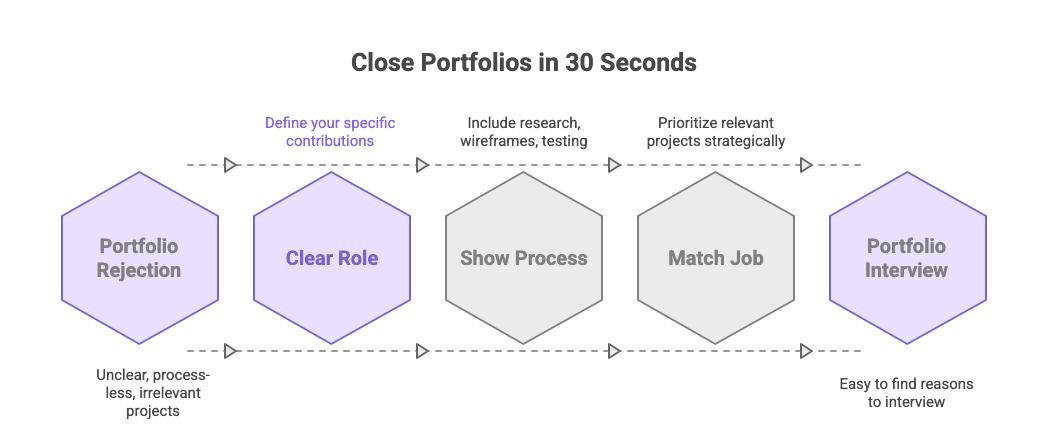
💡 Reality check: Hiring managers aren’t trying to find reasons to reject you. They’re trying to find reasons to interview you. Make it easy for them.
What hiring managers actually look for (and how long they look)
Let’s get inside the decision-making process, because understanding this changes how you structure everything.
When a hiring manager opens your portfolio, they’re asking these questions in order:
Question 1: Does this person’s work look professional? (10 seconds) This is about visual craft and polish. Clean layouts, good typography, intentional use of color and spacing. If your portfolio itself is poorly designed, that’s an instant red flag.
Question 2: Can I quickly tell what this person does? (20 seconds) Is there a clear headline or intro that says “I’m a product designer who specializes in...” or “I’m a UX researcher focused on...”? Or do they have to hunt for it?
Question 3: Do these projects seem relevant to what I need? (30 seconds) Scanning project titles and thumbnails. Looking for keywords and visual cues that match the job. If they don’t see it quickly, they move on.
Question 4: Can this person explain their work clearly? (1-2 minutes) Reading one project summary. Looking for: problem statement, your role, what you did, what the outcome was. If this is unclear or overly long, they stop reading.
Question 5: Do they think like a designer I’d want on my team? (2-5 minutes) If they made it this far, they’re reading a full case study. They want to see: user research or user understanding, clear design rationale, iteration based on feedback, measurable or meaningful outcomes.
Most portfolios lose people at Question 3 or 4. Not because the work is bad, but because the presentation makes it too hard to find the answers.
The portfolio structure that gets callbacks
Okay, so what actually works? Here’s a structure that consistently gets positive responses from hiring managers, based on what they’ve said they look for.
1. Homepage: Make it instantly clear who you are and what you do
Not “I’m a creative problem solver passionate about user-centered design.” That’s everyone. Be specific.
✅ Good: “Product designer focused on complex B2B tools. I turn messy workflows into intuitive systems.” ✅ Good: “UX researcher specializing in early-stage discovery for fintech products.”
Then show 3-5 of your best projects with:
A clear project title
One sentence about what it is
A strong visual thumbnail
2. Case study structure: Answer the hiring manager’s questions upfront
Every case study should follow this flow:
→ Project overview (top of page, can’t be missed)
What the project was
Your role (specific)
Timeline
Tools used
Team context if relevant
→ The problem (1-2 paragraphs max) What user problem or business challenge were you solving? Be specific. Use real context. “Users were abandoning checkout at a 68% rate” is more compelling than “checkout needed improvement.”
→ Research/Discovery (show your thinking) What did you do to understand the problem? User interviews? Analytics? Competitive analysis? Show a few key insights, not everything. Use quotes, photos, data visualizations. (Source: NNG on Showing UX Work)
→ Design process (show iteration, not just finals) Sketches or wireframes. Multiple concepts you explored. Why you chose one direction over another. What changed after testing or feedback. This section proves you can think, not just execute.
→ Final solution (now show the polished work) High-fidelity designs. Prototypes. Annotated screens that explain key decisions. Make it visual, but always with context.
→ Impact (prove it mattered) Metrics if you have them: “Reduced support tickets by 34%” or “Increased conversion by 12%.” Qualitative feedback if you don’t: user quotes, stakeholder reactions, what shipped and how it’s being used.
→ Reflection (optional but powerful) What you learned. What you’d do differently. This shows self-awareness and growth mindset, which hiring managers love.
3. About page: Make yourself memorable and hireable
This is where personality matters. Don’t just list skills. Tell a story about why you do UX work, what you care about, what kind of teams you thrive in.
Include a professional photo. Link to your LinkedIn. Make it easy to contact you. Add a line about what you’re looking for: “Currently seeking a product design role at an early-stage startup where I can own projects end-to-end.”
How to present projects when you don’t have “real” client work
This is the anxiety every junior designer or career switcher faces: “My portfolio is all practice projects. Will anyone take me seriously?”
Short answer: yes, if you present them right.
What doesn’t work: Calling them “concept projects” or “passion projects” or apologizing for them. Don’t say “this is just a fake project I made up.” That kills your credibility immediately.
What does work: Treating them like real projects with real constraints. Here’s how:
→ Pick real problems to solve Don’t redesign Instagram for the 100th time. Find an actual problem in a product you use, or an underserved user group, or a local business that could use help. Make it specific and grounded.
Example: “I noticed my local library’s website had a 12-step process to reserve a book. I redesigned it based on research with 5 regular library users.” That’s real and relatable.
→ Do actual research Talk to real people. Even 5 interviews is research. Run a usability test with friends or family. Look at reviews and complaints. Treat it like a real project because the skills you’re demonstrating are real.
→ Define realistic constraints “I gave myself 2 weeks and a mobile-first constraint because most library users access the site on their phones.” Constraints show you understand how real design work happens, not in a vacuum.
→ Present it professionally Use the same case study structure you’d use for client work. Don’t apologize. Present your thinking, your process, your decisions. The fact that it’s not shipped doesn’t matter if you can prove you know how to think through design problems.
🎯 Take-home: Self-initiated projects are only a problem if you present them like you’re embarrassed by them. Present them like real work, and they become real portfolio pieces.
📦 Resource Corner
Bestfolios A curated collection of strong UX portfolios. Study what works. Notice patterns in how the best portfolios structure case studies and present thinking.
Cofolios Another excellent portfolio gallery with filtering by role type. Especially useful for seeing how people present different kinds of work.
Case Study Club A collection of well-structured case studies across different design disciplines. Great for studying narrative flow and presentation techniques.
How to Build a UX Portfolio (NN/g Article) Research-backed guidance from Nielsen Norman Group on what actually matters in UX portfolios. Based on studies of what hiring managers look for.
Lapa Ninja Landing page inspiration, but useful for portfolio homepage design. Shows effective ways to present yourself and your work at a glance.
Figma Portfolio Templates Free templates to give you a structural starting point. Don’t copy them directly, but use them to understand professional portfolio layouts.
💭 Final Thought
Your portfolio rejection isn’t personal. It’s structural.
The difference between a portfolio that gets interviews and one that doesn’t usually isn’t talent. It’s clarity. It’s making it easy for someone who’s looking at 50 portfolios in one afternoon to quickly see: this person can do the job, this person can think through problems, this person can communicate their work.
That’s it. That’s the bar.
You don’t need more projects. You don’t need more years of experience. You need to present what you already have in a way that answers the questions hiring managers are actually asking.
Fix the structure. Show your thinking. Make your role clear. Do that, and the interviews will come.


