



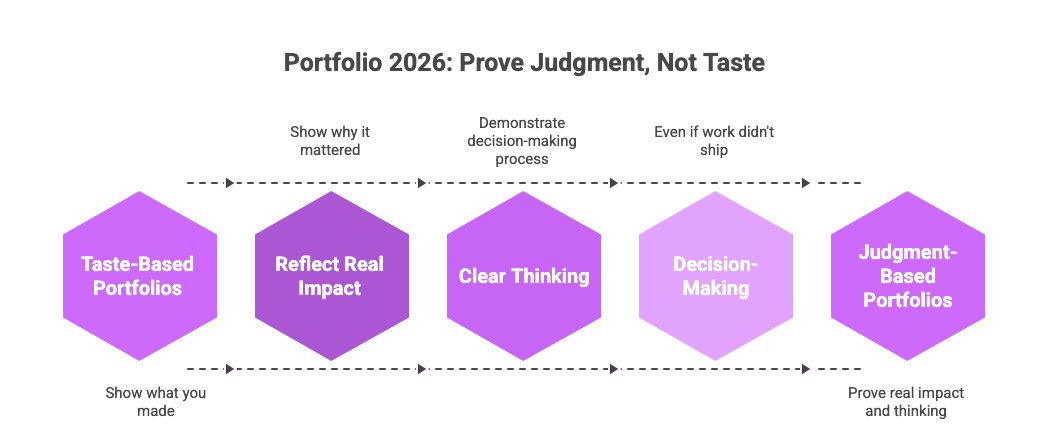
Portfolios used to prove taste.
In 2026, they prove judgment.
Screens show what you made.
Outcome stories show why it mattered.
This issue breaks down how to build a portfolio that reflects real impact, clear thinking, and decision-making. Even if your work never shipped exactly as planned.
In This Issue
• Why screen-first portfolios fail
• What an outcome story is
• The 2026 portfolio structure
• What to include and exclude
• Before and after examples
• Take-Home Exercise
• Resource Corner
But first….
We’re hoping to better understand how people truly feel about conferences today—what works, what doesn’t, and what would genuinely make a conference worth attending and paying for. Your honest feedback would mean a lot and will directly help us design better, more valuable experiences.
Why screen-first portfolios fail
Screens are easy to produce and hard to evaluate.
They show craft but hide context.
Context means the constraints, trade-offs, and realities around the work.
By 2026, reviewers want to understand:
• What problem you tackled
• What decision you influenced
• What changed because of it
If a portfolio cannot answer those, it feels shallow.
What an outcome story is
An outcome story explains how your work changed something meaningful.
An outcome means a measurable or observable improvement, such as increased completion or reduced confusion.
An outcome story includes:
• The problem
• The decision
• The result
Screens support the story. They are not the story.
The 2026 portfolio structure
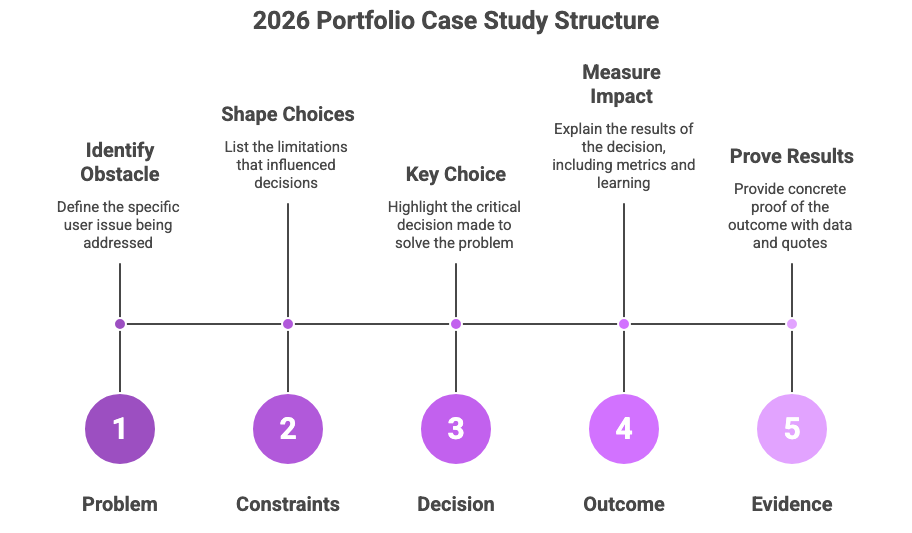
Every case study should follow this simple structure.
1. The problem
Explain the real issue you were addressing.
A problem means the specific obstacle users faced that prevented success.
Example:
“Despite strong acquisition, new users were abandoning the account setup process before completion, leading to an abandonment rate of 80% during onboarding”
2. The constraints
Describe what shaped your choices.
Constraints include:
• Time
• Scope
• Existing systems
• Conflicting goals
Constraints show realism and maturity.
Example: Data / instrumentation constraints
Limited behavioral data
”Analytics showed where users dropped off but did not explain why, requiring qualitative research to fill in the gaps.”
3. The decision
Highlight the key decision you influenced.
A decision means choosing one direction over others.
Example:
“Based on research findings, we chose to introduce a guided decision step instead of asking users to self-select an option upfront.”
4. The outcome
Explain what changed.
An outcome is the effect your decision had.
Example:
“Setup completion increased, and early-stage support requests related to onboarding decreased.”
If nothing shipped, explain what was learned.
Learning is still an outcome.
Example:
“The research clarified that drop-off was driven by decision uncertainty rather than technical friction, allowing the team to deprioritize performance optimizations in favor of clearer guidance.”
5. The evidence
Show proof, not polish.
Evidence could be:
• Metrics e.g. setup completion rate before and after the change
• User quotes
• Before and after comparisons
• Stakeholder alignment
Screens belong here, in service of the story.
JOIN US AT UXCON26
The UX industry is shifting... fast.
AI is rewriting the way we work, teams are demanding business outcomes, and careers are moving through rooms, not résumés.
That’s why UXCON26 matters.
It’s not just talks and workshops... it’s where the people shaping the field show up.
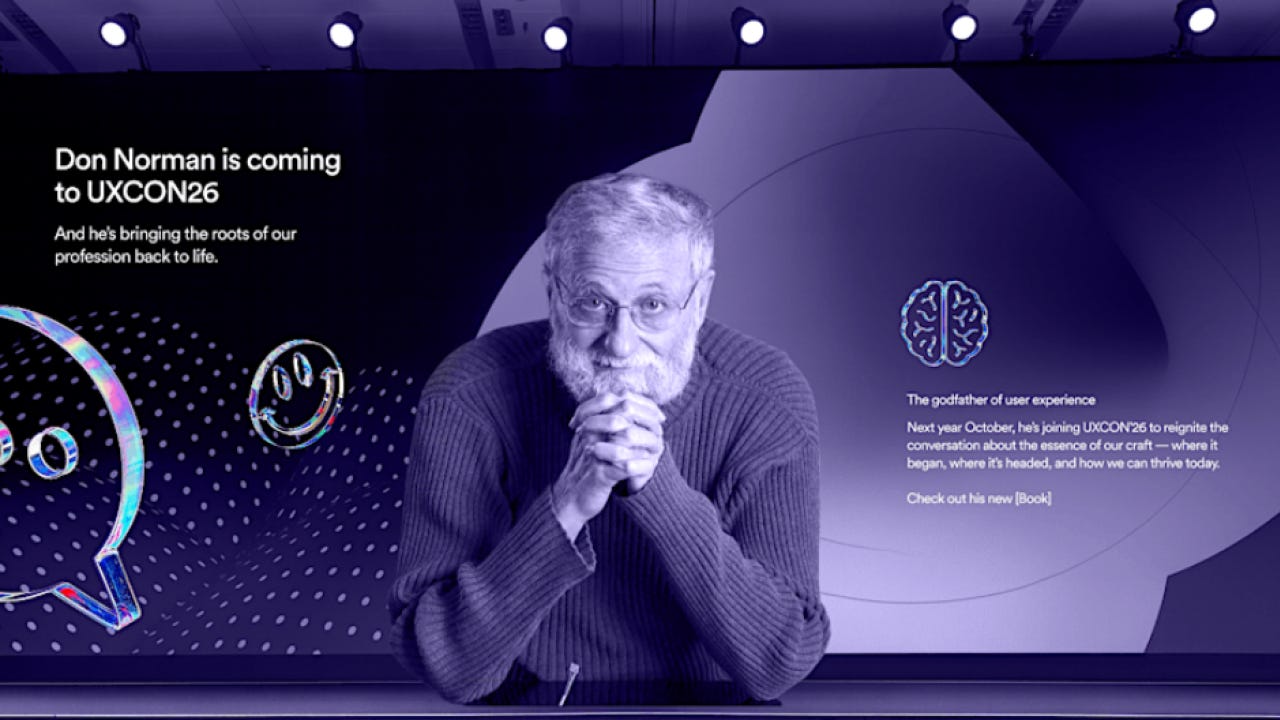
This year, we’re joined by Don Norman whose work defined User Experience before most of us even had the title.
Because the future of UX won’t be decided on Twitter threads or slides.
It’ll be shaped in conversations, in debates, and in the rooms where perspective and community collide.
If you’re ready to evolve with the field, connect with the right minds, and learn from the voices who built it, this is your moment.
back to where we stopped
What to include in 2026
Include work that shows:
• Decision-making under pressure
• Trade-offs
• Learning from failure
• Influence without authority
• Clear problem framing
These signal readiness far more than visual perfection.
What to leave out
Avoid:
Long process explanations
Uncontextualized Tool list (instead of listing tools as a section, embed them where they matter)
If you want to list tools, list them in your resume where keyword matching take place, after all this is what is looked at first.
Every iteration
Pixel-perfect mockups without context
Case studies with no outcome
Less content with more meaning wins.
Before and after example
Before:
“I redesigned the onboarding screens.”
After:
“We reduced first-step confusion by clarifying options, which increased early completion.”
The second tells a story.
The first lists an activity.
Take-Home Exercise
Rewrite one case study using this structure.
Write the problem in one sentence
List the real constraints
Name the key decision you influenced
Describe what changed
Add only the screens that support the story
If you struggle to write the outcome, that is the work to do next.
Resource Corner
The 10 Most Inspirational UX Design Portfolio Examples in ...
Why UX Portfolios Must Evolve in 2026
Final Thought
Screens impress quickly.
Outcomes stick.
A strong 2026 portfolio does not show everything you did.
It shows how you think, decide, and learn.
Tell outcome stories.
Let the screens support the truth.


