



Are your skills becoming obsolete faster than you can learn new ones?
In today’s hyper-accelerated tech landscape, the uncomfortable truth is: probably yes.
AI, automation, and new tooling are reshaping roles quietly and relentlessly.
But what if there were a simple, counterintuitive strategy that could protect your career, and even make you more valuable over time?
Today, we’re unpacking why continuous interviewing (even when you’re not job-hunting) is one of the most powerful defenses against skill obsolescence, and how to use it strategically.
What Is Continuous Interviewing (Really)?
Continuous interviewing is the practice of regularly engaging with the job market even when you’re employed, stable, and not actively looking.
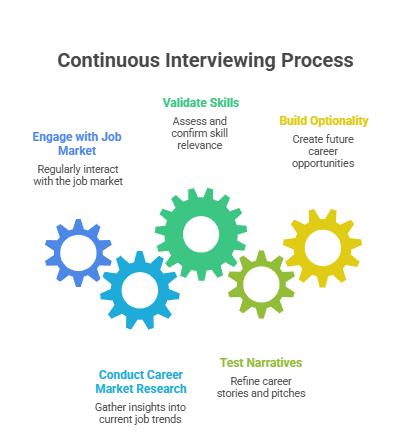
It is:
Career market research
Skill validation
Narrative testing
Optionality building
It is not:
Disloyalty
Job hopping
Panic interviewing
Think of it as career maintenance, not career escape.
Why this Matters (Especially Now)
The pace of change since 2020 has been unforgiving
In just a few years, we’ve seen:
AI systems automate tasks that once defined entire roles
Research, design, and analytics tools collapse workflows from weeks to minutes
Job descriptions quietly shift expectations without changing titles
Skills that were “must-have” not long ago are now optional — or ignored entirely.
Skill decay rarely comes with a warning. It just shows up as fewer callbacks… or stalled growth.
The real problem
Most professionals ask the wrong question:
“How do I keep learning?”
The better question is:
“How do I know what the market actually values right now?”
That’s where continuous interviewing comes in.
The Interview Advantage: Beyond the Job Offer
Interviews are market research in disguise
Every interview is a live snapshot of:
What companies are prioritizing today
What problems they’re actively struggling with
What skills they’re willing to pay for
Instead of guessing where the industry is going, interviews let you observe it directly.
Interview questions reveal future-proof skills
Pay close attention to:
What you’re asked repeatedly
Where interviewers probe deeper
Which skills they assume you already have
Patterns emerge quickly, and those patterns are signals.
You sharpen your value proposition
Interviewing forces clarity:
Can you explain your impact concisely?
Do your examples resonate with today’s problems?
Where do you stumble or feel underprepared?
Every interview stress-tests your professional narrative — safely.
The Skill Scan: Decoding Market Signals
This is where interviewing becomes strategic, not random.
1. Analyze Job Descriptions Ruthlessly
After interviews, review:
Repeated tools, frameworks, or methodologies
“Nice-to-have” skills that keep showing up
Language shifts (e.g., “AI-assisted,” “cross-functional,” “systems thinking”)
If a skill appears across companies and roles, it’s not optional anymore.
2. Track Compensation Signals
Interviewing reveals:
Which skills increase leverage
Where seniority expectations are shifting
What combinations of skills command higher pay
This helps you invest your learning time where ROI is highest.
3. Decode Cultural Expectations
Different companies surface different priorities:
Ownership vs collaboration
Speed vs rigor
Strategy vs execution
Understanding these signals helps you adapt — or intentionally opt out.
Future-Proofing Your Portfolio: Actionable Steps
Insight without action is wasted signal. Here’s how to convert interviews into advantage.
1. Acquire Skills Intentionally
Based on interview patterns:
Take targeted courses (not everything)
Build side projects that mirror real problems
Pursue certifications only when they map directly to demand
Learning without market validation is expensive guesswork.
2. Tune Your Resume & LinkedIn
Use interview feedback to:
Rewrite bullets using language employers already respond to
Highlight outcomes that interviewers cared about
Remove outdated tools or deprioritize fading skills
Your profile should evolve as fast as the market does.
3. Build a Future-Focused Network
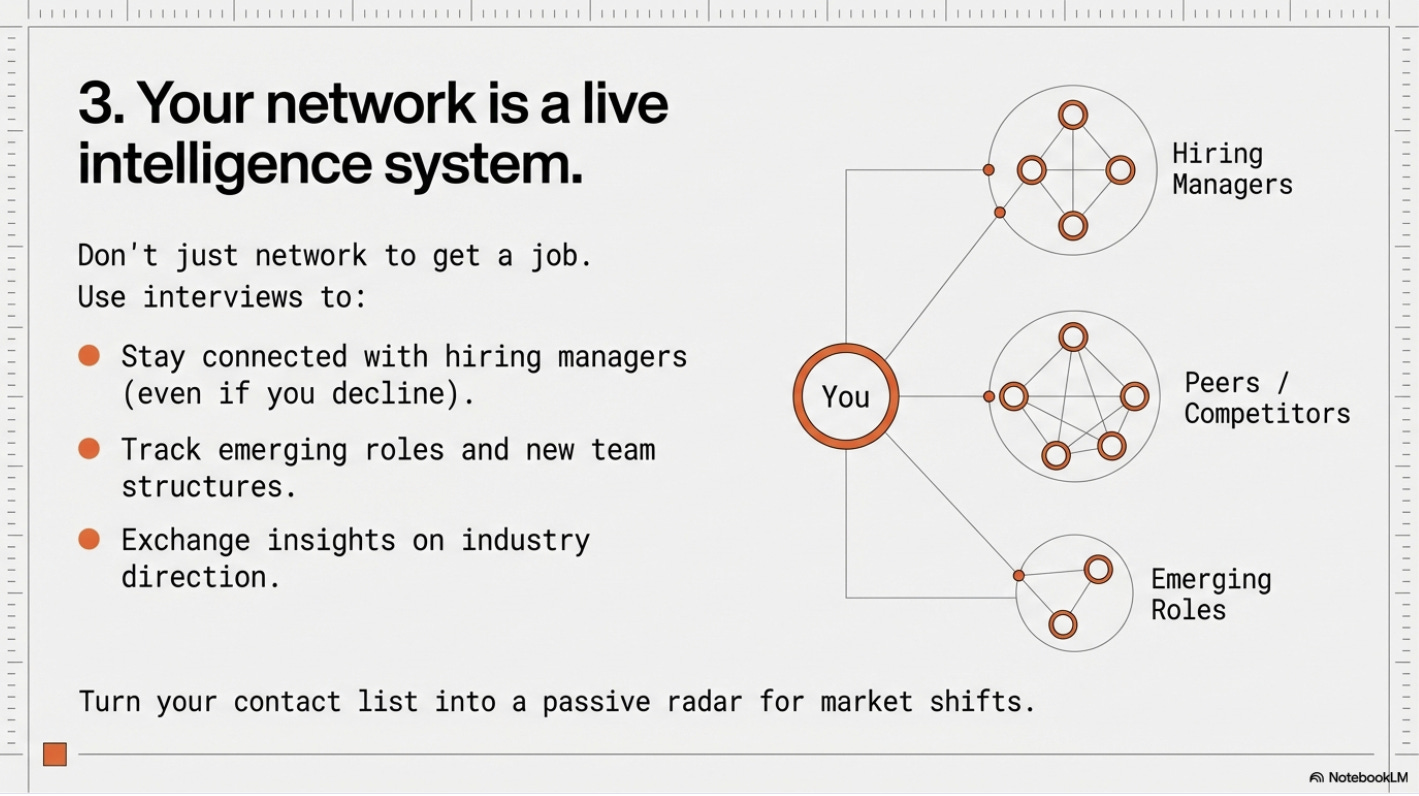
Use interviews to:
Stay connected with hiring managers and peers
Track emerging roles and teams
Exchange insights about where the industry is heading
Your network becomes a live intelligence system.
Always be Interviewing
Always be interviewing.
Because growth does not happen in comfort.
It happens in conversations.
The best UX professionals do not wait for change.
They stay sharp.
They stay curious.
They stay ready.
At UXCON 26, we are bringing together people who treat their careers the same way.
Intentional. Evolving. Always learning.
If you care about staying relevant in a fast-moving industry, you should be in that room.
Join us at UXCON 26 and surround yourself with people who refuse to stand still.
Your Career as a Start-up
The most resilient professionals treat their careers like start-ups.
They:
Validate regularly with the market
Pivot when signals change
Invest in learning strategically, not emotionally
Continuous interviewing is your customer discovery.
Lifelong learning isn’t enough
Plenty of people are learning the wrong things.
The real edge comes from:
Learning what’s in demand
Testing your positioning often
Adapting before stagnation sets in
Defense becomes offense
Always interviewing:
Protects you from sudden market shifts
Expands optionality
Makes you confident, not reactive
It’s not about leaving your job.
It’s about never being trapped by it.
Final Thought
Skill obsolescence isn’t a future threat.
It’s a present condition.
The professionals who thrive aren’t the smartest or busiest; they’re the most market-aware.
Interview often. Listen carefully. Adapt deliberately.
Your career will thank you.


