



You have a streak somewhere. A language app, a fitness tracker, a habit tool. And you have felt the specific dread of almost losing it, the way a 200-day count in the corner of a screen can compel you to open an app at 11:58pm just so the number does not reset.
That feeling is not an accident. It is one of the most powerful and most studied mechanics in all of product design, and it works with almost unfair effectiveness. It is also sitting one design decision away from being a dark pattern.
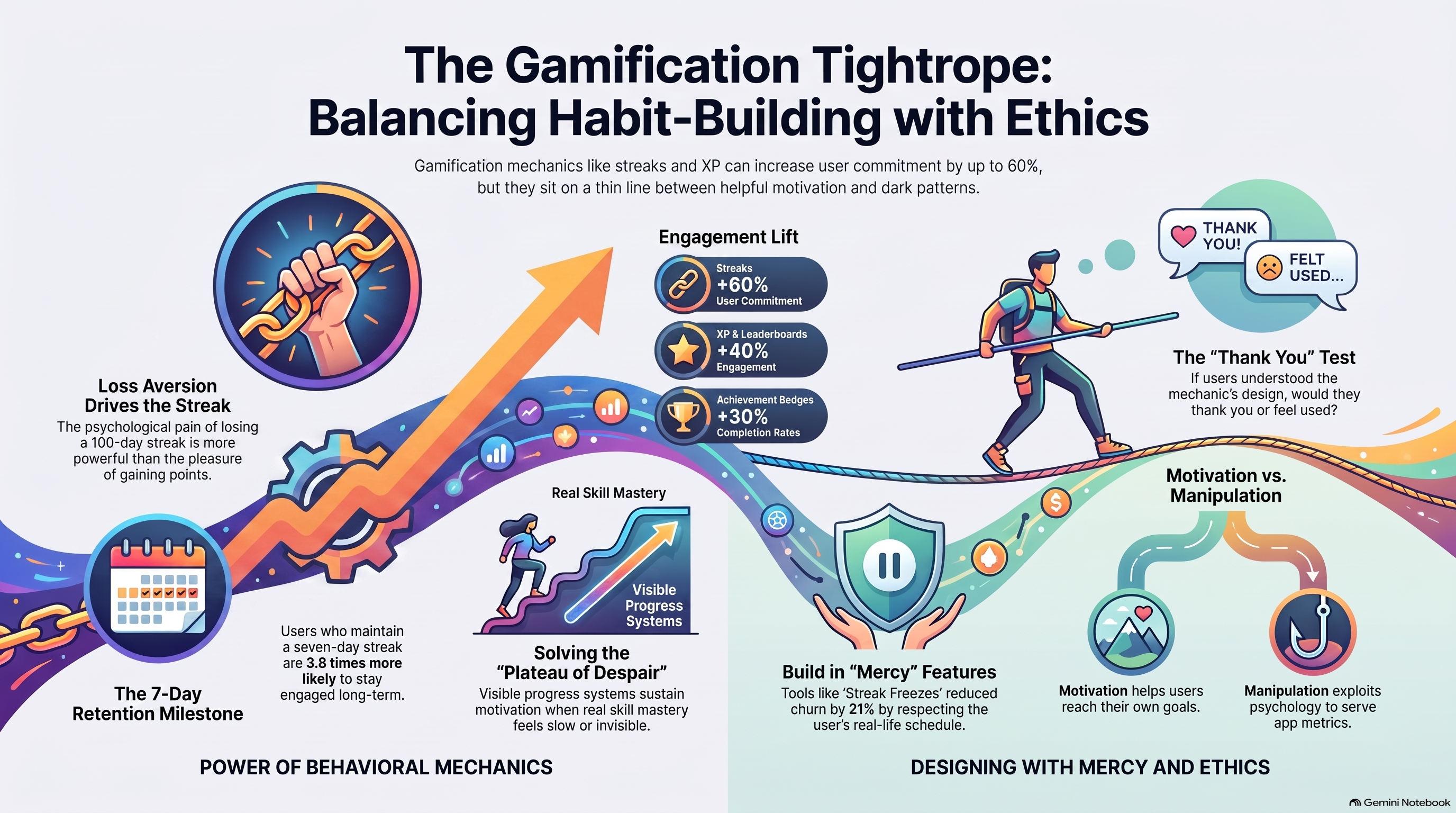
Gamification is having a serious moment in 2026, partly because the data behind it is staggering and partly because the line between motivating people and manipulating them has never been thinner or more legally consequential. This issue is about how gamification actually works, why it works, and where the line sits between a product that helps you and one that just exploits your psychology.
In this issue:
The numbers that make gamification impossible to ignore
Why streaks work on the human brain
What Duolingo actually gets right
The line between motivation and manipulation
How to use these mechanics responsibly
Resource Corner
The numbers that make gamification hard to ignore
Gamification works because it gives people reasons to return, progress, and keep going.
Streaks can increase commitment by ~60%.
XP and leaderboards can lift engagement by ~40%.
Achievement badges can improve completion rates by ~30%.
Duolingo shows what that can look like at scale. Since 2019, its daily active users have grown more than tenfold, while churn in core markets reportedly fell from 47% in 2020 to 28% by 2026.
And streaks appear to matter. Users who reach a seven-day streak are 3.6× more likely to stay engaged long-term.
One number is especially interesting: when Duolingo introduced Streak Freeze, allowing users to protect their progress after missing a day, churn among at-risk users dropped by 21%.(this is a whole ethical story of gamification in a single number, and we will come back to it).
The bottom line: Gamification is not decoration. It is a behavioral design tool. And the more powerful the tool, the more thoughtfully it needs to be used.
Why streaks work on the human brain
To use these mechanics well, you have to understand why they work, and the answer is rooted in well-established psychology.
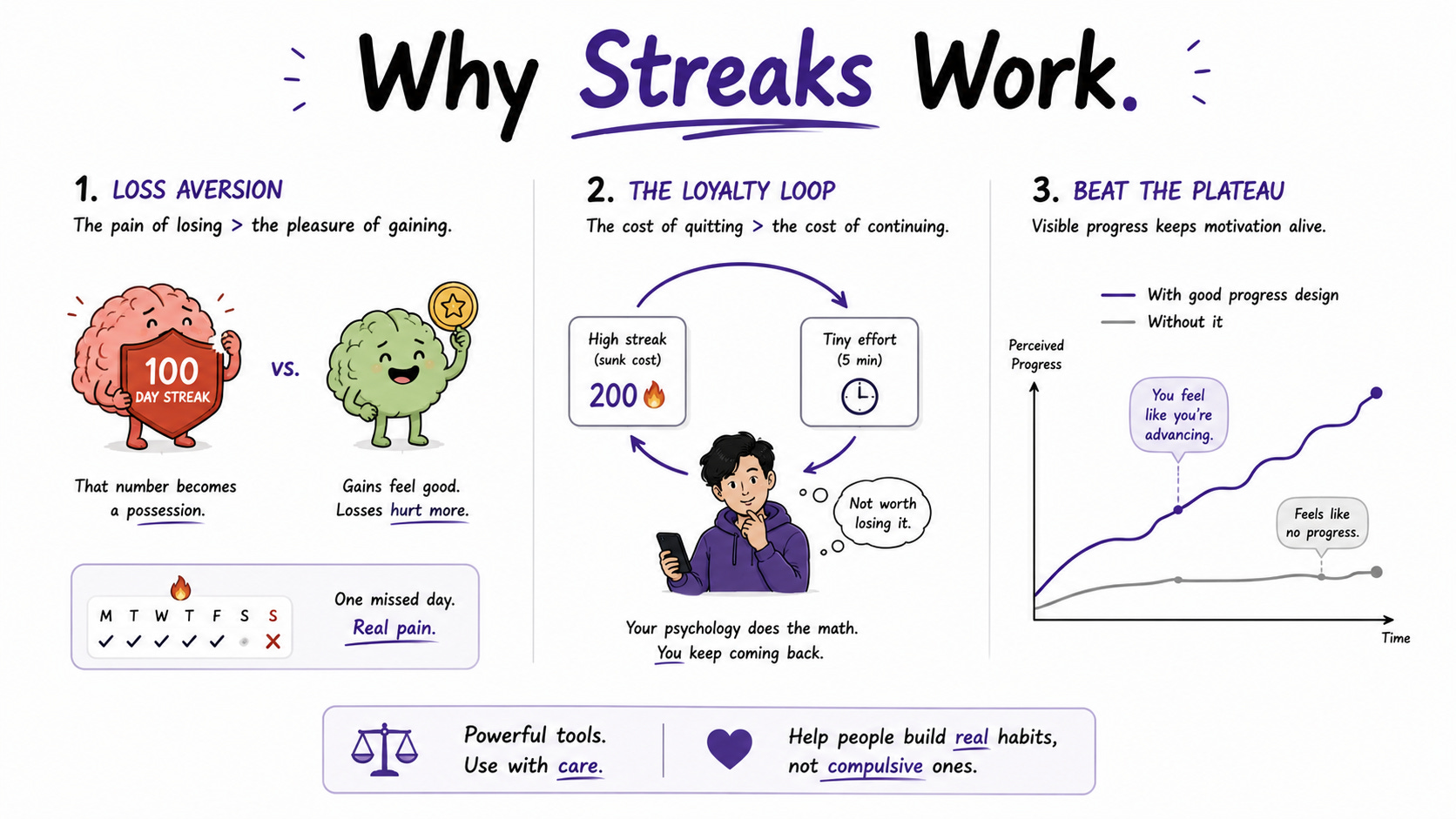
Streaks work because they tap into a powerful psychological principle: loss aversion.
We tend to feel the pain of losing something more strongly than the pleasure of gaining something of equal value. So once someone builds a 100-day streak, it stops feeling like a number. It starts feeling like something they own.
That changes the motivation.
“Complete a lesson to earn points” offers a reward.
“Come back today or lose your 200-day streak” introduces a potential loss.
And potential loss can be a much stronger reason to act.
There is also the loyalty loop. The longer a streak becomes, the more expensive quitting feels. Five minutes in an app can seem like a small price to pay compared with losing months of visible progress.
That is what makes streaks both brilliant and complicated. The same mechanic that helps someone build a healthy habit can also make disengaging feel unnecessarily difficult.
Good gamification can also help users through the “plateau of despair”: the stage where effort is high, but improvement feels invisible. Progress bars, milestones, levels, and streaks give people evidence that they are still moving forward, even when mastery is slow.
That distinction matters: good gamification supports motivation. Bad gamification exploits it.
What Duolingo actually gets right
Duolingo is often held up as the poster child for gamification, but the useful lesson is not simply that it uses streaks, XP, and leaderboards. It is how those mechanics work together.
1. Everything connects.
Completing one lesson can extend your streak, earn XP, improve your league position, and move you toward an achievement. The system feels cohesive rather than like a collection of random rewards.
2. It gives users room to fail.
This is where features like Streak Freeze matter. Missing one day does not have to erase months of progress. Duolingo has also softened some of the pressure around streaks over time, including its notification approach.
The interesting part? Reducing that pressure did not undermine retention. Streak Freeze reportedly reduced churn among at-risk users by 21%.
That is an important design lesson: being kinder to the user does not necessarily mean sacrificing business outcomes.
3. It has personality.
Duo the Owl turns what could feel like a repetitive learning system into something more human, playful, and memorable. The mechanics create momentum; the personality creates connection.
The common thread is simple: the game serves a goal the user already wants to achieve.
Duolingo is not trying to manufacture a desire to learn a language. It is helping people stay motivated to do something they already decided matters to them.
That is where good gamification starts
The line between motivation and manipulation
Gamification becomes risky when the goal quietly shifts from helping the user succeed to keeping the user engaged at any cost.
The mechanics themselves are not the problem. Streaks, points, badges, and leaderboards are just tools. What matters is who they are designed to serve.
A useful question to ask is:
Is this helping users do something they genuinely want to do, or exploiting their psychology to improve a metric?
Motivation looks like:
Streaks that support a habit the user chose
Progress indicators that make real advancement visible
Rewards that celebrate genuine accomplishment
Flexibility when real life gets in the way
The user becomes more engaged and better off.
Manipulation looks like:
Maximizing time-in-app regardless of user benefit
Artificial urgency or scarcity designed to create anxiety
Punishing users for taking breaks
Making quitting feel disproportionately costly
The user becomes more engaged, but potentially worse off.
And increasingly, this is not only an ethical consideration. Regulators are paying closer attention to deceptive and manipulative interface patterns, making responsible engagement design a business issue too.
There is one simple test worth remembering:
If users fully understood how the mechanic was designed to influence them, would they appreciate it—or feel used?
Good gamification can survive that transparency.
How to use gamification responsibly
A few principles can help keep gamification useful without letting it become manipulative.
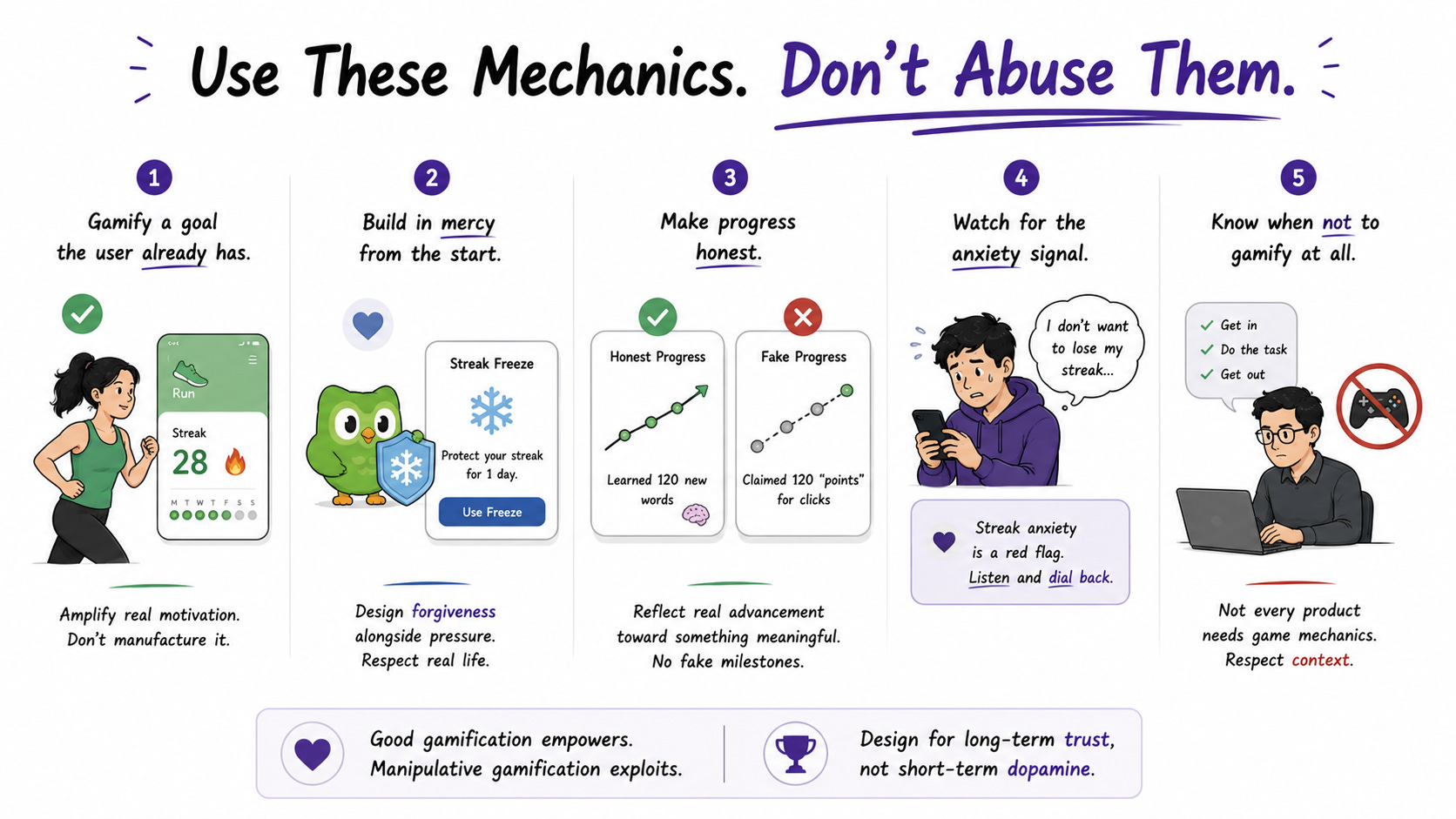
✅ Gamify a goal the user already has
Support an existing motivation instead of manufacturing one. If the mechanic helps users do something they already care about, it is much more likely to feel useful rather than coercive.
✅ Build in mercy from the start
The Streak Freeze lesson is the most important one here. Design forgiveness alongside the pressure. Let users recover streaks, protect progress, and miss a day without feeling like everything is lost.
✅ Make progress real
Badges, levels, and progress bars should represent genuine achievement. Avoid inventing meaningless milestones just to keep people clicking.
✅ Pay attention to anxiety
If users start describing your experience as stressful, punishing, or difficult to step away from, take that seriously. Motivation should create momentum, not dread.
✅ Know when not to gamify
Not every product needs streaks, points, or rewards. Sometimes users simply want to complete a task quickly and leave.
The goal is not to make everything feel like a game. It is to use game mechanics only when they genuinely make progress easier, clearer, or more motivating.
Quick pause. This belongs in the room.
🎯 UXCON26 · One Day · The Whole Community
Good design is increasingly about more than usability. It is about understanding behavior, making better product decisions, influencing teams, and knowing when a design choice helps the user versus simply moves a metric.
That is exactly the kind of conversation we are bringing to UXCON26..
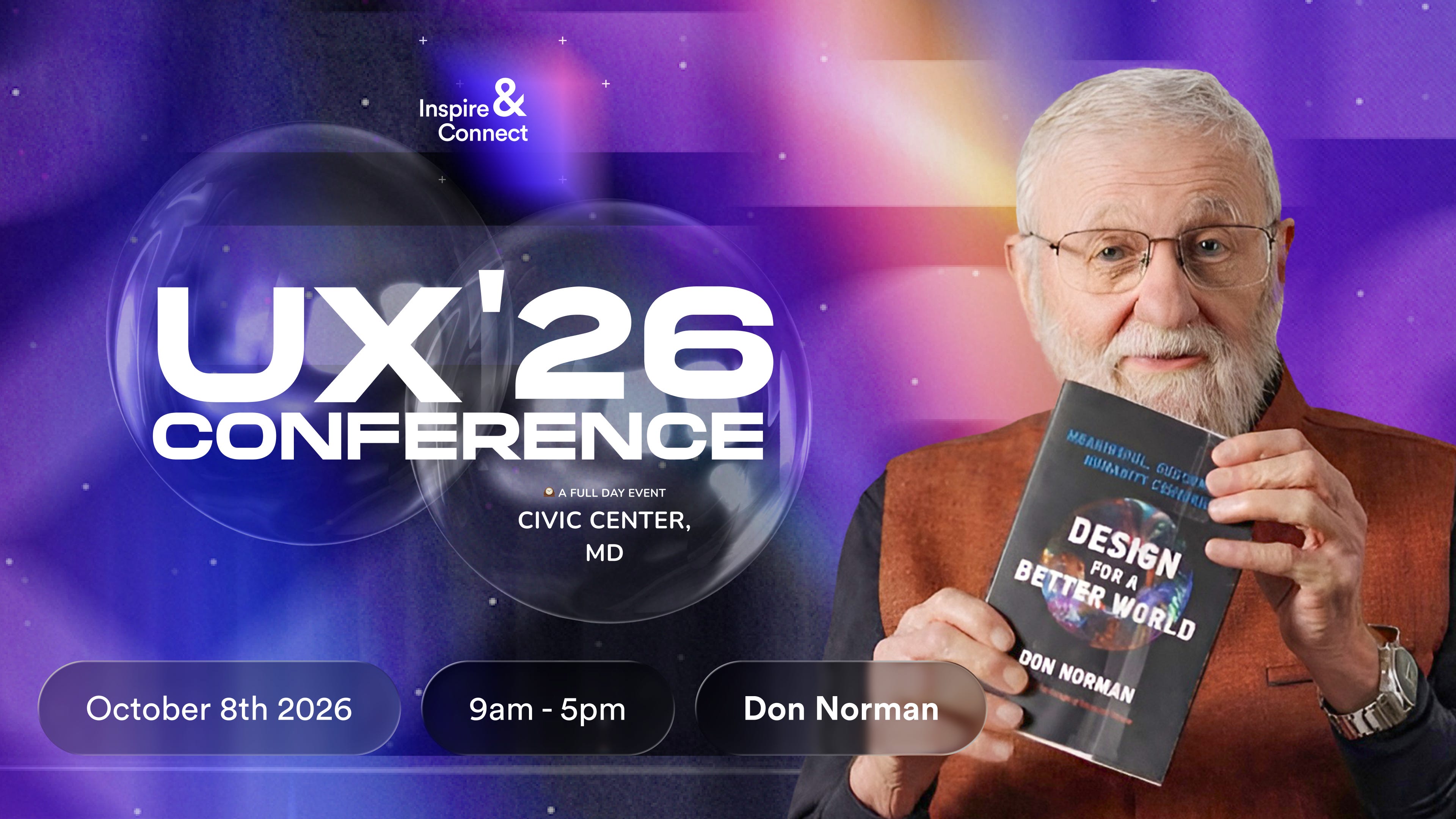
On October 8, 2026, the UX & Product community comes together for a full day built around the craft and the responsibility of this work.
Headlining is Don Norman, who coined the term user experience and at 88 is still pushing this field toward designing more honestly. Alongside him are practitioners from Netflix, The New York Times, Target, UserTesting, and Skylight, hosted by Jeremy Miller of the Beyond UX Design podcast.
📦 Resource Corner
Actionable Gamification by Yu-kai Chou
A practical framework for understanding the human motivations behind gamification.
Duolingo Gamification Case Study 2026
A detailed look at how Duolingo combines streaks, XP, leagues, and rewards.
Hooked by Nir Eyal
A foundational guide to how products build habits through triggers, rewards, and investment.
App Gamification Playbook 2026
A practical guide to gamification loops, metrics, anti-patterns, and ethical risks.
Deceptive Design by Harry Brignull
A useful reference for spotting when engagement design crosses into manipulation.
💭 Final Thought
Gamification gives designers real influence over behavior. The mechanics work. The responsibility is deciding what they work in service of.
Duolingo’s Streak Freeze is a useful reminder that ethical design and effective design are not opposites. Giving users more flexibility reduced pressure and still improved retention.
That is the standard worth aiming for: use gamification to help people make progress toward goals they genuinely care about.
A streak can motivate or manipulate. The difference is whether the user would thank you for it once they understood how it worked.


