


If you are trying to break into UX right now, you have probably felt something like despair.
You did the bootcamp or the degree. You built the portfolio. You applied to fifty, a hundred, two hundred roles. And what came back was silence, or automated rejection, or the maddening loop of “entry-level position, 3 years experience required.” You are starting to wonder if you were sold a dream that no longer exists.

Here is the truth, and it is worth hearing plainly: it is not you. The bottom rung of this ladder genuinely got harder to reach, for reasons that have almost nothing to do with your talent. And buried in those reasons is a problem the entire industry is creating for itself, one that, once you understand it, actually points toward how you break through.
In this issue:
Why the junior door narrowed so fast
The paradox nobody in leadership is saying out loud
The leadership vacuum the industry is walking into
What actually works to break in now
The mindset that separates who makes it
Resource Corner
Why the junior door narrowed so fast
Let’s start with the honest reality, because false optimism helps no one.

The junior market is brutal. By some counts, less than 5% of tech companies are actively open to hiring junior UX designers right now. A single entry-level opening can draw hundreds or over a thousand applications. Portfolios get skimmed for seconds. And the classic trap is everywhere: “entry-level” roles that quietly demand years of prior experience, which is a contradiction that leaves genuine beginners with nowhere to stand.
Several forces created this at once. The layoffs flooded the market with experienced designers, so companies that do have a junior budget can often hire someone mid-level at a junior-adjacent price. Teams got leaner, which reduced the capacity to mentor and support someone new. And then AI arrived and changed the math on what a junior was even for.
None of this is a reflection of whether you are good enough. It is a structural shift in the entry point itself. Understanding that is not an excuse to give up. It is the first step to being strategic instead of demoralized, because the people breaking in right now are not doing it by applying harder to the same closed doors. They are doing it differently.
The paradox nobody in leadership is saying out loud

Here is the uncomfortable truth driving a lot of the junior freeze, stated as bluntly as the field says it privately: a company can now give a senior designer a suite of AI tools and achieve the output that used to require two juniors.
That is the paradox. The traditional role of the junior designer was, in large part, to be the hands. To execute the production work, the wireframes, the screens, the assets, under the direction of someone more senior. That production work is exactly what AI now does quickly and cheaply. So from a short-term, spreadsheet perspective, a senior with AI looks like a better deal than a senior plus two juniors.
This is why so many teams quietly stopped hiring at the entry level. Not out of malice. Out of a narrow, immediate cost calculation that seems to make sense in the moment.
But it only makes sense if you do not think more than a year or two ahead. Because the junior was never only a pair of hands. The junior was the person who was going to become the senior. And a company optimizing away its juniors today is optimizing away its senior designers of tomorrow, without realizing that is what it is doing.
The leadership vacuum the industry is walking into

Follow the logic forward and it gets genuinely alarming for the field, which is exactly why it is worth naming.
What actually works to break in now
Strategy beats volume. The people getting in are not applying to more closed doors. They are doing specific things that work.

✅ Look where the competition is not
Everyone floods the same trendy tech companies. Meanwhile, government roles (through channels like USAjobs.gov), healthcare organizations, financial services, and nonprofits are actively hiring UX talent for digital transformation, and they often provide better training and mentorship for juniors than fast-moving startups. Less competition, more support, real experience. This is the single most underused move available to new designers.
✅ Use the side doors: internships, apprenticeships, freelance
When direct junior roles seem impossible, alternative entry points work. Internships and apprenticeships explicitly expect zero professional experience and frequently convert to full-time roles. Freelance work, even small projects for local businesses or nonprofits with limited budgets, builds a portfolio of real client work, which beats polished fictional projects every time. Document these thoroughly and they become your strongest case studies.
✅ Do real work on real problems
The strongest junior portfolios are not full of beautiful redesigns of Spotify and Netflix that everyone else also has. They show real constraints, a real client, a real problem, a real outcome. Find a nonprofit that needs help. Volunteer. Take the tiny freelance job. Real problems, honestly documented, signal actual experience in a way fictional perfection never can.
✅ Show judgment, not just craft
Since AI now handles production, the thing that makes a junior worth hiring is the beginning of judgment. In your portfolio and interviews, show your thinking. Why you made decisions. What you ruled out. What constraint forced a tradeoff. Hiring managers are no longer looking for someone who can just make screens. They are looking for someone who thinks, and shows it.
✅ Network like it is half the job, because it is
The UX community is genuinely supportive. Join communities, attend meetups and IXDA chapters, go to portfolio reviews, do informational interviews. A huge share of junior roles get filled through connection and referral before they are ever a public posting you would compete against a thousand people for. Relationships are how you get seen as a person instead of one resume in a pile.
The mindset that separates who makes it
Beyond tactics, there is a mindset difference between the people who break through and the people who burn out, and it is worth naming.
The ones who make it treat the tools as unfinished and learn them anyway. The honest framing from the field is that today’s AI tools are “al-dente,” still raw, not yet perfectly resolved or user-friendly, and waiting for them to be polished before learning them is a serious mistake. Juniors who become AI-fluent now, while the tools are still awkward, arrive with exactly the skill that makes them worth more than the “senior plus AI” math assumes. They are not just cheaper hands. They are people who can do the judgment work and operate the new tools natively.
The ones who make it also stay in motion. The temptation, in a hard market, is to freeze: to keep polishing the portfolio forever, to wait until you feel ready, to apply only when everything is perfect. But readiness comes from doing, not preparing. The freelance project, the volunteer work, the informational interview, the imperfect application sent today, these create the momentum that eventually breaks something open.
And the ones who make it do not internalize the market’s brutality as a verdict on their worth. The door is narrow right now for structural reasons. That is a fact about the industry, not a fact about you. Holding that distinction is what lets you keep going long enough to get through.
Quick pause. This one is genuinely for you.
🎯 UXCON26 · One Day · The Whole Community
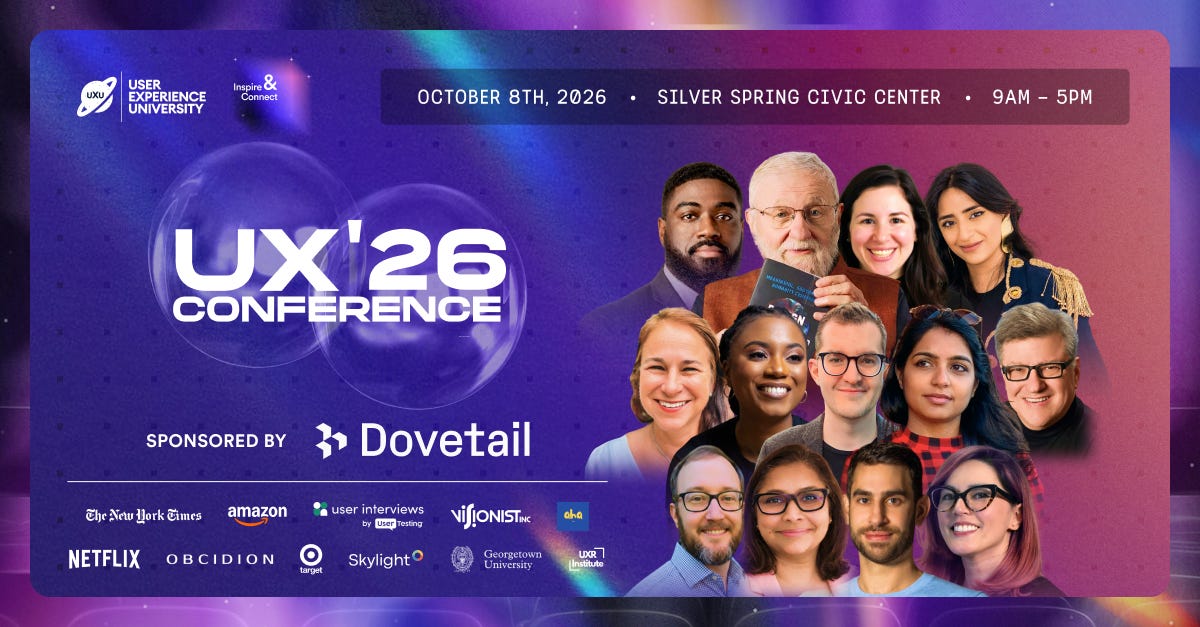
If you are trying to break into UX, the single highest-leverage thing you can do is be in a room with the people already in it. That is where mentorship starts, where referrals happen, where you stop being a resume and start being a person someone remembers.
On October 8, 2026, the UX community comes together for exactly that. Headlining is Don Norman, who coined the term user experience and has spent his life arguing for the human side of this work. Alongside him are practitioners from Netflix, The New York Times, Target, UserTesting, and Skylight, hosted by Jeremy Miller of the Beyond UX Design podcast. These are the people who do the hiring, the mentoring, and the deciding.
Three keynotes. Two panels. One room where the connections that actually change a job search get made.
📦 Resource Corner
How to Land a Junior UX Designer Job in 2026: The Complete Guide (Her UX Path)
Honest about the difficulty and specific about the alternative pathways, government, healthcare, nonprofits, that most junior job seekers overlook. Practical and realistic rather than falsely encouraging.
UX Design 2026+: From Producing to Deciding (UX Raspberry)
The source of the junior paradox and the leadership vacuum argument. Essential reading for understanding the structural forces behind the junior freeze, and why it will not last.
Landing Your First Jr UX Position (Adobe XD Ideas)
A grounded nine-step guide covering specialization, mentorship, and portfolio-building for people with no experience. Solid fundamentals from a trusted source.
How to Land Your First Job in UX Design: 11 Questions Answered (via CareerFoundry)
Strong specifics on portfolio construction for juniors, including the crucial point that one deep case study with real results beats six shallow ones.
Designer Hangout and IXDA
Communities where junior designers find mentorship, portfolio reviews, and the referral relationships that quietly fill many entry-level roles. Networking is not optional in this market, and these are good places to start.
💭 Final Thought
There is a real cruelty in the timing for people entering UX right now. You showed up ready to learn, at the exact moment the industry decided it could skip the part where it teaches you. That is not fair, and pretending it is would be dishonest.
But there is something worth holding onto underneath the difficulty. The industry’s decision to freeze out juniors is a short-term mistake, and the smarter parts of the field already know it. You cannot build senior designers without junior designers first. You cannot automate your way to the judgment, taste, and human understanding that only come from years of actually doing the work. The organizations that understand this are still hiring, still mentoring, still investing in people, and those are exactly the organizations worth working for.
Your job is to find them, and to make yourself undeniable to them, not by out-applying a thousand people to the same closed door, but by doing real work, showing real thinking, learning the new tools while they are still raw, and getting into the rooms where people remember your name.
The door is narrow. It is not closed. And the field needs you more than its short-term spreadsheets currently admit.
Keep going. Get in the room. Do the real work. The future of this field depends on people exactly like you refusing to be optimized away.


