


The UX field is no longer in freefall, but it's not business as usual either. Over the last three months a clearer picture has emerged:
AI is reshaping the craft, multimodal interaction is becoming mainstream, ethical design is shifting from best practice to legal requirement, and the job market is stabilizing with a sharper split between those who can demonstrate impact and those who can't.
The designers who thrive will go deeper, not just faster. Here's everything you need to know — and do — right now.
What’s Actually Changing in UX Right Now
73% of designers say AI as a collaborator will have the most impact in 2026
93% are already using generative AI tools like ChatGPT, Claude & Midjourney in their work.
54% report clients want AI features without clear use cases
Source: Lyssna survey of 100 UX/UI/product designers, Dec 2025
Trend 01: Agentic AI is the new frontier for UX design
AI that works on behalf of users; booking appointments, managing tasks, completing workflows, is shifting UX from reactive to proactive. 60% of designers believe AI agents will have a major impact in 2026.
The design challenge is no longer just “how does a user interact with a screen” but “how do users trust and oversee systems acting for them.”
This is creating entirely new interaction paradigms around delegation, oversight, and failure recovery. Designers who can model these scenarios will be first in line for the most interesting roles in the market
Trend 02: Generative UI: interfaces rebuilt in real time
Generative UI uses AI to reconstruct layouts on the fly based on user intent. A beginner sees simplified tools; an expert sees advanced features automatically surfaced. Content gets condensed or expanded based on context.
The UX implication: designers must now think in systems and intent models, not fixed flows. Adaptive layouts, context-aware navigation, and “situational UX” are replacing static screen design.
Trend 03: AI as copilot, not autopilot — trust is the core problem
The industry is course-correcting from AI-as-oracle to AI-as-thoughtful-collaborator. Leading products are designing AI that is present, optional, and asks before it acts. According to Nielsen Norman Group’s State of UX 2026 report, trust is becoming a central design problem, people who’ve been burned by AI features are slower to adopt new ones.
Designers who can build for transparency, explainability, and graceful failure will be in high demand.
Trend 04: Accessibility as default, powered by AI
53% of designers expect AI-powered accessibility tools to have a major impact this year, the highest ever. The framing is shifting from accessibility as a compliance checklist to accessibility as a design quality signal. AI is enabling dynamic font scaling, color adaptation, and cognitive load reduction in real time.
For practitioners, fluency in accessibility standards is becoming a differentiating skill, not a baseline expectation.
Trend 05: Visual craft is back — but with purpose
After years of safe, minimal interfaces, 2026 is seeing a return to intentional visual design. Motion that explains, typography that breathes, and interfaces with a clear personality are re-emerging — not as decoration but as trust signals. Behance’s 2026 design trends report notes that designers who combine AI workflows with strong visual craft will lead, while purely functional interfaces risk feeling indistinct as component libraries commoditize the baseline.
How to Position Yourself in a Stabilizing Market
“The UX job market isn’t disappearing — it’s evolving and maturing. Roles are more specialized and expectations are shifting.”
— UX Design Institute, March 2026
Nielsen Norman Group’s State of UX 2026 report describes the field as finally stabilizing after years of volatility — but with a catch: senior and generalist roles are recovering faster than entry-level positions, which remain scarce (The supply-to-demand ratio currently sits at 2.5 designers for every open role.). The competitive advantage has shifted from “I know UX tools” to “I can demonstrate business impact.” Here’s how to move.
What the market is actually paying

The salary gap between mid and senior levels has widened, and it hinges less on years of experience than on whether you can tie your work to measurable outcomes. A portfolio that documents process, decisions, and results carries more weight in 2026 than any certification alone.
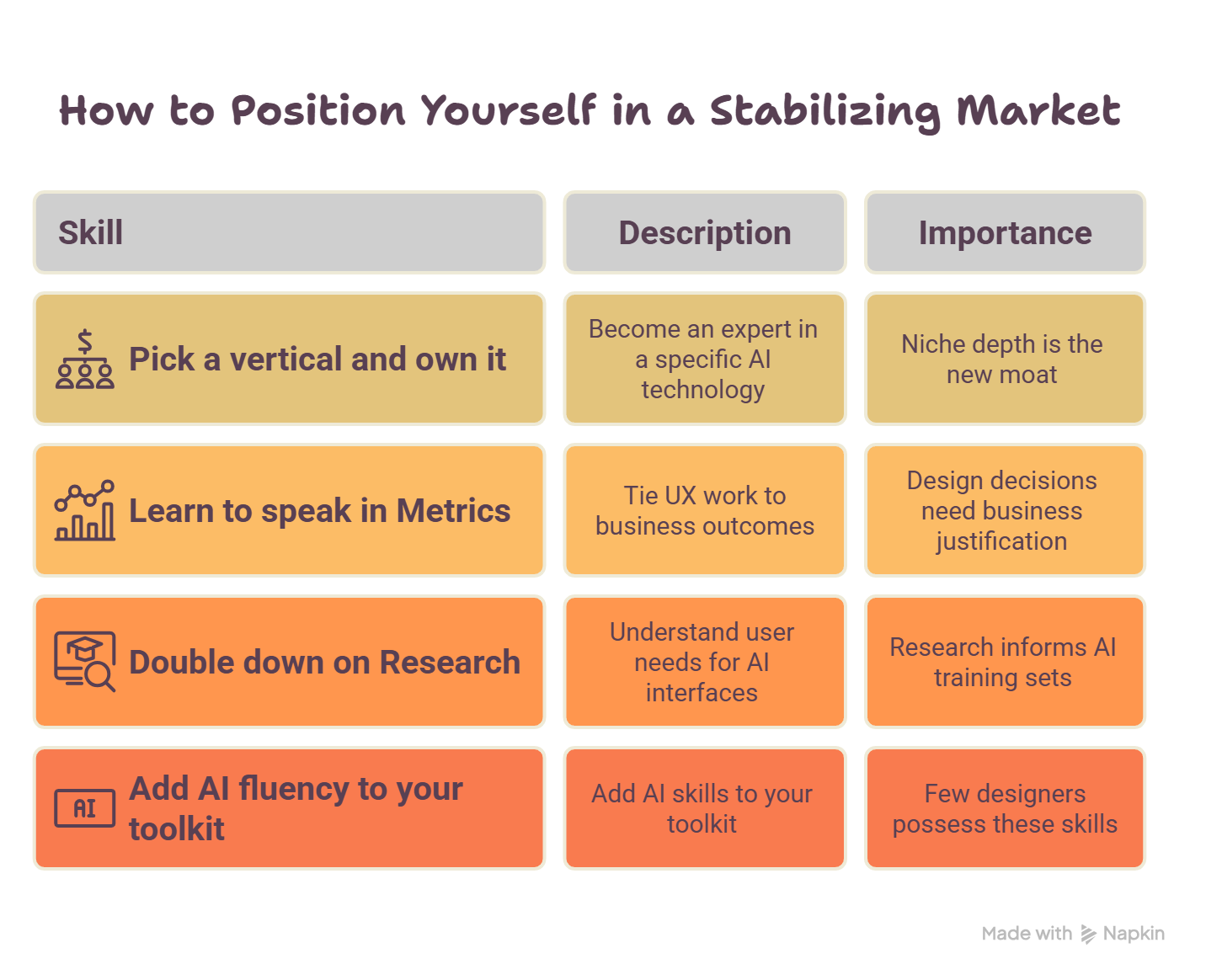
Pick a vertical and own it
Pick one emerging technology — agentic AI, conversational UI, AI accessibility — and become the go-to UX expert for that space.
Learn to speak in metrics
Build fluency in conversion, retention, task success rates, and NPS. A design decision without a business case is increasingly hard to justify.
Double down on research
As AI generates more interfaces faster, the premium on genuine user understanding grows. Research skills, especially qualitative, are increasingly rare and valued. Your data informs not just designs but AI training sets too.
Add AI fluency to your toolkit
54% of US workers say AI skills are critical for career stability, yet only 4% are pursuing AI education.
The gap is your opportunity. Prompt engineering, AI workflow design, and LLM UX patterns are skills few designers have — yet.
The emerging role to watch: Conversational AI Designer — combining UX design, scriptwriting, and behavioral psychology to craft how AI agents handle dialogue, context shifts, and user hesitation. The global conversational AI market is projected to reach nearly $50 billion by 2030. These roles did not exist three years ago.
Trying to figure out what AI means for your career?
You’re not alone.
Many professionals are asking the same questions: What skills should I be learning? What work is becoming more valuable? What can AI actually help me do? How do I stay competitive without becoming an engineer?
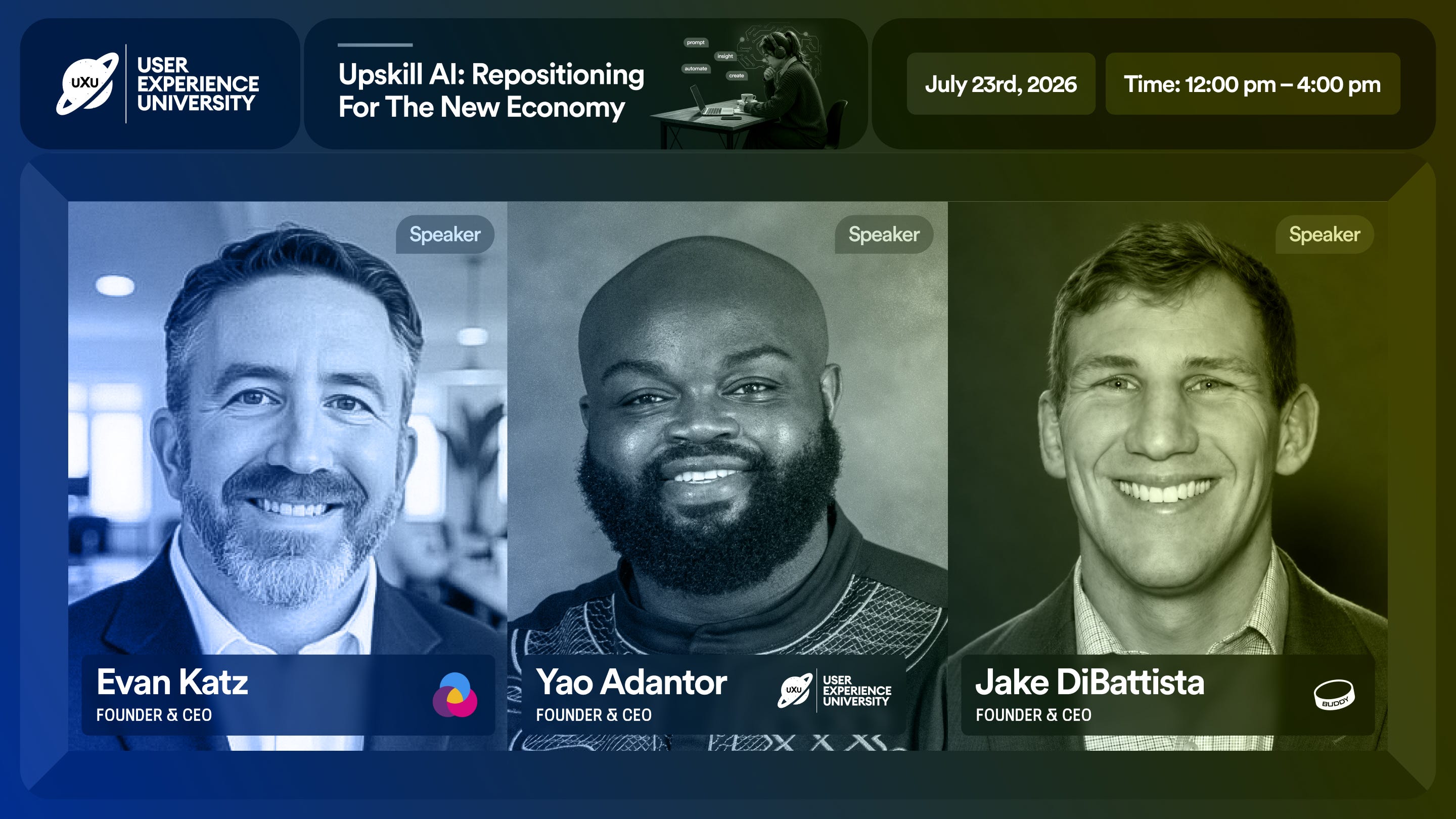
That’s exactly what we’ll explore in Upskill AI: Repositioning for the New Economy, a 4-hour hands-on workshop designed to help you make sense of AI, build practical skills, and leave with a clearer sense of your next move.
📅 July 23, 2026 | 📍 Silver Spring, MD
Resource Corner
State of UX 2026: Design Deeper to Differentiate
Nielsen Norman Group · Jan 16, 2026 · Kate Moran, Raluca Budiu, Sarah Gibbons
UX Design Trends 2026 (Survey of 100 designers)
Lyssna · Dec 23, 2025
The UX Job Market in 2026: The Most In-Demand Skills & Roles
UX Design Institute · Mar 20, 2026 · Emily Stevens
What’s Next: 7 UI Design Trends of 2026
Tubik Studio Blog · Apr 6, 2026
AI & UX Design: Navigating the Market Realities in 2026
UX Playbook · Dec 31, 2025
Behance · 2026
The AI Talent Race: Top AI Jobs to Watch in 2026
Onward Search · Jan 2026
Why Learn AI According to Job Recruiters
edX · Feb 9, 2026 · Janice Mejías Avilés
Your 30-day positioning checklist
Audit your portfolio — does it show process, decisions, and measurable outcomes, or just deliverables?
Identify one AI-adjacent vertical (agentic UX, conversational design, AI accessibility) and start a personal project or case study in it
Complete one AI-focused course — the UX Design Institute’s AI Fundamentals for UX is a solid starting point or better yet, register for our AI Worskhop
Run a Figma AI or Flowstep session to prototype something in under an hour — log what the AI got wrong and right
Benchmark your current or target salary using Glassdoor, Levels.fyi, and PayScope before your next negotiation
Attend a local UX event or community session and upskill your AI skills — our upcoming workshop is a great place to start


