


For years, dark patterns were a UX industry problem. Practitioners flagged them. Conference talks called them out. Harry Brignull built an entire website cataloguing them. The field largely agreed they were wrong.
Companies largely kept using them anyway.
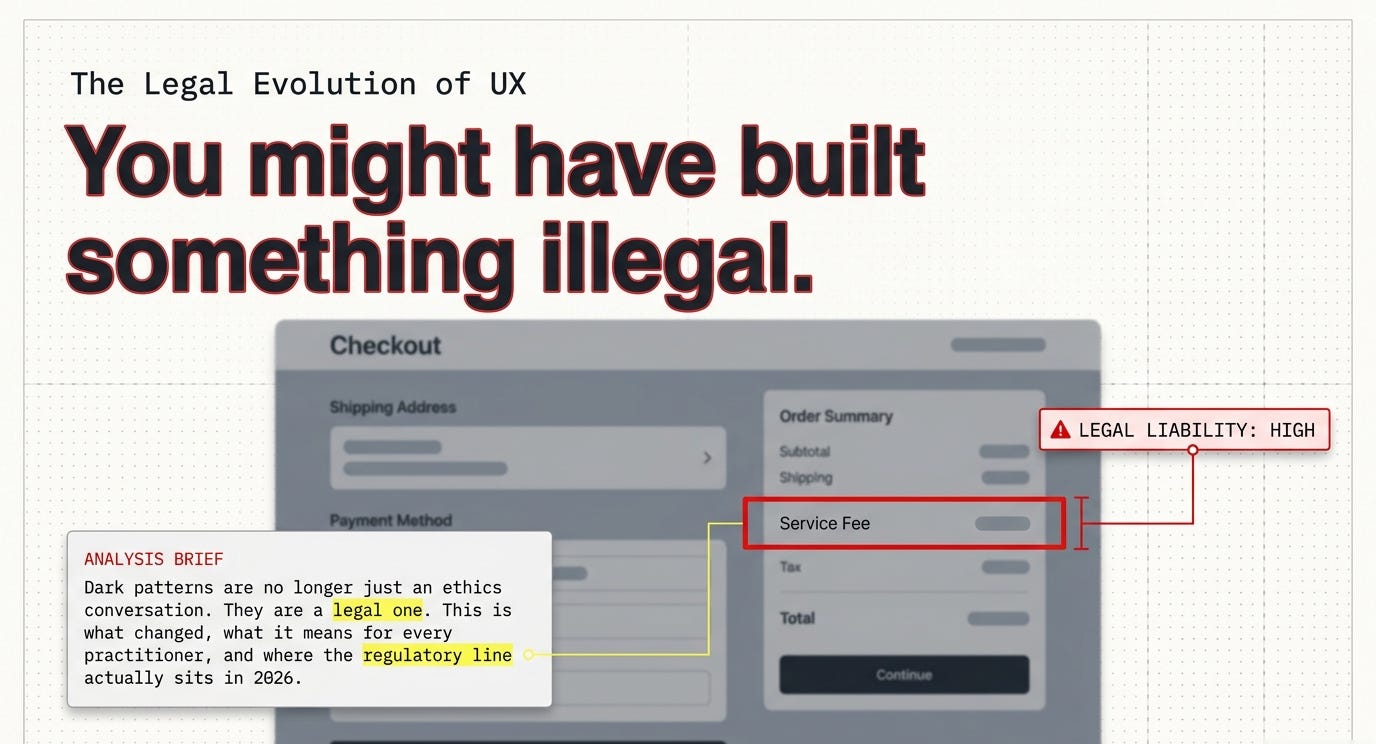
Then regulators started paying attention. And the conversation changed completely.
In 2026, UX decisions are under legal scrutiny, especially when they manipulate users into giving consent or make it harder to refuse. What was once a question of professional ethics is now a question of legal liability. And the settlements are large enough that nobody can pretend this is still just a design philosophy debate. Case Study Club
In This Issue:
What actually changed legally and when
The settlements that made executives pay attention
The most common dark patterns still in production right now
Where the line sits between persuasion and manipulation
What this means for every UX practitioner
How to audit what you have already built
Resource Corner
What Actually Changed Legally And When
The shift did not happen overnight. It built across several years of regulatory action and then accelerated sharply.
As of February 2024, the Digital Services Act explicitly prohibits many dark patterns for large platforms operating in the EU, with fines up to 6% of global annual turnover. That is not a slap on the wrist. For a large platform, 6% of global turnover is an existential number. Uxplaybook
In the US, the FTC’s position hardened significantly. The FTC explicitly targets any user interface designed to manipulate users into decisions they would not otherwise make, reinforcing that compliance is not just about legal disclosures but about the overall user experience. The FTC now treats dark patterns as a form of deceptive or unfair trade practice under Section 5 of the FTC Act. IxDF
In the EU under GDPR, consent must be freely given and informed, so dark patterns that obscure opt-out options or pre-select consent can invalidate it entirely. In the US, California under CCPA and CPRA explicitly prohibits the use of dark patterns to interfere with privacy choices. Case Study Club
The regulatory direction is consistent across markets and it is not reversing. Every major economy is moving toward treating manipulative design as a legal issue rather than an ethical preference.
The UX landscape looks different than it did two years ago.
A practical day to reset how you work in UX
This is not a talk about AI. It is four hours of actual work, your resume, your positioning, your pitch, built inside the tools that are reshaping how hiring works right now. No theory. No slides to forget by Thursday. Just a room full of people who are serious about their next move, doing the work together, led by people who do this for a living.
You leave with something finished. A clearer read on where your skills belong in this economy. And one specific next step you chose before you walked out.
For anyone in this community navigating a transition, a layoff, or just a quiet feeling that the map has changed and nobody handed you a new one.
back to where we stopped….
The Settlements That Made Executives Pay Attention
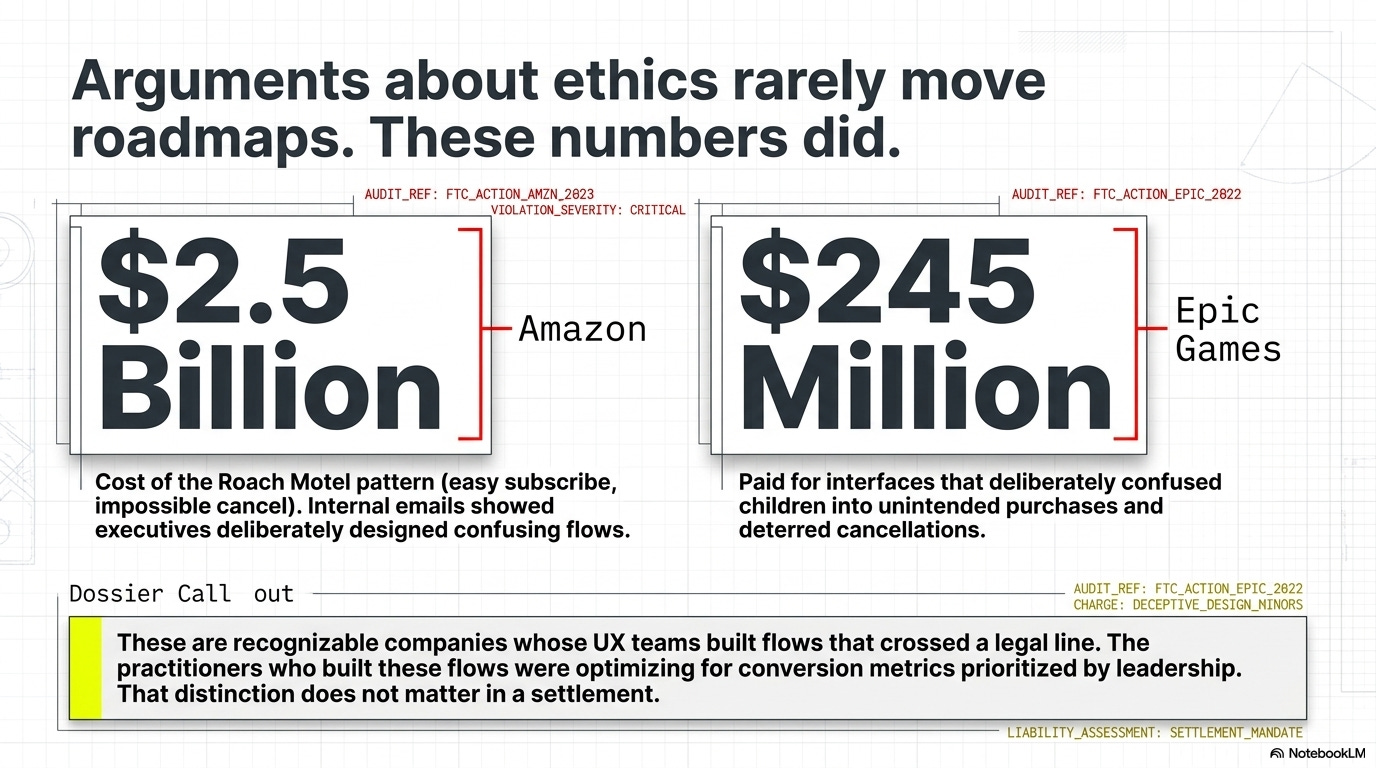
Arguments about ethics rarely move product roadmaps. These numbers did.
💰 Amazon: $2.5 billion
Amazon’s settlement included internal emails showing executives deliberately designed confusing cancellation processes. The “roach motel” pattern, easy to subscribe and nearly impossible to cancel, cost the company a settlement that made international headlines and resulted in mandatory redesigns across their subscription flows. Site Builder Report
💰 Epic Games: $245 million
Epic Games paid $245 million for dark patterns deterring cancellations. Fortnite’s interface was found to have deliberately confused children into making unintended purchases. The FTC described the design choices as intentional, not accidental. Site Builder Report
These are not edge cases or regulatory overreach against bad actors. These are major, recognizable companies whose UX teams built flows that crossed a line the law had drawn. The practitioners who built those flows were not trying to harm users. They were optimizing for conversion metrics someone higher up had prioritized. That distinction does not appear to matter much in a settlement.
The Most Common Dark Patterns Still In Production Right Now
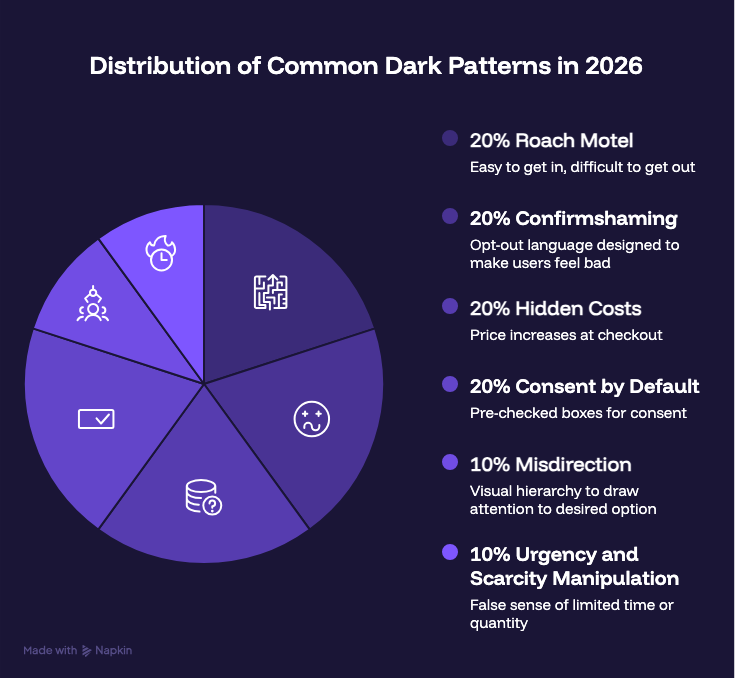
It is 2026. Consumers are more privacy-aware, regulation is tighter, and conversations around ethical data practices are mainstream. And yet dark patterns are still everywhere. Lovable
Here are the ones most likely to still be sitting in products you work on or have worked on.
🔴 Roach Motel Easy to get in, deliberately difficult to get out. Subscription signup is three clicks. Cancellation requires navigating to account settings, finding a buried link, answering a retention survey, declining a downgrade offer, and then confirming twice. This is the pattern that cost Amazon $2.5 billion and it is still the default for a significant percentage of subscription products.
🔴 Confirmshaming Opt-out language designed to make the user feel bad about saying no. “No thanks, I don’t want to save money.” “I prefer to stay uninformed.” The copy is technically accurate. It is also manipulative by design. These practices exploit cognitive biases to manipulate users into taking actions they did not intend. UXpilot.ai
🔴 Hidden costs A price that looks competitive until checkout, where fees, taxes, and “service charges” inflate the total by 30% in the final step. The FTC’s rules now cover hidden fees and deceptive design that impairs user autonomy. What the industry called “price anchoring” regulators are increasingly calling deception. IxDF
🔴 Consent by default Pre-checked boxes for marketing emails, data sharing, and third-party partnerships. The user technically had the ability to opt out. The design made it easy to miss. Consent obtained through default settings or misleading prompts does not constitute valid consent under current regulatory standards. Case Study Club
🔴 Misdirection Visual hierarchy, color, and button sizing deliberately engineered to draw attention to the option the company wants and away from the option the user might prefer. The “Accept All” button is large, colorful, and prominent. “Manage preferences” is small, grey, and positioned where the eye does not naturally land.
🔴 Urgency and scarcity manipulation “Only 2 left!” when inventory is not actually limited. “Sale ends in 10:00” on a timer that resets every time the page loads. These patterns are among the most studied in behavioral economics and among the most legally scrutinized in current regulatory guidance.
Where The Line Sits Between Persuasion And Manipulation
This is the question every UX practitioner working on conversion-focused products is going to face more directly in the coming years.
The distinction regulators have drawn is cleaner than the industry has historically wanted to admit.
Persuasion provides genuine information that helps users make informed decisions aligned with their interests. Manipulation deliberately impairs decision-making through deception, pressure, or exploiting cognitive biases. Site Builder Report
Highlighting a genuine benefit is persuasion. Hiding a rejection option to prevent the user from seeing it is manipulation. Making a product genuinely easy to sign up for is persuasion. Making it deliberately hard to leave is manipulation.
The regulatory standard is this: does the interface subvert user autonomy? If the answer is yes, it is a dark pattern regardless of whether that was the intent. Intent is not the test. Effect is. Site Builder Report
This matters enormously for practitioners. A product manager who tells you “make the cancel button harder to find” is asking you to build something that may now carry legal liability. That is a different conversation than it was three years ago and practitioners need to be equipped to have it.
What This Means For Every UX Practitioner
This is not only a designer problem. It is a field-wide one.
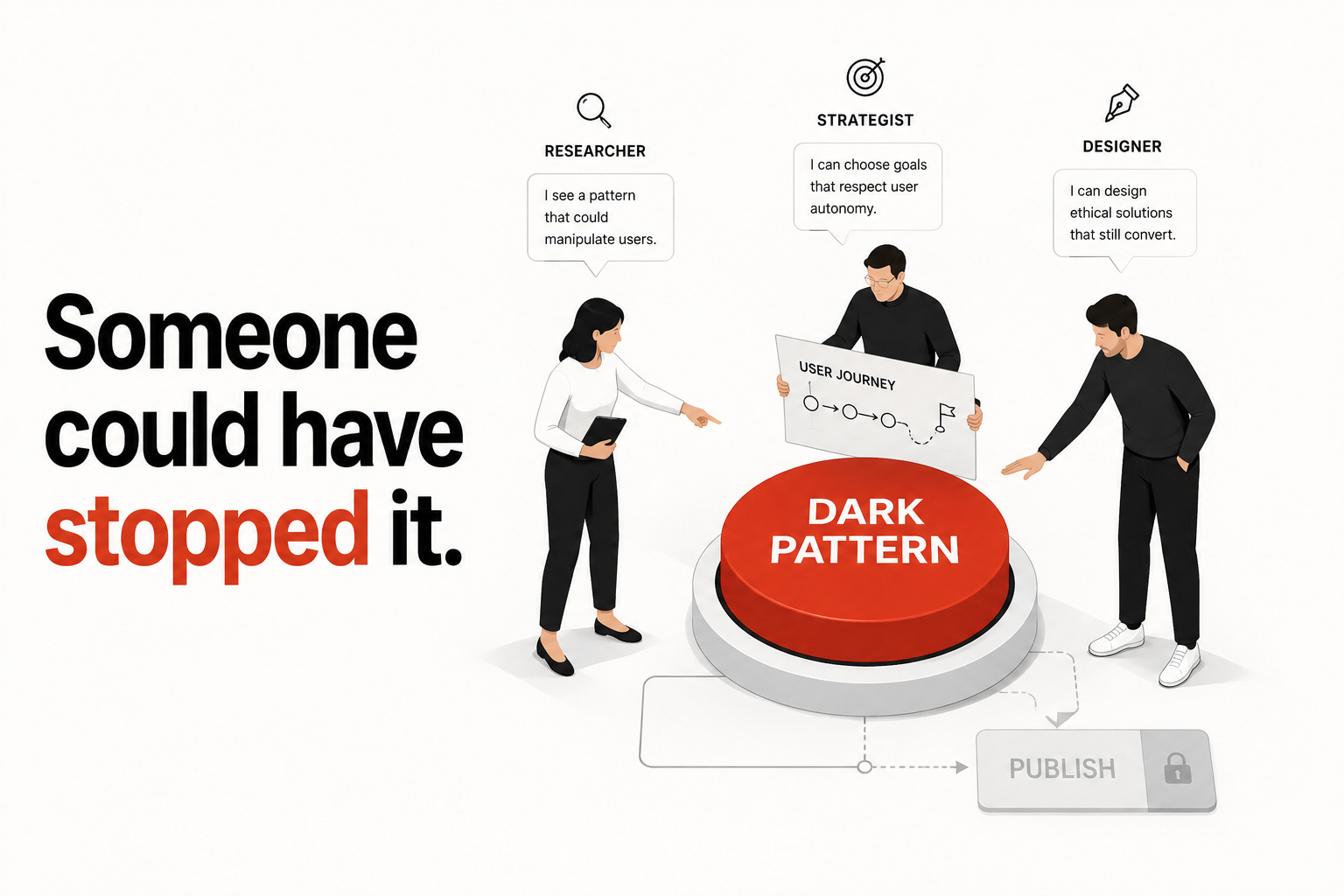
Researchers who do not flag manipulative patterns in usability testing are contributing to their survival. Strategists who optimize purely for funnel metrics without considering whether the funnel respects user autonomy are building the brief that makes the dark pattern possible. Designers who implement what they are told without pushback are the last line of defense that sometimes does not hold.
Designers who can recognize and reject dark patterns, offering ethical alternatives that convert better, are among the most sought-after profiles in the market in 2026, especially in finance, e-commerce, and B2C services managing DSA compliance. Uxplaybook
The field shift here is significant. Ethical UX used to be a values argument that got overruled by business priorities. It is now a risk argument that gets taken to legal and compliance teams. The leverage practitioners have to push back on manipulative design requests has increased considerably because the stakes for the company have increased considerably.
Using that leverage requires being able to name the pattern, cite the relevant regulation, and propose an alternative that achieves the business goal without the legal exposure. That is a different skill set than designing a better interface and hoping someone listens.
How To Audit What You Have Already Built
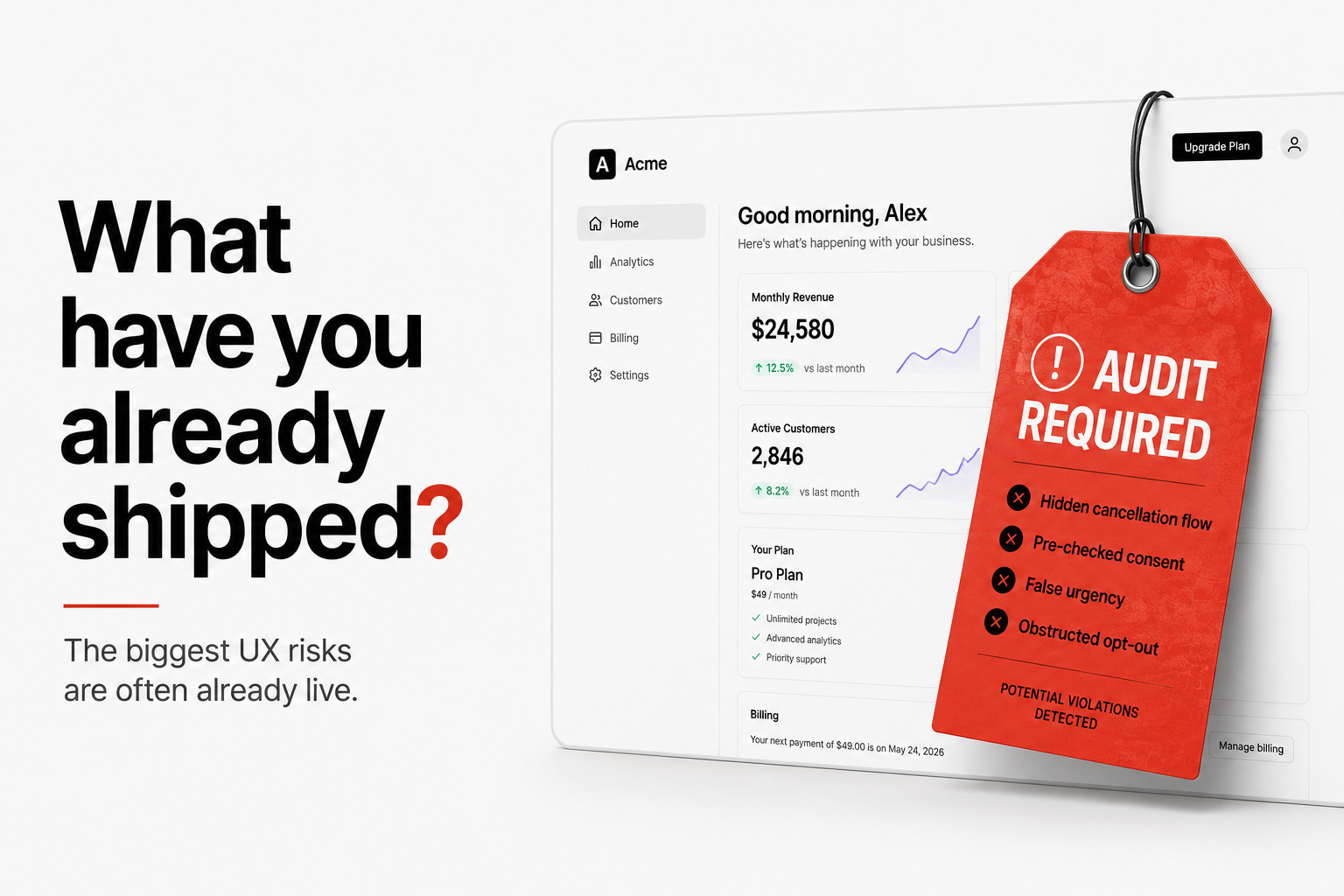
Not a full compliance exercise. A starting point that surfaces the highest-risk areas.
✓ Map every exit flow in your product Cancellation, unsubscribe, data deletion, opt-out. How many clicks does each take? How many of those steps exist to help the user versus to change their mind? Compare the exit flow length to the signup flow length. If the exit is meaningfully longer and more difficult, that asymmetry is worth examining closely.
✓ Review every consent interface Pre-checked boxes. Default-on settings. Consent bundled with terms of service. Cookie banners where “Accept All” is visually prominent and “Reject All” requires a second screen. Each of these is flagged specifically in current regulatory guidance as a potential violation.
✓ Read your own urgency copy critically Is the scarcity real? Is the deadline real? Does the timer reset? Fabricated urgency that creates false pressure on a user decision is explicitly named in FTC guidance as a deceptive practice.
✓ Run a usability session specifically looking for confusion Ask participants to opt out of marketing. Ask them to find the cancellation option. Watch where they hesitate, where they click the wrong thing, where they give up. Confusion that benefits the company is not neutral UX. It is a risk.
✓ Document what you find and share it Businesses are now expected to document consent practices and maintain records for several years. Practitioners who surface dark patterns, document the finding, and escalate it are building an organizational record that matters both ethically and legally. Practitioners who notice something and stay quiet are in a more exposed position than they might realize. IxDF
📦 Resource Corner
Deceptive Design Harry Brignull’s original dark patterns reference site, updated regularly. The Hall of Shame is one of the most useful resources for recognizing patterns in the wild. Required reading before any conversion flow audit.
FTC Dark Patterns Report: Bringing Dark Patterns to Light The actual FTC guidance document. Specific, readable, and essential if you are working on any US-facing product with subscription flows, consent mechanisms, or checkout.
Dark Pattern Avoidance Checklist 2026 Practical audit checklist for consent flows specifically. Covers GDPR, CPRA, and DSA requirements in plain language. Download it before your next audit.
Ketch: Dark Patterns Are Now Illegal Clear breakdown of where each major regulation sits on specific pattern types. Useful for building the business case when pushing back on a dark pattern request internally.
Laws of UX The broader ethical and psychological framework behind good UX decision-making. Understanding why dark patterns work psychologically makes it easier to design alternatives that achieve legitimate business goals without manipulation.
💭 Final Thought
The practitioners who built Amazon’s cancellation flow were not bad people. They were probably optimizing for the metrics they were given, shipping what stakeholders approved, and moving on to the next sprint. That is how most dark patterns get built. Not through malice. Through incentive structures that reward conversion and do not penalize manipulation.
What changed is that the external consequences are now large enough to change the internal incentive structures. A $2.5 billion settlement has a way of getting legal, compliance, and the executive team interested in what the UX team is building and why.
That attention is uncomfortable. It is also an opportunity. Practitioners who understand the regulatory landscape, can name specific patterns and their legal implications, and can propose compliant alternatives that still achieve business goals are bringing something genuinely valuable to the table right now.
The ethics of user-centered design were always supposed to protect users from exactly this. The law just caught up and gave the argument some teeth.


